

Introduction
In today’s rapidly evolving digital landscape, organizations face increasing pressure to align their business strategies with technological capabilities. Enterprise Architecture (EA) has emerged as a critical discipline for bridging this gap, providing a structured approach to managing complexity and driving transformation. The TOGAF Standard, maintained by The Open Group, stands as the world’s leading framework for developing Enterprise Architecture.
For beginners and seasoned professionals alike, navigating the comprehensive TOGAF 10 documentation can be daunting. This is where Visual Paradigm’s Unified Platform becomes an invaluable asset. By integrating powerful modeling tools, certified ArchiMate support, and guided TOGAF ADM processes into a single, intuitive interface, Visual Paradigm transforms abstract architectural concepts into actionable, visual deliverables.
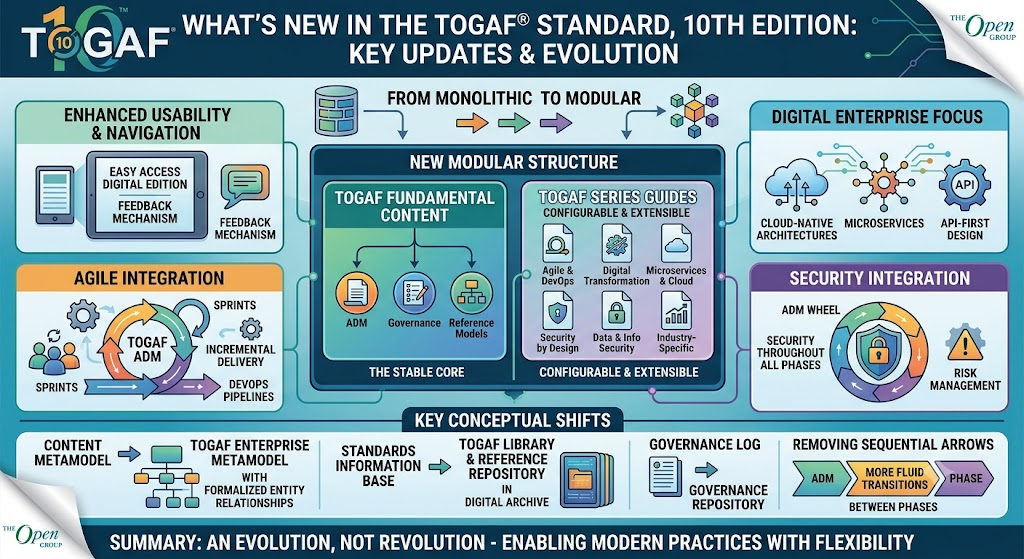
This guide will walk you through the fundamentals of TOGAF 10 and demonstrate how leveraging Visual Paradigm’s unified platform can streamline your journey from architectural strategy to successful implementation.
What is Enterprise Architecture?
Enterprise Architecture (EA) is a strategic approach to optimize and integrate an organization’s processes, both manual and automated, to support business strategy and digital transformation. EA helps in managing and exploiting information effectively, which is crucial for business success and competitive advantage. It provides a holistic view of the enterprise, connecting business goals with IT infrastructure, applications, and data.
Why Use TOGAF?
TOGAF provides a structured approach to developing EA, ensuring consistency, best practices, and consideration of both current and future business needs. It helps in:
-
Strategic decision-making: Aligning IT investments with business priorities.
-
Organizational transformation and agility: Enabling rapid response to market changes.
-
Efficient business operations: Reducing redundancy and improving process efficiency.
-
Effective digital transformation: Creating a harmonized technology environment.
-
Better return on investment: Maximizing the value of existing and future IT assets.
-
Simplified procurement processes: Establishing clear standards for technology acquisition.
Key Concepts
-
Enterprise: Any collection of organizations with common goals, such as a corporation, government agency, or partnership.
-
Enterprise Architecture: A strategic context for the evolution of digital capabilities in response to changing business needs.
-
Architecture Framework: A foundational structure for developing various architectures, including methods for describing baseline and target states.
Benefits of Enterprise Architecture
-
Strategic Decision-Making: Quick response to change and support for enterprise agility.
-
Organizational Transformation: Adoption of new business and technology trends.
-
Efficient Operations: Lower costs, agile organization, shared business capabilities.
-
Digital Transformation: Harmonized environment, improved interoperability, and system management.
-
Return on Investment: Maximized return on existing investments, reduced risk for future investments.
-
Procurement: Simpler, faster, and more flexible procurement processes.
When to Develop Enterprise Architecture
Enterprise Architecture should be developed early and throughout the change process to help decision-makers understand the implications of their decisions. Key reasons for developing EA include:
-
Business transformation initiatives
-
Technology-driven efficiency and cost reduction
-
Mergers or acquisitions
-
Management of technical debt
Roles and Stakeholders
-
Stakeholders: Key people who identify areas of change required to meet new business goals. They have specific concerns that the architecture must address.
-
Architects: Address stakeholder concerns by identifying requirements, developing views of the architecture, and showing trade-offs. They use frameworks like TOGAF to structure their work.
Structure of TOGAF Documentation
-
Introduction: Overview of EA and TOGAF.
-
TOGAF Documentation Set: Scope and structure of TOGAF materials.
-
Core Concepts: Key concepts used across TOGAF components.
-
Definitions: Consistent definitions of terms.
-
Referenced Documents: List of referenced documents.
-
Glossary: Supplementary definitions.
-
Abbreviations: Commonly used abbreviations.
Conditions of Use
-
Free Viewing: The TOGAF Standard is freely available for viewing online.
-
Licensed Download: Can be downloaded and stored under license for internal use.
-
Restrictions: No part may be reproduced or used for commercial gain without permission.
Cost of TOGAF
The TOGAF Standard is free for internal use to develop an Enterprise Architecture. There are restrictions on commercial use.
Getting Started with TOGAF 10
-
Read the Executive Overview: Understand the basics of EA and why TOGAF is needed.
-
Identify Stakeholders: Determine who will be involved in the EA process.
-
Define Objectives: Clearly outline what you aim to achieve with EA.
-
Develop Architecture: Use TOGAF methods to describe baseline and target states.
-
Implement and Monitor: Continuously monitor and adapt the EA to meet evolving business needs.
Accelerating Your TOGAF Journey with Visual Paradigm’s Unified Platform
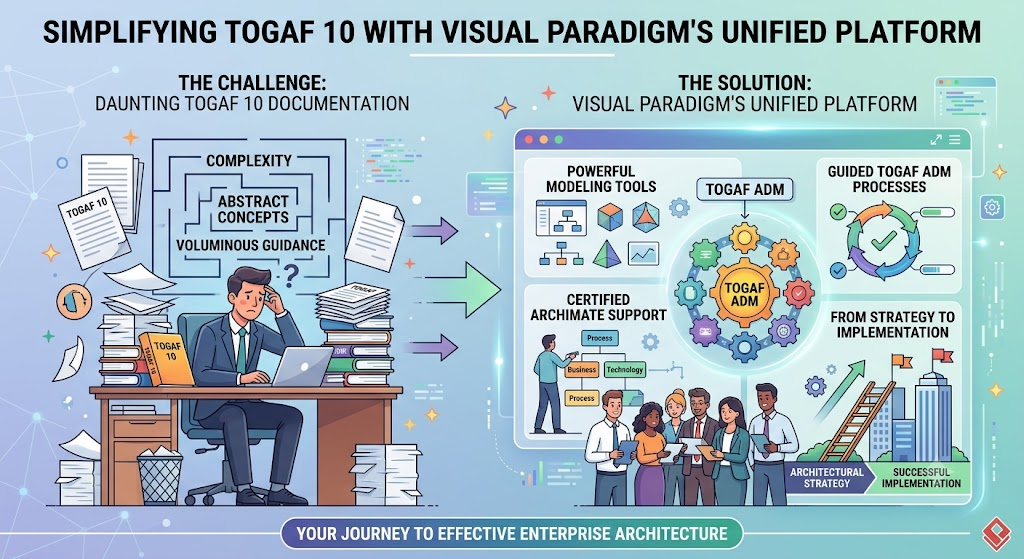
While understanding TOGAF theory is essential, applying it effectively requires robust tooling. Visual Paradigm’s Unified Platform offers a comprehensive solution that integrates seamlessly with the TOGAF Architecture Development Method (ADM). Here’s why it’s the preferred choice for modern enterprise architects:
Comprehensive TOGAF ADM Support
Visual Paradigm provides a step-by-step guide through the entire TOGAF Architecture Development Method (ADM), making it easier to navigate and develop deliverables. The tool includes a process navigator that helps users through each phase of the ADM, ensuring that all necessary steps are completed efficiently. This guided approach reduces the learning curve for beginners and ensures compliance with TOGAF standards for experienced users.
Certified ArchiMate Tools
The tool supports ArchiMate 3, which is certified by The Open Group. This allows enterprise architects to describe, analyze, and visualize the relationships among business domains in an unambiguous way. The inclusion of ArchiMate ensures that the architectural components are aligned with the strategic direction of the business, providing a standardized language for communication across stakeholders.
User-Friendly Interface
Visual Paradigm offers an intuitive interface that simplifies the process of creating and managing enterprise architecture. The tool provides real-life examples, expert guides, and techniques to help users deliver outstanding results. This makes it accessible even for those who may not have extensive training in TOGAF, democratizing enterprise architecture within the organization.
Advanced Modeling Tools
The tool includes a wide range of advanced modeling tools such as element reusability, diagram and element transformation, syntax validation, and custom properties. These features enhance the efficiency and accuracy of the modeling process, making it easier to create complex models that accurately reflect the enterprise’s current and target states.
Collaboration and Integration
Visual Paradigm supports team collaboration with features like task management, review, and commenting. It also integrates with other tools and platforms, ensuring that the enterprise architecture can be seamlessly integrated into the broader organizational framework. This fosters a collaborative environment where stakeholders can provide feedback and stay aligned with the architectural vision.
Positive User Reviews
According to user reviews on PeerSpot, Visual Paradigm has an average rating of 8.2 out of 10, with a positive sentiment score of 7.6. Users appreciate the tool’s comprehensive features and its ability to streamline the enterprise architecture development process.
Customizable and Flexible
The tool allows users to configure the standard TOGAF architecture repository structure or any other file taxonomy to suit their organizational needs. This flexibility ensures that the tool can be adapted to fit the specific requirements of different enterprises, whether they are following strict TOGAF guidelines or a customized hybrid approach.
Auto-Generation of Deliverables
Visual Paradigm automatically generates TOGAF ADM deliverables, reducing the need for manual documentation and references. This feature saves time and ensures consistency in the deliverables, allowing architects to focus on strategic decision-making rather than administrative tasks.
Conclusion
TOGAF 10 provides a robust framework for developing Enterprise Architecture, helping organizations optimize their processes, support business strategy, and achieve digital transformation. However, the true power of TOGAF is unlocked when paired with the right tools. By understanding the key concepts, benefits, and structure of TOGAF, and leveraging Visual Paradigm’s Unified Platform, beginners and experts alike can effectively start their journey in Enterprise Architecture.
Visual Paradigm transforms the theoretical aspects of TOGAF into practical, visual, and collaborative workflows. Its user-friendly interface, advanced modeling capabilities, certified ArchiMate support, and automated deliverable generation make it an excellent choice for organizations looking to streamline their EA processes and achieve better alignment with their strategic goals. Start your TOGAF journey today with a tool that empowers you to build a resilient, agile, and future-ready enterprise.
For more detailed information, refer to the TOGAF documentation and resources available on The Open Group’s website.
References
-
How AI Integrates with the TOGAF Guide-Through Workflow: Explains how AI is embedded into the TOGAF ADM Guide-Through to generate artifacts like ArchiMate diagrams, radar charts, and roadmaps from plain-language descriptions.
-
Transforming Enterprise Architecture: A Case Study on AI-Enhanced TOGAF ADM Implementation with Visual Paradigm: Presents a case study of a financial services firm that improved architecture delivery speed and stakeholder alignment using AI-powered TOGAF ADM tools.
-
What is TOGAF®? Understanding the Open Group Architecture Framework: Offers a foundational overview of TOGAF, its four architecture domains, the Architecture Development Method (ADM), and new features in the TOGAF 10th Edition.
-
Streamline Your Enterprise Architecture with Visual Paradigm’s TOGAF ADM Tools: Details features like the visual process navigator, ArchiMate tools, radar charts, incremental building block development, and seamless deliverable generation.
-
From Static Blueprints to Agile Intelligence: A Beginner’s Guide to TOGAF, ArchiMate, and AI-Driven Enterprise Architecture: A beginner-focused guide on combining TOGAF ADM with ArchiMate modeling and leveraging AI to accelerate architectural workflows.
-
AI-Powered TOGAF ADM Guide-Through (2026 Update): An overview page for the 2026 update of the AI-powered TOGAF ADM Guide-Through, detailing AI’s role across various ADM phases from Preliminary to Migration Planning.
-
What is TOGAF®? Understanding the Open Group Architecture Framework: A Spanish-language introduction to TOGAF describing its history, fundamental goals, four architectural domains, and the ADM’s structured approach.
-
Simplify Enterprise Architecture with TOGAF ADM and Visual Paradigm: Explains how Visual Paradigm’s TOGAF ADM feature provides a structured, collaborative environment for managing all phases of architecture development.
-
Transforming Enterprise Architecture: A Case Study on AI-Enhanced TOGAF ADM Implementation with Visual Paradigm: Spanish translation of the case study on implementing AI-enhanced TOGAF ADM, detailing the methodology, benefits, and key success factors.
-
Comprehensive Guide to TOGAF Architecture Content and Visual Paradigm Integration: Outlines the TOGAF Architecture Content framework and practical steps for integrating Visual Paradigm to automate deliverables and enhance collaboration across all ADM phases.