

Introduction
Enterprise Architecture (EA) serves as the critical bridge between business strategy and IT execution. For decades, The Open Group Architecture Framework (TOGAF) and its Architecture Development Method (ADM) have provided the industry-standard roadmap for this alignment. However, practitioners often face significant hurdles: steep learning curves, repetitive documentation, and the manual effort required to create compliant ArchiMate models. These challenges can stall momentum and obscure the strategic value of EA.
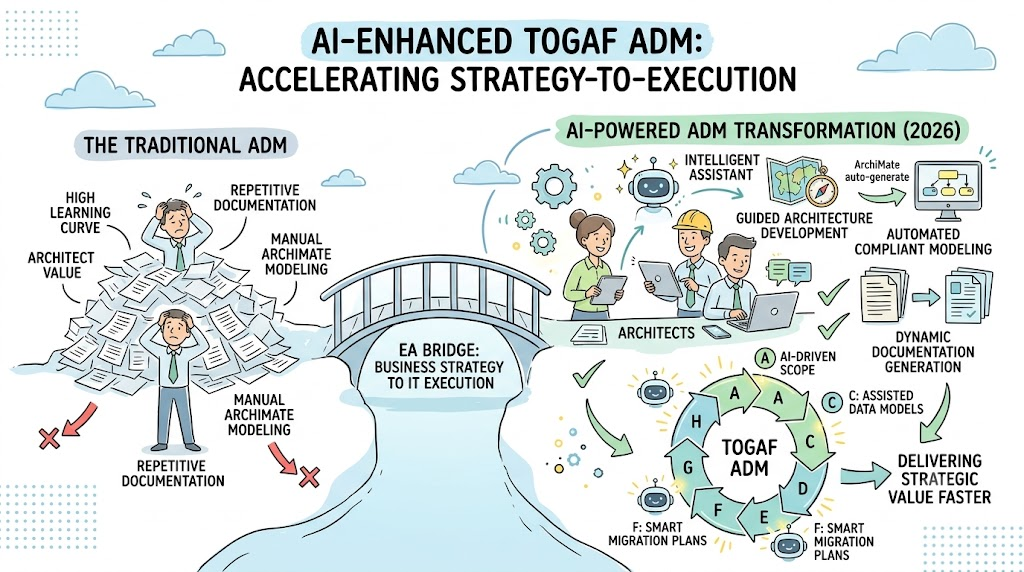
In 2026, the landscape has shifted. The integration of Artificial Intelligence into TOGAF tooling has transformed the ADM from a documentation-heavy obligation into a dynamic, guided experience. This guide explores how modern AI-enhanced workflows streamline every phase of the ADM, providing key concepts, practical examples, and visual navigation to help architects deliver value faster. Whether you are defining a preliminary scope or planning a complex migration, understanding these AI-driven capabilities is essential for modern enterprise architecture.

Key Concept: Visual Phase Navigation
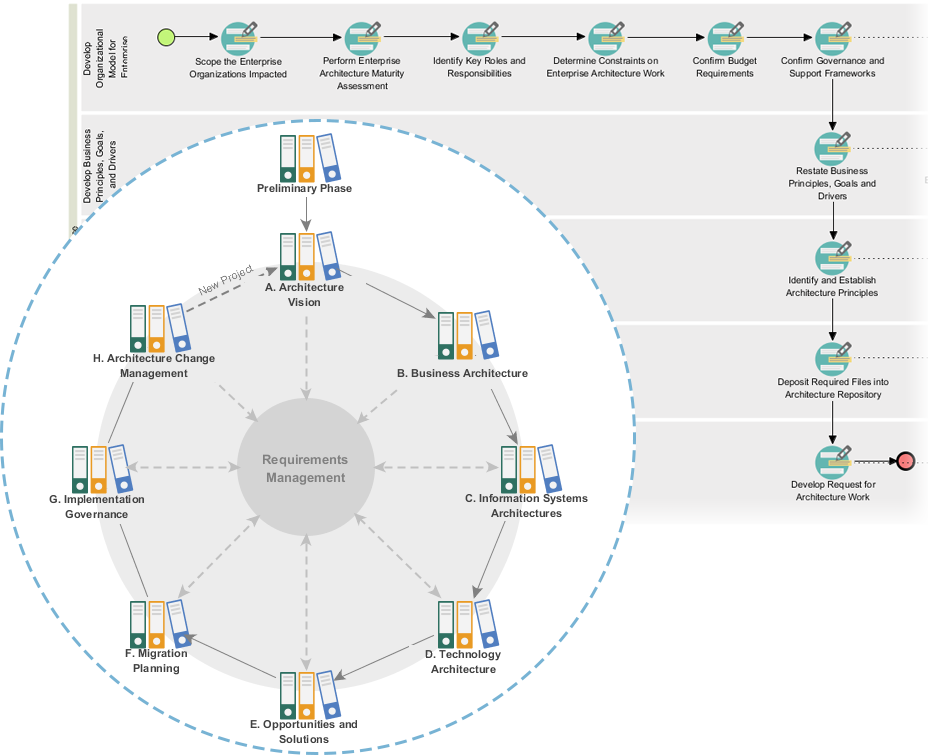
Instead of treating the ADM as a linear checklist, visual navigation treats it as an interconnected ecosystem. For example, when working on Phase B (Business Architecture), the tool visually links relevant inputs from Phase A (Architecture Vision) and outputs destined for Phase C (Information Systems Architectures), maintaining traceability automatically.
The TOGAF ADM Process Navigator
Maximizing EA success requires more than just knowledge; it requires execution support. The TOGAF ADM Guide-Through acts as an intelligent navigator, removing the friction of referencing external documentation and allowing architects to focus on designing solutions using standard TOGAF® ADM diagrams.
Example: Streamlined Compliance
A junior architect tasked with their first ADM cycle no longer needs to read the entire TOGAF specification. The Process Navigator highlights the current step, explains the objective in plain language, and provides direct access to the necessary modeling canvas. This reduces onboarding time from weeks to days.
Actionable Guided Process
Theory must translate into practice. A comprehensive toolkit provides a step-by-step approach to developing deliverables with embedded instructions, real-life examples, and expert techniques. This ensures consistency across different team members and projects.

Key Concept: Embedded Best Practices
Rather than searching for “how to create a Business Capability Map,” the guidance is contextual. When the user selects the Business Capability Modeling activity, the tool presents a pre-configured template, a sample capability hierarchy, and specific tips on granularity, ensuring the output meets organizational standards immediately.
Form Filling and Inline Instruction
Documentation should be a byproduct of design, not a separate chore. Intuitive form-filling interfaces combined with inline instructions empower architects to execute recommended steps or customize content without breaking flow.

Example: Stakeholder Analysis
During Phase A, instead of opening a separate word processor, the architect fills out a structured Stakeholder Assessment form directly within the modeling environment. Inline hints suggest power/interest classifications based on entered roles, and the data automatically populates the corresponding stakeholder matrix diagram.
Deliverable Composer
The gap between performing an activity and producing a formal deliverable is often where efficiency is lost. The Auto Deliverable Composer bridges this by assembling completed activities into professional documents automatically.
Key Concept: Just-in-Time Documentation
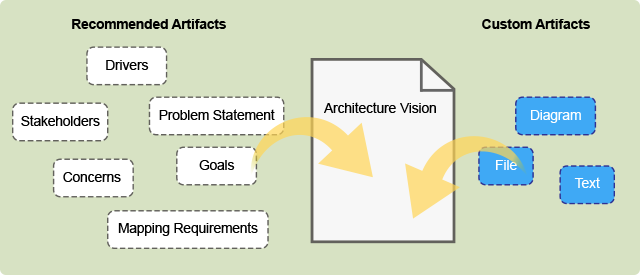
Architects can insert custom text or modify diagrams at any point. If a project requires a non-standard “Cloud Readiness Assessment” alongside the standard “Architecture Definition Document,” the composer allows this hybrid content to be integrated seamlessly, preserving the integrity of the core TOGAF deliverables while accommodating organizational nuance.
Auto Versioning and Deliverable Generation
Enterprise architecture is iterative. Secure storage, version control, and automated generation are vital for collaboration and audit trails. As activities are completed, deliverables can be generated instantly, keeping stakeholders aligned with the latest state of the architecture.


Example: Audit-Ready Artifacts
When transitioning from Phase E to Phase F, the system automatically versions the “Opportunities and Solutions” document. Team members can compare the v1.2 baseline against the v1.3 target to see exactly which work packages were added or modified during the review session, eliminating “version hell.”
Shape and Color Legends for Consistency
Maintaining notation consistency across large teams is difficult. Shape legends and color legends enforce standards by restricting available elements to those valid for the current viewpoint and applying semantic meaning through color.

Key Concept: Semantic Visualization
-
Shape Legend: Prevents errors by only showing ArchiMate elements valid for a “Technology View.” You cannot accidentally place a Business Actor in a pure infrastructure diagram.
-
Color Legend: Instantly communicates status. Green shapes might indicate “Implemented,” Yellow “In Progress,” and Red “To Be Retired.” This allows executives to grasp migration status at a glance without reading detailed reports.
Reuse Elements with Model Extractor
Efficiency in EA comes from reuse. The Model Extractor analyzes existing projects to identify reusable elements, preventing duplication and ensuring a single source of truth across architectural models.

Example: Cross-Domain Consistency
When creating a new Application Architecture diagram for Phase D, the Model Extractor identifies that “Customer Relationship Management System” already exists in the Phase B Business Service model. Selecting it reuses the same underlying object. If the CRM system’s owner changes later, updating it once propagates the change across all views where it appears.
Architecture and Documentation Repository
A well-organized repository is the backbone of sustainable EA. Tools should allow configuration of standard TOGAF taxonomy or custom file structures, enabling intuitive organization via drag-and-drop.

Key Concept: Structured Knowledge Management
Whether following the strict TOGAF Content Framework or a customized corporate taxonomy, the repository ensures that every artifact has a designated home. This facilitates regulatory compliance and makes historical architecture decisions retrievable for future reference.
AI-Powered TOGAF ADM Guide-Through
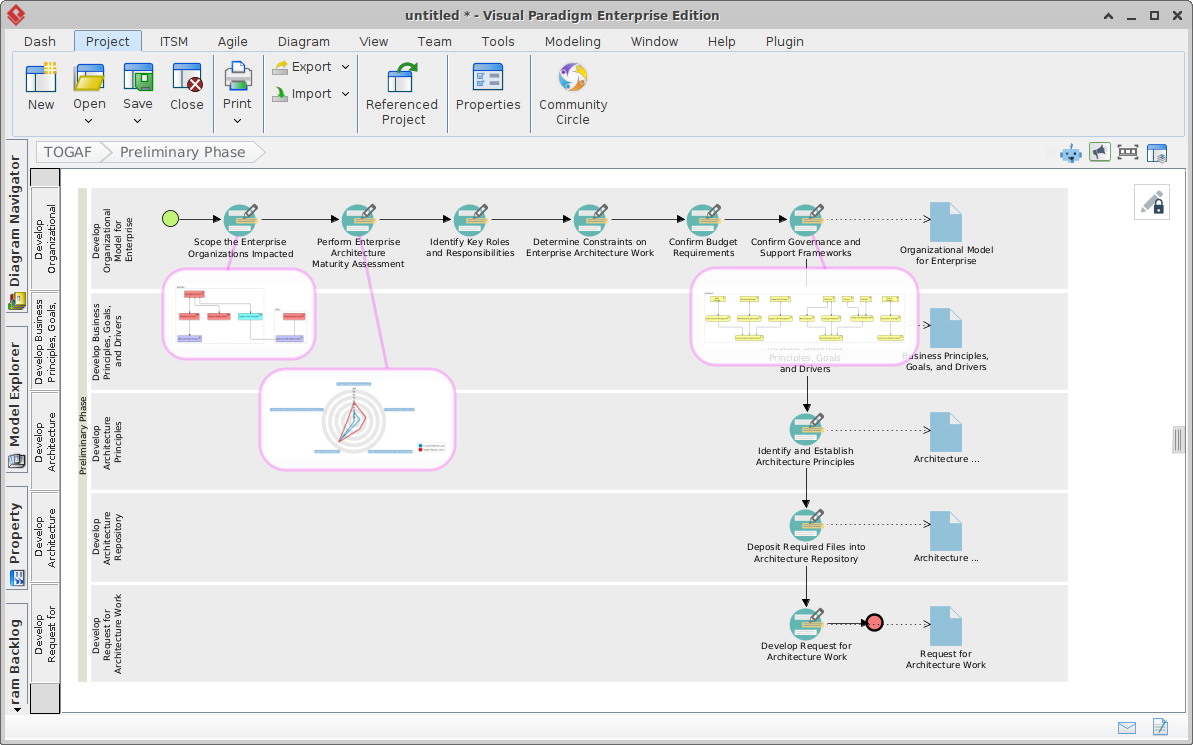
The most significant advancement in 2026 is the integration of AI directly into the ADM workflow. This transforms problem descriptions into professional ArchiMate models and artifacts, acting as an intelligent co-pilot from Preliminary Phase through Migration Planning.
AI TOGAF Generation
Key Concept: Generative Architecture
AI does not replace the architect; it accelerates the “blank page” problem. By analyzing natural language inputs, the AI generates baseline models, suggests target states, and identifies gaps, allowing the architect to focus on validation and refinement rather than drawing boxes and lines.
What’s New: AI-Powered Enhancements in Practice
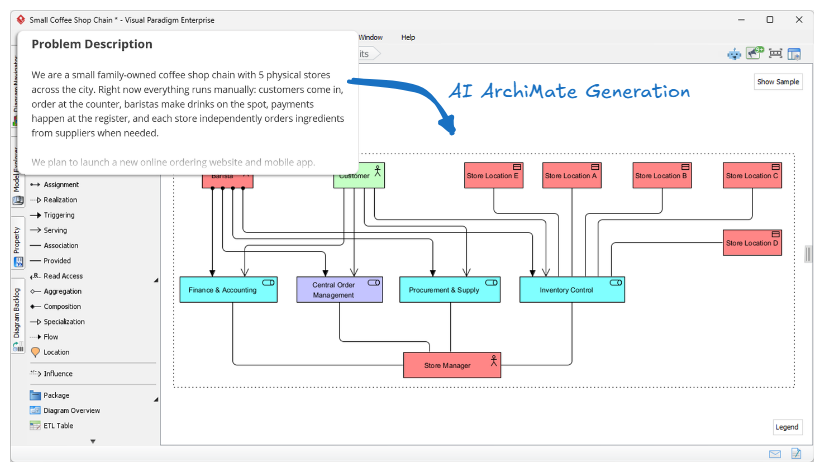
Traditional TOGAF processes involve time-consuming manual modeling. The new AI-powered enhancements address this by integrating intelligent assistance that turns complex tasks into simple, guided steps.
Practical Examples of AI Assistance
-
Automatic ArchiMate Diagram Generation:
-
Input: “We need to migrate our on-premise legacy billing system to a cloud-native microservices architecture while maintaining PCI-DSS compliance.”
-
AI Output: A complete Transition Architecture diagram showing the legacy application node, the new cloud platform, the security controls, and the data flows between them, all using correct ArchiMate 3 notation.
-
-
Smart Radar Charts for Maturity Assessment:
-
Input: Assessment scores for “Data Governance,” “API Management,” “Cloud Ops,” and “Security Posture.”
-
AI Output: A dynamically generated radar chart visualizing current vs. target maturity, automatically highlighting the largest gaps as priority areas for Phase E.
-
-
Intelligent Gap Analysis:
-
Input: Baseline and Target Business Capability models.
-
AI Output: An overlay view that color-codes capabilities requiring enhancement, creation, or retirement, accompanied by a textual summary of the impact.
-
-
Automated Migration Planning:
-
Input: List of approved work packages and dependencies.
-
AI Output: A Gantt-style transition timeline and Work Breakdown Structure (WBS) aligned with TOGAF Phase F requirements, ready for export to project management tools.
-
Why This Approach Remains the Preferred Choice
While AI is emerging across the industry, comprehensive support specifically tailored to the full TOGAF ADM cycle is unique. The combination of deep TOGAF guidance, ArchiMate compliance, collaborative features, and generative AI creates a production-ready environment.
-
Standards-Aligned: AI outputs adhere to TOGAF and ArchiMate standards, ensuring auditability.
-
Editable & Controllable: All AI-generated content is fully editable. Architects maintain ownership and can refine AI suggestions to fit specific organizational contexts.
-
Collaborative: Seamless integration across desktop and online editions supports distributed teams.
Conclusion
Enterprise Architecture in 2026 is no longer about choosing between rigor and speed. With AI-powered enhancements, organizations can achieve both. The philosophy remains clear: true expertise lies in turning complexity into clarity so that everyone—from business stakeholders to IT professionals—can participate effectively. By automating repetitive drawing and documentation, architects reclaim time for strategic thinking, decision-making, and delivering tangible business value.
For practitioners seeking the most advanced and practical way to apply TOGAF ADM today, Visual Paradigm stands out as the ideal partner. Its unique integration of AI-driven Guide-Through, comprehensive ArchiMate support, and robust repository management makes enterprise architecture effective, collaborative, and enjoyable. Download Visual Paradigm today to experience how quickly you can move from ideas to actionable architecture.
Related posts:
 From Static Docs to Living Knowledge: A Case Study on Visual Paradigm OpenDocs
Mastering AI-Powered Diagram-as-Code with Mermaid, PlantUML, and Graphviz
Mastering UML Activity Diagrams: Modeling Workflows, Concurrency, and Object States
Mastering Hierarchical Data Flow Diagrams: A Practical Guide to Taming Complex System Analysis
From Static Docs to Living Knowledge: A Case Study on Visual Paradigm OpenDocs
Mastering AI-Powered Diagram-as-Code with Mermaid, PlantUML, and Graphviz
Mastering UML Activity Diagrams: Modeling Workflows, Concurrency, and Object States
Mastering Hierarchical Data Flow Diagrams: A Practical Guide to Taming Complex System Analysis
