

Introduction
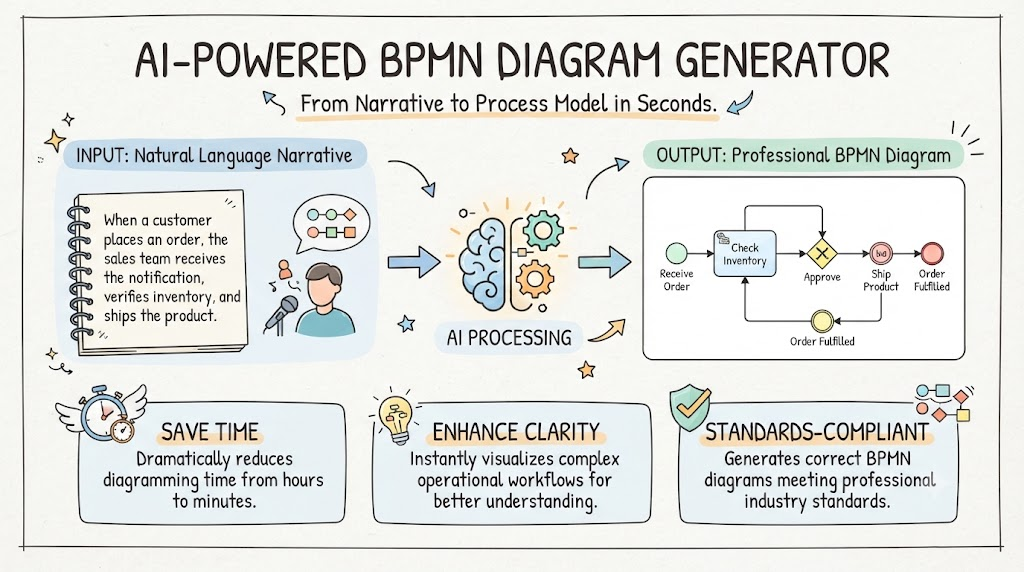
In today’s fast-paced business environment, the ability to quickly translate operational concepts into visual process models has become essential for organizations striving to maintain agility and clarity. Traditional business process modeling often requires hours of manual diagramming, demanding both technical BPMN expertise and significant time investment. This is where Visual Paradigm’s AI-powered BPMN Diagram Generator enters the scene, promising to revolutionize how business analysts and process architects approach workflow documentation. After extensive hands-on testing, this review explores whether the tool truly delivers on its promise of transforming natural language narratives into professional-grade, standards-compliant process diagrams.
Case Study: The Pizza Collaboration
Process Overview and Organizational Context
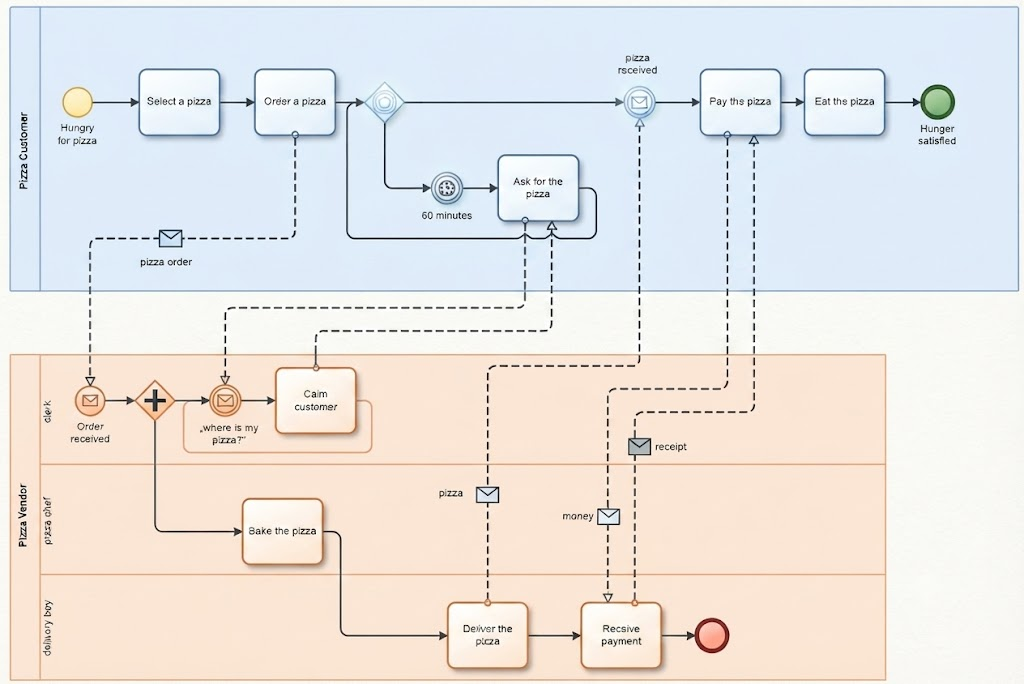
The Pizza Collaboration is a primary example of Business-to-Business (B2B) interaction, modeling explicit communication between two distinct participants: a Pizza Customer and a Pizza Vendor. Unlike internal processes that might use a single pool with multiple lanes to obscure internal communication, this case study utilizes dedicated pools for each participant to highlight their external interactions. This modeling approach allows for the explicit visualization of message flows, which represent the exchange of both informational and physical goods between the two entities.
Key Concepts and Modeling Guidelines
Based on this pizza collaboration example, several core BPMN guidelines for modeling external interactions are established:
-
Pools and Participants: A fundamental recommendation for B2B interactions is that separate participants should be assigned distinct pools to represent their independent processes. This clearly delineates organizational boundaries and is standard for modeling interactions between business partners.
-
Message Flows: These are depicted as dashed arrows crossing pool boundaries, representing the communication or transfer of objects between participants. In this collaboration, message flows include the pizza order, the pizza itself, the money, and the receipt.
-
Event-Based Gateways: This gateway is utilized when a process must wait for one of several potential events to occur. The process proceeds along whichever path is triggered first—in this case, either the arrival of the pizza or a specific time delay.
-
Intermediate Events: Timer Intermediate Events represent a delay or a specific wait time, such as a 60-minute timeout mechanism to interrupt waiting. Message Events indicate the sending or receipt of a message, such as the vendor’s process being triggered by a Message Start Event labeled “Order received”.
Detailed Process Interpretation and Examples
The collaboration follows a “ping-pong” style interaction where the actions of one participant trigger or inform the actions of the other:
-
Customer Initiation: The process begins with the customer’s state of being “Hungry for pizza”. The customer then performs the internal tasks of “Select a pizza” and “Order a pizza”.
-
Explicit Communication: The act of ordering sends a message flow to the Pizza Vendor, which serves as the Message Start Event (“Order received”) for the vendor’s internal process.
-
The Waiting Loop (Event-Based Gateway): After ordering, the customer waits for two possible next steps using an event-based gateway:
-
Pizza Received: If the pizza arrives (a Message Event), the customer proceeds to “Pay the pizza,” “Eat the pizza,” and finally reaches the end state “Hunger satisfied”.
-
60-Minute Timeout: If 60 minutes pass before the pizza arrives, the customer reaches a Timer Intermediate Event. This leads the customer to “Ask for the pizza”. A message flow goes to the vendor’s clerk, who performs the task “Calm customer,” after which the customer returns to the waiting state.
-
-
Vendor Execution: Once the order is received, the vendor’s process involves a Pizza Chef who performs the task “Bake the pizza” and a Delivery Boy who handles “Deliver the pizza” and “Receive payment”.
-
Handling Physical vs. Informational Objects: In this model, physical objects like the pizza and money are represented as message objects. This is because the physical arrival of an object (like the pizza at the door) inherently provides the information needed for the recipient to recognize that the message event has occurred.
-
Completion: The vendor’s process ends after receiving payment and providing a receipt, while the customer’s process concludes once their hunger is satisfied.
Core BPMN Capabilities in Visual Paradigm
Visual Paradigm functions as an enterprise-grade BPMN suite designed for business analysts and process architects, offering a comprehensive set of professional modeling tools.
-
Full BPMN 2.0 Compliance: The platform accurately maps formal business processes using exact notations for tasks, gateways, data objects, and event types, ensuring that models adhere to industry standards.
-
Advanced Layout Structure: Workflows can be organized structurally via customizable pools and swimlanes to clearly differentiate roles, departments, or systems, making complex organizational processes easier to understand at a glance.
-
Verification & Validation: Built-in syntax engines check that models comply with formal rules, preventing orphaned elements or invalid sequence flows that could cause confusion or execution errors.
-
Execution & Simulation: Teams can run simulations to expose process bottlenecks and export clean BPMN XML for downstream execution engines, bridging the gap between design and implementation.
The AI-Assisted BPMN Advantage
The integrated AI Diagram Generator represents a significant shift in workflow methodology, moving from manual shape dragging to text-driven automation. This feature has proven particularly valuable for teams looking to accelerate their process documentation efforts.
-
Text-to-Diagram Translation: Instead of building components manually, users supply plain-English descriptions of an operational concept, and the system handles the heavy lifting of diagram creation.
-
Contextual Parsing: The natural language processing engine recognizes operational tasks, defines logical sequence structures, and applies appropriate gateways (e.g., XOR logic) automatically, demonstrating sophisticated understanding of process logic.
-
Automated Swimlane Formatting: The AI actively identifies distinct actors or departments in text narratives and populates them into categorized pools and lanes, saving considerable manual formatting time.
-
Fully Editable Output: The generated result is not a flat image; it is a fully interactive, adjustable model nested directly inside the Visual Paradigm Desktop environment, allowing for further refinement and customization.
Step-by-Step: How to Generate an AI BPMN Diagram
The AI feature operates natively inside the desktop software when connected to a synchronized workspace. Here’s a practical walkthrough of the process:
-
Open your workspace inside Visual Paradigm Desktop.
-
Navigate to the top menu and select Tools > AI Diagram Generation.
-
Choose Business Process Diagram from the target diagram selection field.
-
Enable the checkbox for Include Pools and Lanes to automatically structure participants.
-
Type or paste your workflow narrative into the main description box.
-
Example text: “The customer submits a claim request. The Support Team reviews the submission. If approved, Finance processes the payment. If rejected, Support sends an update.”
-
-
Click OK to let the engine populate your compliance-ready process map.
The entire process typically takes less than a minute, compared to the 30-60 minutes typically required for manual diagram creation of similar complexity.
Conclusion
Visual Paradigm’s AI-powered BPMN Diagram Generator represents a meaningful evolution in business process modeling tools. By successfully bridging the gap between high-level business logic and rapid diagram creation, it allows teams to bypass tedious manual drafting while maintaining professional standards. The tool’s ability to interpret natural language and translate it into BPMN 2.0-compliant diagrams with proper gateway logic, swimlane organization, and sequence flows demonstrates sophisticated natural language processing capabilities.
For business analysts, process architects, and organizational leaders looking to document and optimize their workflows, this AI-assisted approach offers tangible time savings without sacrificing quality or standards compliance. The combination of automated generation with full editability ensures that users maintain complete control over their models while benefiting from accelerated initial creation. As organizations continue to prioritize operational efficiency and clear process documentation, tools like Visual Paradigm’s AI BPMN Generator are poised to become essential components of the business analyst’s toolkit.
References
- From Narrative to Diagram: How Visual Paradigm’s AI BPMN Generator Transforms Process Modeling Workflows: Comprehensive guide on AI-powered text-to-diagram transformation
- Mastering Business Process Modeling BPMN 2.0 with Visual Paradigm’s AI-Powered Tools: Expert insights on leveraging AI for BPMN modeling
- Visual Paradigm BPMN Review: Bridging the Gap Between Business Logic and Technical Execution: Analysis of BPMN capabilities and execution features
- AI BPMN Business Process Diagram Generator Update: Latest release notes and feature updates
- Understanding the BPMN Notation: A Key to Effective Business Process Modeling: Guide to BPMN notation standards and best practices
- Visual Paradigm AI BPMN Generator Video Tutorial: Video demonstration of AI diagram generation features
- Beyond Code and AI: Why Visual Paradigm Remains Essential for Professional Software Architecture: Overview of comprehensive modeling capabilities
- BPMN Activity Types Explained: Detailed explanation of BPMN task and activity types
- How AI-Powered NLP is Revolutionizing Text-to-BPMN Generation for Enterprise Process Modeling: Deep dive into NLP technology for process modeling
- Visual Paradigm Features Overview: Complete feature set documentation
- BPMN Diagram and Tools: BPMN-specific tools and capabilities
- Visual Paradigm Official Website: Main product information and resources
- Click Start AI – Technical Support: Setup and configuration guide for AI features
- Testing Visual Paradigm’s AI-Powered BPMN Diagram Generator for Real-World Process Mapping: Real-world testing and evaluation
Related posts:
 From Chaos to Clarity: A Practitioner’s Review and Guide to Mastering BPMN
 How to Turn User Stories into Visual Process Diagrams with AI
The Definitive Guide to AI-Powered BPMN: Transforming Process Modeling with Visual Paradigm
From Concept to Cloud: A Team’s Journey Implementing AI-Powered Architecture Design with Visual Paradigm
How to Turn User Stories into Visual Process Diagrams with AI
The Definitive Guide to AI-Powered BPMN: Transforming Process Modeling with Visual Paradigm
From Concept to Cloud: A Team’s Journey Implementing AI-Powered Architecture Design with Visual Paradigm