

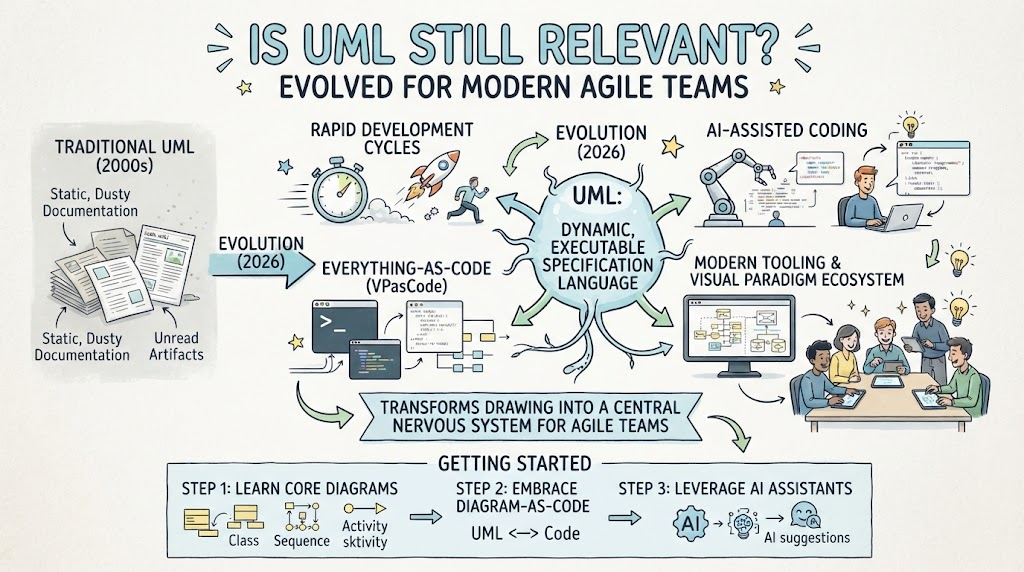
In an era dominated by rapid development cycles, AI-assisted coding, and “everything-as-code” philosophies, a common question arises among engineering leaders: Is UML still relevant?
The answer is a resounding yes, but with a caveat. UML is no longer about creating static, dusty documentation artifacts that sit in a wiki unread. In 2026, UML has evolved into a dynamic, executable specification language. When combined with Diagram-as-Code (VPasCode), AI-embedded support, and modern tooling like Visual Paradigm, UML transforms from a drawing exercise into a central nervous system for Agile teams.
This article explores why UML remains indispensable for modern software delivery and how to get started with Visual Paradigm’s free ecosystem.
1. The Evolution: From Drawing Tools to Modeling Intelligence
Historically, UML tools were criticized for being mere “digital whiteboards.” They produced pictures, not models. Visual Paradigm distinguishes itself by adhering to the philosophy: “We build modeling software, not drawing tools.”
Real Modeling vs. Drawing
-
Semantic Awareness: Elements are reusable across diagrams. Changing a class name in a Class Diagram automatically updates it in Sequence, Activity, and Component diagrams.
-
Syntax Checking: The tool enforces UML 2.x standards, preventing invalid designs before code generation.
-
Abstraction Levels: Support for sub-diagrams and element referencing allows teams to manage complexity without losing traceability.
-
Cross-Platform Native: As a Java-enabled application running on Windows, macOS, and Linux, it ensures consistent modeling experiences across diverse team environments.
2. Diagram-as-Code: VPasCode and AI Integration
Modern Agile teams demand version control, CI/CD integration, and automation. Visual Paradigm addresses this through VPasCode, bridging the gap between visual modeling and text-based workflows.
Why Diagram-as-Code Matters for UML
-
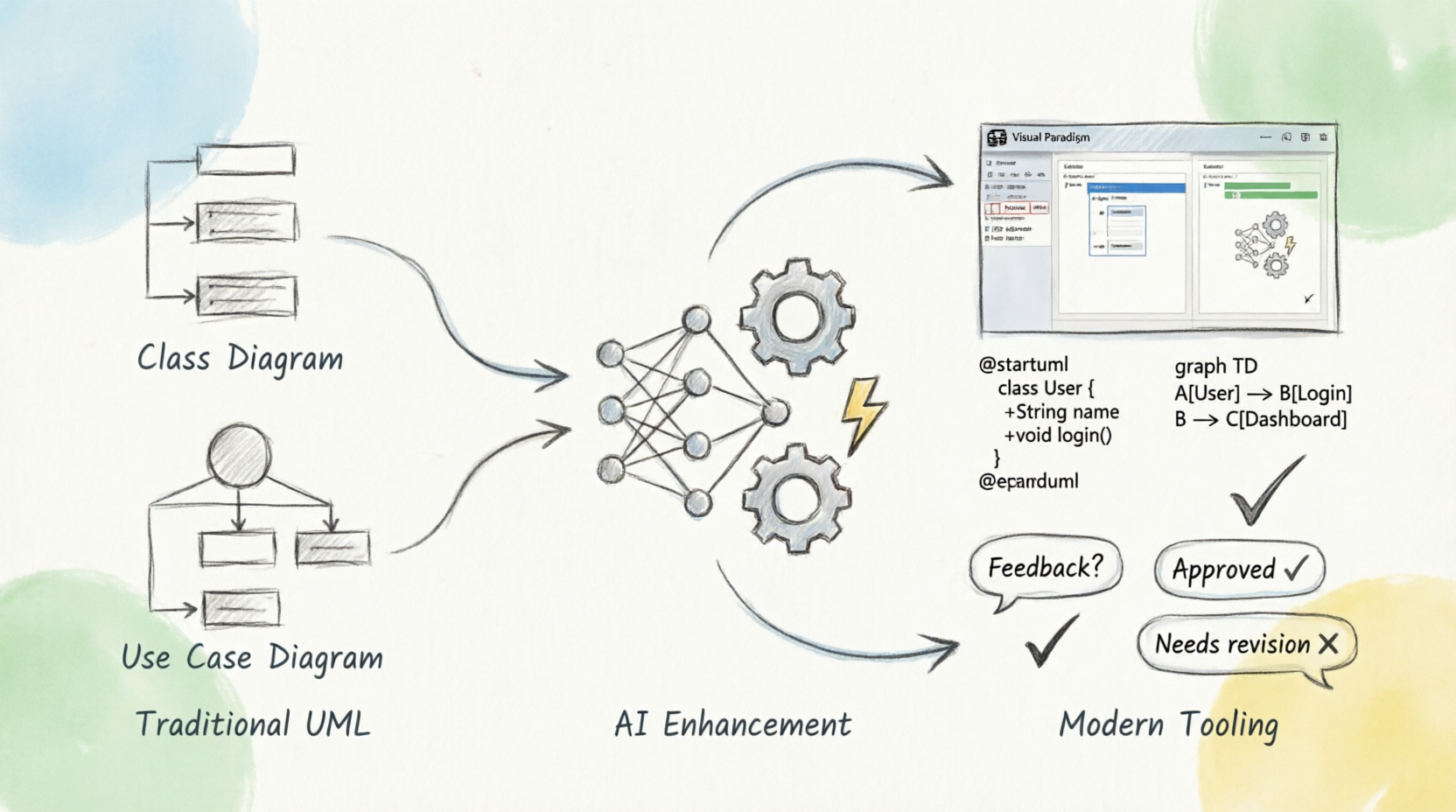
Git-Native Workflows: Models can be serialized into text formats compatible with Git, enabling pull requests, diffs, and code reviews for architecture just as you would for application code.
-
AI Embeddability: Text-based representations of diagrams are significantly easier for Large Language Models (LLMs) to parse, generate, and validate than binary files or raw XML.
-
Automation Pipelines: Generate documentation, skeleton code, or test cases directly from model commits in your CI pipeline.
AI-Assisted Chatbot & Embedded Support
Visual Paradigm integrates AI not as a gimmick, but as a modeling assistant:
-
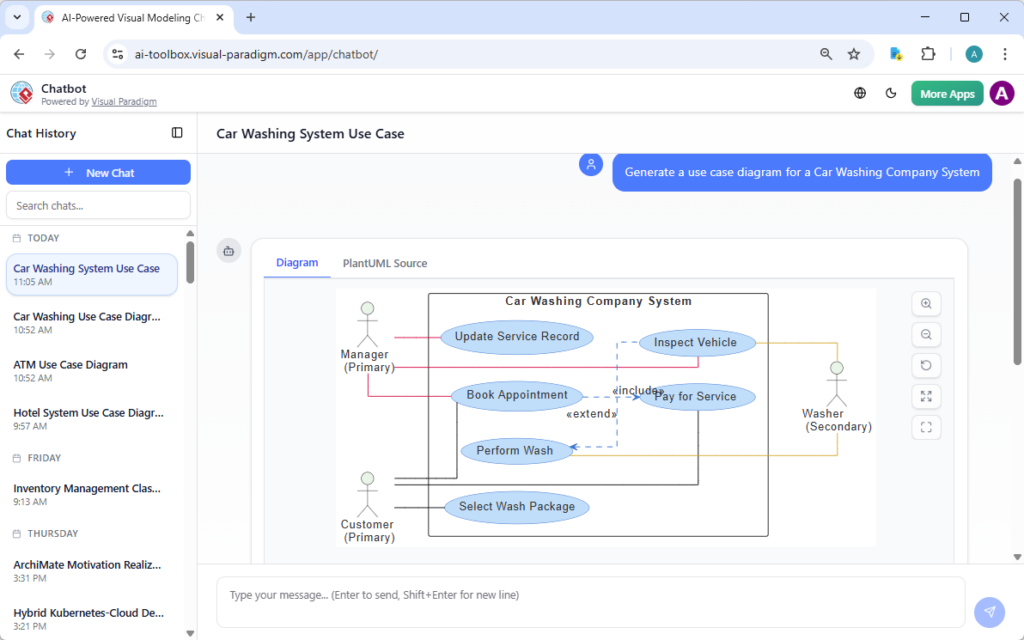
Natural Language to Model: Describe a user flow or API contract in plain English, and the AI generates syntactically correct UML diagrams via VPasCode.
-
Model Validation Chat: Ask the embedded chatbot, “Are there any circular dependencies in this package structure?” or “Suggest improvements for this sequence diagram’s error handling,” and receive context-aware feedback based on your actual model.
-
Documentation Generation: AI can auto-generate technical specs, API references, and stakeholder summaries directly from the live model, keeping documentation perpetually in sync with design.
3. Suitability for Modern Agile Teams
Agile values “working software over comprehensive documentation,” but this is often misinterpreted as “no documentation.” High-performing Agile teams use UML for just-enough, just-in-time communication.
| Agile Challenge | How Visual Paradigm + UML Solves It |
|---|---|
| Ambiguous Requirements | SysML Requirement Diagrams link business needs directly to design elements, ensuring traceability. |
| Complex Microservices | Communication & Sequence Diagrams clarify inter-service contracts before coding begins. |
| Onboarding Velocity | Interactive, navigable models serve as living documentation superior to static wikis. |
| Technical Debt Visibility | Dependency mapping and syntax checking highlight architectural erosion early. |
| Remote/Async Collaboration | Cloud-synced models + AI chat enable asynchronous design reviews across time zones. |
Resource Catalog: Efficiency at Scale
The Resource Catalog feature exemplifies Agile efficiency. Instead of dragging widgets repeatedly, teams access pre-defined, semantically rich elements with minimal clicks. This distinction between “a click and a drag” compounds over sprints, reducing cognitive load and allowing architects to focus on design intent rather than tool mechanics.
4. Comprehensive UML 2.x & SysML Coverage
Modern systems require more than basic class diagrams. Visual Paradigm Community Edition provides full support for all critical diagram types at zero cost:
-
Structural: Class, Object, Package, Component, Deployment, Composite Structure
-
Behavioral: Use Case, Activity, State Machine, Sequence, Communication, Timing, Interaction Overview
-
Data: Entity Relationship Diagrams (ERD)
-
Systems Engineering (SysML): Requirement, Block Definition, Internal Block, Parametric Diagrams
-
Business: Business Concept Diagrams
This breadth ensures that whether you’re designing a cloud-native API, an embedded IoT system, or a business process transformation, one tool covers the entire spectrum.
5. Getting Started: Free Forever Options
Visual Paradigm offers multiple pathways to adopt professional-grade UML modeling without financial barriers.
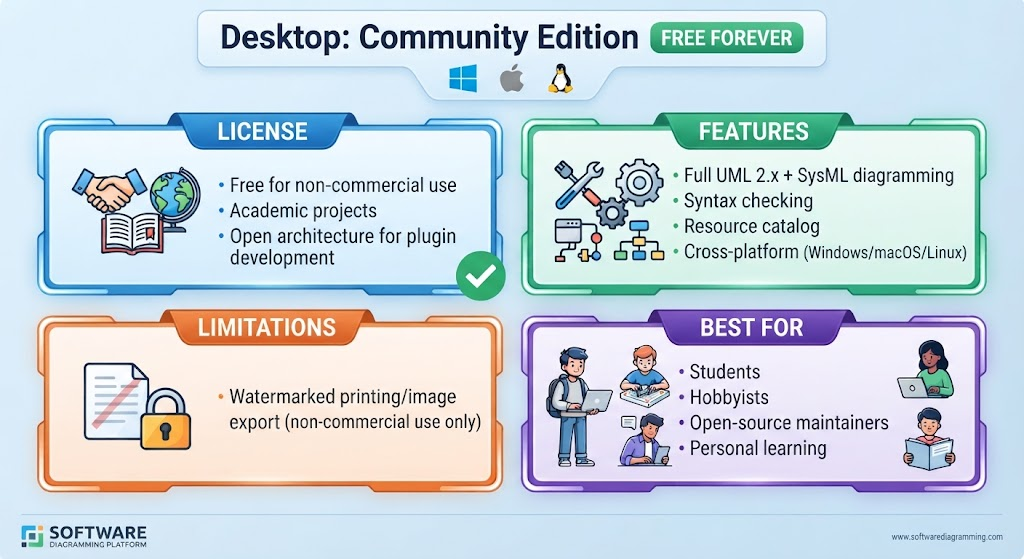
🖥️ Desktop: Community Edition (Free Forever)
-
License: Free for non-commercial use, academic projects, and open-source development
-
Features: Full UML 2.x + SysML diagramming, syntax checking, resource catalog, cross-platform (Windows/macOS/Linux)
-
Limitations: Watermarked printing/image export (non-commercial use only)
-
Best For: Students, hobbyists, open-source maintainers, personal learning
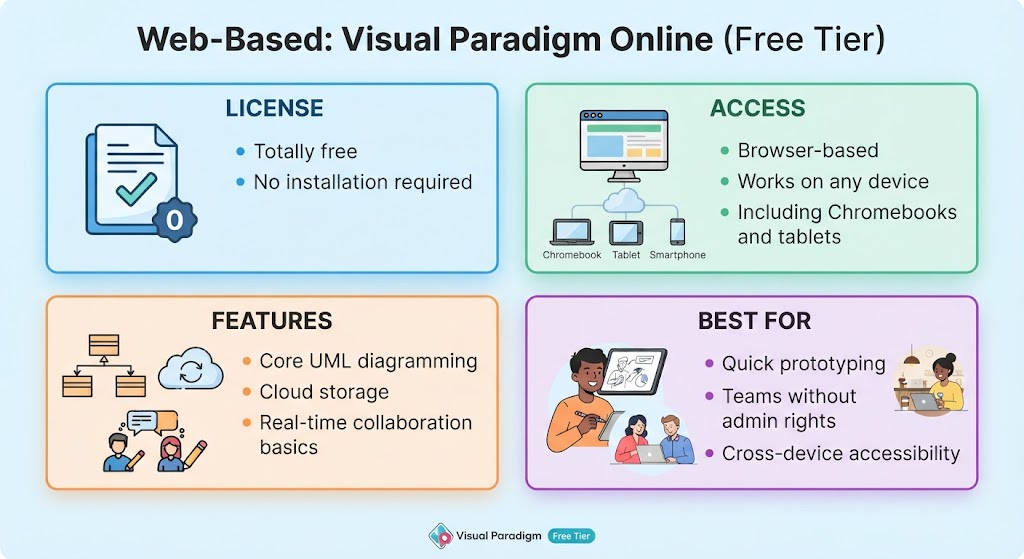
🌐 Web-Based: Visual Paradigm Online (Free Tier)
-
License: Totally free, no installation required
-
Access: Browser-based, works on any device including Chromebooks and tablets
-
Features: Core UML diagramming, cloud storage, real-time collaboration basics
-
Best For: Quick prototyping, teams without admin rights, cross-device accessibility
🎓 Academic Programs
-
Students: Free Community Edition with full features for coursework and capstone projects
-
Educators: Special academic licensing available for classroom instruction and lab deployments
-
Research: Eligible for extended capabilities in funded research projects
💼 Commercial Teams
For organizations requiring commercial usage, unwatermarked exports, advanced team collaboration, and priority AI features, the Modeler Edition is available at $6/month per user—making enterprise-grade modeling accessible even for startups.
Conclusion
UML hasn’t become obsolete; it has matured. In 2026, the combination of semantic modeling, Diagram-as-Code (VPasCode), and AI-assisted design makes UML more relevant than ever for Agile teams who need precision without sacrificing velocity.
Visual Paradigm stands at this intersection, offering a genuinely free entry point that doesn’t compromise on modeling integrity. Whether you choose the desktop Community Edition or the web-based Online version, you gain access to a tool built for outcomes—not just outputs.
Start modeling today. Download the Community Edition or launch Visual Paradigm Online in your browser. Your future self—and your Agile team—will thank you for investing in clarity.