

Introduction
Business Process Model and Notation (BPMN) has long been the gold standard for visualizing complex workflows. However, traditional BPMN creation is often a bottleneck. Analysts spend hours manually dragging shapes, aligning swimlanes, and routing connectors, shifting their focus from strategic process optimization to mechanical drafting.
The emergence of AI-powered Natural Language Processing (NLP) engines is transforming this landscape. By converting plain text narratives into standard-compliant BPMN diagrams, AI allows stakeholders to describe business challenges in natural language while the system handles the technical rigor of diagram construction. This guide explores the architectural approach behind this transformation, detailing how semantic extraction, object generation, smart routing, and iterative refinement work together to create robust, interactive process models.
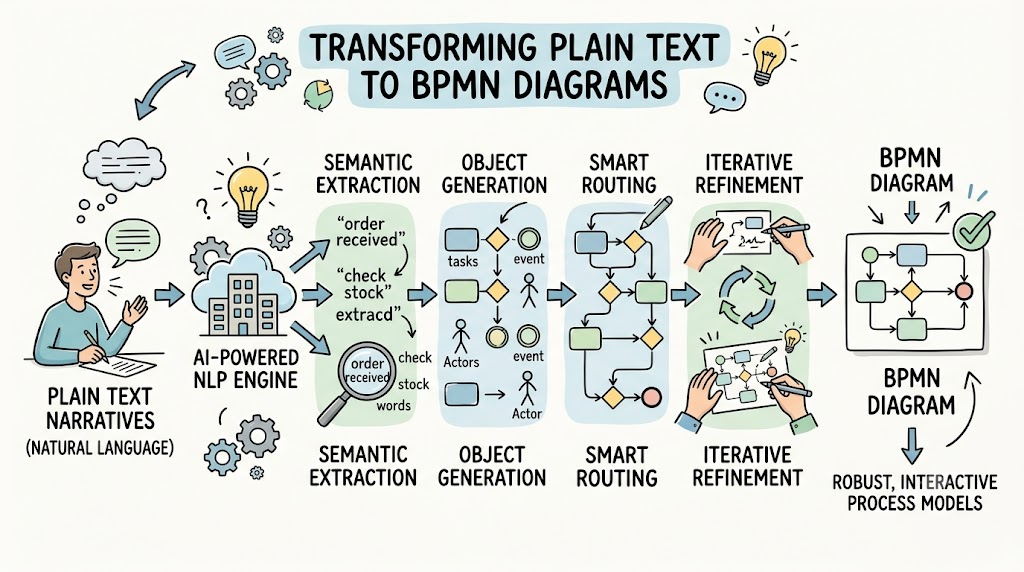
Key Concept 1: Semantic Extraction – Parsing the “Story”
The foundation of AI-driven BPMN is the ability to understand context. The NLP engine does not just look for keywords; it parses the input narrative to extract the underlying “story” of the process. It identifies three critical components:
-
Organizational Entities: These become Pools and Lanes.
-
Operational Actions: These become Tasks.
-
Decision Criteria: These become Gateways.
Examples
| Input Narrative | AI Interpretation | BPMN Element Generated |
|---|---|---|
| “The Finance Department reviews the invoice.” | Entity: Finance Dept | Lane within a Pool |
| “The System automatically validates the data format.” | Entity: System | Separate Pool or Lane |
| “The manager approves the request.” | Action: Approve | User Task |
| “If the amount is over $5,000, send it to Legal.” | Decision: Amount > $5k | Exclusive Gateway (XOR) |
Key Concept 2: Object and Containment Generation
Traditional drawing tools create flat images. AI-powered modeling environments instantiate explicit database objects inside a structured modeling layer. This ensures that the output is not just a picture, but a functional model.
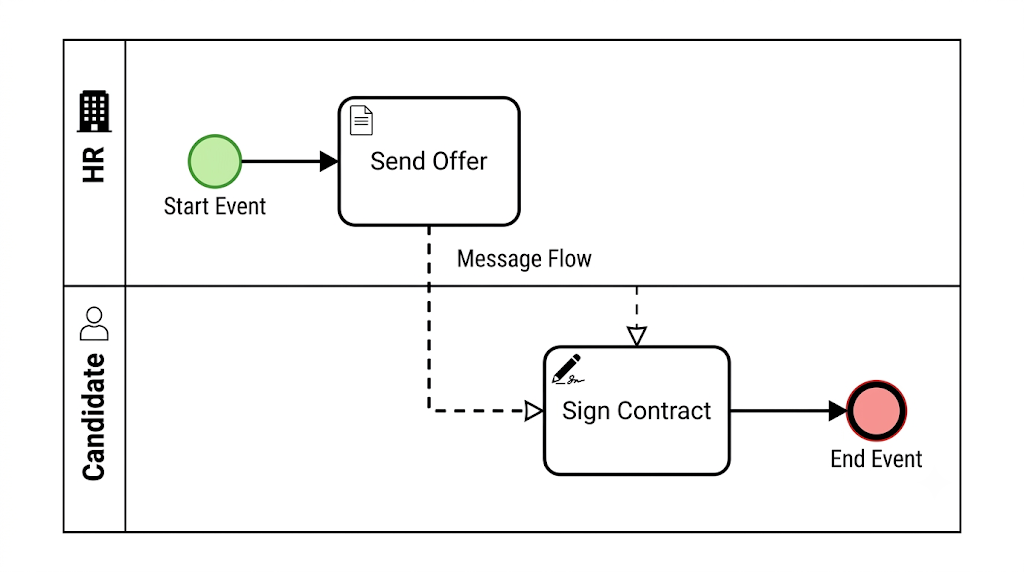
A critical aspect of this generation is satisfying the strict geometric containment required by BPMN swimlanes. The AI mathematically maps activities to reside within specific X/Y coordinate boundaries, ensuring that every task is logically and visually housed within the correct organizational lane.
Example: The Containment Logic
-
Input: “HR sends an offer letter, and the Candidate signs it.”
-
AI Action:
-
Creates a “HR” Lane.
-
Places the “Send Offer” Task strictly within the HR Lane’s coordinates.
-
Creates a “Candidate” Lane.
-
Places the “Sign Contract” Task strictly within the Candidate Lane’s coordinates.
-
Draws a Message Flow between the two lanes to represent the cross-organizational interaction
-
Key Concept 3: Smart Routing Layout
One of the most common frustrations in manual BPMN is the “spaghetti problem”—tangled, overlapping lines that make diagrams unreadable. AI addresses this through semantic layout rules.
-
Optimized Alignment: Elements are aligned based on logical flow rather than arbitrary placement.
-
Even Spacing: Components are distributed evenly to maximize white space and clarity.
-
Intelligent Routing: Sequence flows are routed to avoid crossing other elements whenever possible, ensuring the diagram remains readable as the process scales in complexity.
Example: Scaling Complexity
In a manual draft, adding five new approval steps might result in crossed lines and cramped spaces. An AI engine will automatically re-calculate the layout, expanding the canvas and re-routing connectors to maintain a clean, left-to-right or top-to-bottom flow.
Key Concept 4: Symbol and Logic Mapping
BPMN contains dozens of explicit symbols, each with a specific semantic meaning. The AI engine recognizes variations in text to apply the correct notation, distinguishing between subtle but critical differences in process logic.
Examples of Symbol Mapping
| Textual Cue | BPMN Symbol Applied | Why It Matters |
|---|---|---|
| “Wait for 24 hours” | Timer Boundary Event | Indicates a time-based trigger or delay. |
| “Receive an email confirmation” | Message Start Event | Indicates the process begins with an external communication. |
| “Both teams must approve” | Parallel Gateway (AND) | Indicates concurrent paths that must all complete. |
| “Either Manager A or Manager B approves” | Exclusive Gateway (XOR) | Indicates only one path can be taken. |
| “Check inventory levels” | Service Task | Indicates an automated system action. |
Key Concept 5: Iterative Visual Refinement
Because the output is a true process model rather than a static image, the generated diagram is fully interactive. This shifts the analyst’s role from drafting to strategic optimization.
-
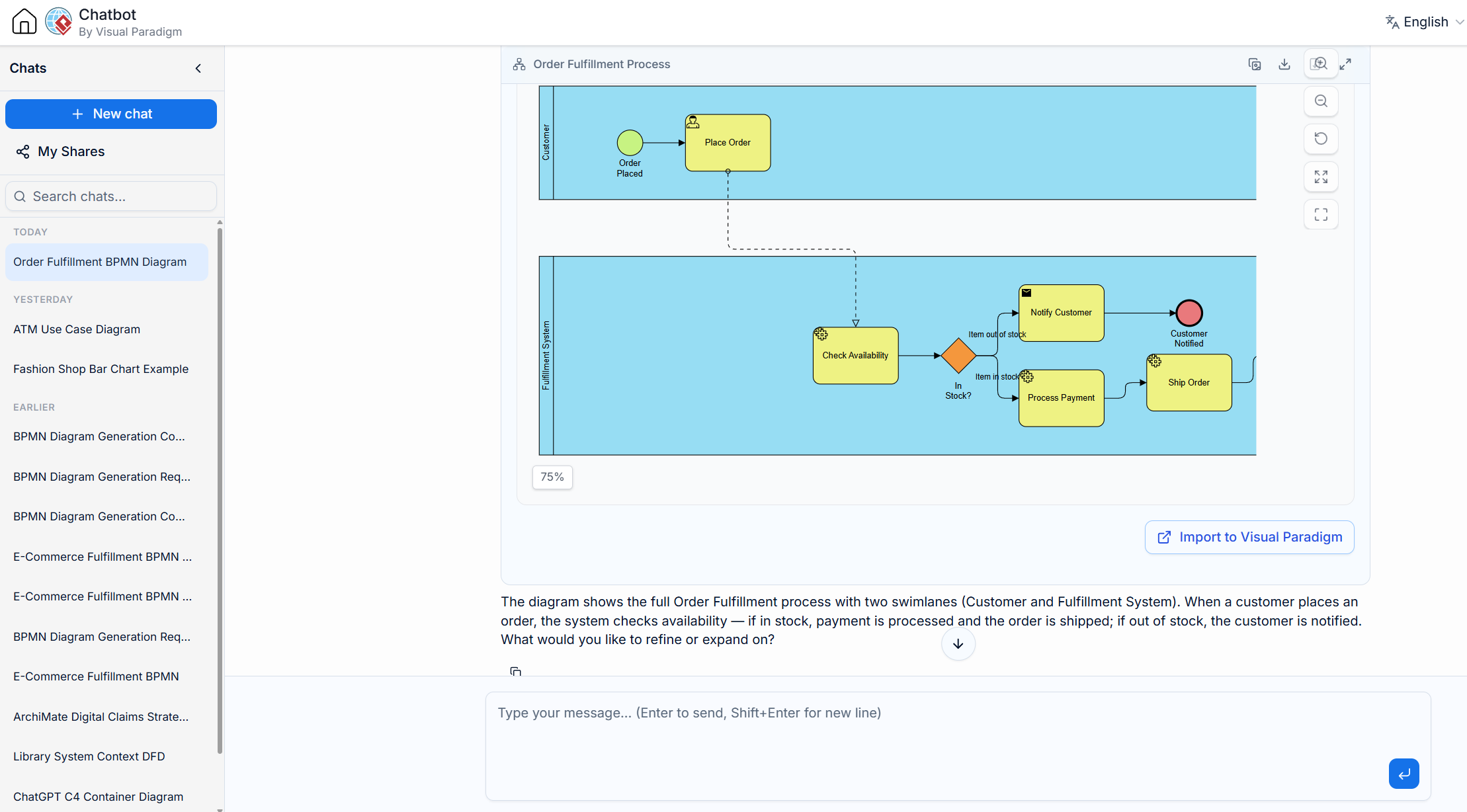
Conversational Refinement: Users can refine the diagram via chatbot (e.g., “Add a rejection path here”).
-
Sub-process Expansion: High-level tasks can be expanded into detailed sub-processes for deeper analysis.
-
Manual Editing: Users can transition to drag-and-drop editing for fine-tuning, knowing the underlying model remains intact.
Example Workflow
-
Generate: AI creates a high-level “Order Fulfillment” diagram.
-
Refine: User types, “What happens if the item is out of stock?”
-
Update: AI adds a decision gateway and a “Notify Customer” task.
-
Expand: User clicks on “Process Payment” to view the detailed sub-process involving fraud checks and bank APIs.
Conclusion
The integration of AI into BPMN modeling represents a paradigm shift in business analysis. By automating the mechanical aspects of diagram construction—semantic extraction, geometric containment, smart routing, and symbol mapping—organizations can accelerate their process documentation efforts. This allows product managers and business analysts to focus on what truly matters: identifying bottlenecks, optimizing workflows, and driving strategic value.
For teams looking to implement this advanced approach, tools like Visual Paradigm offer robust environments that support these AI-driven capabilities. Visual Paradigm combines powerful modeling standards with intelligent features, enabling users to transform natural language descriptions into precise, standard-compliant BPMN diagrams efficiently. By leveraging such tooling, organizations can bridge the gap between business narrative and technical execution, ensuring clarity and compliance in every process model.