

Business process modeling is the backbone of operational efficiency, yet creating detailed BPMN diagrams has traditionally been a time-consuming, manual task requiring specialized expertise. The integration of artificial intelligence into this space is changing everything.
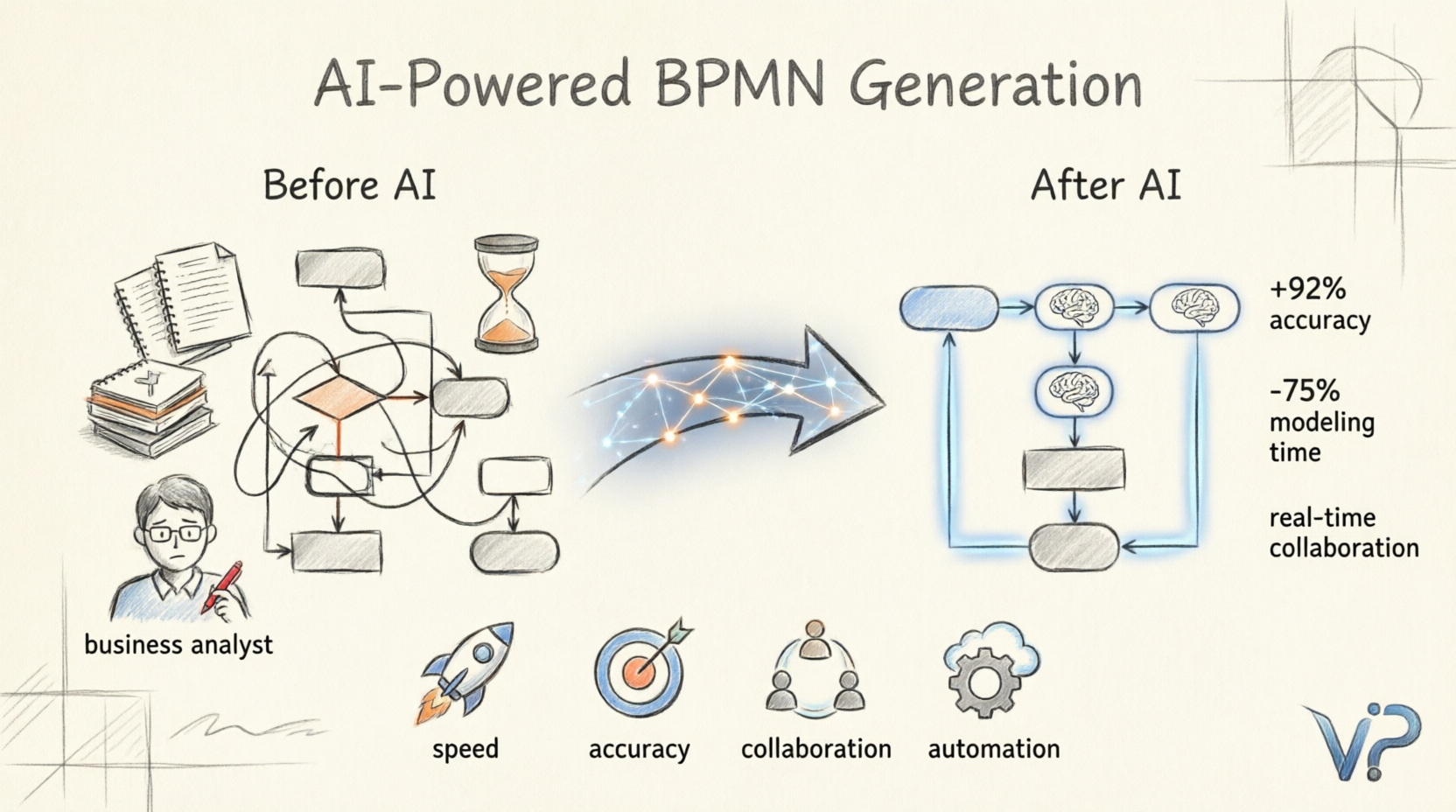
This comprehensive guide explores how AI-powered BPMN generation—particularly through Visual Paradigm’s ecosystem—is revolutionizing the way business analysts, process architects, and organizations approach workflow design.
1. Introduction to BPMN and the AI Revolution
What is BPMN?
Business Process Model and Notation (BPMN) is the global standard for visualizing business processes. It provides a standardized graphical language that bridges the communication gap between business stakeholders and technical teams .
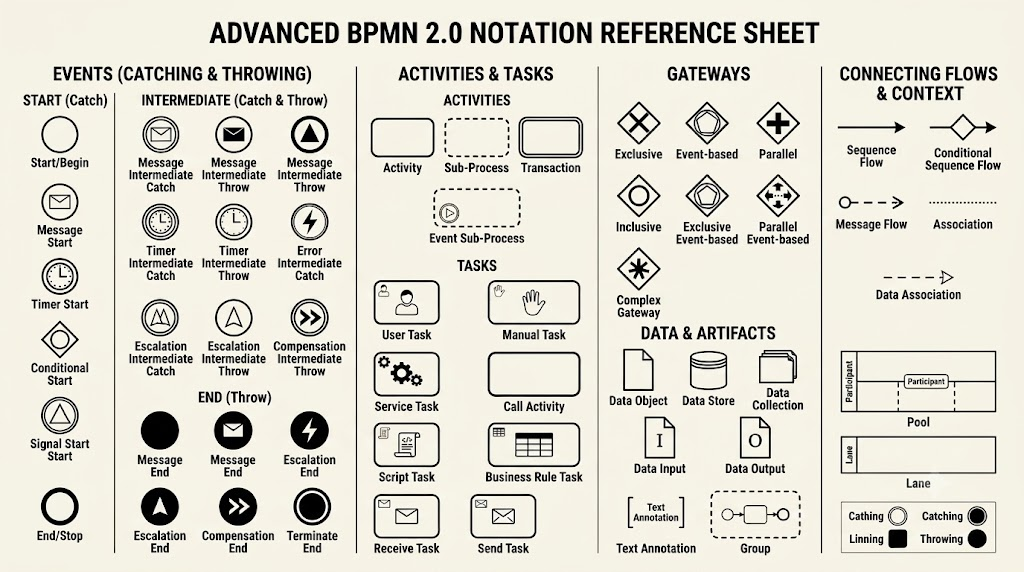
A BPMN diagram represents a business process as a collection of related activities that transform inputs into outputs to achieve a specific business goal. The notation includes:
-
Flow Objects: Activities, gateways, and events that define the process flow
-
Connecting Objects: Sequence flows, message flows, and associations
-
Swimlanes: Pools and lanes that organize activities by participant or department
-
Artifacts: Data objects, groups, and annotations that provide additional context
Why BPMN Matters
The standardized nature of BPMN delivers several critical advantages:
-
Clarity: Universal symbols make diagrams accessible to both technical and non-technical stakeholders
-
Communication: Facilitates effective dialogue between business analysts, process designers, and developers
-
Process Improvement: Helps identify bottlenecks, inefficiencies, and optimization opportunities
-
Automation: BPMN diagrams serve as blueprints for process automation using BPM software
The AI Paradigm Shift
Traditional BPMN creation requires:
-
Deep knowledge of BPMN 2.0 notation standards
-
Manual drag-and-drop placement of every element
-
Time-consuming layout adjustments
-
Iterative refinement cycles
AI-powered generation transforms this workflow. Tools like Visual Paradigm’s AI BPMN Generator can convert plain-English text descriptions into professional-grade, BPMN 2.0-compliant diagrams in seconds . This represents a fundamental shift from manual drawing to conversational, automated modeling .
2. How AI BPMN Generation Works
The Technology Behind the Magic
AI BPMN generators typically employ sophisticated natural language processing (NLP) engines that interpret process descriptions and translate them into structured diagram components . The technical architecture often follows a multi-stage pipeline:
Stage 1 – NLP to Intermediate Representation: The AI processes natural language input and generates a structured format (often JSON) that captures the process logic, participants, activities, and decision points .
Stage 2 – Semantic Mapping: The system maps the structured representation to BPMN elements, inferring appropriate task types, gateway structures, and flow relationships .
Stage 3 – Layout Generation: The final stage produces BPMN 2.0 XML with visual layout information, enabling immediate rendering in BPMN-compatible tools .
Key Technical Capabilities
Cross-Pool Collaboration: Advanced AI generators can handle multi-pool collaboration diagrams, maintaining consistent ID naming across pools and enabling direct semantic validation of message flows .
Automatic Gateway Generation: For parallel and inclusive gateways, AI systems automatically create corresponding join nodes and connect them appropriately .
Lane Inheritance: Elements within branches inherit the lane of the parent gateway, ensuring clear organizational context .
Flow Inference: The system automatically infers front and back links based on element order and branching logic .
3. Visual Paradigm’s AI BPMN Ecosystem
The Premier AI BPMN Tool
Visual Paradigm stands out as a comprehensive ecosystem for AI-powered BPMN, combining instant AI-driven creation with professional-grade editing and collaboration tools . The platform offers an end-to-end solution that bridges conceptual ideas and implementation-ready models.
VP Desktop: Professional-Grade AI Modeling
Visual Paradigm Desktop is the flagship application designed for serious business analysts and architects. It features a powerful AI business process diagram generator that understands operational needs and constructs complete diagrams from plain-language descriptions .
Key differentiators:
-
Advanced structural elements: Support for pools and lanes to define responsibilities across departments
-
Professional refinement tools: Full access to industry-leading modeling suite after AI generation
-
Seamless integration: Output is a native Visual Paradigm diagram, enabling drag-and-drop editing
Step-by-Step Generation Process
Creating a process diagram using Visual Paradigm’s AI involves a straightforward workflow :
-
Access the AI Tool: Navigate to
Tools > AI Diagram Generationin the top menu bar -
Select Diagram Type: Choose
Business Process Diagramfrom the available options -
Define Participants (Optional): Check
Include Pools and Lanesto organize the flow by roles or departments -
Provide Your Description: Enter a detailed description of the process (e.g., “A patient appointment scheduling and treatment process in a healthcare clinic”)
-
Generate: Click OK to initiate automated modeling
The AI immediately builds the diagram within your project, providing a professional foundation for further refinement .
AI Chatbot Interface
Visual Paradigm also offers an AI-powered chatbot that enables natural language diagram creation. Users can engage in conversational interactions to generate, modify, and iterate on BPMN diagrams without navigating traditional menus .
4. Real-World AI BPMN Examples
Employee Onboarding Process
Prompt: “An employee onboarding process in a mid-sized company.”
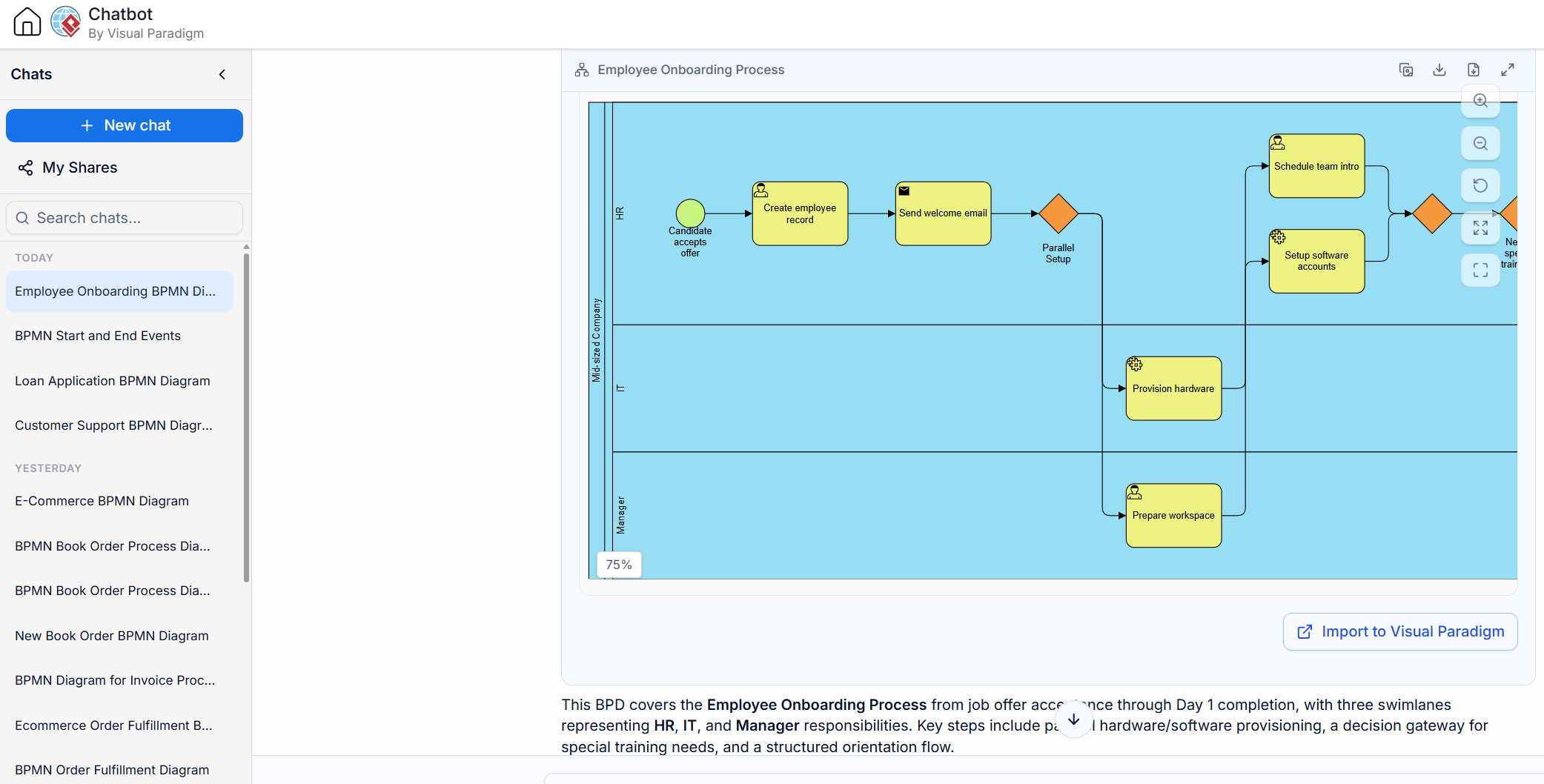
The AI generates a comprehensive process flow covering:
-
New hire documentation submission
-
IT system access provisioning
-
Manager introduction and orientation
-
Benefits enrollment
-
Training scheduling and completion tracking
Customer Support Ticket Resolution
Prompt: “A customer support ticket resolution process for a SaaS company.”
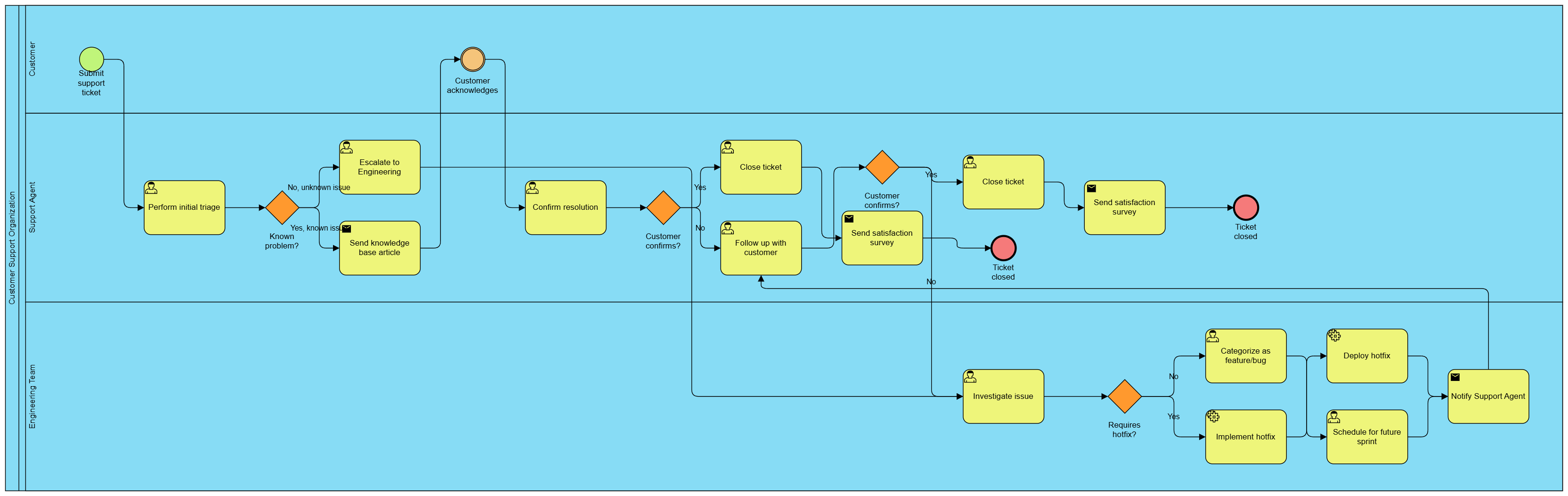
The generated diagram includes:
-
Ticket categorization and prioritization
-
Immediate resolution attempt with conditional branching
-
Escalation paths for unresolved issues
-
Bug report creation and engineering handoff
-
Customer notification and verification flow
Loan Application and Approval
Prompt: “A loan application and approval process in a retail bank.”
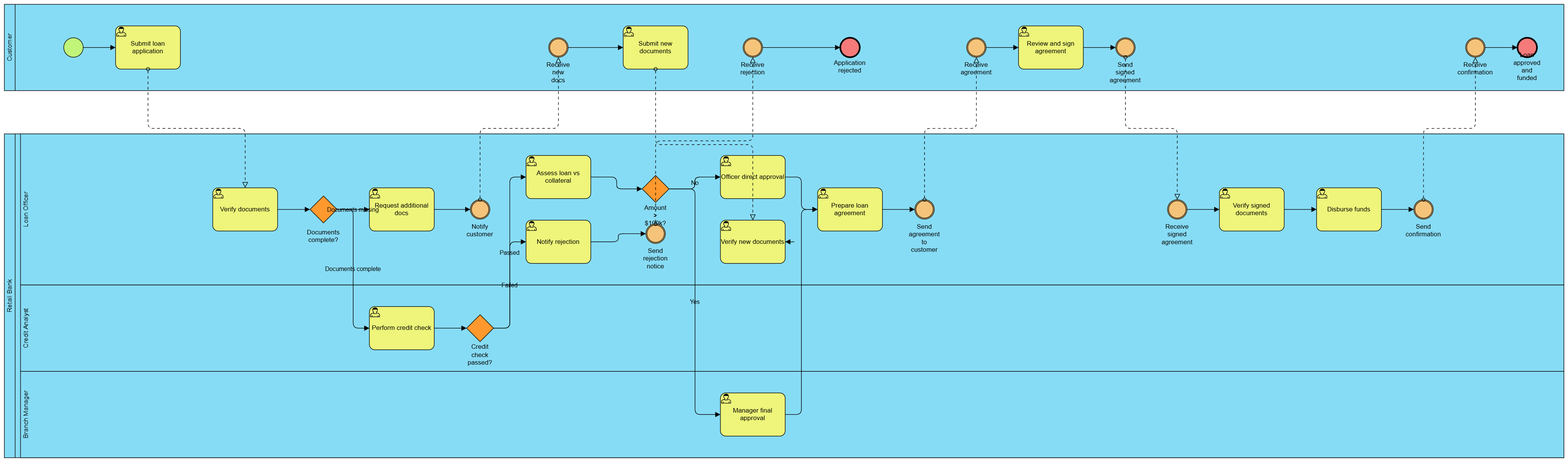
The AI produces a sophisticated cross-functional process featuring:
-
Application validation and verification
-
Credit report retrieval and creditworthiness assessment
-
Committee review for high-value applications
-
Approval and rejection notification flows
-
Multiple decision gateways with conditional logic
5. Maximizing AI Effectiveness: Prompt Engineering
The Importance of Well-Structured Prompts
The quality of AI-generated diagrams depends significantly on prompt quality. A well-written prompt clearly describes the process flow, roles, and decision logic, enabling the AI to accurately convert these elements into BPMN components .
Best Practices for Effective Prompts
Define Objective and Scope :
-
State the process goal (e.g., “customer onboarding” or “invoice approval”)
-
Define start and end points
-
Mention expected outcomes or milestones
Structure Logically :
-
Describe steps in chronological order
-
Break down the process into distinct activities or phases
-
Specify essential components: activities/tasks, actors/roles, start and end events, inputs and outputs
Be Specific and Provide Context :
-
Use precise wording and real-world context
-
Avoid unnecessary ambiguity
-
Too vague: “Create a purchase process”
-
Better: “Create a purchase approval process where employees submit a request, managers approve or reject it, and finance processes payment”
Include Decision Logic :
-
Decision points (gateways) and conditions
-
Parallel steps or branches
-
Exceptions or alternative paths
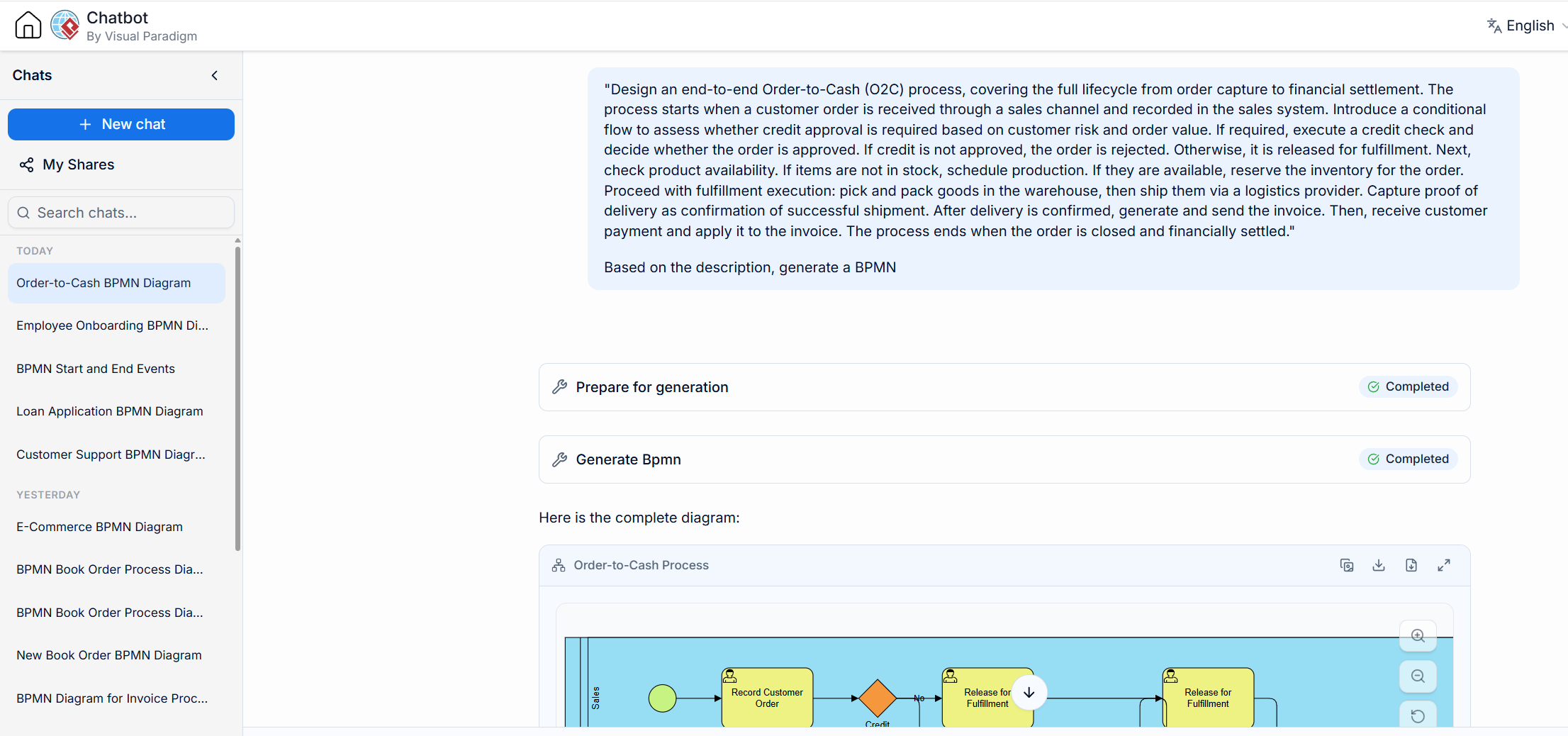
Complex Prompt Example
This detailed prompt demonstrates the level of specificity that yields sophisticated results :
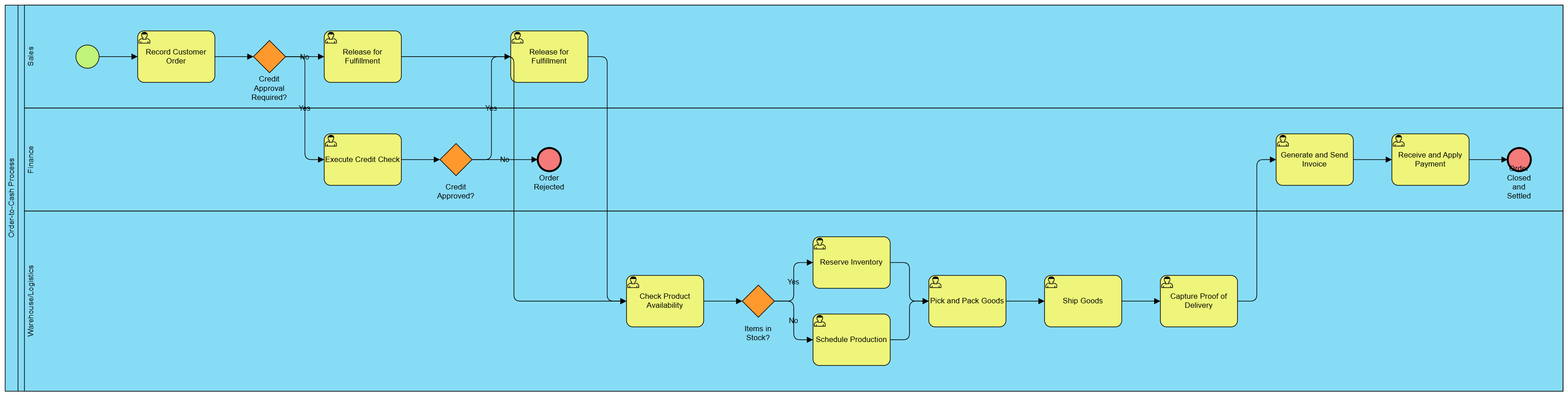
“Design an end-to-end Order-to-Cash (O2C) process, covering the full lifecycle from order capture to financial settlement. The process starts when a customer order is received through a sales channel and recorded in the sales system. Introduce a conditional flow to assess whether credit approval is required based on customer risk and order value. If required, execute a credit check and decide whether the order is approved. If credit is not approved, the order is rejected. Otherwise, it is released for fulfillment. Next, check product availability. If items are not in stock, schedule production. If they are available, reserve the inventory for the order. Proceed with fulfillment execution: pick and pack goods in the warehouse, then ship them via a logistics provider. Capture proof of delivery as confirmation of successful shipment. After delivery is confirmed, generate and send the invoice. Then, receive customer payment and apply it to the invoice. The process ends when the order is closed and financially settled.”
Visual Paradigm AI Chatbot – Complex Prompt Example
Generated BPMN Diagram Prompt based on The Complex Prompt:
6. AI BPMN Capabilities and Limitations
What AI Excels At
Instant Drafting: Move from blank canvas to structured BPMN model in seconds .
Standard Compliance: Ensure diagrams follow BPMN 2.0 notation, including proper task types, gateways, and events .
Complex Structure Handling: Automatically categorize tasks into pools and lanes, making cross-functional processes easy to read .
Accelerated Iteration: Quickly test different process variations by describing changes in natural language .
Knowledge Capture: Transform team knowledge and verbal process descriptions into documented visual workflows .
Multi-Language Support: Generate BPMN process models in multiple languages .
Current Limitations
Need for Validation: While AI strives for accuracy, generative AI can produce occasional inaccuracies. Review and validation with stakeholders remains essential .
Pool and Lane Support: Some AI BPMN tools face limitations with pools and lanes due to library constraints .
Complex Logic Nuance: Highly complex or nuanced decision logic may require manual refinement .
Structural Boundaries: AI may have difficulty generating certain complex nested structures beyond a certain depth .
Quality Evaluation
AI BPMN generation quality is typically evaluated across two dimensions :
Structural Validity:
-
Elements are properly configured
-
XML opens without errors in BPMN viewers
-
No significant overlap in layout
-
Proper gateway branch configuration
Semantic Fit:
-
Process logic conforms to the prompt
-
Pool/lane division is reasonable
-
Parallel gateways reflect “simultaneous” descriptions
-
Exclusive gateways reflect “if/otherwise” branching
7. The AI Modeling Ecosystem: Beyond Generation
Complete Modeling Lifecycle
Visual Paradigm’s AI capability is part of a larger ecosystem that supports the full modeling lifecycle :
-
Generate: Create initial process models with AI from text descriptions
-
Refine: Modify any element using professional drag-and-drop editing tools
-
Collaborate: Share with team members for feedback and iteration
-
Version Control: Track changes and maintain historical versions
-
Traceability: Link processes to data objects and requirements
Integration with Other Modeling Standards
The AI capabilities extend beyond BPMN to support seamless transition between different modeling standards, including UML, SysML, and other notations .
AI-Assisted Analysis
Beyond diagram generation, AI powers specialized analysis toolsets that guide users through:
-
Defining business problems
-
Generating process stories
-
Visualizing processes
-
Defining KPIs and reports with AI assistance
8. Technical Requirements and Access
Desktop Version Requirements
To use AI capabilities in Visual Paradigm Desktop, users must meet these requirements :
-
Version: Latest version of Visual Paradigm Desktop
-
Connectivity: Desktop application connected to Visual Paradigm Online for AI service access
-
Project Hosting: Active project hosted on Visual Paradigm Online
-
License: Professional Edition or higher with active maintenance
Online Platform Access
For users preferring browser-based modeling, Visual Paradigm Online offers web-based BPMN diagram creation without the desktop prerequisites .
9. Conclusion: The Future of Process Modeling
AI-powered BPMN generation represents a paradigm shift in business process modeling. What once required hours of manual drafting, deep BPMN knowledge, and iterative refinement can now be accomplished in seconds through simple text descriptions .
The benefits are clear:
-
Accelerated modeling: Dramatically reduced time from concept to visual diagram
-
Democratized access: Anyone can document processes without learning BPMN notation first
-
Standard compliance: Automatic adherence to BPMN 2.0 standards
-
Enhanced iteration: Quick testing of process variations
-
Knowledge preservation: Transformation of team knowledge into documented workflows
As AI technology continues to evolve, the integration between natural language understanding and process modeling will only deepen. Organizations that embrace these tools can focus their expertise on strategic process optimization rather than manual drafting, gaining competitive advantage through faster, more accurate, and more accessible business process modeling.
Related posts:
 From Chaos to Clarity: A Practitioner’s Review and Guide to Mastering BPMN
 How to Turn User Stories into Visual Process Diagrams with AI
BPMN for Beginners: Key Concepts & Best Practices with Visual Paradigm’s AI Chatbot
Decoding the Flow: A Beginner’s Guide to Reading BPMN Diagrams with Visual Paradigm
How to Turn User Stories into Visual Process Diagrams with AI
BPMN for Beginners: Key Concepts & Best Practices with Visual Paradigm’s AI Chatbot
Decoding the Flow: A Beginner’s Guide to Reading BPMN Diagrams with Visual Paradigm