

In Agile product development, user stories are the gold standard for defining feature requirements from an end-user perspective. While user stories excel at capturing user intent and acceptance criteria, text-heavy backlogs often obscure the broader operational workflow. As systems scale, development teams struggle to visualize how individual user stories interconnect, leading to missing edge cases, redundant functionality, and architectural misalignment.
To solve this, product managers and system analysts are bridging the gap between Agile requirements and visual process design. Converting text-based user stories into formal Business Process Model and Notation (BPMN) diagrams creates a clear blueprint for engineering teams. With the advent of modern AI BPMN tools, specifically Visual Paradigm’s AI BPMN Tool, product leaders can instantly translate user story acceptance criteria into structured process models, streamlining backlog refinement and sprint planning.
The Gap Between Agile Stories and Process Architecture
A standard user story follows a simple format: “As a [user role], I want to [action], so that [benefit].” Accompanied by acceptance criteria, this format provides functional context. However, software features do not exist in isolation—they operate within multi-step workflows involving API integrations, database updates, and asynchronous user notifications.
Relying solely on textual user stories presents several common challenges during development:
- Hidden Workflow Dependencies: Text stories struggle to depict parallel processes, failure recovery paths, or complex branching logic across system boundaries.
- Misalignment Between Product and Engineering: Developers may interpret acceptance criteria differently than product managers intended, resulting in rework during sprint testing.
- Fragmented System Architecture: Without visual process mapping, individual features are built as isolated modules rather than cohesive end-to-end user journeys.
Translating User Stories to BPMN: A Practical Example
Consider an e-commerce feature user story:
User Story: As a registered customer, I want to apply a promotional discount code at checkout so that I can save money on my order.
Acceptance Criteria:
- Validate the code against active promotion rules upon entry.
- If valid, recalculate order total and display saved amount.
- If invalid or expired, display an error message and prompt re-entry.
- If the code usage limit is reached during checkout, trigger a notification to the marketing system.
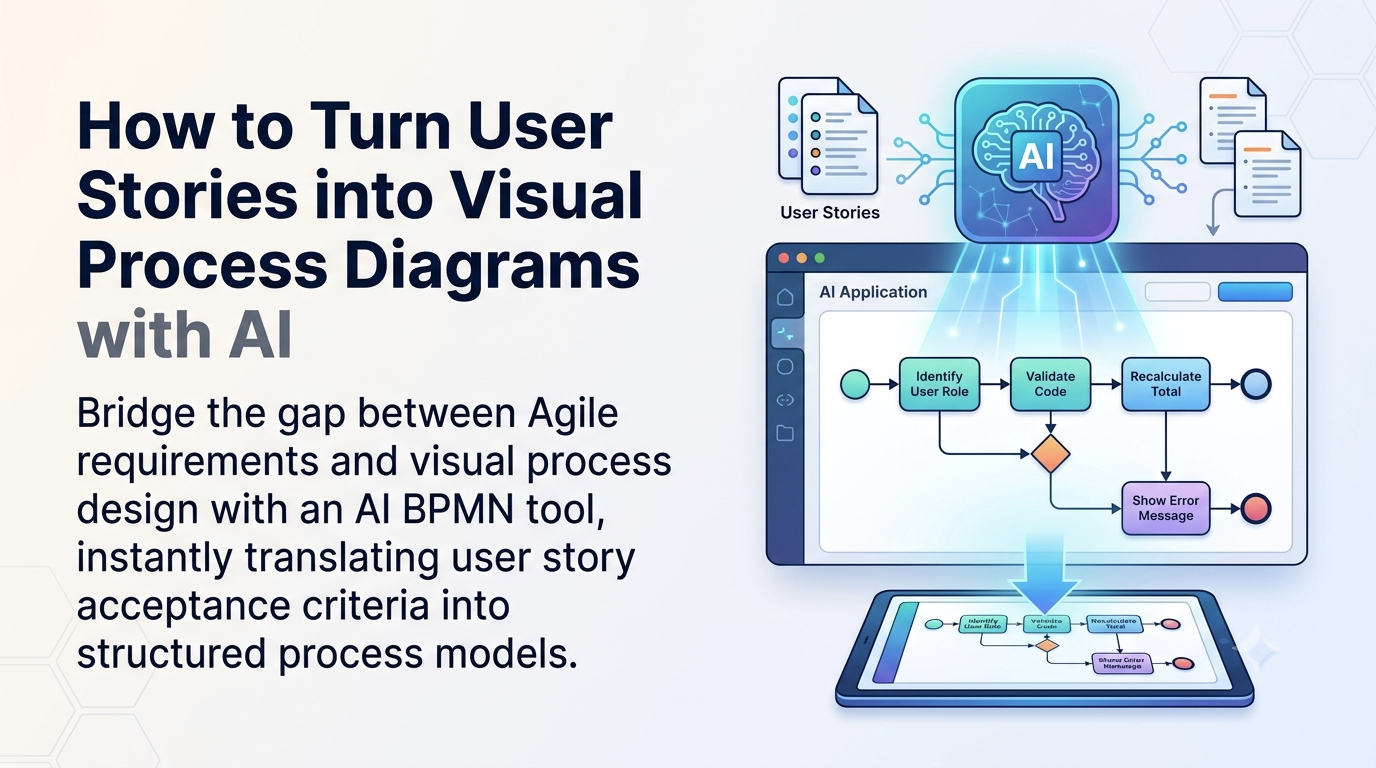
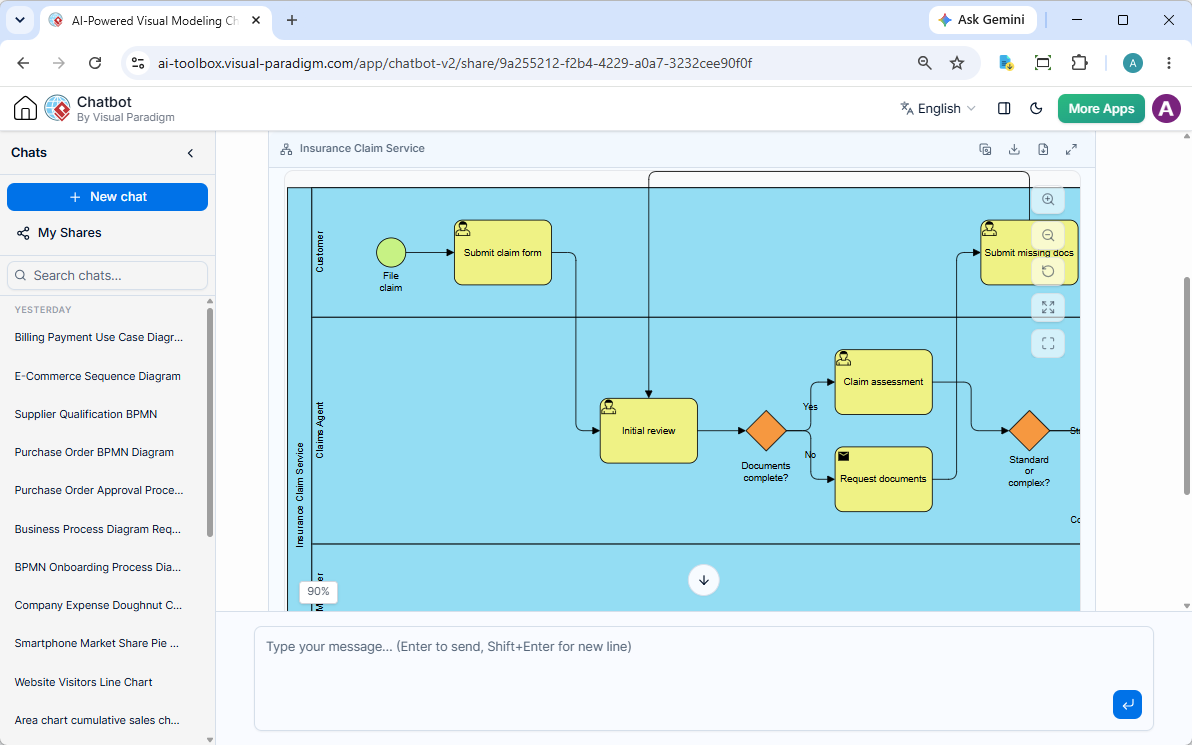
Translating these acceptance criteria into a visual BPMN model transforms flat text into a dynamic decision flow. The initial user action becomes a start event, validation steps map to service tasks, logic checks turn into exclusive gateways, and system notifications form message events. This is precisely what Visual Paradigm’s AI engine achieves by parsing your requirements and generating a compliant diagram automatically.
Accelerating Agile Discovery with Visual Paradigm AI
Manually drawing a BPMN diagram for every user story in a multi-epic backlog can quickly slow down product management velocity. This is where Visual Paradigm‘s AI BPMN tool becomes an indispensable productivity booster for product teams.
By simply pasting user story acceptance criteria directly into Visual Paradigm’s AI BPMN Tool, product managers can instantly generate standard-compliant process diagrams. The generative AI engine parses the conditions, extracts user roles into swimlanes, and maps out conditional gateway branches automatically, all within the familiar Visual Paradigm interface.
Integrating Visual Paradigm into your Agile workflow delivers several key benefits:
- Instant Backlog Visualization: Generate visual process baselines in seconds during backlog grooming sessions to validate feature logic with developers in real time.
- Automatic Edge Case Identification: Generative AI models within Visual Paradigm can analyze requirement text and highlight missing logical paths (e.g., handling timeout exceptions) before code is written.
- Interactive Iteration: Refine feature workflows conversationally by asking the Visual Paradigm AI assistant to add alternative payment paths or secondary authorization loops on the fly.
Best Practices for Product Managers and Agile Teams
To get the most out of visual process mapping during product development using Visual Paradigm, adopt these actionable guidelines:
1. Embed BPMN Diagrams into Jira or User Story Cards
Attach generated process models directly to user story tickets in your team’s project management software. Visual diagrams provided by Visual Paradigm provide immediate context for developers and QA engineers reviewing acceptance criteria.
2. Link Process Tasks to System Specifications
Don’t stop at the diagram. Ensure you leverage Visual Paradigm’s unified modeling capabilities to link process elements directly to UML class diagrams, ERDs, and API endpoints. This ensures that the visual process model remains synchronized with your technical architecture.
3. Use AI-Generated Diagrams to Align Business and IT
Leverage visual models created in Visual Paradigm as a common language during sprint planning. Business stakeholders can easily verify business logic, while engineering leads can assess technical feasibility and backend service requirements using the same source of truth.
Frequently Asked Questions
Can an AI BPMN tool parse multiple user stories simultaneously?
Yes. By providing an epic summary or a set of related user stories as text input, Visual Paradigm’s AI BPMN tool can construct an end-to-end workflow capturing interactions across multiple features and user roles.
Do developers need extensive BPMN training to read these diagrams?
No. Basic BPMN elements—such as tasks, decision gateways, and swimlanes—are intuitive to read. Visual workflows significantly improve clarity over dense blocks of text requirements, especially when generated by industry-standard tools like Visual Paradigm.
How does turning user stories into BPMN improve QA testing?
A complete BPMN model explicitly illustrates every execution path, including success states, error handlings, and decision branches. QA engineers can use these visual paths generated by Visual Paradigm to create comprehensive test scenarios without missing edge cases.
Conclusion
User stories are ideal for capturing intent, but visual process diagrams provide the structural clarity required to build robust software systems. By adopting enterprise-grade Visual Paradigm, product managers can effortlessly convert user requirements into precise, standard-compliant models. This bridges the communication gap between product strategy and engineering execution, reducing rework and accelerating sprint delivery with the power of AI.
Related posts:
 From Text to Process Flow: A Hands-On Review of Visual Paradigm’s AI-Powered BPMN Generator
 From Chaos to Clarity: A Practitioner’s Review and Guide to Mastering BPMN
The Definitive Guide to AI-Powered BPMN: Transforming Process Modeling with Visual Paradigm
From Chaos to Clarity: A Practitioner’s Review and Guide to Mastering BPMN
The Definitive Guide to AI-Powered BPMN: Transforming Process Modeling with Visual Paradigm
 BPMN for Project Managers: Visual Planning That Actually Works