Automating BPMN Modeling: From Text Prompts to Swimlane Diagrams in Visual Paradigm
In the rapidly evolving landscape of business process management, the bottleneck has traditionally been the time required to translate abstract requirements into formal technical diagrams. Visual Paradigm, a leading enterprise-grade modeling tool, has addressed this challenge by integrating advanced Generative AI directly into its BPMN (Business Process Model and Notation) workflow. This tutorial explores how users can leverage the AI Diagram Generation feature to transform simple text descriptions into complex, multi-lane swimlane diagrams, significantly accelerating the requirements analysis phase.
The Power of Text-to-Process Generation
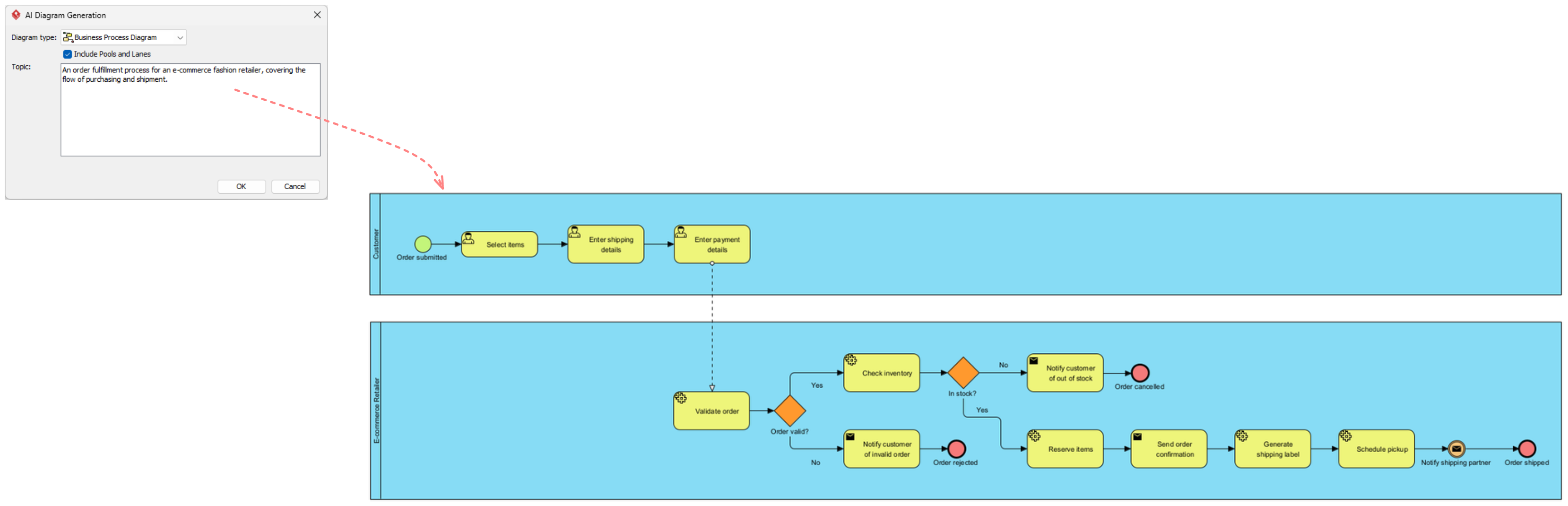
The image above illustrates a pivotal interaction within the Visual Paradigm interface. Unlike traditional modeling tools that require manual drag-and-drop of shapes, this feature utilizes Natural Language Processing (NLP) to interpret a user’s narrative description of a process and render it into a structured BPMN diagram.
The workflow begins with the AI Diagram Generation dialog box. Here, the user defines the scope of the project by selecting the diagram type—typically a Business Process Diagram—and entering a specific topic. The system then parses the input text to identify key entities (actors), tasks, and decision points, automatically mapping them into logical swimlanes.
Step-by-Step: Generating an E-Commerce Fulfillment Process
Let us walk through the specific example shown in the screenshot, which details an order fulfillment process for an e-commerce fashion retailer. This process involves two primary actors: the Customer and the E-commerce Retailer.
- Inputting the Context: The user provides a concise prompt: “An order fulfillment process for an e-commerce fashion retailer, covering the flow of purchasing and shipment.” Visual Paradigm analyzes this sentence to understand the domain (e-commerce) and the intent (fulfillment/shipment).
- Architecture Setup: The tool automatically creates a Pool representing the entire system and defines Lanes (swimlanes) for the distinct actors involved. In this case, it identifies “Customer” and “E-commerce Retailer” as the necessary partitions.
- Task Extraction & Placement: The AI maps specific verbs from the text to BPMN activities.
- “Select items” and “Enter shipping details” are placed in the Customer lane.
- “Validate order”, “Check inventory”, and “Generate shipping label” are correctly routed to the E-commerce Retailer lane.
Interpreting the Resulting Swimlane Diagram
The output shown in the lower half of the image demonstrates a robust BPMN 2.0 compliant diagram. The visual separation of lanes is crucial for Responsibility Matrix analysis, ensuring that every task is assigned to the correct actor.
1. The Customer Lifecycle
The top lane (Customer) represents the external trigger. It begins with a Start Event (Green Circle) labeled “Order submitted.” The flow proceeds through user-initiated tasks:
- Select items: Represented by a task with a Person Icon (User Task), indicating manual intervention.
- Enter shipping & payment details: Sequential tasks leading to the handover of the request to the retailer system.
2. The Retailer Logic
The bottom lane (E-commerce Retailer) contains the complex business logic. The diagram reveals a sophisticated validation workflow:
- Validation Gateways: The process hits an Exclusive Gateway (Diamond shape) to determine if the order is valid.
- If No, the process flows to a notification task and terminates with a Red End Event (Order rejected).
- If Yes, it proceeds to inventory checks.
- Inventory Check: Another decision point determines if items are “In stock?”
- If No, it triggers a cancellation workflow.
- If Yes, it triggers the fulfillment sequence: Reserving items, sending confirmation, generating a shipping label, and notifying a partner.
3. Connecting the Actors
A critical feature of this generated diagram is the Message Flow (represented by the dashed line). This connects the “Select items” task in the Customer lane to the “Validate order” task in the Retailer lane. This visual cue signifies the transfer of data between external participants and the internal system, a core concept in BPMN.
Conclusion
By using Visual Paradigm’s AI capabilities, analysts can bypass the tedious manual setup of swimlanes and gateways. Instead, they focus on the high-level narrative, allowing the tool to handle the structural compliance of the diagram. This “Top-Down” approach ensures that the resulting architecture accurately reflects the intended business logic from the very first draft.