
Architectural Data Democratization: Solving Visualization Gaps with VP QueryBase
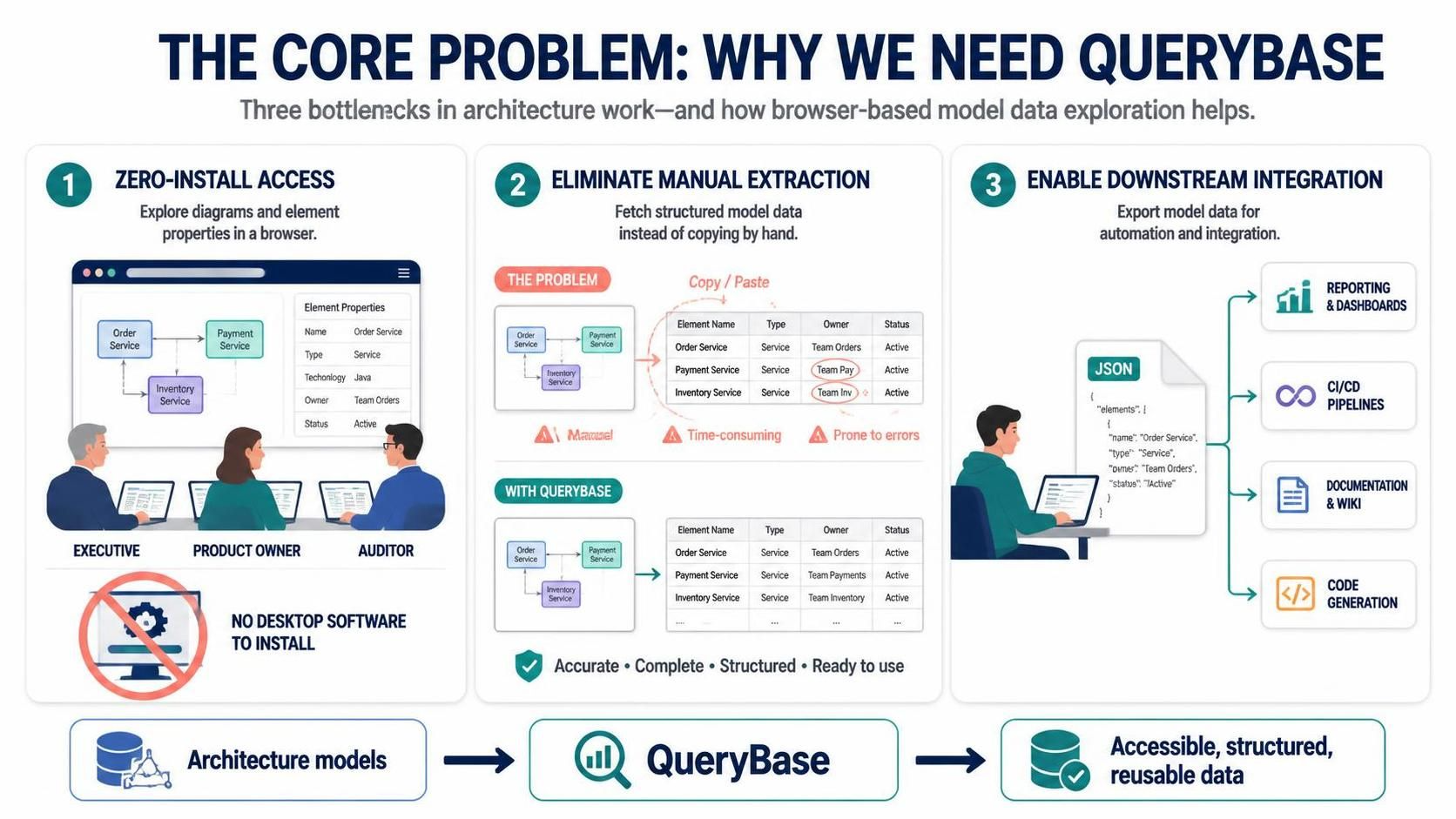
In the modern software development lifecycle, a significant disconnect often exists between the visual representation of system architecture and the structural data required for automation. For years, technical teams have relied on static images for documentation, while business stakeholders and auditors lacked the ability to inspect the underlying logic without installing heavy desktop software. This tutorial explores how the QueryBase architecture resolves these critical bottlenecks, transforming static diagrams into dynamic, queryable assets.
1. The Zero-Install Accessibility Paradigm
The first major challenge in enterprise architecture is accessibility. High-stakes stakeholders—such as executives, product owners, and external auditors—often require access to architectural diagrams to make informed decisions. However, the traditional workflow requires them to install complex desktop environments like Visual Paradigm, which is frequently blocked by corporate security policies or simply unnecessary for a one-time review.
QueryBase introduces a browser-based solution that decouples the viewer from the authoring tool:
- Universal Access: Stakeholders can access the architecture repository via a web URL without any software installation.
- Role-Based Security: The system allows for granular control, ensuring that auditors can inspect properties (like ownership and status) without accidentally modifying the source model.
- Interactive Inspection: Users can click on diagram elements to retrieve detailed metadata instantly.
2. Eliminating Manual Data Extraction
For technical teams, the “Copy/Paste” workflow is a notorious source of error. When documentation is generated manually from static images, the data becomes “dead”—it is difficult to update, prone to hallucinations, and impossible to automate. This leads to the “Maintenance Trap,” where documentation quickly becomes outdated the moment the code changes.
QueryBase replaces manual extraction with direct querying. Instead of a team member manually transcribing attributes from a diagram into a spreadsheet, the system exposes the model data via a structured interface. This ensures that the data retrieved is always accurate, complete, and current.
The Transformation Logic
The shift from manual to programmatic data retrieval can be visualized as a transition from unstructured to structured workflows:
[OLD WORKFLOW]
Diagram Image  ----(Human Eye)---->  Copying  ----(Paste)---->  Spreadsheet
(Static, Error-Prone, Manual Effort)

[QUERYBASE WORKFLOW]
Architecture Model  ----(Query API)---->  Structured Data (JSON)
(Accurate, Instant, Automated)
3. Enabling Programmatic Downstream Integration
The ultimate value of QueryBase lies in its ability to serve as a data source for downstream automation. By exposing model data in standard formats like JSON, developers can build pipelines that react to architectural changes in real-time. This bridges the gap between System Design and DevOps.
Integration Patterns
QueryBase enables the following automated workflows:
- Automated Reporting & Dashboards: Connect BI tools (like PowerBI or Tableau) directly to the architecture model to track system health, service ownership, or technology stack distribution.
- CI/CD Pipelines: Integrate with Jenkins or GitHub Actions to enforce architecture constraints. For example, a pipeline can query the model to ensure a new microservice is correctly registered before deployment.
- Documentation Generation: Automatically generate API documentation (Swagger/OpenAPI) or technical wikis by querying the element definitions.
- Code Generation: Use the model data to scaffold boilerplate code for new services, ensuring that the generated code aligns with the approved architectural design.
Conclusion
By adopting a QueryBase architecture, organizations move away from “dumb” diagrams and towards “smart” data repositories. This approach eliminates the friction of software installation for stakeholders, removes the tedium of manual data entry for engineers, and unlocks the full potential of automated software delivery pipelines.