Transforming Workflows with AI-Assisted BPMN 2.0: A Guide to Modern Modeling with Visual Paradigm
In today’s fast-paced business environment, clear communication and efficient workflows are the backbone of organizational success. Yet, many teams struggle to translate complex processes into understandable, actionable models. This is where Business Process Model and Notation (BPMN) 2.0 comes in—the global standard that has revolutionized how businesses visualize, analyze, and optimize their workflows.
For years, creating professional BPMN diagrams required specialized expertise and significant time investment. But the landscape has changed. With the introduction of AI-assisted features in modern tools like Visual Paradigm, the gap between textual descriptions and executable process models has never been narrower. What once took hours of manual diagramming can now be accomplished in minutes, making professional-grade business process modeling accessible to everyone—from business analysts to project managers.
Understanding the Challenge: From Narrative to Model
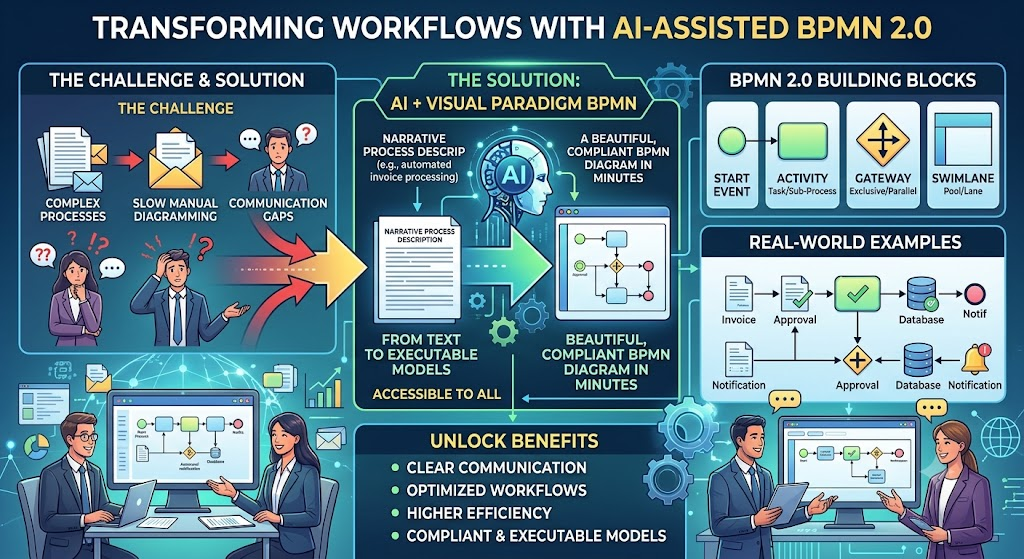
The traditional process of modeling begins with a challenge: bridging the communication gap between business stakeholders and technical modelers. Business users often describe processes using natural language (narrative descriptions), such as “The system sends an invoice, waits for approval, and then updates the database.”
Converting these narratives into formal models traditionally involved:
- Slow Manual Diagramming: Dragging and dropping shapes manually, which is time-consuming.
- Communication Gaps: Misinterpretations between what the business wants and what the modeler draws.
- Complexity: Struggling to manage complex logic without the right notation knowledge.
The solution lies in leveraging AI to automate the translation of text into compliant BPMN diagrams, ensuring accuracy and speed.
The Solution: AI + Visual Paradigm
Visual Paradigm has integrated advanced AI capabilities that allow users to generate fully compliant BPMN diagrams directly from narrative text. This approach transforms the workflow from a manual drafting exercise into a strategic design session.
How It Works
- Input: You provide a narrative process description (e.g., “Automated Invoice Processing”).
- Analysis: The AI engine analyzes the text to identify events, activities, and decision points.
- Generation: Visual Paradigm instantly generates a beautiful, compliant BPMN diagram.
- Refinement: The modeler reviews and fine-tunes the diagram, knowing the heavy lifting of syntax and structure is already done.
Mastering BPMN 2.0 Building Blocks
To fully appreciate the output of AI-assisted tools, one must understand the fundamental building blocks of BPMN 2.0. Visual Paradigm ensures that every generated element adheres to these strict standards.
1. Start Event
Every process begins with a Start Event. It signifies the trigger for the process, such as the receipt of an email or a scheduled time. In Visual Paradigm, this is often the first element generated when the AI detects a trigger phrase.
2. Activity (Task/Sub-Process)
Activities represent the actual work being performed. They are the “meat” of the process. For example, “Send Invoice” or “Approve Request.” Visual Paradigm allows these to be expanded into sub-processes if the logic becomes too complex for a single box.
3. Gateway (Exclusive/Parallel)
Gateways control the flow of the process. They are the decision points.
- Exclusive Gateway (Diamond): “This OR That.” The path splits based on a condition (e.g., if the amount is > $1000, go to Manager Approval).
- Parallel Gateway: “This AND That.” The flow splits to execute multiple paths simultaneously.
4. Swimlanes (Pools/Lanes)
Swimlanes organize the diagram by actor or department. Visual Paradigm’s AI is smart enough to recognize nouns in your text that represent roles (e.g., “Finance Team,” “System”) and automatically assign the corresponding tasks to the correct lanes.
Real-World Examples
Visual Paradigm’s AI capabilities shine in complex scenarios. Here are two examples of how narrative descriptions transform into executable models.
Example 1: Automated Invoice Processing
Narrative: “When an invoice is received, the system checks the amount. If it is under $500, it is automatically approved and sent to the database. If it is over $500, it goes to a manager for approval. Once approved, it is saved.”
Visual Paradigm Output: The AI creates a flow with a Start Event (Receive Invoice), a Parallel Gateway (System Check), an Exclusive Gateway (Amount Decision), and parallel paths for the Database save, merging correctly at the end.
Example 2: Multi-Organization Workflows
Narrative: “Client submits a request. Vendor receives it and processes it. Vendor sends an invoice. Client receives it and pays.”
Visual Paradigm Output: The AI constructs a Collaboration Diagram using Pools for the Client and the Vendor, connected by Message Flows (dashed lines with an envelope icon) to show the exchange of documents between organizations.
Unlocking the Benefits
By combining the rigor of BPMN 2.0 with the speed of AI in Visual Paradigm, organizations achieve:
- Clear Communication: Models are easily understood by both technical and non-technical stakeholders.
- Optimized Workflows: Visualizing the process highlights bottlenecks instantly.
- Higher Efficiency: Drastic reduction in time spent drawing and formatting diagrams.
- Compliant & Executable Models: Because Visual Paradigm generates strict BPMN 2.0 syntax, these diagrams can often be directly executed by workflow engines.
Conclusion
The future of business process modeling is here. By leveraging AI-assisted tools like Visual Paradigm, you can transform complex textual descriptions into professional, compliant, and executable BPMN diagrams in minutes. Whether you are managing simple internal tasks or orchestrating complex cross-organizational workflows, Visual Paradigm provides the robust architecture and intelligent assistance needed to succeed.