

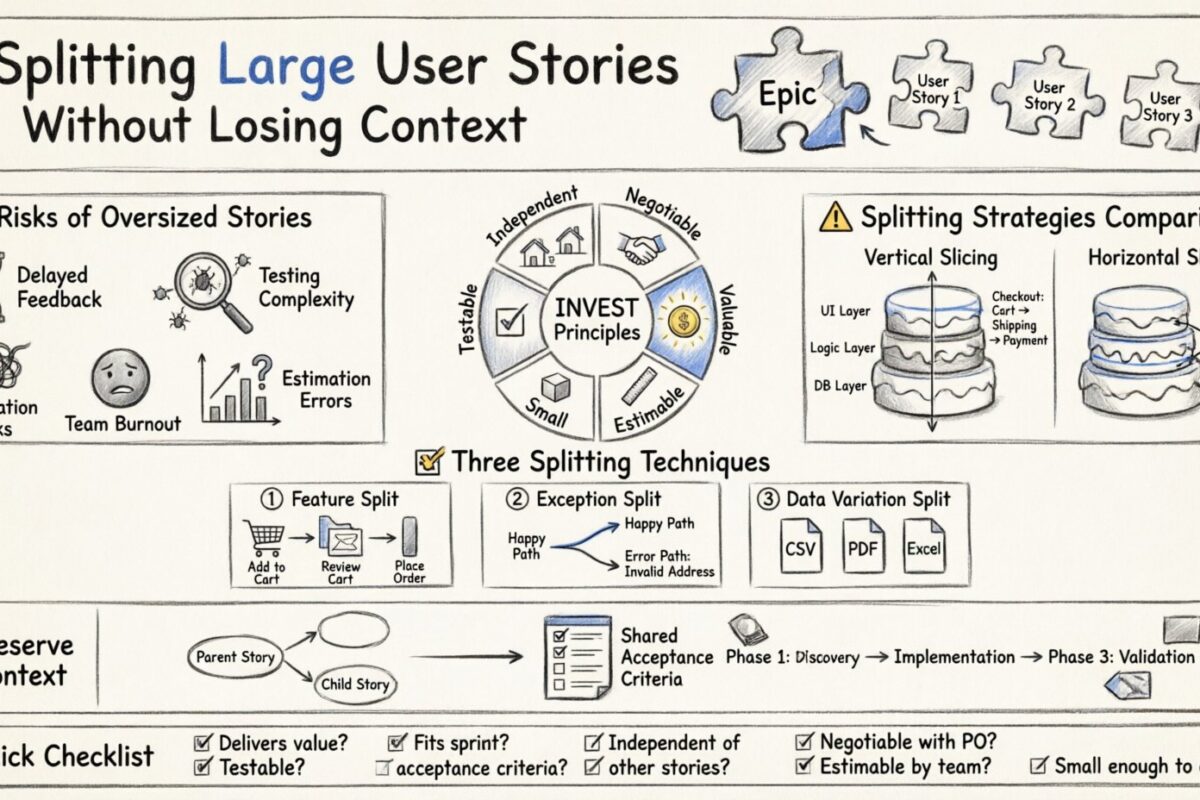
In the fast-paced world of software development, the gap between a big idea and a deliverable feature often bridges a complex series of tasks. When a single user story grows too large, it becomes a bottleneck. It slows down progress, obscures risk, and makes testing a nightmare. This phenomenon is often referred to as a spike or an epic disguised as a story. The challenge lies in breaking these down into manageable pieces without losing the original intent or the narrative flow that connects them.
This guide explores the art and science of splitting large user stories effectively. We will examine strategies to maintain context, ensure every slice delivers value, and keep the team aligned. By mastering the mechanics of decomposition, teams can improve predictability and quality without sacrificing the holistic view of the product.
⚠️ The Hidden Cost of Oversized Stories
Before diving into solutions, it is crucial to understand why large stories are problematic. A story that is too big fails the test of time. It cannot be completed within a single sprint, leading to partial work that sits in a state of flux. This creates technical debt and uncertainty.
Consider the risks associated with keeping stories large:
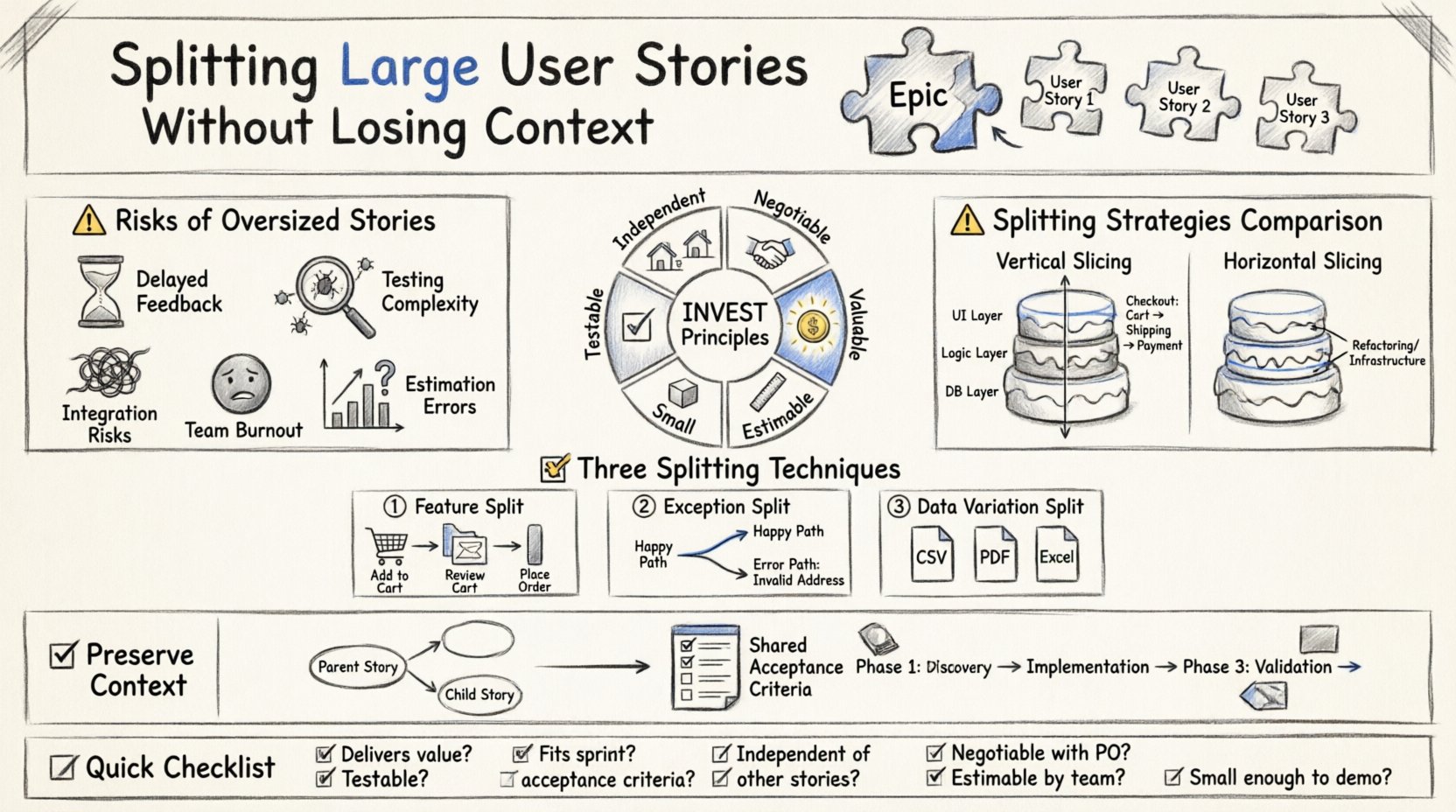
- Delayed Feedback: Stakeholders do not see working software until the very end of the cycle. By then, the direction may have shifted.
- Testing Complexity: QA teams struggle to validate a massive feature set in one go. Edge cases multiply exponentially.
- Integration Risks: Combining multiple untested components increases the likelihood of conflicts in the codebase.
- Team Burnout: Working on a monolithic task for weeks drains motivation. The lack of small wins demoralizes the team.
- Estimation Errors: Large stories are inherently difficult to estimate accurately. This leads to missed deadlines and reduced velocity.
To mitigate these issues, teams must adopt a disciplined approach to decomposition. The goal is not just to make tasks smaller, but to make them valuable.
🧱 Core Principles for Effective Splitting
Splitting is not random. It requires adherence to specific principles that ensure the resulting stories remain useful. The most widely recognized framework for this is the INVEST model. While splitting, each new story should ideally fit these criteria:
- Independent: The story should not rely on other stories to be functional.
- N
- Valuable: Each slice must deliver value to the user or stakeholder.
- E
- Small: It should fit within a sprint.
- Testable: Clear acceptance criteria must exist.
When a story is split, the Value criterion is the most critical. A split story that cannot stand alone provides no value. If the user cannot use the feature, the split was incorrect.
📊 Comparing Splitting Criteria
| Criterion | Focus | Example Application |
|---|---|---|
| Vertical Slicing | End-to-end functionality | Adding a single new field to a form and displaying it. |
| Horizontal Slicing | Layer-based implementation | Refactoring the database schema for the whole system. |
| Exception Handling | Edge cases and errors | Handling network timeouts or invalid data entry. |
| Data Variations | Content differences | Supporting different currencies or languages. |
🔪 Strategies for Vertical Slicing
Vertical slicing is the gold standard for splitting user stories. It involves cutting through all the layers of the application (database, business logic, user interface) to deliver a specific, working piece of functionality. This ensures that every story produces a deployable increment.
1. The Feature Split
If a story describes a complex workflow, break it down by the specific actions the user can perform. Instead of building the entire checkout process at once, isolate individual steps.
- Original Story: As a shopper, I want to complete a purchase so I can buy items.
- Split 1: As a shopper, I want to add items to a cart so I can review my selection.
- Split 2: As a shopper, I want to enter shipping details so I can proceed to payment.
- Split 3: As a shopper, I want to select a payment method so I can finalize the order.
Each of these is a standalone value. The cart works without shipping. Shipping works without payment (for preview purposes). This allows for incremental releases.
2. The Exception Split
Often, the happy path is simple, but the edge cases make a story large. Splitting the happy path from the exception path can clarify requirements and reduce risk.
- Original Story: As a user, I want to reset my password so I can regain access.
- Split 1 (Happy Path): As a user, I want to receive a reset link via email so I can change my password.
- Split 2 (Exception): As a user, I want to be notified if my email is not found so I can correct my input.
- Split 3 (Exception): As a user, I want to lock my account after multiple failed attempts so it remains secure.
3. The Data Variation Split
Supporting different types of data often bloats a story. By isolating data types, teams can simplify validation and logic.
- Original Story: As an admin, I want to upload reports in CSV, PDF, and Excel formats.
- Split 1: As an admin, I want to upload CSV reports.
- Split 2: As an admin, I want to upload PDF reports.
- Split 3: As an admin, I want to upload Excel reports.
🏗️ When to Use Horizontal Slicing
Vertical slicing is not always the answer. Sometimes, horizontal slicing is necessary. This involves building functionality layer by layer across the entire system. While this does not produce user value immediately, it is useful for technical foundations.
Use horizontal slicing when:
- Refactoring: You need to update a library used by every feature.
- Infrastructure: You are setting up a new database schema or API gateway.
- Security: You are implementing authentication across the whole application.
- Performance: You are optimizing the caching layer for all endpoints.
Even when using horizontal slices, try to keep them small enough to be tested independently. A horizontal split that touches every module should still be treated as a single story.
🧭 Preserving Context During Decomposition
The most significant risk in splitting is losing the context. If a team member picks up a small story without understanding how it fits into the larger picture, the implementation may drift from the original vision. This is known as context switching or fragmentation.
1. Linking Stories Together
Use parent-child relationships in the backlog management system. Mark the original large story as an epic or parent. Each split story should reference the parent ID. This creates a traceability chain.
- Epic: Implement User Profile Management.
- Story A: Add Profile Picture Upload.
- Story B: Update Contact Information.
- Story C: Change Password Settings.
This structure ensures that when reviewing Story A, the developer sees Story B and Story C are coming. It provides a roadmap of the whole feature.
2. Shared Acceptance Criteria
Some rules apply to the whole feature, not just the slice. Define these in a shared document or a common section of the story template. This ensures consistency.
- Security: All profile updates must require re-authentication.
- Performance: Page load time must remain under 2 seconds.
- Accessibility: All form fields must have proper labels for screen readers.
By listing these globally, every split story inherits the constraints. This prevents one slice from introducing a security flaw that affects the whole.
3. Visual Mapping
User story mapping is a powerful technique to visualize the flow. Create a backlog of user activities along the horizontal axis and the stories that support them along the vertical axis. This creates a skeleton of the feature.
This map serves as a visual contract. When splitting a story, the team can look at the map to see what comes before and after. It prevents the team from building a story in isolation that breaks the flow of the user journey.
🚫 Common Pitfalls to Avoid
Even with good intentions, splitting can go wrong. Here are common mistakes teams make when trying to reduce story size.
- Over-Splitting: Making stories so small that they take only 2 hours to complete. This increases the overhead of meetings and updates. Aim for stories that take 1 to 3 days.
- Splitting by Technology: Do not split a story just because it involves a backend task and a frontend task. If the frontend task requires the backend to be done first, it is a dependency, not a value split. This creates a waterfall within the sprint.
- Losing the User: Splitting stories into technical tasks (e.g., “Create Database Table”) without a user value statement (e.g., “As a user, I want to save my progress”).
- Ignoring Dependencies: Failing to check if one split story blocks another. This leads to idle time for team members.
- Duplicate Acceptance Criteria: Copying and pasting acceptance criteria without updating them for the specific slice. This leads to confusion during testing.
📋 Checklist for Story Splitting
Before finalizing a split, run through this checklist to ensure quality and clarity.
- ☐ Does this split story deliver independent value?
- ☐ Can it be tested in isolation?
- ☐ Is the effort estimate realistic for a sprint?
- ☐ Are the dependencies clearly identified?
- ☐ Does the story link back to the parent epic?
- ☐ Are the acceptance criteria specific to this slice?
- ☐ Does it maintain the user flow context?
- ☐ Have we considered the exception paths?
🔄 Refinement Techniques
Splitting is not a one-time event. It is an ongoing conversation during backlog refinement. As the team learns more about the problem, the stories may need to be split further or combined.
1. The “How” vs. “What” Debate
Ensure the story focuses on the what (user value) rather than the how (technical implementation). If a story is large because the team doesn’t know how to build it, that is a spike, not a story. Split the spike out as a research task.
- Bad: As a user, I want the system to use Redis caching for faster reads.
- Good: As a user, I want the dashboard to load in under 1 second.
- Research Spike: Evaluate Redis implementation options and estimate effort.
2. Iterative Refinement
Start with a rough split. As the sprint begins, the team might realize a slice is still too big. It is acceptable to split a story during the sprint if the risk is too high. However, this should be rare. Regular refinement sessions before the sprint planning help prevent this.
🤔 Frequently Asked Questions
Here are common questions teams ask when dealing with large stories.
Q: How do I know when a story is too big?
A: If the team cannot agree on an estimate, or if the story requires more than one sprint to complete, it is too big. Also, if testing it feels overwhelming, it is likely too large.
Q: Should I split stories based on who does the work?
A: No. Splitting by role (e.g., “Frontend Task”, “Backend Task”) creates dependencies. Split by value or functionality so that any team member can pick up the work and move it forward.
Q: What if the customer wants the whole feature at once?
A: Communicate the risks. Explain that delivering in slices allows for earlier feedback and reduces the chance of building the wrong thing. Offer the smallest slice that provides the core benefit first.
Q: Do all stories need to be vertical?
A: Most should be. Vertical slices deliver value. Horizontal slices are for technical debt or infrastructure. If a horizontal slice is too big, split it by component or module, but ensure it remains a technical story.
🏁 Final Thoughts
Splitting large user stories is a balancing act. It requires judgment, experience, and clear communication. The objective is not just to make the work smaller, but to make it more valuable. When done correctly, splitting reduces risk, improves quality, and keeps the team focused on delivering what matters to the user.
By adhering to vertical slicing principles, maintaining context through linking and mapping, and avoiding common pitfalls, teams can navigate complex features with confidence. The result is a steady stream of working software and a satisfied stakeholder. Keep refining your approach, and let the data from your sprints guide your future splitting decisions.