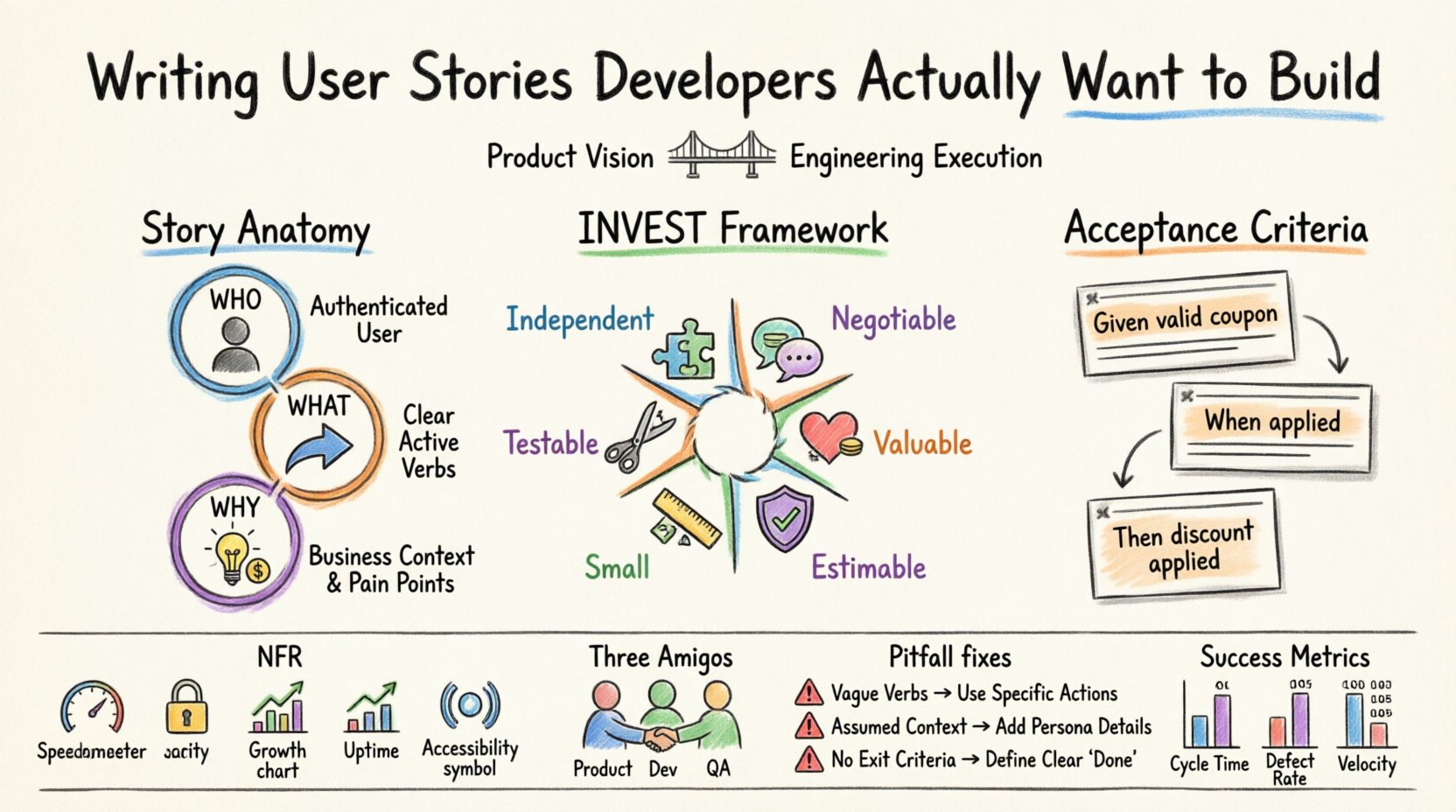
In the intersection of product vision and engineering execution, user stories serve as the bridge. However, a bridge built on vague assumptions often leads to structural failure. Developers are not simply code generators; they are problem solvers who require context, constraints, and clarity to function at their peak. When a story lacks detail, the resulting implementation inevitably drifts from the intended goal, leading to rework, technical debt, and frustration on both sides of the aisle.
This guide explores the mechanics of crafting user stories that resonate with engineering teams. It moves beyond the standard “As a user, I want…” template to focus on the nuances that enable accurate estimation, robust implementation, and successful delivery. By prioritizing clarity over volume, teams can reduce friction and increase velocity.
📝 The Anatomy of a Clarity-Focused Story
A user story is a promise of conversation. It is not a specification document, but it must contain enough information to initiate that conversation effectively. The standard format provides a skeleton, but the muscle and nerves lie in the details.
1. The Actor (Who)
Identifying the persona is the first step. Is this for an authenticated admin, a guest visitor, or an automated system? The actor determines permissions, data access, and UI constraints.
- Specificity Matters: Instead of “User,” specify “Authenticated User with Premium Subscription.” This immediately flags potential access control logic.
- Contextual Roles: Consider the workflow. Does this actor perform this action daily or once a year? Frequency impacts UI design and performance requirements.
2. The Action (What)
This describes the functionality. It must be an active verb. Avoid passive constructions that allow for multiple interpretations.
- Clear Verbs: Use “Submit,” “Calculate,” or “Sync” rather than “Handle” or “Manage.”
- Scope Boundaries: Define what the feature is not doing. Scope creep often begins with ambiguous “What” statements.
3. The Value (Why)
This is the most critical element for developers. Understanding the “Why” allows engineers to make trade-off decisions that align with business goals. If a developer knows the goal is data accuracy, they might prioritize validation over speed. If the goal is speed, they might prioritize caching over strict consistency.
- Business Context: Link the story to a broader initiative or metric.
- User Pain Point: Describe the problem being solved. “To reduce checkout abandonment by 5%.”
📐 The INVEST Framework for Engineering
The INVEST principle is a checklist for story quality. While known in agile circles, its application specifically for development teams requires a technical lens.
Independent
Stories should not depend on other stories to be delivered. Dependencies create bottlenecks. If Story B requires Story A to be finished before work begins, Story A becomes a critical path item that blocks the entire sprint.
- Refactor Dependencies: If a story depends on an API, treat the API definition as a separate story.
- Modular Design: Break complex features into smaller, self-contained units.
Negotiable
The story is not a contract; it is a request for a discussion. Developers should be able to negotiate the implementation details. A rigid story that dictates database schema or library choice stifles innovation and technical expertise.
- Focus on Outcomes: Define the behavior, not the mechanism.
- Allow Solutions: Let the team propose the best technical approach to meet the requirement.
Valuable
Every story must deliver value to the user or the business. If a story is purely technical (e.g., “Upgrade framework version”), it needs to be framed as enabling future value (e.g., “Upgrade framework to support new security features”).
- Technical Debt: Acknowledge refactoring as value. “Improve API response time to reduce server costs.”
- Direct Impact: Ensure the story connects to a user need or a system stability requirement.
Estimable
A story is not estimable if the scope is unknown. Developers cannot guess the complexity of undefined requirements. If a story is too large to estimate, it needs to be broken down.
- Known Technology: The stack should be familiar enough to make a judgment call.
- Ambiguity Removal: If requirements are vague, the story should be paused until clarified.
Small
Stories should be small enough to be completed within a single iteration. Large stories introduce risk. If a story spans weeks, the feedback loop is too long, and changes become expensive.
- Timebox: Aim for stories that take 1 to 3 days of focused work.
- Granularity: If a story feels like a project, split it into functional slices.
Testable
This is the developer’s safety net. If a story cannot be tested, it cannot be verified. Ambiguity in testing criteria leads to subjective “Done” states.
- Acceptance Criteria: Every story must have clear pass/fail conditions.
- Edge Cases: Define how the system behaves when things go wrong.
📋 Acceptance Criteria: The Contract
Acceptance criteria (AC) define the boundaries of the story. They are the rules that determine when the work is complete. Without them, “Done” becomes a subjective opinion.
Structure of Effective Criteria
Use a structured format like Given/When/Then to ensure logic is preserved.
- Given: The initial context or state of the system.
- When: The action taken by the user or system.
- Then: The expected outcome or state change.
Examples of Acceptance Criteria
- Positive Path: Given a valid coupon code, when the user applies it at checkout, then the total price is reduced by the discount amount.
- Negative Path: Given an expired coupon code, when the user applies it, then an error message is displayed stating the code is invalid.
- System Constraint: Given a network timeout, when the request fails, then the user sees a retry option rather than a blank screen.
⚙️ Non-Functional Requirements
Developers often discover that functional requirements are only half the battle. Non-functional requirements (NFRs) define the quality attributes of the system. Ignoring NFRs in the story description leads to performance issues and security vulnerabilities later.
Key NFR Categories
| Category | Description | Example Requirement |
|---|---|---|
| Performance | Speed and responsiveness | Page load time must be under 2 seconds. |
| Security | Data protection and access control | Passwords must be hashed using bcrypt. |
| Scalability | Ability to handle growth | System must support 1,000 concurrent users. |
| Reliability | Uptime and error handling | System availability must be 99.9%. |
| Usability | Accessibility and interface design | Must comply with WCAG 2.1 Level AA. |
🤝 Collaboration Dynamics
Writing a story is not a solitary act. It is the beginning of a collaborative process. The goal is to align understanding before a single line of code is written.
Refinement Sessions
Regular backlog refinement ensures stories are ready for development. This is not the time to write the story, but to polish it.
- Clarify Ambiguity: Ask questions. If a requirement is unclear, mark it as “Needs Clarification” rather than guessing.
- Technical Discovery: Allow developers to flag potential technical hurdles during refinement.
- Estimation: Use story points or hours to gauge effort. If the team is unsure, the story is not ready.
The Three Amigos
Involve three perspectives in the review process: Product, Development, and Quality Assurance.
- Product: Ensures business value and user needs are met.
- Development: Ensures technical feasibility and architecture.
- QA: Ensures testability and edge cases are covered.
⚠️ Common Pitfalls and Fixes
Even experienced teams fall into traps. Recognizing these patterns early prevents wasted effort.
| Pitfall | Impact on Development | Recommended Fix |
|---|---|---|
| Vague Verbs | Confusion on behavior | Use specific action words (e.g., “Generate” vs “Handle”) |
| Missing Edge Cases | Runtime errors, crashes | Explicitly state behavior for empty states or errors |
| Assumed Context | Wrong assumptions about data | Document existing data structures and constraints |
| Scope Creep | Missed deadlines | Split stories into smaller, independent units |
| UI vs. Logic Confusion | Frontend/Backend disconnect | Separate API contracts from UI behavior |
📊 Measuring Success
How do you know if your stories are effective? Track metrics that reflect the flow of work and the quality of output.
Key Metrics
- Cycle Time: How long does it take from “Ready” to “Done”? Shorter times indicate clearer requirements.
- Defect Rate: How many bugs are found after release? High rates suggest unclear acceptance criteria.
- Reopen Rate: How often is a ticket returned to the backlog? High rates imply incomplete stories.
- Velocity Consistency: Does the team complete similar amounts of work each sprint? Fluctuation often signals estimation errors.
🔧 The Developer Experience (DX)
Writing stories for developers is about improving their experience. A developer who understands the “Why” and “How” feels more ownership over the code. They become partners in the product rather than order takers.
Providing Context
- Design Assets: Link to mockups or wireframes. Visuals convey information faster than text.
- API Documentation: If the story involves an API, provide the schema.
- Reference Data: If specific data formats are required, provide examples.
Reducing Cognitive Load
Complexity is the enemy of velocity. Keep stories simple.
- One Goal Per Story: Avoid combining authentication and payment processing in one ticket.
- Clear Dependencies: If a story relies on another, link them explicitly.
- Minimal Dependencies: Avoid stories that block others unless absolutely necessary.
🔄 Feedback Loops
The process of writing stories is iterative. Feedback from the implementation phase should inform future story writing.
Retrospectives
Use team retrospectives to discuss story quality. If a story caused confusion, discuss how to improve the template or process.
- What went well? Which stories were easy to implement?
- What was difficult? Which stories required constant clarification?
- Action Items: Update the story template or refinement checklist based on findings.
🛡️ Security and Compliance
In modern software, security is not an afterthought. It must be embedded in the story definition.
Security Considerations
- Authentication: Who is allowed to access this feature?
- Audit Logging: Does this action need to be recorded?
- Data Privacy: Is any personal data being collected or stored?
- Input Validation: How is user input sanitized to prevent injection attacks?
🏁 Final Thoughts
Writing user stories that developers want to build is about respect. It respects their time, their expertise, and their need for clarity. When the input is high quality, the output is reliable. The goal is not to dictate every detail, but to provide enough guardrails for the team to navigate the solution confidently.
By adhering to the INVEST principles, defining clear acceptance criteria, and maintaining open communication channels, teams can transform their backlog from a source of friction into a roadmap for success. This approach reduces waste, accelerates delivery, and creates a healthier environment for both product and engineering.
Start by auditing your current stories. Look for vague verbs, missing edge cases, and untested assumptions. Small changes in how you write can lead to significant improvements in how you build. The investment in clarity pays dividends in every sprint that follows.