Organizations often invest significant resources into strategic planning, only to watch those plans gather dust on a shelf. The gap between high-level vision and day-to-day execution remains one of the most persistent challenges in modern management. While the intention is noble, the methodology used to bridge this gap is frequently flawed. This guide explores why traditional approaches stumble and how the Business Motivation Model (BMM) provides a robust framework for alignment.
The Strategic Planning Trap 🎯
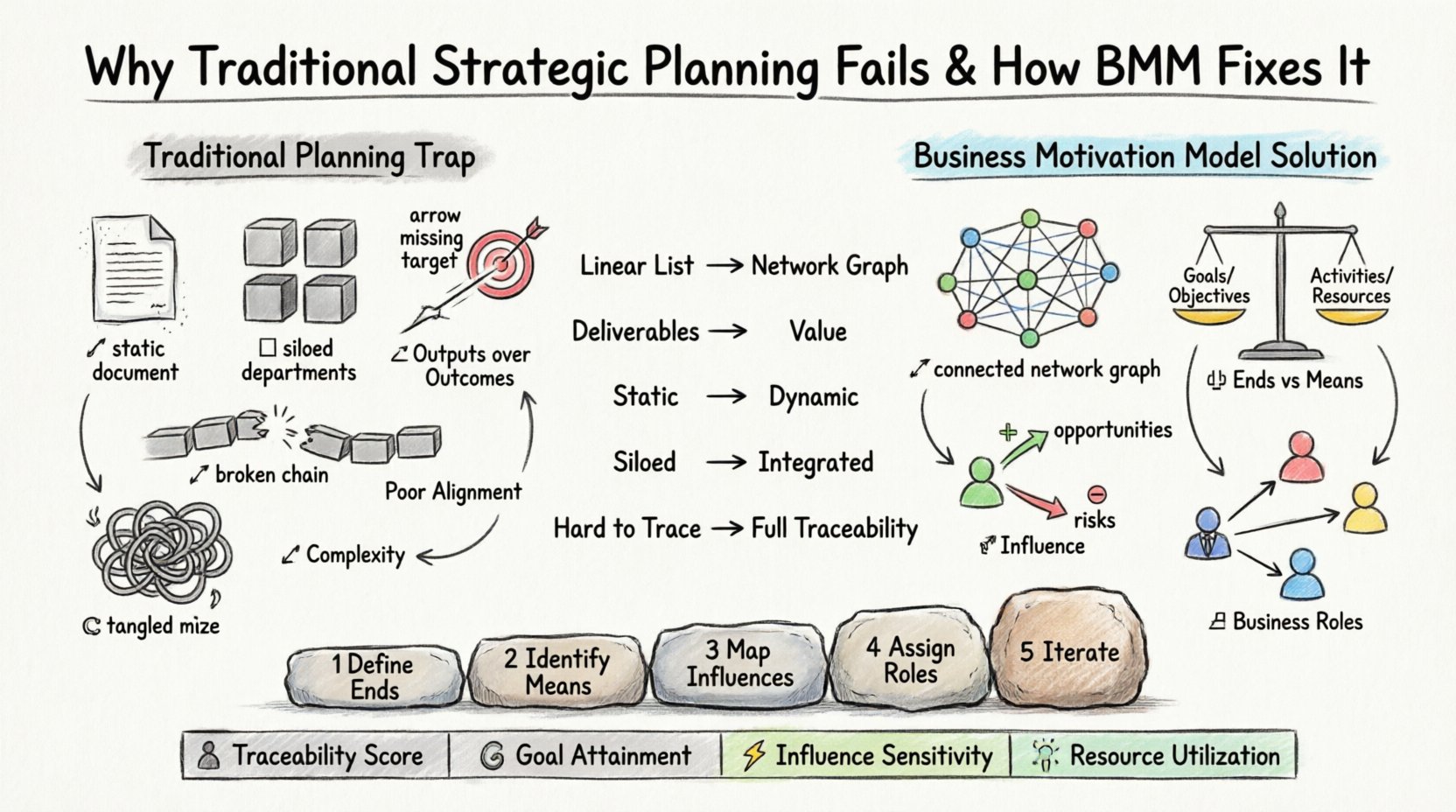
Strategic planning is a staple activity for executives and boards. However, the process often suffers from inherent structural weaknesses. When a plan is created in a vacuum, disconnected from operational realities, it becomes a theoretical exercise rather than a practical roadmap. Several factors contribute to this systemic failure.
- Static Documentation: Plans are often treated as static documents created annually. They lack the agility to adapt to rapid market shifts, regulatory changes, or technological disruptions.
- Siloed Departments: Marketing, operations, finance, and IT often operate in isolation. A strategy defined by leadership may not translate into actionable tasks for the frontline staff.
- Focus on Outputs, Not Outcomes: Traditional planning emphasizes deliverables (what we are building) rather than the value those deliverables create (why we are building it).
- Lack of Motivation Alignment: A strategy might make sense logically, but if the incentives and motivations of the employees do not align with the strategic goals, adoption will fail.
- Complexity and Ambiguity: Plans often become too dense to understand. Without clear relationships between high-level goals and specific actions, employees feel overwhelmed.
When these issues persist, organizations experience “strategy drift.” The original intent is slowly eroded by operational pressures, resulting in a disconnect between what the organization says it wants and what it actually achieves.
What is the Business Motivation Model? 🧩
The Business Motivation Model is a standard for business architecture that provides a structured way to represent the motivations, goals, and objectives of an enterprise. Unlike traditional planning documents that list goals in a hierarchy, BMM defines the relationships between different elements. It answers the questions of why, what, and how in a connected graph rather than a linear list.
This model helps organizations visualize the complete chain of motivation. It connects external influences (such as market trends or regulations) to internal goals, and then maps the means (activities, resources) required to achieve those ends. By treating strategy as a network of relationships, BMM offers clarity and traceability.
The core value lies in its ability to link the ends (goals) with the means (actions). It ensures that every activity within the organization can be traced back to a specific strategic objective. If an activity cannot be linked to a goal, it is flagged as waste. If a goal has no means attached, it is flagged as unattainable.
Core Elements of the BMM Framework 🔗
To understand how BMM fixes planning failures, one must understand its fundamental building blocks. The model relies on specific concepts to define the business environment.
1. Ends vs. Means
The distinction between ends and means is critical for clarity.
- Ends: These are the outcomes an organization seeks. This includes Goals (the desired result) and Objectives (the measurable criteria for achieving the goal). Ends answer the question: “What are we trying to achieve?”
- Means: These are the things used to achieve the ends. This includes Activities (the work performed), Resources (the assets required), and Capabilities (the skills or functions needed). Means answer the question: “How are we going to do it?”
In traditional planning, this distinction is often blurred. A strategy might list “Increase Revenue” as a goal but then list “Launch New Website” as a goal as well. BMM clarifies that the website is a means to the end of revenue growth.
2. Influence
Businesses do not exist in a vacuum. External factors influence the success of goals. BMM uses the concept of Influence to map these relationships.
- Positive Influence: A factor that supports the achievement of a goal (e.g., a new regulation that favors your product).
- Negative Influence: A factor that hinders the achievement of a goal (e.g., a competitor lowering prices).
By mapping influences, organizations can proactively manage risks and opportunities. Instead of reacting to changes, the model allows teams to see how external shifts impact specific strategic targets.
3. Business Roles
Goals and activities are not performed by abstract entities; they are performed by people or roles. BMM explicitly links motivations to Business Roles. This ensures accountability. If a goal is not met, the model identifies which role was responsible for the means required to achieve it.
Traditional Planning vs. Business Motivation Models 🆚
Comparing the two approaches highlights why the shift is necessary. The following table outlines the key differences in structure, focus, and adaptability.
| Feature | Traditional Strategic Planning | Business Motivation Model (BMM) |
|---|---|---|
| Structure | Linear hierarchy (Top-down lists) | Network graph (Relationships and connections) |
| Focus | Outputs and deliverables | Outcomes and value creation |
| Flexibility | Static; hard to update without rewriting | Dynamic; easy to trace impact of changes |
| Alignment | Often siloed between departments | Integrated across the entire enterprise |
| Traceability | Difficult to link actions to goals | Full traceability from activity to strategic goal |
| External Context | Often treated separately (SWOT) | Integrated via Influence relationships |
This comparison demonstrates that while traditional planning provides a snapshot, BMM provides a map. A map shows the terrain, the obstacles, and the paths available. A snapshot only shows where you stood at one moment in time.
Implementing BMM in Your Organization 🏗️
Adopting this model requires a shift in mindset rather than just a change in documentation. The process involves identifying the key elements and defining their relationships. It does not require expensive software, but rather disciplined analysis.
Step 1: Define the Enterprise Ends
Begin by identifying the high-level goals and objectives of the organization. These should be clear, measurable, and time-bound. Avoid vague statements. Instead of “Improve Customer Service,” define “Reduce average response time to under 2 hours by Q4.”
Step 2: Identify the Means
For each end, identify the activities and resources required. This step often reveals gaps. You may find a goal with no clear path to execution, or an activity that serves no strategic purpose. This is a critical cleanup phase.
Step 3: Map the Influences
List the external factors affecting these goals. Identify which factors are positive and which are negative. This helps in risk management and opportunity identification. It moves the conversation from “What do we want?” to “What could stop us?”
Step 4: Assign Roles
Link the goals and activities to specific business roles. This creates ownership. When roles are assigned, accountability is established. It also highlights conflicts where multiple roles claim responsibility for the same activity or goal.
Step 5: Iterate and Maintain
The model is not a one-time setup. As the business environment changes, the influences and means must be updated. This ensures the strategy remains relevant. Regular reviews keep the alignment intact.
Measuring Impact and Alignment 📊
One of the greatest advantages of using the Business Motivation Model is the ability to measure alignment. In traditional settings, success is often measured by project completion. In BMM, success is measured by goal achievement.
Consider the following metrics:
- Traceability Score: What percentage of daily activities can be traced back to a strategic goal?
- Goal Attainment Rate: How many defined goals are met within the target timeframe?
- Influence Sensitivity: How much does a change in an external factor impact the probability of achieving a goal?
- Resource Utilization: Are resources being allocated to activities that directly support the ends?
These metrics provide a feedback loop. If the traceability score drops, it indicates that the organization is drifting. If the goal attainment rate is low, it suggests the means are insufficient or the goals are unrealistic.
Common Pitfalls to Avoid ⚠️
Even with a solid framework, implementation can go wrong. Awareness of common pitfalls helps ensure success.
- Over-Modeling: Creating a model that is too complex to be useful. Start simple and add detail only where it adds value.
- Lack of Stakeholder Buy-in: If the people doing the work do not understand or agree with the goals, the model will fail. Involvement in the modeling process is crucial.
- Ignoring the Human Element: Goals and activities are driven by people. The model must respect the capabilities and limitations of the workforce.
- Treating it as a One-Off: BMM is not a project; it is a discipline. It requires ongoing maintenance and review.
- Confusing Means and Ends: Ensure that activities are not mistakenly treated as goals. An activity is a step; a goal is the destination.
Final Thoughts on Strategic Clarity 💡
The failure of traditional strategic planning is rarely due to a lack of ambition. It is usually due to a lack of connection. When the link between the boardroom and the frontline is broken, strategy becomes fiction.
The Business Motivation Model offers a solution by formalizing these connections. It forces organizations to define not just what they want, but how they will get there, who will do it, and what might get in the way. By adopting this structured approach, organizations can move from reactive management to proactive alignment.
Strategic success is not about having a perfect plan. It is about having a clear, adaptable, and traceable system for motivation. When every employee understands how their work contributes to the broader mission, execution becomes natural rather than forced. This clarity is the foundation of sustainable growth and resilience in a volatile market.
Adopting BMM is an investment in clarity. It reduces the noise of conflicting priorities and highlights the path forward. For leaders seeking to bridge the gap between vision and reality, the Business Motivation Model provides the necessary architecture to make strategy work in practice, not just on paper.