
Agile frameworks promise flexibility, yet there is a distinct line between adaptability and instability. When user stories keep changing mid-sprint, the rhythm of the team breaks. Velocity drops. Confidence erodes. Quality suffers. This is not merely a scheduling issue; it is a fundamental challenge to delivery predictability and team morale. Navigating scope shifts requires a structured approach, clear boundaries, and transparent communication. This guide outlines the specific steps to manage evolving requirements without sacrificing the integrity of the current sprint cycle.
🧩 Understanding the Impact of Mid-Sprint Scope Shifts
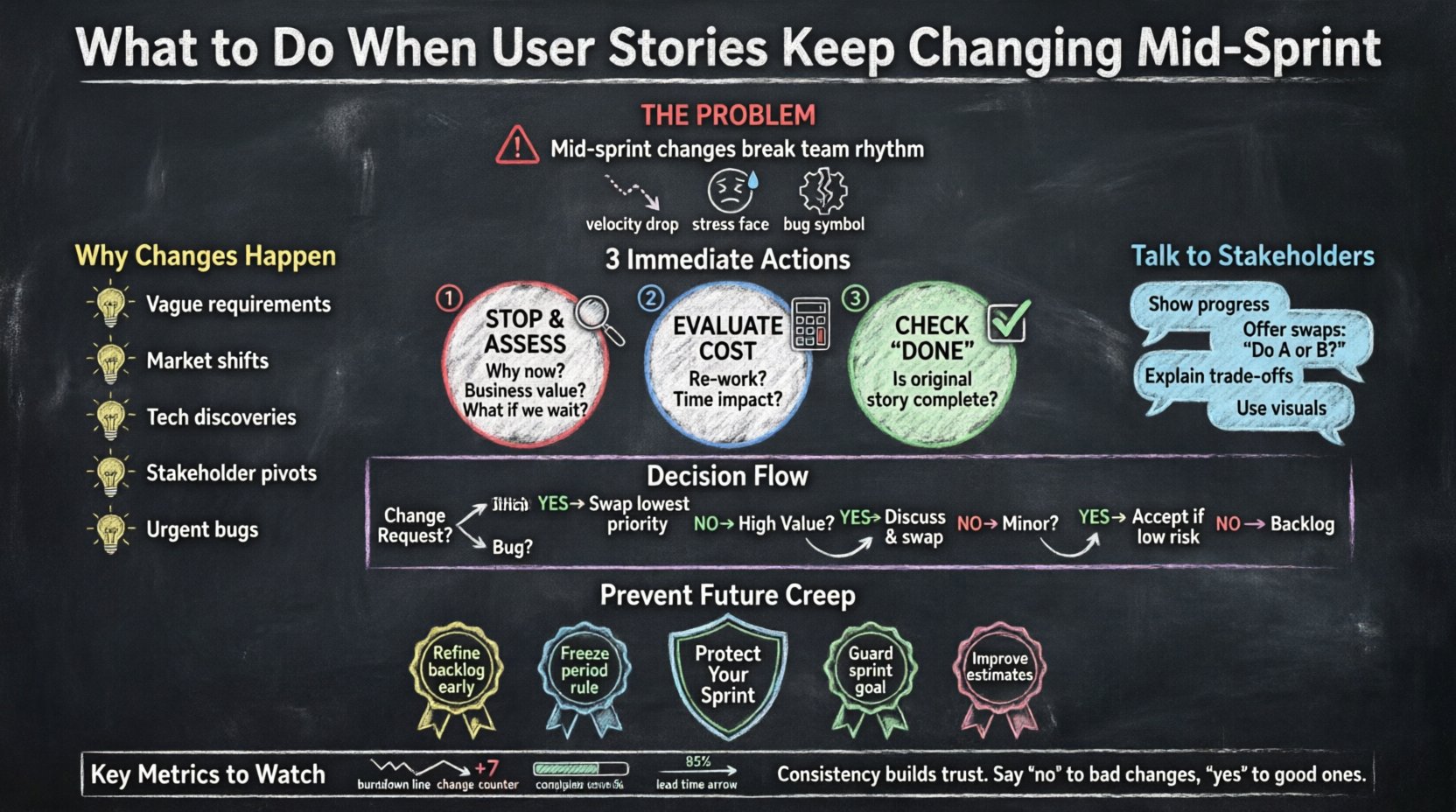
Changing requirements during a sprint is a common occurrence in software development. However, the frequency and nature of these changes determine whether they are manageable or destructive. A single, well-communicated adjustment might be absorbed with minimal friction. Constant pivoting creates a state of perpetual context switching, which significantly reduces cognitive throughput.
The consequences of unmanaged changes include:
- Reduced Velocity: Developers lose time re-estimating tasks and reworking completed code.
- Increased Technical Debt: Rushed changes often bypass proper architectural planning, leading to brittle code.
- Lower Quality Assurance: Testing cycles get compressed, increasing the risk of defects reaching production.
- Team Burnout: Constant uncertainty creates anxiety and a feeling that effort is never “done”.
- Missed Commitments: The original sprint goal becomes impossible to achieve, damaging stakeholder trust.
Recognizing these risks is the first step toward implementing a defense mechanism. The goal is not to resist all change, but to process it through a defined protocol.
🔍 Identifying the Root Causes of Changing Stories
Before taking action, it is necessary to diagnose why the user stories are changing. Addressing the symptom without treating the cause leads to recurring issues. Common drivers for mid-sprint modifications include:
- Unclear Initial Requirements: Stories were defined too vaguely during backlog refinement, leading to ambiguity during implementation.
- New Market Information: Competitor actions or customer feedback necessitate immediate pivots in functionality.
- Technical Discovery: Developers uncover dependencies or constraints that were not visible during the estimation phase.
- Stakeholder Hesitation: Decision-makers change their minds because they did not visualize the feature clearly before committing.
- Urgent Bug Fixes: Critical issues in production demand resources, forcing existing work to be deprioritized.
Each cause requires a different mitigation strategy. Understanding the source allows the team to adjust their processes rather than just reacting to the immediate pressure.
🚦 Immediate Actions for the Team
When a change request arrives during the sprint, the team must follow a triage process. This prevents ad-hoc decisions that undermine the sprint plan. The following steps provide a framework for evaluation.
1. Stop and Assess
Do not immediately accept the new requirement. Pause the implementation of the affected story. Gather the relevant stakeholders, including the product owner and the development lead. Ask specific questions about the change:
- Why is this change necessary now?
- What is the business value of this new requirement compared to the original story?
- What happens if we do not implement this change by the end of the sprint?
2. Evaluate the Cost
Calculate the impact on the remaining work. If a developer has spent two days on a feature, does the new requirement invalidate that work entirely? Often, the answer is no, but the remaining work increases significantly. Quantify the effort required to integrate the change.
3. Consult the Definition of Done
Ensure the team understands what “complete” means. If the original story has met the Definition of Done, it is technically finished. Changing it after this point is technically a new story, not an update. This distinction is vital for accurate tracking.
🗣️ Communicating with Stakeholders
Communication is the bridge between development teams and business stakeholders. When pushing back on changes, the tone must be professional and data-driven, not defensive. The objective is to align expectations, not to say “no” arbitrarily.
- Be Transparent: Share the current sprint progress openly. Show the remaining capacity.
- Offer Options: Instead of a flat refusal, present alternatives. “We can do this new story, but it means we must drop Story B. Which is higher priority?”
- Explain Trade-offs: Stakeholders need to understand that prioritizing one thing means deprioritizing another. This is the essence of opportunity cost.
- Use Visuals: Show the team’s workload visually. A simple chart of remaining effort can speak louder than words.
🛠️ Technical Implications of Scope Shifts
From an engineering perspective, changing a user story mid-sprint is not just about UI updates. It often affects the underlying architecture. Developers must consider the following technical factors:
- Database Schema Changes: New fields may require migrations that take time and carry risk.
- API Contract Modifications: If the backend is shared, changing the response structure affects other services consuming it.
- Integration Dependencies: New features might rely on external systems that are not yet ready.
- Code Refactoring: Adding logic to an existing function can introduce bugs in unrelated areas (regression).
Ignoring these technical realities leads to fragile systems. A thorough code review is essential when a story is modified after work has begun. The review should specifically focus on the areas impacted by the change.
📊 Decision Matrix for Scope Changes
To streamline decision-making, teams can use a matrix to categorize change requests. This helps in standardizing the response to incoming requests.
| Request Type | Impact on Sprint Goal | Recommended Action |
|---|---|---|
| Critical Bug Fix | High | Swap with lowest priority story immediately. |
| High Business Value | Medium | Discuss trade-offs with Product Owner. Swap stories. |
| Minor UI Adjustment | Low | Accept if effort is minimal and no regression risk. |
| New Feature Request | High | Move to backlog. Do not break current sprint. |
| Clarification on Existing Story | N/A | Implement as part of original story. No swap needed. |
This table provides a quick reference for the team during sprint events. It removes ambiguity from the decision process.
🛡️ Prevention Strategies for Future Sprints
While managing changes is necessary, reducing the frequency of mid-sprint scope creep is the ultimate goal. This requires improvements in the planning and refinement phases.
1. Invest in Backlog Refinement
Ensure stories are well-defined before the sprint begins. The team should have a clear understanding of acceptance criteria. If a story is too large, break it down into smaller, testable units. Smaller units are easier to adjust without derailing the entire sprint.
2. Establish a Change Control Process
Create a formal rule for how changes enter the sprint. For example, no new items are added after the first two days of the sprint. This “freeze period” allows the team to focus on execution. Emergency requests should be routed through a specific channel, such as a dedicated triage meeting.
3. Protect the Sprint Goal
Every sprint should have a specific goal, not just a list of tasks. If a change threatens the goal, it should be evaluated against the goal itself. Sometimes, the goal must be adjusted, but this should be a conscious decision, not a passive drift.
4. Improve Estimation Accuracy
Review past sprints to understand why estimates were off. If technical debt consistently causes delays, factor that into future planning. Better estimates lead to more realistic commitments, which reduces the likelihood of needing to cut scope.
🧠 The Psychology of Change
It is important to recognize the human element. Developers often feel a sense of failure when their work is changed or discarded. This can lead to resentment and disengagement. Leaders must foster psychological safety.
- Acknowledge Effort: Recognize the work already done, even if it is not used.
- Frame Changes as Learning: Shift the narrative from “wasted work” to “gained insight” about the product requirements.
- Encourage Open Dialogue: Allow team members to voice concerns about the frequency of changes without fear of retribution.
- Celebrate Stability: When a sprint runs without major disruptions, highlight this success to reinforce the value of stability.
📈 Metrics to Monitor
To track the health of the sprint and the frequency of changes, several metrics can be monitored. These data points help identify trends over time.
- Sprint Burndown: A flat or erratic burndown chart often indicates scope creep.
- Change Request Rate: Count how many new items are added per sprint.
- Story Completion Rate: Compare planned stories to completed stories. A high discrepancy suggests poor planning or frequent changes.
- Lead Time: Measure how long it takes from request to deployment. High lead times may indicate constant re-prioritization.
⚖️ Balancing Flexibility and Commitment
Agile methodologies are built on the principle of responding to change. However, this does not mean commitments are meaningless. There is a balance to strike. The team needs the freedom to adapt, but the business needs the reliability of delivery.
If a sprint is constantly disrupted, the sprint planning process is likely failing. The capacity allocated to the team is being ignored. If the business is constantly changing its mind, the backlog refinement process is insufficient. Both sides must take responsibility.
Agility is not about speed alone; it is about the ability to sustain momentum while navigating uncertainty. A team that can say “no” to bad changes while saying “yes” to good ones is a mature team. This maturity comes from experience, clear processes, and mutual respect between developers and product owners.
🔄 Handling Technical Discovery
Sometimes, changes are not due to business decisions but technical realities. During implementation, a developer might find that a chosen solution is not viable. This requires a different handling method than a business requirement change.
- Document the Discovery: Write down what was found and why it blocks progress.
- Present Solutions: Offer at least two paths forward. One might be quick but risky; another might be slow but stable.
- Update the Story: If the story changes due to technical constraints, update the ticket immediately to reflect the new reality.
- Learn from the Block: Why was this not discovered during refinement? Adjust the refinement process to catch these issues earlier.
📝 Final Thoughts on Managing Sprint Integrity
Managing user stories that change mid-sprint is a core competency for any software delivery team. It requires a blend of technical discipline, emotional intelligence, and strategic communication. By following a structured approach, teams can protect their focus while remaining responsive to business needs.
The key is consistency. Treat every change request with the same level of scrutiny. Do not make exceptions that undermine the process. Over time, this consistency builds trust. Stakeholders learn to respect the sprint boundary, and the team gains the stability needed to produce high-quality work.
Remember that a sprint is a time-boxed experiment. If the experiment changes significantly, the results of the sprint may be invalid. This is why protecting the sprint goal is critical. It ensures that the data gathered from the sprint remains useful for future planning.
Ultimately, the goal is a predictable delivery rhythm. When changes are managed correctly, the team can deliver value consistently without burning out. This is the true definition of agility.