Creating software is not just about writing code; it is about solving problems that people actually face. In the world of agile development, user stories serve as the bridge between business requirements and technical implementation. However, a story that looks perfect on paper can fail completely if it does not address the genuine needs of the end user. Validating user stories against real customer needs is a critical process that ensures every line of code delivered provides value. This guide explores how to align your development efforts with actual user expectations, reducing waste and increasing satisfaction.
Why Validation Matters in Product Development 🧐
When a team builds a feature based on assumptions rather than evidence, the risk of failure increases significantly. Validation is the act of confirming that the solution being built matches the problem being solved. Without this step, teams often fall into the trap of building features that are technically impressive but practically useless. This phenomenon is often referred to as “feature bloat” or “gold-plating,” where resources are spent on functionality that users do not want or need.
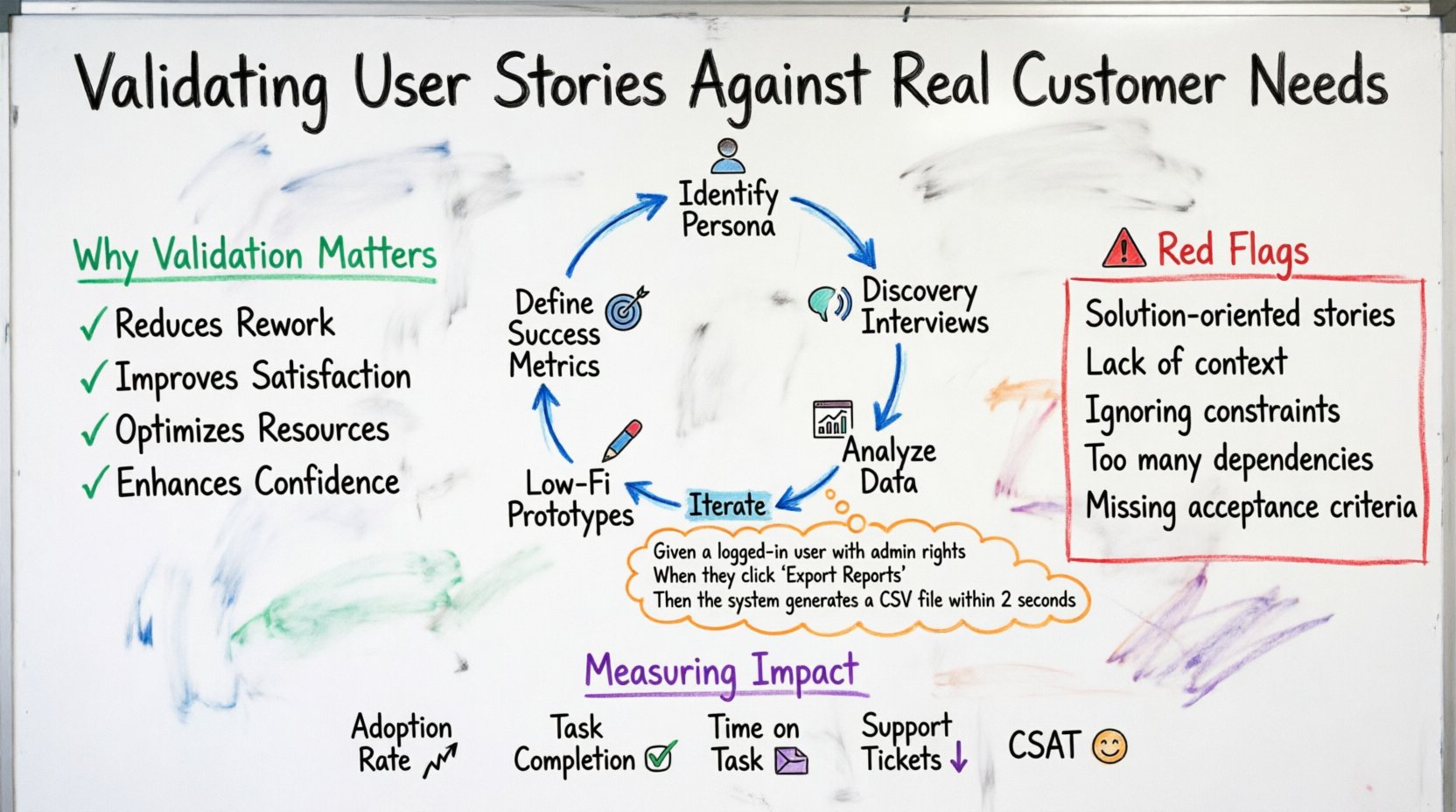
Validating user stories serves several vital functions:
- Reduces Rework: Identifying issues early in the process is far cheaper than fixing them after deployment.
- Improves User Satisfaction: Users feel heard when their actual pain points are addressed directly.
- Optimizes Resource Allocation: Teams focus time and effort on high-impact activities rather than low-value tasks.
- Enhances Team Confidence: Knowing that the work is grounded in reality reduces uncertainty and stress.
It is essential to view validation not as a final checkpoint, but as a continuous activity that runs throughout the lifecycle of a story. From the initial idea to the final release, feedback loops ensure alignment.
The Cost of Assumptions 💸
Every user story begins with an assumption. For example, “Users want a dark mode feature because they spend a lot of time in dimly lit rooms.” This statement contains multiple assumptions that need verification:
- Do users actually spend time in dimly lit rooms?
- Does the current theme cause eye strain?
- Is dark mode the best solution, or is high contrast sufficient?
- Will users actually toggle the switch once added?
If a team proceeds without testing these assumptions, they might build a dark mode that is inaccessible to visually impaired users, or they might build a toggle that nobody ever uses. The cost here is not just financial; it is also reputational. Users lose trust in a product that feels disconnected from their workflow.
Step-by-Step Validation Process 🔄
Implementing a robust validation framework requires discipline and specific techniques. Below is a structured approach to ensuring your user stories remain grounded in reality.
1. Identify the Stakeholder Persona
Before validating a story, you must know who the story is for. A generic “user” is not enough. You need to define specific personas. For instance, distinguishing between an “Admin User” who manages data and an “End User” who consumes data is crucial. Each persona has different needs, motivations, and constraints.
2. Conduct Discovery Interviews
Direct conversation is often the most effective way to validate needs. Instead of asking “Do you want this feature?”, ask “Tell me about the last time you encountered this problem.” This open-ended questioning reveals the context behind the request. Listen for emotional cues and specific details about their workflow.
3. Analyze Existing Data
Numbers do not lie. Review analytics to see how users currently interact with the system. Look for drop-off points in the user journey. If users are abandoning a specific form, the issue might not be the input fields but the length or complexity. Data provides objective evidence to support or refute user feedback.
4. Create Low-Fidelity Prototypes
Building a full solution is expensive. Create sketches, wireframes, or clickable prototypes that represent the core functionality. Show these to users early. Ask them to perform tasks using the prototype. Their hesitation or confusion highlights validation gaps before any code is written.
5. Define Success Metrics
How will you know the validation was successful? Establish key performance indicators (KPIs) before development begins. If the goal is to reduce support tickets, track ticket volume. If the goal is to increase engagement, track session duration. Clear metrics allow you to measure impact objectively.
Defining Clear Acceptance Criteria ✅
Acceptance criteria are the conditions that a user story must satisfy to be considered complete. They act as the definition of done for a specific story. When validation is involved, acceptance criteria should reflect user outcomes, not just technical completion.
Consider the difference between these two criteria sets:
- Technical: “The system shall save the user profile to the database.”
Weakness: This does not confirm the user knows their profile was saved. - Validation-Based: “When the user clicks save, a success message appears, and the profile is visible in the settings menu.”
Strength: This confirms the user experience is complete and intuitive.
Using the “Given-When-Then” format is a best practice for writing these criteria. It structures the logic clearly:
- Given: The context or preconditions.
- When: The action the user takes.
- Then: The expected outcome or result.
This structure forces the team to think about the user’s perspective. It moves the focus from “what the system does” to “what the user achieves.”
Gathering Authentic Feedback 🗣️
Feedback collection is not a one-time event. It requires a strategy to ensure the input is genuine and actionable. Here are several methods to gather feedback effectively.
- Usability Testing: Observe users interacting with the product. Do not intervene. Let them struggle if necessary. Their struggle points are opportunities for improvement.
- Surveys: Use surveys to gather quantitative data from a larger audience. Keep questions focused and avoid leading language.
- Customer Support Logs: Analyze tickets and chat logs. These often contain the rawest form of user feedback regarding pain points.
- Beta Programs: Release features to a small group of trusted users. Their detailed feedback can catch edge cases that internal testing misses.
- Analytics Review: Monitor heatmaps and click streams to see where users actually go versus where you expect them to go.
Comparison of Validation Methods 📊
Different stages of development require different validation techniques. The table below outlines the most common methods and their suitability.
| Method | Stage | Cost | Depth of Insight | Best For |
|---|---|---|---|---|
| Interviews | Discovery | Medium | High | Understanding problems and motivations |
| Surveys | Validation | Low | Medium | Quantitative data from large groups |
| Prototyping | Design | Medium | High | Testing flow and usability |
| A/B Testing | Release | Medium | High | Comparing two variations of a feature |
| Analytics | Ongoing | Low | Medium | Tracking behavior after launch |
Red Flags in User Story Definition 🚩
Certain patterns in user stories indicate a lack of validation. If you notice these flags, pause and reconsider the story.
- Solution-Oriented: “The user needs a button to export data.” This focuses on the feature, not the outcome. The user might need the data for a report, but an export button isn’t the only solution.
- Lack of Context: “Users want to search faster.” Who are the users? What is the current speed? What is the target speed? Vague criteria lead to vague results.
- Ignoring Constraints: A story that ignores technical limitations or regulatory requirements is likely to fail during implementation or compliance checks.
- Too Many Dependencies: If a story relies on five other teams or systems, the risk of misalignment increases. Break it down.
- Missing Acceptance Criteria: If there are no clear conditions for success, the story is not ready for development.
Iterative Refinement 🛠️
Validation is not a linear path; it is a cycle. As you build and test, you will learn more. This new information should feed back into the backlog. Stories should be treated as hypotheses. If a story fails validation, it does not mean the team failed; it means the hypothesis was incorrect. This is valuable information.
Refinement involves:
- Re-prioritization: Move stories that are no longer relevant to the back.
- Splitting: Break large stories into smaller, testable chunks.
- Updating Criteria: Adjust acceptance criteria based on new feedback.
- Documenting Learnings: Keep a record of what worked and what didn’t for future reference.
Measuring Impact 📈
Once a validated story is released, the work is not done. You must measure the impact to confirm the validation was accurate. Did the feature solve the problem? Did the metrics move in the right direction?
Common metrics to track include:
- Adoption Rate: How many users are using the feature?
- Task Completion Rate: Can users finish the task successfully?
- Time on Task: Is the process faster than before?
- Support Ticket Reduction: Is the feature reducing confusion?
- Customer Satisfaction Score (CSAT): What do users say about the change?
If the metrics do not improve, you must investigate. Was the validation flawed? Was the implementation poor? Or did user needs change? Continuous measurement ensures the product remains relevant over time.
Building a Culture of Validation 🤝
Validation cannot be the responsibility of a single person. It requires a cultural shift where every team member values customer insight. Developers should talk to users. Designers should check data. Product owners should listen to support teams. When everyone understands the cost of building the wrong thing, the quality of output improves.
Encourage questions during planning sessions. Ask “How do we know this is true?” frequently. Create safe spaces for admitting that a story might be wrong. This transparency leads to better products and happier teams.
Final Thoughts on Alignment 🌟
Validating user stories against real customer needs is the foundation of successful product development. It requires effort, time, and a willingness to challenge assumptions. However, the return on investment is substantial. You build products that people love, teams that feel confident, and businesses that grow sustainably.
Start small. Pick one story this sprint and apply these validation techniques. Gather feedback, refine your criteria, and measure the outcome. Over time, these practices become second nature. The goal is not perfection on the first try, but continuous improvement based on real-world evidence. By staying grounded in user needs, you ensure that your development efforts create meaningful impact.