The field of User Experience (UX) design is vast. It is not a single job title. It is a collection of specialized functions working together. Many people enter this industry with a general idea. They know they want to design digital products. However, they often do not know the specific path that fits their skills. This guide breaks down the major UX career paths. We will look at the responsibilities, skills, and daily realities of each role. Our goal is to help you find the position that aligns with your natural strengths. 🚀
Choosing a career path is about more than just salary or job titles. It is about where you spend your time. It is about the problems you enjoy solving. Do you prefer talking to people and analyzing data? Do you prefer crafting pixels and interactions? Do you prefer organizing complex information? Understanding these distinctions is the first step toward a fulfilling career. Let us explore the landscape together.
Understanding the UX Ecosystem 🌍
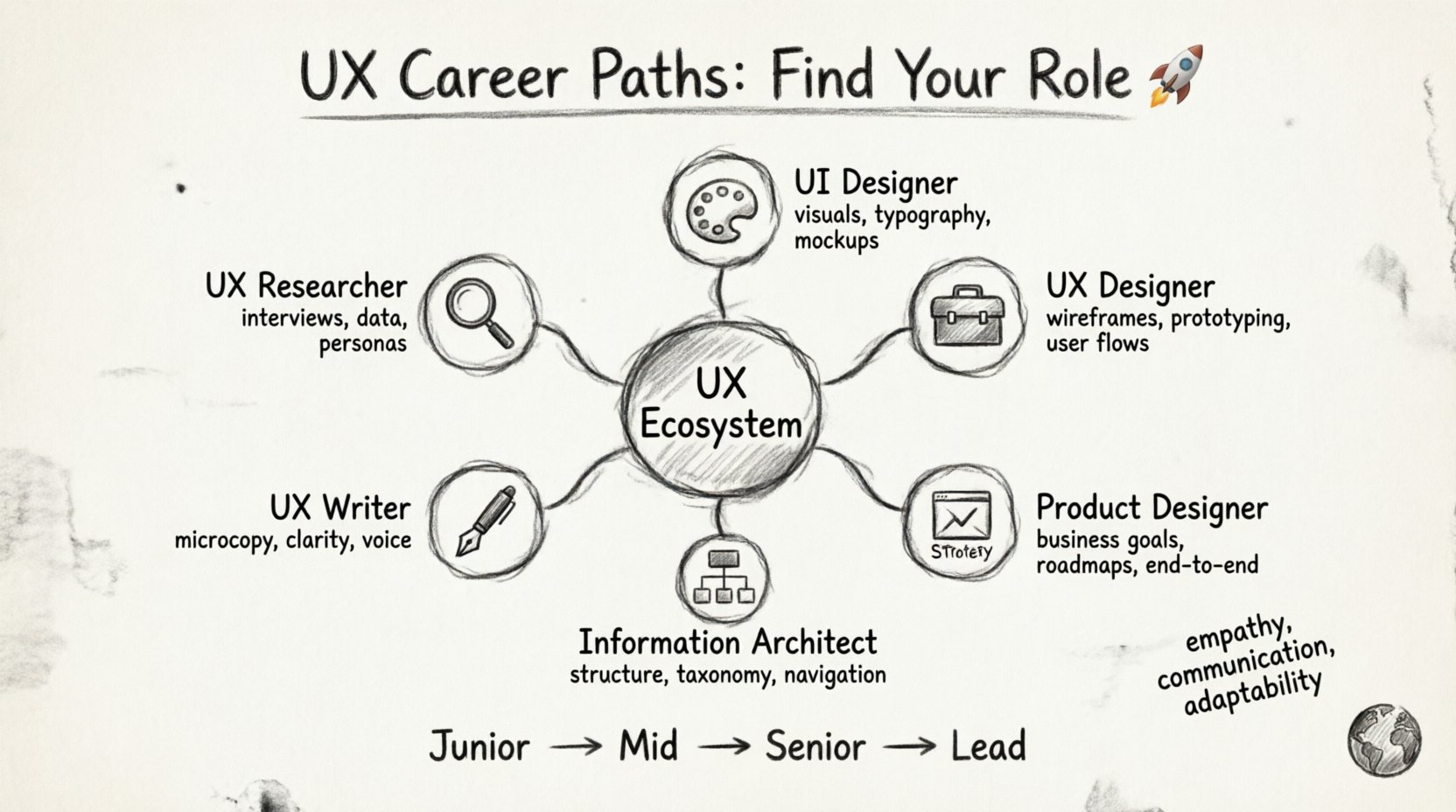
Before diving into specific titles, it helps to understand the ecosystem. UX is the umbrella term for the entire experience a user has with a product. This includes the visual design, the usability, the accessibility, and the emotional response. Different professionals focus on different parts of this umbrella. Some focus on the “why” behind user behavior. Others focus on the “what” the interface looks like. Still others focus on the structure of the information itself.
Organizations vary in how they structure these teams. Some have distinct departments for research and design. Others combine these functions into a single role. Regardless of the structure, the core functions remain consistent. Below is a breakdown of the primary roles you might encounter.
Key Roles in the Industry
- UX Researcher: Focuses on understanding user needs through data and interviews.
- UI Designer: Focuses on the visual aesthetics and interactive elements.
- UX Designer: A generalist who handles both research and visual design.
- Product Designer: A strategic role covering end-to-end product development.
- Information Architect: Focuses on structure, navigation, and content organization.
- UX Writer: Focuses on the words and language within the interface.
- Usability Engineer: Focuses on technical feasibility and system constraints.
Deep Dive: UX Researcher 🔍
If you are naturally curious and empathetic, a research career might be the right fit. The UX Researcher is responsible for uncovering insights about the target audience. They do not design the product. Instead, they provide the evidence that guides the design decisions. This role is critical for avoiding assumptions and building products that people actually want.
Core Responsibilities
- Conducting user interviews to gather qualitative data.
- Designing and executing surveys to gather quantitative data.
- Facilitating usability testing sessions to observe user behavior.
- Analyzing data to identify patterns and pain points.
- Presenting findings to stakeholders and design teams.
- Creating user personas and journey maps.
A typical day involves a mix of planning studies, speaking with users, and synthesizing notes. You might spend the morning reviewing analytics. The afternoon could be dedicated to moderating a focus group. The evening might involve organizing your findings into a report. Attention to detail and strong communication skills are essential. You must be able to translate complex data into clear recommendations for the design team. 📊
Deep Dive: UI Designer 🎨
The UI Designer focuses on the look and feel of the product. This role is about translating the structural and functional requirements into a visual language. It involves color theory, typography, spacing, and iconography. The goal is to create an interface that is not only functional but also visually appealing and consistent.
Core Responsibilities
- Creating high-fidelity mockups and prototypes.
- Developing and maintaining design systems.
- Selecting color palettes and typography.
- Ensuring visual consistency across all screens.
- Collaborating with developers to ensure accurate implementation.
- Refining micro-interactions and animations.
UI Designers spend a significant amount of time in design tools. They create screens that guide the user through a task. Precision is key. A pixel out of place can disrupt the rhythm of the experience. You need a strong eye for detail. You also need to understand how visual elements affect user psychology. For example, does a red button signal danger or an action? Does white space make content feel exclusive or cluttered? 🖌️
Deep Dive: UX Designer 🛠️
The UX Designer role is often a hybrid. In many organizations, this person handles both the research and the design. They bridge the gap between user needs and business goals. They are responsible for the flow of the experience from start to finish. This role requires a broad skill set and the ability to wear many hats.
Core Responsibilities
- Creating wireframes and low-fidelity prototypes.
- Conducting competitive analysis.
- Mapping user flows and information architecture.
- Running usability tests.
- Designing the interface based on research findings.
- Iterating on designs based on feedback.
This path is ideal for those who enjoy variety. You might research a user problem in the morning. By the afternoon, you are sketching solutions. You need to be comfortable with both abstract thinking and concrete execution. You must be able to justify your design decisions with data. This role is highly valued because it connects the dots between the user and the business. 🔄
Deep Dive: Product Designer 📦
The Product Designer role is a step beyond traditional UX design. It includes a focus on business strategy and product vision. A Product Designer is often involved from the very beginning of the idea phase. They help define what the product should be, not just how it should look. They work closely with product managers and engineers.
Core Responsibilities
- Participating in strategic planning meetings.
- Defining product goals and success metrics.
- Designing end-to-end user experiences.
- Collaborating across cross-functional teams.
- Ensuring the design supports business objectives.
- Managing the design process from concept to launch.
Success in this role requires business acumen. You need to understand how design decisions impact revenue, retention, and efficiency. You are not just solving user problems. You are solving business problems using design. This often involves balancing competing priorities. You might need to push back on scope creep or advocate for user needs when they conflict with short-term goals. 🤝
Deep Dive: Information Architect 🗂️
Information Architecture (IA) is the backbone of any digital product. The Information Architect organizes and structures content so users can find what they need. If a user cannot navigate a site, the design fails regardless of how pretty it looks. This role is about logic, hierarchy, and taxonomy.
Core Responsibilities
- Creating site maps and navigation structures.
- Defining content categorization and tagging systems.
- Designing search functionality and filtering logic.
- Ensuring logical flow between pages.
- Collaborating with content strategists.
- Conducting card sorting exercises to validate structure.
IA professionals often work with large amounts of content. They need strong organizational skills. They must think about how users mentally model the product. If a user expects to find settings under “Profile” but it is under “Account”, the structure is flawed. This role requires patience and a systematic approach to problem-solving. 🧩
Deep Dive: UX Writer ✍️
UX Writing is a specialized field focused on the words users see. This includes button labels, error messages, onboarding text, and help documentation. It is the voice of the product. A good UX writer makes the interface feel human and clear. They ensure that every word serves a purpose.
Core Responsibilities
- Writing microcopy for buttons and forms.
- Creating tone and voice guidelines.
- Editing existing copy for clarity and brevity.
- Collaborating with designers on content placement.
- Ensuring accessibility in text content.
- Translating complex technical terms into plain language.
This role is often overlooked but is crucial for usability. Confusing text causes errors. Ambiguous labels cause frustration. A UX Writer needs a background in linguistics, copywriting, or psychology. They need to understand how users read and scan text. They must be concise. Every word counts in a digital interface. 🗣️
Comparing the Paths: A Skills Matrix 📈
To help you visualize the differences, consider the following matrix. This compares the roles based on key skill requirements and focus areas.
| Role | Primary Focus | Key Skill | Output |
|---|---|---|---|
| UX Researcher | User Needs | Data Analysis | Reports, Personas |
| UI Designer | Visuals | Typography & Color | Mockups, Style Guides |
| UX Designer | Experience | Prototyping | Flows, Wireframes |
| Product Designer | Business & User | Strategy | Roadmaps, Solutions |
| Information Architect | Structure | Organization | Site Maps, Taxonomies |
| UX Writer | Language | Clarity | Copies, Guidelines |
Soft Skills That Matter Across All Roles 🤝
Regardless of the specific title you choose, certain soft skills are universal. The design industry is collaborative. You will rarely work in isolation. You will need to present your work to stakeholders. You will need to defend your decisions. You will need to listen to feedback.
- Communication: You must articulate your ideas clearly. You should be able to explain technical constraints to non-technical team members.
- Empathy: You must understand the feelings of the user. You must also understand the feelings of your colleagues.
- Adaptability: Requirements change. Feedback changes. You need to pivot without losing momentum.
- Critical Thinking: You must question assumptions. You must analyze the “why” behind every design choice.
- Time Management: You will often have multiple projects running simultaneously. Prioritization is key.
Career Progression: From Junior to Senior 🪜
Every path has a progression. Understanding the ladder helps you plan your growth. While titles vary by company, the general trajectory is consistent.
Entry Level (Junior)
At this stage, you are learning the ropes. You work under the guidance of senior team members. Your tasks are often execution-focused. You might create simple screens or conduct basic interviews. The goal is to build a strong foundation. You are expected to learn the tools and the processes. 🌱
Mid Level (Intermediate)
Here, you take ownership of smaller projects. You begin to make decisions without constant supervision. You start to mentor juniors. You are expected to understand the business context better. You contribute to strategy discussions. You refine your craft and specialize further. 🌿
Senior Level
Senior designers are the backbone of the team. They solve complex problems. They influence product direction. They set quality standards. You are expected to be a thought leader within the organization. You mentor others and manage stakeholder relationships. 🌳
Lead / Principal Level
At this level, you focus on the broader vision. You manage teams or large initiatives. You align design with company strategy. You might specialize in a niche area like accessibility or design systems. You spend less time on pixels and more on systems and culture. 🏛️
How to Decide: A Framework for Choice 🧠
Choosing a path can feel overwhelming. Use this framework to evaluate your options. Be honest with yourself about your preferences.
1. Analyze Your Interests
- Do you love talking to people? Look toward Research.
- Do you love making things look beautiful? Look toward UI.
- Do you love organizing complex systems? Look toward IA.
- Do you love writing and editing? Look toward UX Writing.
2. Assess Your Strengths
- Are you analytical and logical? Research or IA might suit you.
- Are you creative and visual? UI or Generalist Design might suit you.
- Are you strategic and business-minded? Product Design might suit you.
3. Consider Your Work Style
- Do you prefer deep, focused work alone? Research or Writing.
- Do you prefer collaboration and meetings? Product Design or UX Design.
- Do you prefer quick iteration? UI or UX Design.
4. Look at the Market
Research job listings in your area. See which roles are in demand. Note the required skills. This helps you tailor your learning path. It also helps you understand the reality of the current market. 📉
Building Your Portfolio for the Right Role 📁
Once you choose a path, you need to prove your abilities. Your portfolio is your proof. However, the content of the portfolio changes based on the role.
- For Researchers: Show case studies of your studies. Explain your methodology. Show the insights you found. Highlight how your work influenced the product.
- For UI Designers: Show polished visuals. Demonstrate your design system skills. Show before and after comparisons. Explain your visual choices.
- For UX Designers: Show the process. Start with the problem. Show your research. Show your wireframes. Show the final design. Explain the impact.
- For Product Designers: Show business impact. Use metrics. Show how you balanced user needs with business goals. Highlight cross-functional collaboration.
Quality is more important than quantity. Three strong case studies are better than ten shallow ones. Focus on the thinking behind the work. Explain the “why” just as much as the “what”. 💡
Common Misconceptions About UX Careers 🚫
There are several myths that confuse people entering the field. Let us address them directly.
Myth 1: You Need to Know How to Code
While knowing code helps, it is not a requirement for most design roles. You need to understand the constraints. You do not need to build the product yourself. You need to communicate effectively with developers. 🚫
Myth 2: UX Design is Just Making Things Look Good
This is the definition of UI, not UX. UX is about the entire experience. It includes functionality, performance, and emotion. If a product looks good but does not work, it fails. 🚫
Myth 3: You Need a Design Degree
Many successful designers come from diverse backgrounds. Psychology, sociology, and engineering backgrounds are valuable. Skills and portfolio matter more than the specific degree you hold. 🚫
Myth 4: The Field is Static
The field evolves rapidly. New technologies like AI and voice interfaces change the landscape. You must commit to continuous learning. Stagnation leads to obsolescence. 🚫
Final Thoughts on Finding Your Fit 🌟
There is no single correct path. Many designers switch roles throughout their careers. You might start as a researcher and move into design. You might start in UI and move into product strategy. This fluidity is a feature of the industry. It allows you to grow and explore.
The most important step is to start. Gain experience. Take on projects. Seek feedback. Reflect on what you enjoy doing. Pay attention to the tasks that make you lose track of time. That is where your strength lies. Trust your instincts. The right role will feel like the right fit. 🌟
Remember, the goal is not just to get a job. It is to find work that challenges you and brings satisfaction. Whether you focus on data, visuals, or words, your contribution matters. The digital world needs diverse perspectives. Bring yours to the table. The future of design is in your hands. 🌍