In the landscape of software development, the gap between what stakeholders envision and what developers build is often the source of significant friction. Ambiguity in requirements leads to rework, delayed releases, and frustrated teams. To bridge this divide, teams require a shared language that is precise, readable, and executable. One of the most effective techniques for achieving this clarity is the Given When Then syntax. This approach transforms vague user stories into concrete specifications of behavior.
When applied correctly, this method serves as more than just a writing exercise; it becomes a contract between the business, the design team, and engineering. It ensures that every feature delivered aligns with the intended value. This guide explores the mechanics, benefits, and best practices for using Given When Then to specify user story behavior effectively.
🧠 Understanding the Core Structure
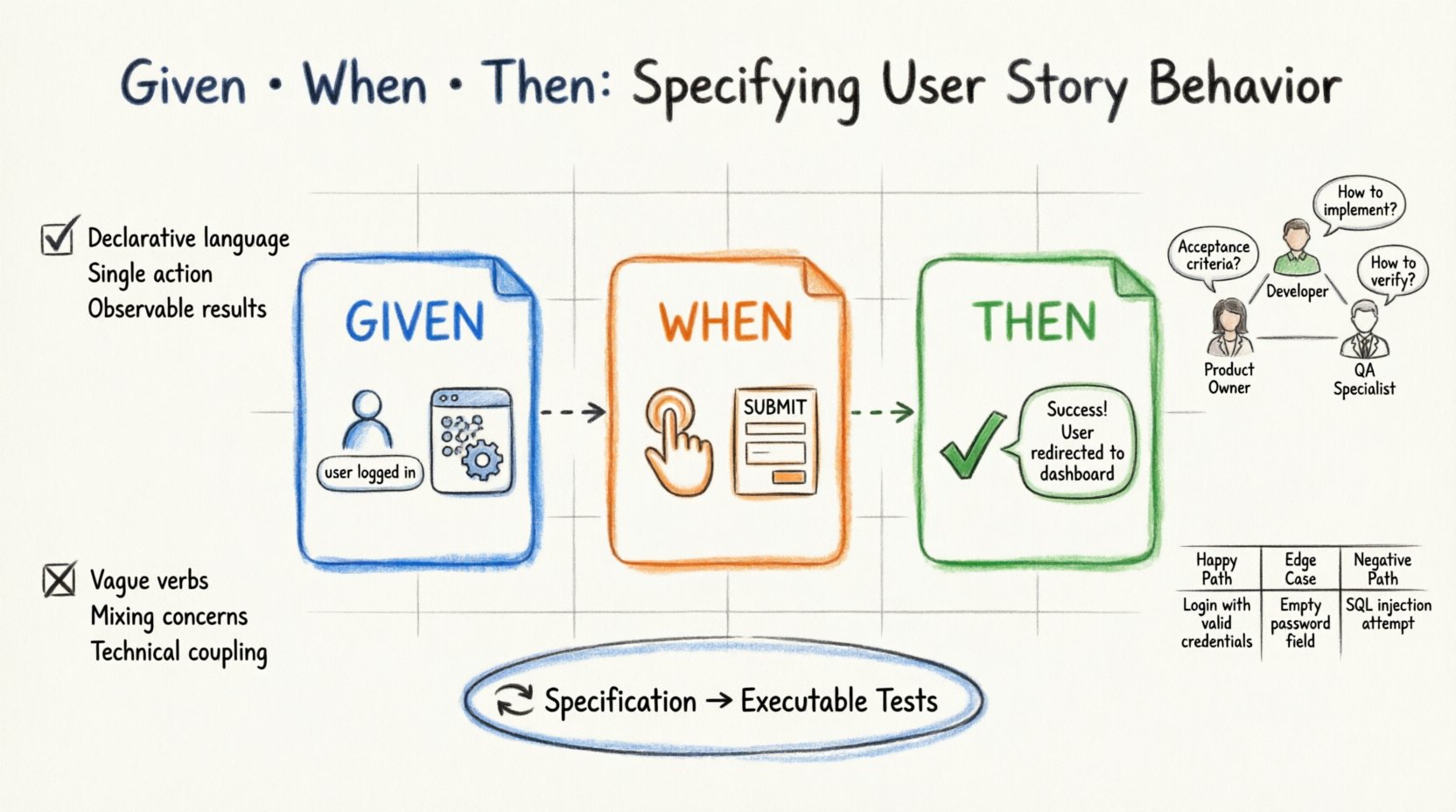
The Given When Then pattern is a fundamental component of Behavior Driven Development (BDD). It structures acceptance criteria in a way that mimics natural language, making it accessible to non-technical stakeholders while remaining detailed enough for automated testing. Each part of the pattern serves a distinct purpose in defining the lifecycle of a scenario.
- Given: Establishes the initial context or state. It sets the stage by describing the preconditions required before the action takes place.
- When: Describes the specific event or action that triggers the behavior. This is the input or the stimulus.
- Then: Defines the observable outcome or result. It verifies that the system behaves as expected following the action.
By separating context, action, and result, teams can isolate variables and understand exactly what part of the system is responsible for a specific behavior. This modularity reduces complexity and makes debugging significantly easier.
📝 Breaking Down the Components
🏗️ The “Given” Context
The Given step is often the most overlooked, yet it is critical for setting the correct environment. It should not describe the action itself but rather the state of the system. A well-written Given step answers the question: “What must be true before we start?”
Consider the nuances in writing this section:
- State vs. Data: Distinguish between the state of the application (e.g., a user is logged in) and the data present (e.g., the user has a balance of $100).
- Preconditions: List all necessary prerequisites. If a payment fails because of insufficient funds, the Given step must ensure the balance is actually checked.
- Readability: Keep it declarative. Avoid imperative language like “Click the button.” Instead, use “The user is on the dashboard.”
When the Given step is ambiguous, tests fail unpredictably. If the system state is not defined clearly, the automation might run against a different environment than intended, leading to false negatives.
🚀 The “When” Trigger
The When step represents the interaction. It is the moment the user or system initiates a change. This should be a single, atomic action. If you combine multiple actions into one When step, it becomes difficult to isolate which part of the flow caused a failure.
Key considerations for the When section include:
- Single Responsibility: Focus on one event per scenario. If you need to test a sequence of events, consider splitting them into separate scenarios or using Scenario Outlines.
- User Intent: Frame the action from the perspective of the user or the system boundary. “The user submits the form” is better than “The submit button is clicked.”
- Timing: Avoid vague terms like “soon” or “later.” Be specific about the trigger.
📝 The “Then” Outcome
The Then step is the verification mechanism. It confirms that the system responded correctly to the When step. This is where the value proposition is validated.
Effective Then steps should:
- Be Observable: Verify something that can be seen or measured. Check UI elements, database records, or API responses.
- Avoid Implementation Details: Focus on the result, not the internal logic. “The confirmation message appears” is better than “The database ID is incremented.”
- Cover Success and Failure: Ensure you specify what happens if the action fails. “Then an error message is displayed” is as important as “Then the order is placed.”
📊 Improving Clarity with Structured Data
To enhance readability and reduce repetition, teams often use tables within their specifications. This is particularly useful when testing multiple variations of the same behavior with different data inputs.
| Scenario Type | Focus | Example |
|---|---|---|
| Happy Path | Standard success flow | Given valid credentials, When login is attempted, Then the dashboard is shown. |
| Edge Case | Boundary conditions | Given a password with 8 characters, When reset is requested, Then the password is accepted. |
| Negative Path | Error handling | Given an expired session, When access is requested, Then a redirect to login occurs. |
Using this structure allows stakeholders to scan the requirements quickly and understand the scope of coverage without reading dense paragraphs of text.
🚫 Common Pitfalls to Avoid
Even with a solid framework, teams often introduce errors that undermine the effectiveness of the specification. Identifying these pitfalls early ensures the longevity of the documentation.
❌ Mixing Concerns
A frequent mistake is combining business rules with technical constraints in the same step. For instance, saying “Given the database is connected” mixes infrastructure with behavior. The system should assume connectivity is handled at a lower level. Focus on the business context.
❌ Vague Verbs
Words like “process,” “handle,” or “manage” are too broad. They do not define the outcome. Instead of “The system processes the order,” use “The order confirmation email is sent.” Specificity eliminates interpretation errors.
❌ Too Many Scenarios
While detail is good, over-specification creates maintenance overhead. If a scenario has twenty Given steps, it is likely trying to do too much. Break it down into smaller, reusable context blocks.
❌ Technical Coupling
Do not write scenarios that depend on specific implementation details like class names or database schemas. These change frequently and break tests unnecessarily. Focus on the observable behavior.
👥 Collaboration Dynamics
The power of Given When Then lies in the collaboration it fosters. It is not just a documentation format; it is a facilitation tool for team alignment.
- Product Owners: They define the “Then” outcomes based on business value. They ensure the behavior meets user needs.
- Developers: They clarify the “Given” context to understand preconditions and dependencies.
- QA Specialists: They validate the “When” actions to ensure the system responds correctly and edge cases are covered.
This shared understanding reduces the reliance on documentation that sits in a silo. When the specification is written in a shared format, everyone contributes to the quality of the requirement.
🔁 From Specification to Automation
One of the primary advantages of this syntax is its direct mapping to automated testing frameworks. While the specific tools vary, the logical structure remains consistent.
When a scenario is written clearly, it can be translated into executable code with minimal friction:
- Step Definitions: Each Given, When, or Then phrase can be mapped to a function in the test suite.
- Reusability: Common contexts (like “User is logged in”) can be defined once and reused across multiple scenarios.
- Regression Safety: As the application evolves, these scenarios act as a safety net, ensuring new code does not break existing behavior.
This integration creates a single source of truth. The acceptance criteria are the tests, and the tests are the acceptance criteria. This alignment ensures that what is tested is exactly what was agreed upon.
💎 Practical Examples
To illustrate the difference between a standard requirement and a behavior specification, let us look at a specific feature: a password reset request.
❌ Vague Specification
“The user should be able to reset their password if they forget it. The system should send an email.”
This leaves too much room for interpretation. What happens if the email address is invalid? What if the user does not exist? The email timing is undefined.
✅ Given When Then Specification
Scenario: Requesting a Password Reset
Given the user has an account registered with the email “[email protected]”
When they submit the reset form with that email address
Then a confirmation message is displayed on the screen
And a reset link is sent to “[email protected]”
Scenario: Resetting with Unknown Email
Given there is no account associated with “[email protected]”
When they submit the reset form
Then a generic success message is displayed
And no email is sent to the provided address
These examples demonstrate how security and usability are addressed explicitly. The second scenario protects user privacy by not revealing whether an account exists, a crucial security consideration.
🛡️ Data-Driven Scenarios
Often, a single behavior applies to multiple data sets. Writing separate scenarios for each variation can become repetitive. The solution is to use Scenario Outlines.
This structure allows you to define the flow once and populate it with different data points.
| Input Amount | Expected Balance | Status |
|---|---|---|
| $50 | $150 | Success |
| $-10 | $100 | Error |
| $1000 | $1000 | Limit Reached |
By defining the flow with placeholders, you maintain readability while ensuring comprehensive coverage. This approach reduces duplication and makes updates easier. If the flow changes, you update the template rather than fifty individual scenarios.
📏 Maintenance and Evolution
Specifications are not static artifacts. They must evolve as the product matures. Regular reviews are necessary to ensure the Given When Then steps remain accurate.
Best practices for maintenance include:
- Refactoring Steps: If a step becomes too complex, refactor it into smaller, meaningful units.
- Deprecation: Remove scenarios that no longer reflect current business logic.
- Versioning: Keep track of changes to scenarios to understand how requirements shifted over time.
Investing time in maintaining these specifications pays dividends in reduced bug counts and faster onboarding for new team members. New developers can read the scenarios to understand the system behavior without digging through code.
💡 Final Thoughts on Specification
Writing clear specifications is a discipline that requires practice and attention to detail. The Given When Then pattern provides a robust framework for this discipline. It forces teams to think through the implications of their features before writing code.
By focusing on context, action, and result, you create a living document that drives development and testing. It aligns the team around a shared definition of done. This alignment is the foundation of high-quality software delivery.
Remember that the goal is communication. If a stakeholder cannot understand the scenario, it is not ready. Use this structure to foster dialogue, clarify expectations, and build software that truly meets user needs.