In the dynamic landscape of software development, a persistent gap often exists between what stakeholders envision and what the engineering team delivers. This disconnect typically stems from a translation failure. Business requirements are often documented in formal specifications, lengthy documents, or verbal discussions filled with domain-specific jargon. Agile user stories, conversely, are concise, user-centric statements designed to spark conversation and guide development. Successfully bridging this divide is not merely a documentation exercise; it is a critical competency that ensures value delivery, reduces waste, and aligns technical output with strategic goals.
This guide explores the methodology for transforming high-level business needs into actionable, testable user stories. We will examine the core principles, the step-by-step translation process, and the collaborative practices required to maintain fidelity between the original intent and the final implementation.
🧩 Understanding the Source Material: Business Requirements
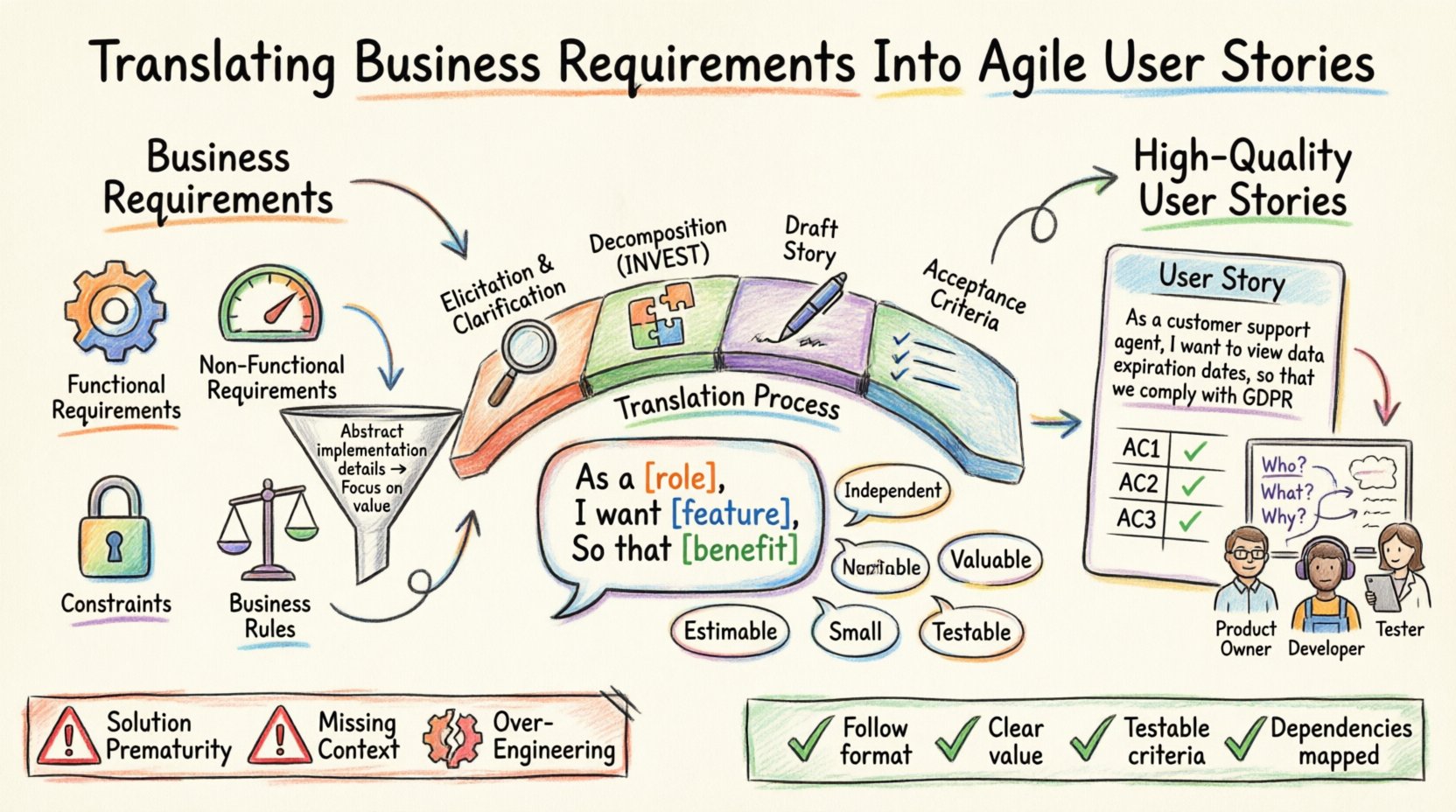
Before one can translate requirements into stories, one must understand the source material. Business requirements define the capabilities a system must possess to solve a business problem or achieve an objective. These are distinct from technical specifications, which dictate how the system is built. A common pitfall is confusing the what with the how.
- Functional Requirements: These describe specific behaviors or functions. For example, “The system must calculate tax based on regional rates.”
- Non-Functional Requirements: These describe quality attributes, such as performance, security, or reliability. For example, “The checkout process must load within two seconds.”
- Constraints: These are limitations on the solution, such as regulatory compliance, budget limits, or technology stack restrictions.
- Business Rules: These are specific definitions, conditions, or policies that govern how data is processed or managed.
When receiving these inputs, the Product Owner or Business Analyst acts as the first filter. The goal is to abstract the specific implementation details and focus on the underlying value. A requirement stating “We need a button that says Save” is a solution. The requirement behind it is “We need a mechanism to persist user changes to the database.” The latter is a requirement; the former is a potential implementation detail.
📝 The Anatomy of a High-Quality User Story
A user story is a tool for communication. It is not a contract, but a placeholder for a conversation. The standard format follows the template:
As a [role],
I want [feature],
So that [benefit/value].
Each component serves a specific purpose in the translation process:
- The Role: Identifies the user or system actor. This ensures the story is user-centric, not system-centric. Instead of “The system should allow login,” use “As a registered user, I want to log in securely.”
- The Feature: Describes the action or capability. This is derived directly from the functional requirement.
- The Benefit: Explains the why. This is the most critical part of the translation. If the benefit cannot be articulated, the requirement may not warrant development.
Consider the translation of a business requirement: “The system must comply with GDPR data retention policies.”
- Weak Translation: “As a developer, I want to add a database flag for retention.” (Focuses on implementation).
- Strong Translation: “As a customer support agent, I want to view the expiration date of user data, so that I can ensure we do not retain data longer than legally permitted.”
🔄 The Translation Workflow: From Requirement to Story
The process of translation is iterative. It involves decomposing large requirements into smaller, manageable units of work. The following steps outline a robust workflow.
1. Elicitation and Clarification
Do not assume understanding. Engage with stakeholders to clarify ambiguities. Business requirements are often high-level summaries. Ask questions like:
- Who exactly is the primary user of this feature?
- What happens if this condition is not met?
- Is this a priority for the next sprint, or is it a long-term goal?
- Are there any existing processes we are replacing?
2. Decomposition
Large requirements, often called epics or themes, are too big to fit into a single development cycle. They must be broken down. Use the INVEST model to guide this decomposition:
- Independent: Stories should be as self-contained as possible to allow flexible ordering.
- Negotiable: Details are not fixed; they are open for discussion between the team and the stakeholder.
- Valuable: Every story must deliver tangible value to the user or business.
- Estimable: The team must have enough information to estimate the effort required.
- Small: Stories should be small enough to be completed within a sprint.
- Testable: There must be a clear way to verify the story is complete.
3. Drafting the Story
Once decomposed, write the story statement. Ensure the language is clear and free of technical jargon where possible. If technical terms are unavoidable, define them in the story notes or glossary.
4. Defining Acceptance Criteria
A story is not complete without criteria for success. Acceptance criteria define the boundaries of the story. They are not the same as the story statement itself.
Use the following table to distinguish between the two:
| Component | Purpose | Example |
|---|---|---|
| User Story | Describes the who, what, and why from a user perspective. | As a shopper, I want to filter products by price range so I can find affordable items quickly. |
| Acceptance Criteria | Defines the specific conditions that must be met for the story to be accepted. | 1. Price range slider exists. 2. Only products within range display. 3. “No results” message appears if range is invalid. |
Acceptance criteria can be written in various formats, including natural language, bulleted lists, or structured formats like Given/When/Then (Gherkin). The key is clarity and testability.
🛠️ Deep Dive: Writing Effective Acceptance Criteria
Acceptance criteria are the contract between the business and the development team. Poorly written criteria lead to rework, misunderstandings, and defects. To ensure quality, adhere to the following principles.
1. Be Specific and Unambiguous
Avoid words like “fast,” “user-friendly,” or “efficient.” These are subjective. Replace them with measurable metrics.
- Bad: “The page should load fast.”
- Good: “The page must render within 2 seconds on a standard broadband connection.”
2. Cover Happy and Unhappy Paths
Requirements often describe the ideal scenario. Testing and development must account for edge cases. Ensure your criteria cover error handling and invalid inputs.
- What happens if the user enters a negative number?
- What happens if the network connection drops during submission?
- What is the default state if data is missing?
3. Include Non-Functional Requirements
Functional criteria describe what the system does. Non-functional criteria describe how the system behaves. These are often overlooked during the translation phase.
- Security: “Passwords must be hashed before storage.”
- Performance: “The API response time must be under 100ms.”
- Accessibility: “All interactive elements must be navigable via keyboard.”
4. Collaborative Definition
Do not write acceptance criteria in isolation. The “Three Amigos” approach—bringing together the Product Owner, a Developer, and a Tester—is highly effective. This ensures the story is valuable, buildable, and testable.
🤝 Collaboration Strategies for Translation
Translation is not a solitary act. It requires active engagement from multiple roles. The following strategies facilitate smooth translation.
1. Backlog Refinement Sessions
Hold regular sessions dedicated to grooming the backlog. This is where requirements are discussed, stories are drafted, and acceptance criteria are defined. Keep these sessions focused and time-boxed to maintain efficiency.
2. Visual Aids and Prototypes
Text can be ambiguous. Use wireframes, flowcharts, or mockups to supplement written requirements. A visual representation often clarifies complex workflows faster than paragraphs of text.
3. Continuous Feedback Loops
Translation is not a one-time event. As development progresses, new details may emerge. Maintain a channel for feedback where stakeholders can review working software and provide input before the next iteration.
⚠️ Common Pitfalls in Requirement Translation
Even with a structured process, errors occur. Being aware of common pitfalls helps teams avoid them.
- Solution Prematurity: Defining the solution before understanding the problem. For example, “We need a mobile app” instead of “We need to allow customers to manage accounts on the go.” The latter opens up multiple solution paths.
- Missing Context: Writing stories without understanding the surrounding business rules. A story about “Updating a user profile” might fail if the team doesn’t know that a change triggers an email notification or a security audit log.
- Over-Engineering: Creating stories that are too complex or technical. If a story takes three sprints to complete, it is too large. Break it down further.
- Ignoring Dependencies: Failing to identify stories that rely on other work. A frontend story might depend on an API endpoint not yet built. Map these dependencies early.
- Assuming Knowledge: Assuming the team knows the business domain. Document assumptions and clarify them during refinement.
📊 Measuring the Quality of Translation
How do you know if your translation process is working? Look at these indicators:
- Definition of Done (DoD) Adherence: Are stories accepted without defects? If many stories fail QA, the acceptance criteria may be vague.
- Velocity Stability: Does the team deliver a consistent amount of value per sprint? High variance often indicates estimation errors caused by poor understanding of requirements.
- Change Request Frequency: How often do requirements change mid-sprint? A high rate suggests requirements were not understood or stable at the start.
- Stakeholder Satisfaction: Does the delivered feature match the business need? Feedback from end-users is the ultimate metric.
🌟 The Role of Non-Functional Requirements
While functional requirements drive the visible features, non-functional requirements (NFRs) drive the system’s quality. Often, NFRs are buried in the general requirements document and get lost during translation. They must be explicitly pulled out and assigned to relevant stories.
For instance, a requirement stating “The system must be secure” is not a user story. It must be translated into specific stories:
- Story 1: “As a system, I want to encrypt data in transit, so that credentials are protected from interception.”
- Story 2: “As a security officer, I want to receive alerts for failed login attempts, so that brute force attacks are detected.
NFR stories should be treated with the same rigor as functional stories. They require acceptance criteria, testing, and estimation.
🔍 Handling Complex Business Rules
Business rules are the logic that governs decisions. They are often the source of the most confusing requirements. A rule might state, “Users over 18 can access the premium tier unless they have a suspended account.”
To translate this:
- Identify the primary actor (User).
- Identify the trigger (Accessing premium tier).
- Identify the conditions (Age > 18 AND Account Status != Suspended).
- Create stories for each logical branch if they are complex enough.
Sometimes, a single story is insufficient for complex logic. In these cases, create a technical spike story to research the implementation details before committing to the functional story.
📝 Summary Checklist for Story Creation
Before adding a story to the sprint backlog, run it through this checklist:
- ☐ Does it follow the As a… I want… So that… format?
- ☐ Is the value proposition clear?
- ☐ Are the acceptance criteria specific and testable?
- ☐ Is it estimated and small enough for a sprint?
- ☐ Are dependencies identified and managed?
- ☐ Does it align with the current product roadmap?
- ☐ Have stakeholders validated the story?
🚀 Moving Forward
Translating business requirements into agile user stories is a skill that improves with practice. It requires empathy for the user, clarity of thought, and a willingness to collaborate. By focusing on the why behind every feature, maintaining rigorous acceptance criteria, and fostering open communication, teams can ensure that the software they build truly solves the problems it was designed to address. The goal is not just to write stories, but to facilitate the delivery of genuine value.
As you refine your process, remember that documentation is a means to an end. The ultimate value lies in the conversations and the working software that results from them. Keep the focus on clarity, collaboration, and continuous improvement.