Strategic alignment is often the missing link between high-level vision and operational execution. Without a structured approach to defining intent, organizations struggle to maintain focus as market conditions shift. The Business Motivation Model (BMM) provides a standardized framework for capturing the logic behind business decisions. Developed by the Object Management Group (OMG), this model allows architects and leaders to articulate why an organization does what it does.
At its foundation, BMM separates the why from the how. It creates a clear lineage from the initial motivation down to the specific actions taken. This guide explores the six core elements that constitute the model. Understanding these components is essential for anyone involved in business architecture, strategic planning, or organizational design.
Each element serves a distinct purpose, yet they function together as an interconnected system. By mapping these relationships, stakeholders can identify gaps, assess risks, and ensure that every operational task traces back to a strategic driver. This clarity reduces waste and enhances agility.
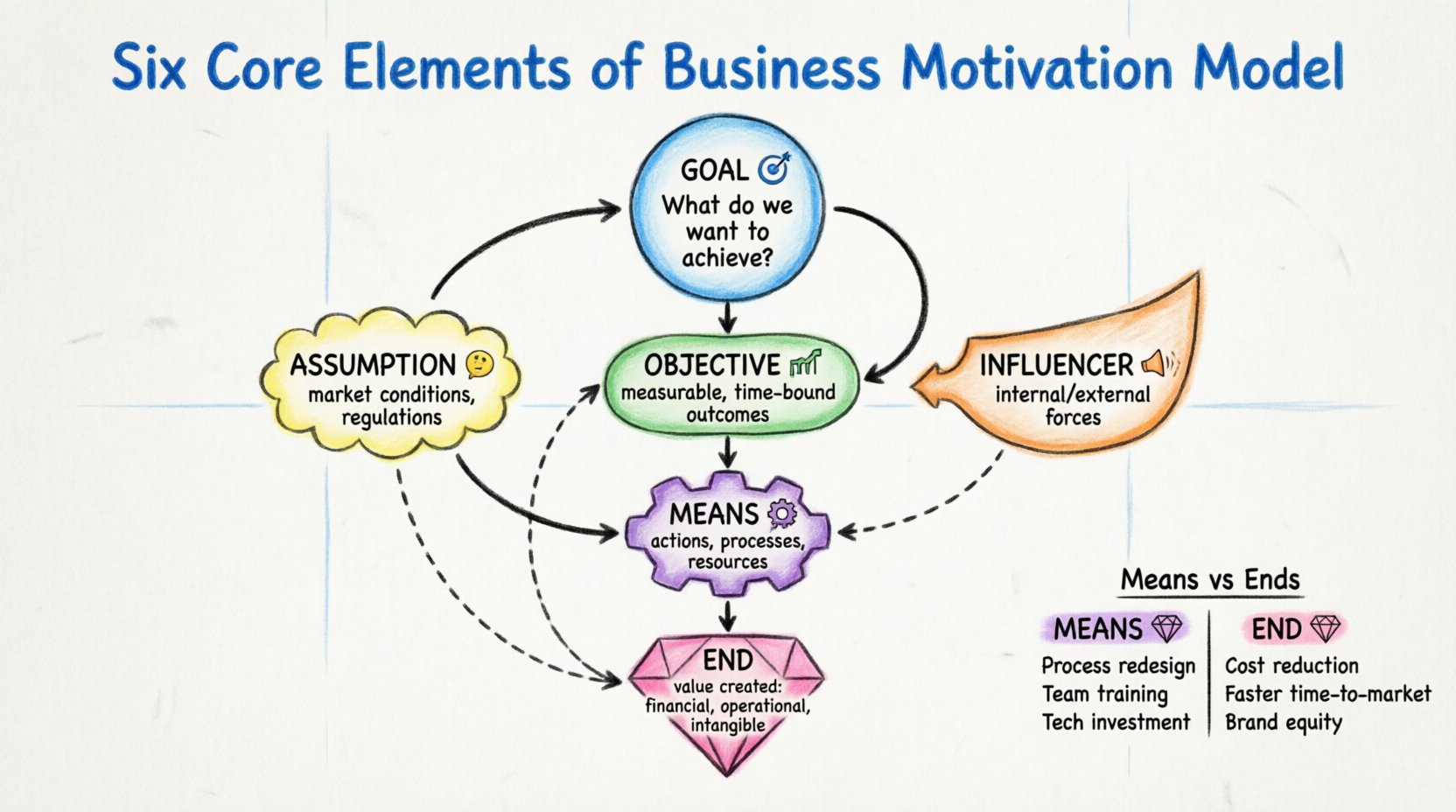
1. Goal: The Primary Motivation 🎯
The Goal represents the core motivation behind an activity or an organization. It is the driving force that dictates direction. In the context of BMM, a goal is not merely a target to be reached; it is the expression of desire or intent. Goals answer the fundamental question: What do we want to achieve?
- Characteristics of a Goal:
- It is high-level and often qualitative.
- It provides the rationale for existence.
- It is influenced by external factors.
- It can be shared across multiple units.
For example, a company might have a goal to improve customer satisfaction. This is broad enough to guide various departments but specific enough to inform decision-making. Goals are the top-level nodes in the motivation hierarchy. They are influenced by external influencers and assumptions, which shape the feasibility of the goal.
It is crucial to distinguish a Goal from a Task. A goal is the desired state, whereas a task is the action taken to get there. Confusing the two leads to process inefficiencies. If a team focuses only on the action without understanding the underlying goal, they may optimize the wrong process.
2. Objective: Measurable Intent 📏
While Goals describe the motivation, Objectives define the measurable outcomes. An Objective is a specific result that supports a Goal. If the Goal is the destination, the Objective is the milestone that proves progress. Objectives make the abstract concrete.
- Key Attributes:
- Quantifiable or verifiable.
- Time-bound.
- Directly linked to a Goal.
- Used for performance tracking.
Consider the goal of improving customer satisfaction. An associated objective might be reduce support ticket resolution time to under 2 hours by Q4. This objective allows the organization to measure success objectively. Without objectives, goals remain vague aspirations that are difficult to manage.
Objectives bridge the gap between strategy and execution. They provide the criteria by which success is judged. In a business architecture context, objectives are often linked to Key Performance Indicators (KPIs). This linkage ensures that daily activities are evaluated against the strategic targets set by leadership.
3. Assumption: The Contextual Conditions 🤔
No business plan exists in a vacuum. Assumptions are the conditions that must hold true for the plan to succeed. They represent the uncertainties that surround the Goal and Objectives. Identifying assumptions is critical for risk management.
- Types of Assumptions:
- Market conditions remain stable.
- Regulatory frameworks do not change.
- Technology infrastructure supports required capacity.
- Key personnel remain with the organization.
When building a BMM, explicitly documenting assumptions prevents hidden risks from derailing the strategy. If an assumption proves false, the Goal or Objective may no longer be viable. For instance, if the assumption that customer demand will grow by 10% is incorrect, the objective to increase production capacity by 20% becomes a liability.
Assumptions act as a filter for validation. Before committing resources, stakeholders should stress-test these conditions. This process is known as assumption analysis. It ensures that the strategy is robust against known variables. In dynamic environments, assumptions must be reviewed regularly to maintain relevance.
4. Influencer: External and Internal Forces 📢
Influencers are the factors that impact the Goal, Objective, or the ability to achieve them. They can be positive or negative. Influencers represent the environment in which the organization operates. They are distinct from the organization itself; they act upon the organization.
- Categories of Influencers:
- Regulatory: Laws, compliance requirements, government policies.
- Market: Competitors, economic trends, customer preferences.
- Internal: Culture, leadership changes, resource availability.
- Technological: Emerging tech, legacy system constraints.
Mapping influencers helps leaders understand the forces shaping their strategic landscape. An influencer might force a change in a Goal. For example, a new data privacy law (Influencer) might require a revision of the Data Utilization Goal. By tracking influencers, organizations can anticipate shifts rather than reacting to them after the fact.
In the BMM, influencers are connected to Goals and Objectives. This connection highlights dependency. If a critical Influencer changes, the model flags the affected Goals. This mechanism supports change management by showing the ripple effects of external events.
5. Means: The Actions Taken 🛠️
Means are the specific actions, processes, or activities undertaken to achieve an Objective. They are the direct effort applied to the problem. Means are the operational side of the model. They answer the question: What are we doing to make this happen?
- Characteristics of Means:
- Controllable by the organization.
- Often mapped to business processes.
- Involve resources (people, systems, money).
- Can be initiated or stopped.
A distinction exists between Means and the broader Strategy. Means are the tactical execution. For example, if the Objective is launch a new mobile application, the Means might include hire developers, design UI prototypes, and conduct user testing. These are discrete actions that can be planned and scheduled.
Means are critical for resource allocation. Knowing the specific actions required allows managers to budget and staff effectively. If the Means are not clearly defined, the Objective remains theoretical. This element ensures that strategy translates into work.
6. End: The Value or Result 💎
The End represents the value created by the Means. While the Means are the actions, the End is the outcome or benefit derived from those actions. It is the justification for the effort. Ends can be tangible or intangible.
- Types of Ends:
- Financial: Revenue increase, cost reduction.
- Operational: Efficiency gain, error reduction.
- Intangible: Brand reputation, employee morale.
Understanding the End is vital for prioritization. If a Means does not produce a valuable End, it should be reconsidered. For example, a Means of implementing a complex reporting system should yield an End of better decision-making speed. If the End is not realized, the Means were wasted.
Ends are often linked back to Objectives. The End validates that the Objective was met. This creates a closed loop of value creation. In business architecture, mapping Means to Ends helps identify activities that do not contribute to value, supporting continuous improvement initiatives.
Comparing Means and Ends ⚖️
Confusion often arises between Means and Ends because both relate to the “how.” However, the distinction lies in control versus value.
| Feature | Means | End |
|---|---|---|
| Definition | The action taken. | The value gained. |
| Control | Directly controlled. | Indirectly influenced. |
| Focus | Process and Activity. | Outcome and Benefit. |
| Example | Training staff. | Increased productivity. |
Recognizing this difference prevents organizations from optimizing processes (Means) without regard for the actual value (End) produced. A common pitfall is perfecting a process that no longer serves a valuable End.
Structuring the Relationships 🔄
The power of the Business Motivation Model lies in how these elements connect. They form a hierarchy that flows from motivation to execution.
- Goal to Objective: Goals influence Objectives. One Goal can have multiple Objectives.
- Objective to Means: Objectives are achieved through Means. Multiple Means may support one Objective.
- Means to End: Means produce Ends. One Mean can produce multiple Ends.
- Assumptions & Influencers: These surround the entire structure, affecting the feasibility of Goals, Objectives, and Means.
This structure allows for traceability. If an End is not achieved, one can trace back to see if the Means were insufficient, the Objective was unrealistic, or an Assumption was invalid. This traceability is essential for root cause analysis in complex organizations.
Implementing the Model Without Tools 📝
Building a BMM does not require expensive software. The core value is in the thinking and the documentation. Organizations can start with simple whiteboarding sessions or document-based modeling.
- Identify Stakeholders: Who defines the Goals? Who executes the Means?
- Define the Goal: Start with the high-level intent. Keep it concise.
- Break Down Objectives: Ask what measurable steps lead to the Goal.
Document Assumptions: List what must be true for success.
Map Influencers: Identify external pressures.
Define Means and Ends: Link actions to value.
Validate: Review with leadership to ensure alignment.
This manual approach forces clarity. It prevents the model from becoming a bureaucratic exercise. The goal is understanding, not just documentation. As the organization matures, these models can be formalized into digital repositories, but the logic remains the same.
Common Challenges in Business Motivation Modeling ⚠️
Even with a clear framework, organizations face hurdles when applying BMM.
Ambiguity in Goals
If a Goal is too vague, Objectives become misaligned. Stakeholders must agree on the definition of terms. For instance, increase revenue is better defined as increase recurring revenue by 15%.
Static Models
Business environments change. A BMM created today may be obsolete in six months. Models must be living documents. Regular review cycles are necessary to update Assumptions and Influencers.
Over-Engineering
Trying to model every single detail can lead to paralysis. Focus on the critical path. Not every task needs to be mapped to a Goal. Prioritize strategic initiatives that drive the most value.
Disconnect from Operations
Strategy teams often create the model, while operations teams execute the work. If there is no feedback loop, the model becomes a theoretical artifact. Operations teams should contribute to defining Means to ensure feasibility.
Strategic Alignment and Governance 🏛️
Once the elements are defined, governance ensures they are maintained. Governance involves regular audits of the model against reality. Are the Assumptions still valid? Are the Ends being achieved by the Means?
This governance structure supports decision-making. When a new project is proposed, it can be checked against the existing BMM. Does it support a Goal? Does it align with current Objectives? If not, the project may be deprioritized. This acts as a filter for strategic investment.
Transparency is key. When stakeholders understand the logic behind decisions, they are more likely to support the direction. The BMM provides the language for these conversations. It moves discussions from opinion-based to logic-based.
Conclusion on Value Creation 🚀
The Business Motivation Model offers a disciplined approach to understanding organizational intent. By breaking down the complex web of strategy into six core elements, leaders gain visibility into the drivers of their business.
Goals provide the vision, Objectives provide the measure, Assumptions provide the context, Influencers provide the environment, Means provide the action, and Ends provide the value. Together, they form a complete picture of how an organization creates value.
Adopting this framework requires effort, but the return is clarity. In a world of constant change, having a structured way to document and validate motivation is a significant competitive advantage. It ensures that resources are directed where they matter most.