
Modern enterprises operate in an environment defined by complexity and rapid change. As organizations expand across borders, they face the challenge of maintaining strategic alignment without stifling local autonomy. The Business Motivation Model (BMM) provides a standardized framework for understanding the reasons behind business activity. However, deploying this model across a global footprint requires careful planning and structural integrity. This guide outlines the practical steps and architectural considerations necessary to scale motivation models effectively.
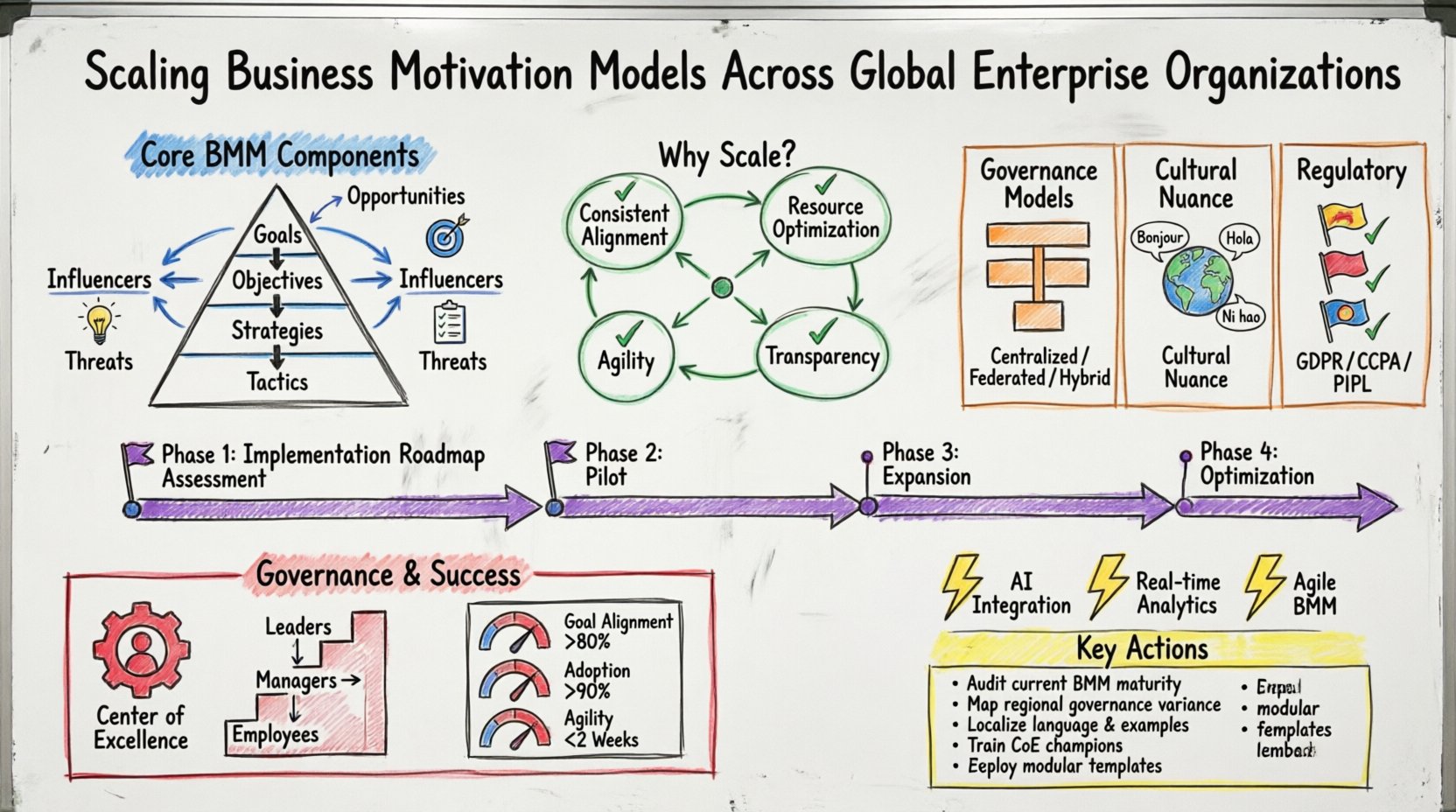
🧩 Understanding the Business Motivation Model Foundation
Before attempting to scale, one must understand the core components of the Business Motivation Model. This model, often associated with standardization bodies like the Object Management Group, focuses on the “why” behind business actions. It connects high-level intent to specific execution details.
- Goals: Desired states that the organization wishes to achieve. These are broad and often qualitative.
- Objectives: Measurable steps taken to reach a goal. These are specific and quantifiable.
- Influencers: Factors that impact the achievement of goals or objectives. These can be positive (opportunities) or negative (threats).
- Strategies: High-level approaches used to overcome influencers and achieve objectives.
- Tactics: Specific actions derived from strategies to deliver value.
When implemented correctly, this hierarchy creates a clear line of sight from the boardroom to the front line. In a global context, this line of sight must remain unbroken despite time zone differences, cultural variations, and regulatory environments.
🚀 Why Scaling BMM Matters for Global Enterprises
Many large organizations struggle with siloed operations. A department in one region may pursue a goal that contradicts a strategy in another region. Scaling the Business Motivation Model helps mitigate these risks by providing a common language.
Key benefits of scaling include:
- Consistent Alignment: Ensures all regions understand the overarching purpose of their work.
- Resource Optimization: Identifies where effort is duplicated or where gaps exist in coverage.
- Agility: When market conditions change, the model allows for rapid recalculation of tactics without losing sight of the goal.
- Transparency: Stakeholders can trace a specific task back to a high-level organizational intent.
Without a scaled approach, enterprises often rely on ad-hoc communication. This leads to misinterpretation of strategy and inefficient resource allocation. A formalized model reduces ambiguity.
🌍 Structural Challenges in Global Deployment
Scaling is not merely a technical task; it is an organizational challenge. Different regions have different operating models. Some may prefer centralized control, while others require decentralized decision-making. Balancing these needs is critical.
1. Governance Models
Choosing the right governance structure determines how motivation data flows through the organization.
| Model Type | Description | Best For |
|---|---|---|
| Centralized | One global team defines all goals and objectives. | Highly regulated industries with strict compliance needs. |
| Federated | Global framework with local autonomy on tactics. | Diverse markets requiring local adaptation. |
| Hybrid | Core goals are global, execution varies by region. | Most large-scale multinational corporations. |
2. Cultural Nuances
Language and culture influence how motivation is perceived. A goal defined as “Efficiency” in one culture might be interpreted as “Cost Cutting” in another, potentially harming morale. The model must be flexible enough to accommodate local terminology while maintaining global semantic consistency.
3. Regulatory Compliance
Different jurisdictions have different rules regarding data and business practices. A strategy valid in one country might be non-compliant in another. The BMM structure must allow influencers to tag regulatory constraints clearly.
🛠️ Building a Unified Motivation Framework
To scale successfully, the enterprise needs a foundational framework. This framework acts as the container for all motivation data.
1. Standardization of Terminology
Define a global glossary. Ensure that terms like “Revenue Growth” or “Customer Satisfaction” have the same definition across all units. This prevents the situation where Region A reports success while Region B reports failure on the same metric due to different measurement standards.
- Create a taxonomy for goals and objectives.
- Assign unique identifiers to every element.
- Maintain version control for all definitions.
2. Hierarchical Decomposition
Not every employee needs to see the entire global model. Decompose the model into manageable layers.
- Level 1: Corporate Strategy: Board level, long-term vision.
- Level 2: Business Unit: Division or Product Line specific goals.
- Level 3: Regional: Country or Zone specific adaptations.
- Level 4: Operational: Team and individual tasks.
Each level rolls up to the one above it. This ensures that local wins contribute to global success.
3. Integration with Existing Systems
The model does not exist in isolation. It must integrate with performance management, project management, and financial systems. While specific software tools vary, the data exchange points must be standardized. For example, a tactic completed in a project management system should automatically update the status of the corresponding objective in the motivation model.
📊 Implementation Roadmap
Rolling out a scaled BMM is a multi-phase endeavor. Rushing this process often leads to low adoption rates.
Phase 1: Assessment and Design
Begin by auditing current practices. Where are the gaps in alignment? Identify key stakeholders who will champion the model. Design the taxonomy and governance structure. Define who has the authority to change goals and who must be consulted.
Phase 2: Pilot Deployment
Select a single region or business unit to test the framework. This allows for real-world feedback. Monitor how users interact with the model. Are the definitions clear? Is the data entry burden too high? Adjust the process based on this feedback before global rollout.
Phase 3: Gradual Expansion
Expand to other regions in waves. Do not attempt to onboard the entire organization simultaneously. Provide training and support resources for each new group. Ensure that the infrastructure can handle the increased data load.
Phase 4: Optimization
Once fully deployed, focus on maintenance. Regularly review the relevance of goals. Archive outdated strategies. Ensure the model evolves with the market.
⚖️ Governance and Change Management
Sustaining a global motivation model requires robust governance. Without oversight, the model can become outdated or ignored.
1. Establishing a Center of Excellence
Create a dedicated team responsible for the integrity of the model. This team does not manage daily operations but ensures the framework remains valid. They handle taxonomy updates, resolve conflicts between regions, and audit data quality.
2. Training and Enablement
People do not adopt models they do not understand. Training should be role-based.
- Leaders: How to set strategic goals and track progress.
- Managers: How to translate goals into team objectives.
- Employees: How to link daily tasks to broader objectives.
Training materials should be available in all supported languages. Visual aids often work better than text-heavy documents.
3. Incentive Alignment
If performance bonuses are tied to local metrics that contradict global goals, the model will fail. Compensation structures must align with the motivation model. If a global goal is “Sustainability,” local incentives should reward sustainable practices, not just short-term profit.
🧩 Operationalizing Alignment
Operational alignment means ensuring that daily work reflects the strategic intent. This requires visibility and feedback loops.
1. Visual Dashboards
Provide dashboards that show the status of goals and objectives. These should be accessible to relevant stakeholders. Visual indicators (green, yellow, red) help quickly identify areas needing attention without reading detailed reports.
2. Regular Review Cycles
Schedule regular meetings to review the motivation model. Quarterly business reviews are common. During these sessions, discuss which influencers have changed. Did a new competitor enter the market? Has a regulation changed? Update the model accordingly.
3. Feedback Mechanisms
Allow employees to flag issues with the model. If a tactic is impossible to achieve due to a specific constraint, they should have a channel to report this. This keeps the model grounded in reality.
📈 Measuring Success and Impact
How do you know if the scaled BMM is working? You need specific metrics to evaluate effectiveness.
| Metric | Description | Target |
|---|---|---|
| Goal Alignment Score | Percentage of projects linked to a strategic goal. | > 80% |
| Update Frequency | How often the model is reviewed and updated. | Quarterly |
| Adoption Rate | Percentage of managers actively using the model. | > 90% |
| Strategic Agility | Time taken to adjust goals based on market shifts. | < 2 Weeks |
Tracking these metrics helps identify bottlenecks. If the Goal Alignment Score is low, it suggests a disconnect between planning and execution. If Adoption Rate is low, the training or tooling may be insufficient.
🤝 Managing Influencers and Risks
In a global context, influencers are often external and volatile. Economic shifts, political changes, and supply chain disruptions can impact goals instantly.
Effective management involves:
- Monitoring: Continuous scanning of the external environment.
- Categorization: Tagging influencers by region and impact type.
- Response Planning: Pre-defined strategies for common risks.
When an influencer changes status, the model should highlight the affected objectives. This triggers a review process to adjust tactics or strategies as needed.
🔮 Future Considerations
The landscape of business architecture continues to evolve. As organizations integrate more data and automation, the Business Motivation Model will adapt.
- Data Analytics: Real-time data feeds can update influencer status automatically, reducing manual maintenance.
- Artificial Intelligence: AI can suggest optimal strategies based on historical performance data.
- Agile Integration: Combining BMM with agile methodologies allows for faster iteration of tactics while maintaining strategic stability.
Staying ahead of these trends requires a commitment to continuous improvement. The model is not a static document but a living system that supports the organization.
🏁 Summary of Key Actions
Scaling the Business Motivation Model is a significant undertaking that yields long-term benefits. It requires a balance between standardization and flexibility. By following a structured approach, defining clear governance, and fostering a culture of alignment, enterprises can ensure their global operations move in the same direction.
Key takeaways for success include:
- Establish a common language for goals and objectives.
- Choose a governance model that fits the organizational culture.
- Pilot before scaling to identify potential friction points.
- Align incentives and performance management with the model.
- Measure success using specific, trackable metrics.
- Maintain the model through regular reviews and updates.
With disciplined execution, the Business Motivation Model becomes a powerful tool for navigating the complexities of the global marketplace. It transforms strategy from a theoretical concept into a tangible driver of organizational performance.