In the complex landscape of modern enterprise architecture, strategies often lose their potency over time. Organizations find themselves executing plans that no longer align with market realities or internal capabilities. This phenomenon, known as strategic stagnation, requires a fundamental re-examination of the underlying motivational structures. The Business Motivation Model (BMM) provides the necessary framework to diagnose these disconnects and redesign the organization’s intent. This guide explores a detailed scenario where a traditional business architecture approach is revitalized through rigorous motivation modeling.
Understanding Strategic Stagnation 📉
Strategic stagnation is not merely a lack of new ideas; it is a misalignment between what an organization intends to achieve and the means available to achieve it. Over years of operation, goals may become static while the environment shifts rapidly. Several symptoms indicate this state:
- Decoupled Goals: High-level objectives exist in one document, while operational tasks follow a different path.
- Resource Misallocation: Budget and personnel are directed toward legacy initiatives rather than emerging opportunities.
- Communication Gaps: Stakeholders cannot articulate how their daily work contributes to the broader mission.
- Inertia: Resistance to change persists even when performance metrics indicate a need for transformation.
Addressing these issues requires more than a simple review of KPIs. It demands a structural redefinition of the organization’s motivation. The Business Motivation Model offers a standardized way to visualize and manage these relationships. By mapping the connections between stakeholders, intentions, and means, leaders can identify where the breaks in the chain occur.
The Business Motivation Model Framework 🏗️
The Business Motivation Model is an OMG standard that defines the structure of business motivation. It is not a software tool but a conceptual model for organizing business knowledge. It focuses on four primary elements that interact to drive organizational behavior:
- Stakeholders: Entities who have an interest in the outcomes, such as customers, employees, or shareholders.
- Intention: The specific aims of the organization, categorized as Goals, Objectives, and Missions.
- Means: The resources and actions used to achieve intentions, including Assessments, Actions, and Roles.
- Influencers: Factors that affect the achievement of intentions, either positively or negatively.
Understanding the relationships between these elements is crucial. For instance, a Goal is supported by Means, which are performed by Stakeholders, and influenced by external Influencers. When a strategy stagnates, it is often because one of these relationships has weakened or become ambiguous.
Case Study Background: The Legacy Corp Scenario 🏢
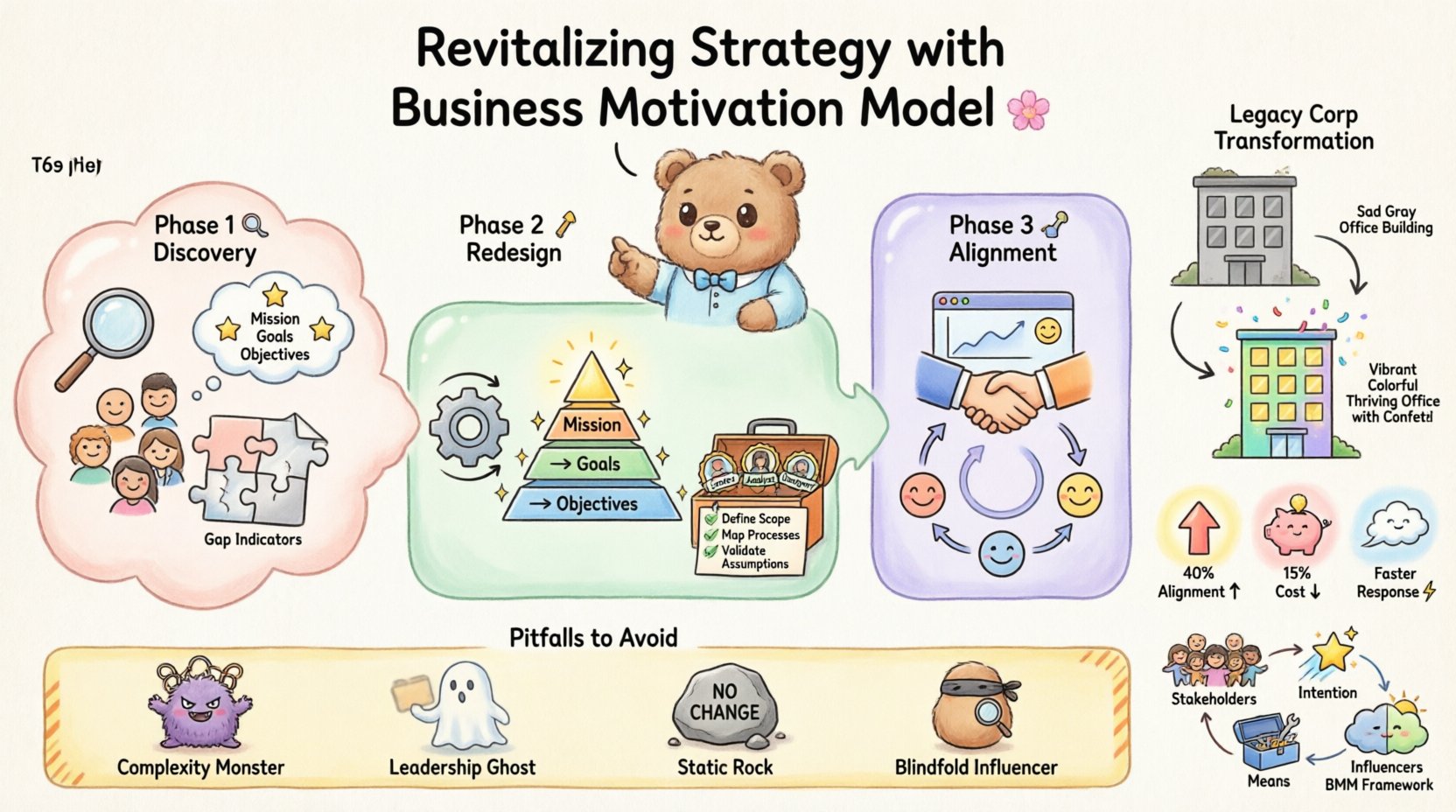
To illustrate the application of this model, consider a hypothetical entity referred to as Legacy Corp. This organization had operated for over two decades with a dominant market position. However, as new competitors entered the market with digital-first approaches, Legacy Corp found its growth plateauing.
The initial diagnosis revealed several issues:
- The mission statement was vague and outdated.
- Departmental goals conflicted with one another.
- There was no clear link between executive strategy and team-level actions.
- External market shifts were not formally tracked as influencers.
Management decided to adopt a Business Motivation Model redesign to realign the organization. The project was not about changing the product line immediately but about changing how the organization thought about its direction.
Phase 1: Discovery and Diagnosis 🔍
The first phase involved mapping the current state of motivation. The team gathered representatives from various levels of the hierarchy to interview them about their understanding of the company’s direction.
Mapping Stakeholders and Intention
During this phase, the team documented who the key stakeholders were and what they believed the intentions to be. A significant finding was the divergence between the Board’s stated intentions and the operational team’s perception.
| Element | Current State | Identified Gap |
|---|---|---|
| Stakeholder | Executives only | Front-line staff excluded |
| Intention | High-level Vision | Lack of measurable Objectives |
| Means | Legacy Processes | No link to new digital capabilities |
This table highlights the critical disconnects found during the discovery phase. The lack of front-line stakeholder engagement meant that operational realities were ignored when setting high-level goals.
Identifying Influencers
The team also cataloged the influencers. Previously, these were treated as external noise. The redesign process formalized them as critical inputs. Positive influencers included emerging technologies, while negative influencers included regulatory changes and competitor pricing strategies.
Phase 2: Redesigning Intention and Means 🛠️
With the diagnosis complete, the team moved to redesigning the core motivational elements. The goal was to create a coherent chain of intent that flowed from the top to the bottom of the organization.
Refining the Intention Hierarchy
The first step was to clarify the hierarchy of intentions. This involved distinguishing between:
- Mission: The fundamental reason the organization exists.
- Goal: Broad, long-term outcomes that support the mission.
- Objective: Specific, measurable targets that support the goals.
Legacy Corp revised its mission to focus on customer agility rather than product stability. This shift immediately influenced how goals were set. Goals were no longer about maintaining market share but about capturing new customer segments.
Aligning Means with Intention
Once intentions were clear, the means were re-evaluated. The organization had to determine if its current actions supported the new goals. A significant portion of the budget was found to be supporting legacy products that did not align with the new mission.
The redesign process involved:
- Assessing Roles: Ensuring job descriptions reflected the new strategic focus.
- Reviewing Actions: Eliminating processes that added no value to the new objectives.
- Resource Allocation: Shifting funds from legacy lines to innovation channels.
This step required difficult decisions. However, by linking every action back to a specific intention, the team could justify resource changes based on strategic alignment rather than historical precedent.
Phase 3: Alignment and Governance 🤝
A redesigned model is useless if it is not integrated into the governance of the organization. Phase 3 focused on embedding the Business Motivation Model into regular business operations.
Establishing Review Cycles
The organization instituted quarterly reviews of the motivation model. During these sessions, stakeholders examined whether the influencers had changed and if the means were still effective. This created a dynamic system where strategy could adapt to external shifts without requiring a full overhaul.
Communication and Training
To ensure adoption, the organization invested in training. Employees learned how to interpret the intention hierarchy and how their roles fit into the means. This reduced ambiguity and empowered staff to make decisions that aligned with the broader strategy.
Key communication strategies included:
- Visual Dashboards: Displaying the links between goals and actions in real-time.
- Regular Town Halls: Discussing the status of influencers and intentions.
- Feedback Loops: Allowing stakeholders to report when intentions were becoming misaligned with reality.
Outcomes and Metrics 📊
After twelve months of implementing the Business Motivation Model redesign, Legacy Corp observed tangible changes. The metrics tracked during this period reflected the success of the approach.
Strategic Alignment Scores
Surveys measuring the alignment between daily tasks and strategic goals showed a 40% improvement. Employees could clearly articulate how their work contributed to the mission.
Resource Efficiency
By eliminating actions that did not support the intentions, the organization reduced operational costs by 15%. Resources were redirected to areas with higher strategic value.
Response Time to Market
With a clearer understanding of influencers, the organization could pivot faster. The time required to launch new initiatives decreased significantly because the means were already aligned with the intentions.
Common Implementation Pitfalls ⚠️
While the redesign was successful, there are common pitfalls that organizations often encounter when applying the Business Motivation Model. Awareness of these issues can prevent failure.
- Over-Complexity: Creating too many intentions or means can confuse stakeholders. Keep the model simple and focused.
- Lack of Leadership Buy-in: If executives do not use the model, it will be ignored by the rest of the organization.
- Static Modeling: Treating the model as a one-time exercise rather than a living document leads to renewed stagnation.
- Ignoring Influencers: Focusing only on internal goals while ignoring external market forces is a recipe for failure.
It is essential to treat the Business Motivation Model as a tool for continuous improvement rather than a static framework. Regular updates are necessary to maintain relevance.
Sustaining Momentum 🚀
Once the initial redesign is complete, the focus shifts to sustaining the momentum. This requires a cultural shift where motivation is viewed as a core competency of the business.
Embedding in Culture
Organizations must encourage a mindset where questioning intentions is welcomed. When a stakeholder sees that an action no longer supports a goal, they should feel empowered to raise it. This creates a self-correcting system that resists stagnation.
Continuous Learning
As the market evolves, so must the intentions. The organization should commit to ongoing learning about new technologies and trends. This ensures that the influencers are always up to date, allowing the strategy to remain agile.
Final Considerations 💡
Revitalizing a stagnant strategy requires more than a new slogan or a reorg chart. It requires a deep understanding of what drives the organization. The Business Motivation Model provides the structure to make these drivers visible and manageable.
By systematically mapping stakeholders, intentions, means, and influencers, leaders can identify the root causes of stagnation. The case of Legacy Corp demonstrates that even large, established organizations can regain momentum through disciplined modeling and alignment.
The path forward involves commitment to the process. It is not a quick fix but a methodical approach to business architecture. Organizations that adopt this mindset position themselves to adapt to change rather than be overwhelmed by it. The result is a more resilient, responsive, and motivated enterprise.