Enterprise architecture often struggles with a disconnect between high-level strategy and low-level implementation. Teams build systems that function well technically but fail to deliver actual business value. This gap exists because motivation—the driving force behind decisions—is often treated as a separate concern rather than a foundational element of design. By integrating the Business Motivation Model (BMM) directly into your architectural planning, you ensure every component serves a defined purpose.
This guide provides a structured approach to aligning your technical landscape with organizational intent. We will explore how to map wants, needs, goals, and capabilities to create a cohesive system that delivers measurable outcomes. 🏗️
🧠 Understanding the Core Concepts
Before diving into integration, it is essential to understand the components of the Business Motivation Model. This framework provides the vocabulary needed to describe why an organization exists and how it intends to succeed. It bridges the gap between abstract strategy and concrete action.
Key Components of the Model
- Wants: The desired outcomes that drive action. These are the high-level aspirations of stakeholders.
- Needs: The specific requirements that must be met to satisfy a want.
- Goals: Broad, qualitative statements of what the organization wants to achieve.
- Objectives: Quantitative, measurable targets that define success more precisely than goals.
- Measures: The metrics used to track progress toward objectives.
- Plans: The specific actions and resources allocated to achieve objectives.
- Capabilities: The abilities an organization possesses to execute its plans.
- Resources: The assets required to support capabilities.
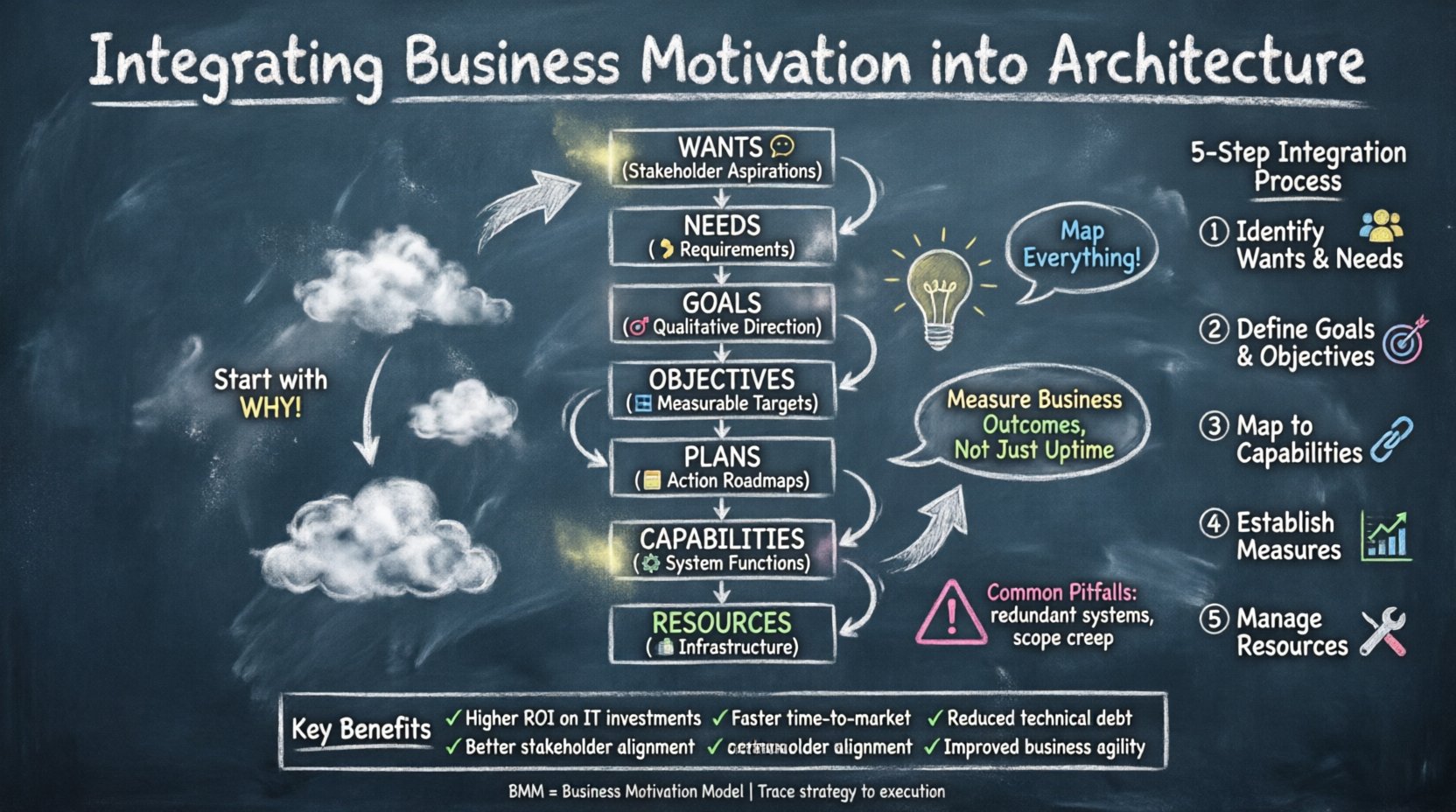
When these elements are clearly defined, they form a chain of logic. A resource supports a capability, which enables a plan, which achieves an objective, which fulfills a goal, which satisfies a need, which addresses a want. Architecture sits at the intersection of these elements, enabling the capabilities required to execute the plan.
📉 Why Architecture Without Motivation Fails
Many architectural projects suffer from scope creep, misalignment, or lack of adoption. This typically happens when technical requirements are derived without tracing back to business drivers. Without this traceability, you risk building solutions that are technically impressive but strategically irrelevant.
Common issues include:
- Redundant Systems: Multiple teams building similar functionality because they do not understand the shared business goal.
- Technical Debt: Short-term technical fixes that do not support long-term strategic objectives.
- Low Adoption: Users reject tools because the features do not solve their actual needs.
- Wasted Investment: Capital spent on capabilities that do not contribute to revenue or efficiency goals.
Integrating motivation ensures that every architectural decision can be justified by a business want or need. It shifts the conversation from “Can we build this?” to “Should we build this, and why?” 🤔
🔗 Step-by-Step Integration Process
Integrating motivation into architecture requires a deliberate process. It is not a one-time activity but a continuous alignment effort. Follow these steps to embed the model into your workflow.
Step 1: Identify Core Stakeholder Wants and Needs
The foundation of any architecture is understanding who benefits from it. You must engage with stakeholders to uncover their underlying motivations. Do not just ask what features they want; ask what problem they are trying to solve.
- Conduct interviews with key business leaders.
- Document the specific pain points driving current requests.
- Categorize inputs into Wants (strategic desires) and Needs (functional requirements).
- Validate these inputs with a cross-functional group to ensure alignment.
This step prevents the common pitfall of solving the wrong problem. If a stakeholder wants a new report, the need might be visibility into inventory levels, not the report itself. Architecture should solve the visibility problem, not just generate the document.
Step 2: Define Strategic Goals and Objectives
Once needs are clear, translate them into measurable goals. Goals provide direction, while objectives provide the yardstick for success. In an architectural context, these often relate to performance, security, cost, or time-to-market.
- Ensure goals are qualitative (e.g., “Improve customer satisfaction”).
- Ensure objectives are quantitative (e.g., “Reduce latency to under 200ms”).
- Link each architectural capability to at least one objective.
- Avoid objectives that are purely technical unless they directly support a business metric.
By defining these early, you create a filter for architectural decisions. Any component that does not contribute to an objective can be questioned or removed.
Step 3: Translate Intent into Architectural Capabilities
Capabilities are the bridge between strategy and execution. In architecture, a capability represents a specific ability the system must have to fulfill a business plan. This is where the model physically meets the design.
Use the following table to map business elements to architectural elements:
| Business Element | Architectural Equivalent | Example |
|---|---|---|
| Goal | Strategic Direction | Expand into new markets |
| Objective | Performance Target | Support 10k concurrent users |
| Plan | Implementation Roadmap | Q3 Migration to Cloud |
| Capability | System Function | Order Processing Service |
| Resource | Infrastructure/Asset | Database Cluster |
This mapping ensures that no architectural component is orphaned. If a service exists without a corresponding business capability, it should be reviewed for necessity. If a business capability has no supporting architecture, it is a risk to the organization.
Step 4: Establish Measures and Plans
Architecture must be measured to ensure it remains effective. Establishing measures involves defining how you will know if the architecture is delivering value. This goes beyond uptime and latency; it includes business outcomes.
- Define Key Performance Indicators (KPIs) for architectural health.
- Set up regular reviews to compare actual performance against objectives.
- Create plans for remediation if measures fall short.
- Document the decision history to track why certain measures were chosen.
Measures keep the architecture accountable. If a system is fast but does not improve customer retention, it may not be meeting the business goal, even if technical metrics are green.
Step 5: Manage Dependencies and Resources
Finally, ensure that the necessary resources are available to support the defined capabilities. This involves looking at budget, personnel, and technology assets.
- Map resources to capabilities to identify gaps.
- Assess resource constraints before finalizing the plan.
- Adjust plans if resources are insufficient to meet objectives.
- Monitor resource utilization to prevent bottlenecks.
Resource management prevents over-promising. An architecture that requires more compute power or skilled staff than is available will fail to deliver the intended motivation.
🚧 Common Challenges in Alignment
Implementing this integration is not without hurdles. Understanding common pitfalls helps you navigate them effectively.
- Lack of Clear Ownership: If no one owns the business motivation model, it becomes a theoretical exercise. Assign an architect or business analyst to maintain the linkage.
- Changing Priorities: Business goals shift. Architecture must be flexible enough to adapt without requiring a complete rebuild. Use modular design principles.
- Communication Gaps: Business and technical teams often speak different languages. Use the BMM as a shared glossary to facilitate discussion.
- Over-Engineering: Trying to model every detail can slow down delivery. Focus on the high-level motivations first and refine details as needed.
- Static Models: A model that is created once and never updated is useless. Treat the motivation model as a living document.
🔄 Maintaining Relevance Over Time
The business environment is dynamic. Strategies evolve, markets change, and technology advances. To keep your architecture relevant, you must maintain a feedback loop.
Regular Review Cycles
Schedule periodic reviews where the architecture is measured against current business objectives. Ask:
- Do our current goals still reflect the organization’s direction?
- Are our measures still capturing the right data?
- Has the cost of maintaining capabilities changed relative to their value?
Adapting to Change
When a goal changes, the architecture must reflect that. This might mean retiring old services or building new ones. The motivation model provides the justification for these changes. It answers the question: “Why are we doing this now?”
- Document the reason for architectural changes.
- Link changes back to updated business objectives.
- Communicate the rationale to stakeholders to maintain trust.
💡 Key Takeaways for Implementation
Successfully integrating business motivation into architecture requires discipline and clarity. Here are the essential points to remember:
- Start with the Why: Never design a solution without understanding the underlying want or need.
- Use Shared Language: Adopt the BMM terminology to bridge business and technical gaps.
- Map Everything: Ensure a traceable link from resources up to high-level goals.
- Measure Value: Track business outcomes, not just system uptime.
- Iterate: Update the model as business conditions change.
- Focus on Capabilities: Design systems based on abilities needed to execute plans, not just technical stacks.
🛠️ Practical Application
To apply this in your next project, begin with a workshop. Gather stakeholders and architects together. Use a whiteboard to map out the Wants and Needs. Then, work backward to identify the Capabilities required. This visual approach helps everyone see the connections.
Ensure that the documentation is accessible. If the model exists only in a closed document, it will not influence design. Integrate it into your standard architectural artifacts. When you draft a design document, include a section that references the business goals it supports.
This practice creates a culture of accountability. Developers and architects understand that their work contributes to the larger mission. This alignment fosters better decision-making and reduces rework.
📊 Summary of Benefits
Implementing this approach yields tangible results. Organizations that align architecture with motivation experience:
- Higher ROI on IT investments.
- Faster time to market for strategic initiatives.
- Better stakeholder satisfaction.
- Reduced technical debt through focused development.
- Improved agility in responding to market shifts.
By treating motivation as a first-class citizen in your architecture, you ensure that your systems are not just working, but working for the right reasons. This creates a resilient foundation for long-term growth and stability. 🌱