
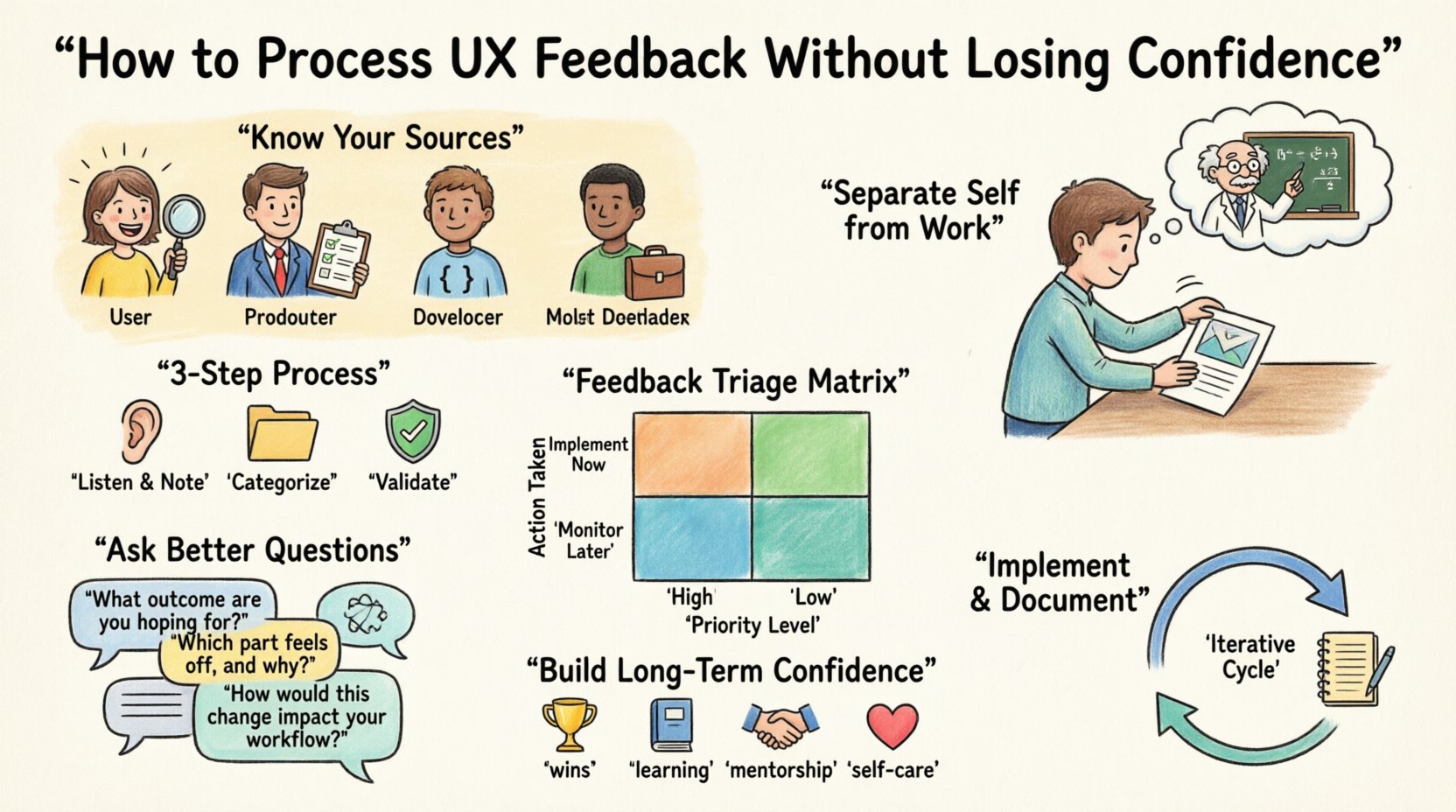
Design is a deeply personal endeavor. When you present a solution, you are not merely submitting a file; you are sharing a part of your professional judgment and creative thought process. Consequently, feedback often lands with a weight far heavier than the words themselves. It can feel like a critique of your competence rather than your work. This emotional friction is common among designers, regardless of experience level. The challenge lies not just in interpreting the data, but in maintaining your professional self-worth while navigating the iterative nature of user experience design.
This guide explores the mechanics of receiving, processing, and implementing UX feedback without eroding your confidence. We will move beyond surface-level advice and examine the psychological frameworks, communication strategies, and structural processes that allow you to remain resilient. Your goal is not to avoid criticism, but to build a system where feedback fuels your growth rather than halting it.
Understanding the Source of Feedback 🗣️
Before you can process feedback effectively, you must understand what is actually being said. Feedback is rarely uniform. It comes from various stakeholders, each with different priorities, constraints, and levels of understanding regarding the design process. Identifying the source helps you contextualize the input.
- Users: These are the most critical voices. Their feedback is based on behavior, pain points, and actual needs. It is rarely about aesthetics and almost always about functionality.
- Product Managers: Their focus is often on business goals, timelines, and feature scope. They may request changes that prioritize market fit over usability nuances.
- Developers: They provide feedback on technical feasibility, performance constraints, and implementation complexity. Their input ensures the design is buildable.
- Stakeholders: Executives or clients may offer feedback based on brand perception or high-level strategy. This feedback often requires translation into specific design actions.
When feedback arrives, pause before reacting. Ask yourself: Who is providing this input, and what is their primary objective? A request from a developer regarding code efficiency is different from a request from a stakeholder regarding visual branding. Distinguishing between these sources prevents you from taking every comment as a personal challenge to your design skills.
The Psychology of Critique: Separating Self from Work 🧠
One of the most difficult hurdles in design is the emotional attachment to the output. When you spend hours refining a flow or crafting a micro-interaction, that work becomes an extension of your identity. Criticism of the work can inadvertently feel like criticism of you.
To maintain confidence, you must practice cognitive separation. This is the mental discipline of viewing your designs as objects to be tested, not extensions of your self-worth. Consider the following mindset shifts:
- View Feedback as Data: Treat every comment as an input variable for the next iteration. It is not an opinion on your value; it is information about the current state of the solution.
- Adopt the Scientist Mindset: A hypothesis is tested. If the results show the hypothesis is wrong, the scientist does not fail; they simply learned something new. Your design is a hypothesis about user behavior.
- Focus on the Problem: Shift the focus from “my design” to “the problem we are solving.” When the conversation centers on the user’s pain points, it becomes easier to detach emotionally from the solution you proposed.
This separation is not about becoming cold or detached. It is about creating a psychological safety net that allows you to iterate rapidly. When you stop fearing the critique, you open yourself to better solutions.
A Framework for Processing Feedback 📋
Receiving feedback can be overwhelming if you try to address every point immediately. A structured triage process helps you manage the volume of input and decide what deserves attention. Use the following workflow to filter and organize incoming critiques.
Step 1: The Silence Phase
When feedback is delivered, especially in live meetings, the instinct is to defend your choices. Resist this urge. Allow the feedback to be fully absorbed. Take notes. Do not argue. Do not explain your rationale immediately. Simply listen and record. This prevents defensive reactions that can derail the conversation.
Step 2: Categorization
Once the feedback is recorded, sort it into categories. This helps you see patterns and prioritize. Common categories include:
- Usability Issues: Users cannot complete a task or are confused by the interface.
- Visual/Brand Concerns: Alignment with design systems or brand guidelines.
- Technical Constraints: Feasibility of implementation.
- Strategic Misalignment: Does this feature support the broader business goals?
Step 3: Validation
Not all feedback is equal. Some points are based on anecdotal evidence, while others are backed by data. Prioritize feedback that aligns with user research or usability metrics. If a stakeholder suggests a change, ask: “What user behavior or data point is driving this request?”
The Feedback Triage Matrix 📊
To visualize how you should prioritize different types of feedback, consider the matrix below. This tool helps you decide whether to accept, discuss, or defer a specific piece of input.
| Category | Source | Priority | Action |
|---|---|---|---|
| Usability Blocker | User Testing | High | Immediate Fix |
| Technical Constraint | Engineering | Medium | Collaborative Solution |
| Visual Preference | Stakeholder | Low | Discuss Rationale |
| Feature Request | Product | Medium | Backlog Review |
| Personal Opinion | Peer | Low | Consider for Next Iteration |
Asking the Right Questions 💬
When feedback is vague, such as “make this pop” or “it feels off,” it is difficult to act. You need to translate subjective feelings into actionable requirements. This is where your communication skills become as important as your design skills. Asking clarifying questions demonstrates your commitment to the project without appearing defensive.
Use these open-ended questions to dig deeper:
- “Can you tell me more about what isn’t working for you?” This shifts the conversation from judgment to specific pain points.
- “What outcome are you hoping to achieve with this change?” This reveals the underlying goal behind the request.
- “How does this align with the user persona we are targeting?” This brings the focus back to the end user rather than personal preference.
- “Are there specific examples of other interfaces you feel work better?” This grounds the feedback in concrete references.
By asking these questions, you transform a potential conflict into a collaborative problem-solving session. You position yourself as a partner in the process, not just an executor of instructions.
Implementing Changes with Integrity 🛠️
Once you have processed the feedback and decided on a course of action, the implementation phase begins. This is where confidence is often tested again. Will the change actually solve the problem? Will it introduce new issues? You must approach implementation with a sense of ownership.
Iterative Refinement
Do not assume one change will fix everything. Implement the feedback, then test it again. If the solution introduces a new usability issue, acknowledge it and iterate further. This cycle of build-measure-learn is fundamental to UX design. It is not a sign of failure to go back to the drawing board; it is the definition of the profession.
Documenting the Rationale
Keep a record of why decisions were made. When feedback leads to a change, note the reason for that change. If you decide to push back on a request, document your reasoning based on usability principles or user data. This documentation serves two purposes:
- Accountability: It proves that decisions were made thoughtfully, not arbitrarily.
- Future Reference: It helps you and your team understand the context of past decisions when similar issues arise later.
Building a Culture of Constructive Critique 🌱
While much of the responsibility lies in how you process feedback individually, the environment plays a significant role. You can influence the culture of feedback within your team. A healthy design culture encourages open dialogue where ideas are challenged respectfully.
- Establish Norms: Set expectations for feedback sessions. For example, require that feedback be specific and actionable. Avoid vague comments that leave room for interpretation.
- Encourage Peer Reviews: Create safe spaces for internal critique before presenting to stakeholders. This builds resilience and allows you to catch issues early.
- Model Vulnerability: When you receive feedback, respond with gratitude. Say, “Thank you for that perspective. I will look into it.” This signals that feedback is welcome and safe.
When the team sees that feedback leads to improvement rather than conflict, the quality of the discourse improves. You become a leader in this culture by example.
Handling Difficult Feedback Situations ⚠️
Not all feedback is constructive. Sometimes you will encounter comments that are dismissive, inconsistent, or purely opinion-based. In these cases, maintaining your confidence requires boundaries and professional diplomacy.
Dealing with Inconsistency
If stakeholders give conflicting feedback, do not take it as a personal failure to understand the vision. Instead, facilitate a discussion to align their views. You can say, “I noticed a difference in direction between what was discussed in the last meeting and the new request. Can we align on the primary goal here?” This clarifies the objective without blaming anyone.
Dealing with Personal Attacks
Occasionally, feedback may cross the line into personal territory. If this happens, remain calm and redirect the conversation to the work. You might say, “I want to ensure we focus on the best outcome for the product. Let’s discuss how this specific change impacts the user experience.” If the behavior persists, it may require escalation to a manager or HR, but usually, a firm redirection is sufficient.
Maintaining Long-Term Confidence 🌟
Finally, confidence is a resource that requires maintenance. The design industry is fast-paced, and the volume of feedback can accumulate over time. To prevent burnout or loss of confidence, adopt sustainable habits.
- Track Your Wins: Keep a portfolio of successful iterations. When you feel doubt creeping in, review projects where your design choices led to measurable improvements.
- Continuous Learning: Stay updated on UX research methods and design patterns. Knowledge is a buffer against insecurity. The more you understand the principles behind your work, the more confident you will be in defending your decisions.
- Mentorship: Seek out mentors or peers who can offer perspective. Talking through a difficult feedback session with a senior designer can provide clarity and reassurance.
- Disconnect: Remember that your worth as a human is not tied to your output. Take breaks. Step away from the screen. Engage in hobbies unrelated to design to maintain a balanced perspective.
The Path Forward
Processing UX feedback is a skill that evolves over time. It requires a balance of empathy for the stakeholder, respect for the user, and confidence in your own professional judgment. By separating your identity from your work, utilizing a structured triage process, and fostering a culture of constructive critique, you can navigate the iterative nature of design without losing your voice.
Every piece of feedback, whether positive or negative, is an opportunity to refine your craft. The designers who thrive are not those who never receive criticism, but those who learn to listen, analyze, and adapt without compromising their professional integrity. With the right mindset and tools, you can turn every critique into a stepping stone toward a stronger, more resilient design practice.