
When architects begin designing data structures, attention often gravitates toward the connections. We focus heavily on entities and the relationships that bind them together. Lines are drawn, crow’s feet are added, and the cardinality is defined. It is easy to assume that the skeleton of the database is defined solely by how tables link to one another. However, this perspective overlooks the fundamental building blocks that actually hold the data together: the attributes.
Attributes are the specific pieces of information stored within an entity. They define the nature of the data itself, not just how it relates to other data. While relationships determine the structure of the network, attributes determine the integrity, performance, and usability of the information within that network. Ignoring the nuance of attribute design can lead to a system that functions but struggles with scale, data quality, and query efficiency.
This guide explores the critical role attributes play in Entity-Relationship Diagrams (ERD). We will move beyond the basic definitions to examine how attribute choices influence normalization, storage optimization, and long-term maintainability.
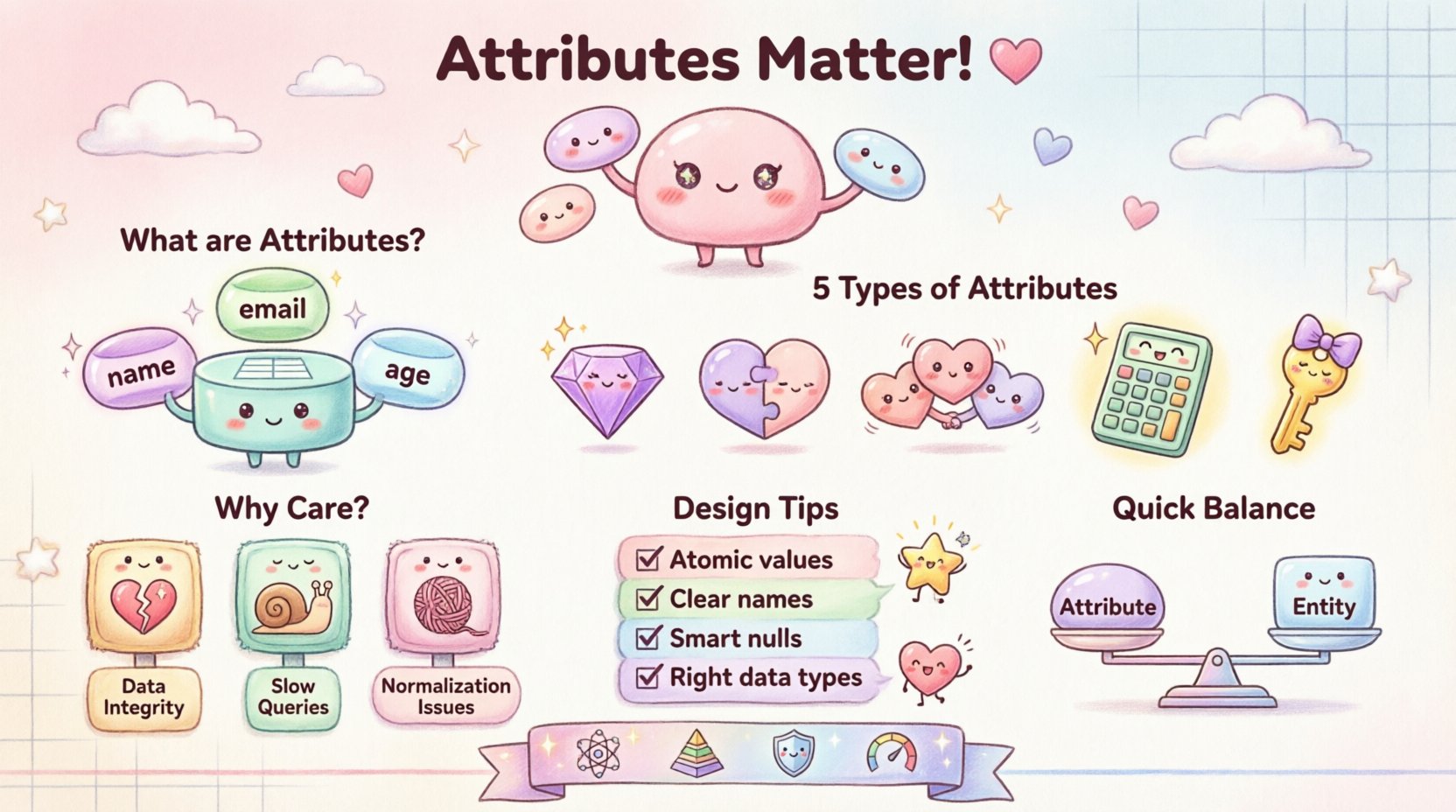
🛠️ Defining Attributes in the Data Model
An attribute is a property or characteristic of an entity. In a physical database, this translates to a column within a table. In the conceptual phase, it is the circle or oval connected to the entity rectangle in an ER diagram. The distinction between an entity and an attribute is sometimes blurry, but the rule of thumb is simple: if the data describes the entity and cannot exist independently, it is an attribute.
Consider a Customer entity. The name, address, and date of birth are attributes. They describe the customer but do not exist as standalone records in the same way an order or a product might. However, the decision of how to store these attributes is where the complexity begins.
Types of Attributes You Must Know
Not all attributes are created equal. Understanding the specific classification of an attribute helps in determining its storage requirements and constraints. Below is a breakdown of the common types encountered during data modeling.
| Attribute Type | Description | Example |
|---|---|---|
| Simple Attribute | Atomic value; cannot be divided further. | Age, Social Security Number |
| Composite Attribute | Divided into sub-parts. | Address (Street, City, Zip) |
| Multi-valued Attribute | Can hold multiple values for a single entity instance. | Phone Numbers, Email Addresses |
| Derived Attribute | Calculated from other attributes. | Age (calculated from DOB), Total Price |
| Key Attribute | Uniquely identifies the entity. | Customer ID, Order Number |
Each of these types requires specific handling in the logical design phase. Failing to distinguish between a simple attribute and a composite one can lead to rigid schemas that are difficult to modify later. For instance, storing a full address as a single string makes it hard to filter by city or zip code without complex string manipulation.
⚖️ The Hidden Cost of Poor Attribute Design
Many teams treat attributes as trivial details to be filled in after the relationships are established. This approach often results in significant technical debt. When attributes are poorly defined, the consequences ripple through the entire system.
- Data Integrity Issues: If an attribute allows null values without clear business logic, reports become unreliable. If an attribute lacks constraints (like maximum length or valid range), the database accepts garbage data.
- Query Performance Degradation: Storing derived data redundantly without indexing can slow down updates. Conversely, not indexing frequently queried attributes can make search operations sluggish.
- Normalization Violations: Improperly splitting or merging attributes often leads to anomalies during insertion, deletion, or updating of records.
- Scalability Bottlenecks: Attributes that grow unbounded (like storing a list of tags in a single text field) prevent efficient partitioning and sharding strategies.
It is not merely about having the right columns; it is about having the right constraints and data types. A varchar field used for storing a phone number is less efficient and less accurate than a specific integer or formatted string type that validates the input.
🔍 Deep Dive: Attribute Design Patterns
To build robust systems, designers should apply specific patterns when defining attributes. These patterns ensure consistency and clarity across the data model.
1. Atomicity and the First Normal Form
The first rule of attribute design is atomicity. Every attribute should hold a single, indivisible value. Avoid storing multiple values in one cell.
- Bad Practice: A
skillscolumn containing “SQL, Python, Java”. - Good Practice: A separate junction table linking Employee and Skill.
Violating atomicity complicates querying. You cannot easily count how many employees know “Python” without parsing strings. Keeping attributes atomic simplifies the logic required for data retrieval and aggregation.
2. Naming Conventions and Clarity
Attribute names must be self-explanatory. Ambiguity is the enemy of maintainability. Avoid abbreviations that might not be obvious to future developers. Use singular nouns for attributes to reflect that they describe a single property of the entity.
- Ambiguous:
dateorval. - Clear:
birth_dateortransaction_value.
Consistency in naming also helps automated tools generate documentation and code. If the model uses created_at everywhere, the generated SQL queries will follow that pattern, reducing cognitive load for the engineering team.
3. Handling Nullability
Every attribute must have a defined rule regarding nulls. In many systems, NULL is treated differently than an empty string or zero. Deciding whether an attribute can be null should be based on business logic.
- Mandatory Attributes: If a Customer cannot exist without an email address, the attribute should be
NOT NULL. - Optional Attributes: If a Product might not have a middle name, the attribute should allow
NULL.
Overusing NULL can lead to three-valued logic errors in SQL queries (where NULL = NULL is false). Explicitly handling nulls in the design phase prevents these logical traps.
🧩 Attributes vs. Relationships: Finding the Balance
There is often a debate regarding when to stop adding attributes and start creating new entities. This is the classic “Attribute vs. Entity” dilemma. The decision hinges on the cardinality of the relationship.
If an attribute can exist independently or has its own set of properties, it should likely be an entity. If it is purely descriptive and dependent on the parent, it remains an attribute.
- Scenario A: A Car has a
colorattribute. This is descriptive. It has no life of its own. - Scenario B: A Car has an
owner. The owner is a person who has their own attributes (name, address). This is a relationship to an entity, not an attribute. - Scenario C: A Course has
topics. If topics are standard (Math, Science), they can be attributes. If topics are complex (having a description, a difficulty level), they should be entities.
Getting this balance wrong leads to either overly denormalized tables or unnecessarily fragmented models. The goal is to capture the necessary detail without introducing complexity that the business logic does not require.
📉 Impact on Normalization
Normalization is the process of organizing data to reduce redundancy. Attributes are the primary units being moved around during this process. Understanding how attributes behave is essential for reaching 3rd Normal Form (3NF).
Transitive Dependencies
A transitive dependency occurs when a non-key attribute depends on another non-key attribute. This is a common pitfall in attribute design.
Imagine a Order table that contains order_id, customer_id, customer_name, and customer_address.
customer_namedepends oncustomer_id.customer_addressdepends oncustomer_id.customer_namedoes not depend onorder_id.
Here, customer_address is transitively dependent on order_id through customer_id. To normalize this, you must move the customer attributes to a separate Customer table. This reduces storage and ensures that if a customer moves, you only update one record.
Functional Dependencies
Every attribute must have a clear functional dependency on the primary key. If you cannot determine which key determines an attribute’s value, the attribute does not belong in that table. This check is vital for data integrity.
Rule: Every non-key attribute must provide a fact about the key, the whole key, and nothing but the key.
🚫 Common Pitfalls to Avoid
Even experienced designers can fall into traps when defining attributes. Below are the most frequent errors and how to prevent them.
1. Storing Derived Data
It is tempting to store calculated values to save computation time during queries. For example, storing the total_price in an order table instead of calculating it from line_items.
- Risk: Data inconsistency. If the item price changes, the historical order total becomes incorrect unless you also update the total price field.
- Solution: Store only the base data. Calculate derived values at query time or in an application layer.
2. Ignoring Data Types
Using a generic string type for everything is a quick way to save time, but it creates problems later. Dates stored as strings cannot be sorted or filtered efficiently. Numbers stored as strings prevent mathematical operations.
- Best Practice: Select the specific data type that matches the domain. Use
DATE,INT,DECIMAL, orBLOBas appropriate.
3. Overlooking Character Sets
Text attributes require a defined character set. If you assume ASCII but receive UTF-8 input, you will lose special characters. This is critical for global applications.
- Check: Ensure the database supports the necessary collation and character encoding for your target audience.
🚀 Performance Implications of Attributes
Attributes directly influence how the database engine retrieves and stores data. The physical implementation of an attribute affects performance metrics.
Indexing Strategies
Not all attributes should be indexed. Indexing adds overhead to write operations (INSERT, UPDATE, DELETE) but speeds up read operations (SELECT).
- High Cardinality: Attributes with many unique values (like Email) are good candidates for indexes.
- Low Cardinality: Attributes with few unique values (like Gender or Status) are often poor candidates for indexes unless used in specific filtering combinations.
Storage Efficiency
Variable-length attributes can save space compared to fixed-length attributes, but they may introduce fragmentation. Understanding the storage engine is important.
- Fixed Length: Faster retrieval, wastes space if data is short.
- Variable Length: Saves space, slightly slower retrieval due to metadata overhead.
✅ A Checklist for Attribute Design
Before finalizing your ER diagram, run through this checklist to ensure your attributes are robust.
- ☑️ Is every attribute atomic (no lists in a single field)?
- ☑️ Does every attribute have a unique, descriptive name?
- ☑️ Is the data type appropriate for the expected value?
- ☑️ Are nullability constraints defined for all fields?
- ☑️ Have derived attributes been removed in favor of calculation?
- ☑️ Do any attributes violate normalization rules?
- ☑️ Is the storage size optimized for the expected data volume?
- ☑️ Are foreign keys correctly linked to parent attributes?
Following this list ensures that the foundation of your data model is solid. It shifts the focus from “does it work now” to “does it work for years”.
🔗 The Interplay of Attributes in Complex Systems
In complex systems, attributes often span multiple contexts. Consider an audit trail. You might need an attribute to track who changed a record and when. This is often implemented as a set of attributes on every table (created_by, created_at, updated_by, updated_at).
While this adds redundancy, it is a deliberate design choice for traceability. In this case, the attributes are not just data points; they are system metadata. Understanding the purpose of every attribute is key to managing this complexity.
Another consideration is internationalization. Attributes like names or addresses must handle different formats. A single attribute structure might not suffice for a global user base. Designing for flexibility early—perhaps by using separate attributes for first name and last name rather than a single full_name string—can save significant refactoring effort later.
🛡️ Security and Privacy Considerations
Attributes often hold sensitive information. Designing for security starts with identifying which attributes require protection.
- PII (Personally Identifiable Information): Names, addresses, and IDs require encryption at rest and in transit.
- Access Control: Some attributes should only be visible to specific roles. The ER diagram should ideally note which fields are sensitive, even if the enforcement happens at the application layer.
- Compliance: Regulations like GDPR or CCPA impact how long you store certain attributes. Designing the schema to support data retention policies (e.g.,
expires_atattributes) helps with compliance.
Neglecting these considerations during the modeling phase can lead to expensive security patches or legal issues down the line. Treat sensitive attributes with the same rigor as structural ones.
📝 Summary of Key Takeaways
Attributes are the substance of your database. Without them, relationships are just empty lines connecting empty boxes. A well-designed set of attributes ensures that the data is accurate, efficient, and secure.
- Focus on Atomicity: Keep data granular and indivisible.
- Respect Normalization: Eliminate transitive dependencies to prevent anomalies.
- Define Constraints: Use data types and nullability to enforce business rules.
- Consider Performance: Index wisely and choose storage types carefully.
- Plan for Security: Identify sensitive data early.
By dedicating time to the nuances of attribute design, you create a data model that is resilient to change and efficient in operation. The power of an ER diagram lies not just in its connections, but in the precision of the details it captures.