Organizations often struggle to align their daily operations with long-term ambitions. This disconnect frequently stems from a misunderstanding of how motivation functions within an enterprise structure. The Business Motivation Model (BMM) offers a robust framework for clarifying these relationships, yet it remains shrouded in confusion. Many leaders treat strategy as a static document rather than a dynamic system of interrelated elements. This guide aims to clarify the core principles, dismantle common misconceptions, and provide a clear path toward effective strategic alignment.
Strategic success is not about magic; it is about structure. When we strip away the jargon, the Business Motivation Model is simply a way to document what an organization wants, why it wants it, and how it plans to get there. It connects stakeholders to outcomes through goals, objectives, and rules. Below, we explore the reality behind the myths that often stall progress.
🏗️ Understanding the Foundation: What Is the Model? 📋
Before dissecting the myths, it is necessary to establish a shared understanding of the core components. The model does not dictate a specific software tool or methodology. Instead, it provides a conceptual language for describing business intent.
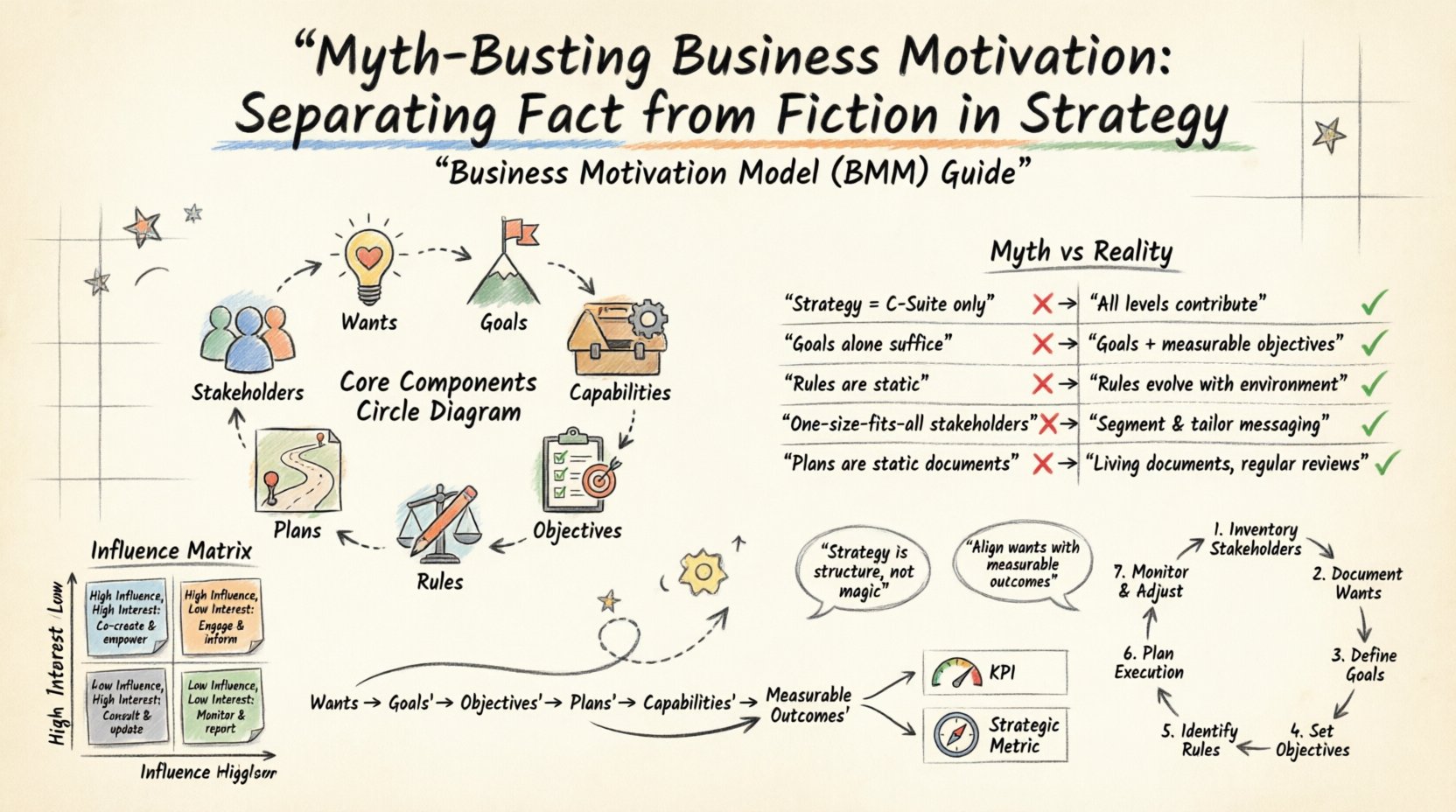
Core Components Defined
- Stakeholders: Individuals or groups who have a vested interest in the enterprise. This includes shareholders, employees, customers, and partners.
- Wants: The desires or needs that drive a stakeholder. These are the “why” behind the actions.
- Goals: High-level outcomes that a stakeholder wishes to achieve. They are often abstract and long-term.
- Objectives: Specific, measurable steps taken to fulfill a goal. They are the tangible targets.
- Rules: Constraints or policies that must be followed during execution. These define the boundaries of operation.
- Plans: The specific actions and resources allocated to achieve objectives.
- Capabilities: The abilities or assets required to execute the plans.
When these elements are mapped correctly, the organization gains visibility into how a specific task (like a marketing campaign) contributes to a high-level goal (like market dominance). Without this map, efforts often scatter, leading to wasted resources and confused teams.
🚫 The Top Myths About Strategic Motivation 🔥
There is significant noise surrounding how businesses approach motivation and strategy. This section addresses the most prevalent misconceptions that hinder effective implementation.
Myth vs. Reality Comparison
| Myth | Reality |
|---|---|
| Strategy is only for the C-Suite. | Strategy requires input from all levels to be executable. |
| Goals are enough; objectives are optional. | Goals without measurable objectives are merely wishes. |
| Rules are rigid and unchangeable. | Rules must evolve as the business environment shifts. |
| One size fits all for all stakeholders. | Different stakeholders have unique wants and influence levels. |
| Plans are static documents. | Plans are living documents subject to regular review. |
Myth 1: Strategy is Only for Leadership 🤔
Many organizations believe that strategic motivation is the sole responsibility of executives. They create high-level goals and expect the rest of the workforce to simply execute them without context. This top-down approach often fails because it ignores the “Wants” of the operational staff.
- The Reality: Stakeholders exist at every level. A frontline employee has wants that influence their performance. If their personal goals align with the organizational goals, execution improves.
- The Risk: Ignoring lower-level stakeholders leads to disengagement and resistance to change.
- The Fix: Engage teams in the definition of objectives. Ensure they understand how their daily tasks link to the broader picture.
Myth 2: Goals Are Sufficient Without Objectives 🎯
It is common to see mission statements that declare “We will be the best in the world.” While inspiring, this is not a strategy. It is a statement of desire. Without Objectives, there is no way to measure progress.
- The Reality: Goals are directional. Objectives are measurable milestones. A goal might be “Increase Customer Satisfaction.” An objective could be “Reduce response time to under 24 hours by Q3.”
- The Risk: Without objectives, teams cannot track success. Resources may be poured into areas that do not move the needle on the actual goal.
- The Fix: Apply the SMART criteria to every objective. Ensure every goal has at least one measurable objective attached to it.
Myth 3: Rules Are Static and Unchangeable ⚖️
Compliance and policy are often viewed as the final word. Once a rule is set, it is assumed to remain in place indefinitely. However, business environments are fluid.
- The Reality: Rules constrain behavior to ensure safety, compliance, or brand consistency. However, if a rule prevents a strategic objective from being met, it must be reviewed.
- The Risk: Rigid adherence to outdated rules can strangle innovation and block strategic pivots.
- The Fix: Treat rules as variables in the strategy equation. Regularly audit them against current strategic needs.
Myth 4: One Size Fits All for All Stakeholders 🤝
Organizations often treat all employees as a monolith. They issue the same communication and expect the same reaction. This ignores the diversity of motivation within a workforce.
- The Reality: A salesperson is motivated by different factors than an engineer. A shareholder is motivated by ROI, while a community member is motivated by social impact.
- The Risk: Generic motivation strategies fail to resonate. Resources are wasted on communication that does not land.
- The Fix: Segment stakeholders. Understand their specific Wants and influence. Tailor the message and the incentives accordingly.
Myth 5: Plans Are Static Documents 📄
It is tempting to create a five-year plan and file it away. The belief is that the plan is the strategy. In reality, the plan is a snapshot in time.
- The Reality: Plans must be reviewed and adjusted as capabilities change and market conditions shift. A plan without a review mechanism is obsolete.
- The Risk: Teams continue to follow a plan that no longer serves the business, leading to strategic drift.
- The Fix: Establish quarterly or monthly review cycles. Update the linkage between Goals, Objectives, and Plans based on new data.
🔗 Aligning Stakeholders and Capabilities 🤝
Once the myths are cleared, the focus shifts to alignment. This involves connecting the human element (Stakeholders) with the operational element (Capabilities).
The Influence Matrix
Not all stakeholders hold the same power. To manage motivation effectively, you must map the influence each party has over the enterprise.
- High Influence, High Interest: These are key partners. They must be actively engaged in the planning process.
- High Influence, Low Interest: These stakeholders need to be kept satisfied. They can block progress if neglected.
- Low Influence, High Interest: These groups should be kept informed. Their feedback is valuable for execution details.
- Low Influence, Low Interest: These can be monitored with minimal effort.
Linking Wants to Capabilities
Capability is the bridge between what you want to do and what you can do. A common failure point is setting a Goal that exceeds the available Capabilities.
For example, if the Goal is “Expand into a new international market,” the Capability required includes “Multilingual support staff” and “Local regulatory knowledge.” If these capabilities do not exist, the plan cannot succeed, regardless of how well the Goal is defined.
- Identify existing capabilities.
- Identify gaps between current capabilities and those needed for the Goal.
- Create a Plan to acquire or develop the missing capabilities.
📊 Measuring Success: KPIs vs. Strategic Metrics 📈
Measurement is often the last step in the process, but it should be the first step in planning. You cannot manage what you do not measure. However, there is a distinction between Key Performance Indicators (KPIs) and Strategic Metrics.
Understanding the Difference
| Key Performance Indicator (KPI) | Strategic Metric |
|---|---|
| Operational focus. | Strategic focus. |
| Short-term tracking. | Long-term alignment. |
| Measures efficiency (e.g., output per hour). | Measures effectiveness (e.g., market share growth). |
Integrating Metrics into the Model
Every Objective should have a corresponding metric. This creates a direct line of sight from daily activity to strategic outcome.
- Define the Metric: What data point proves the objective is met?
- Set the Threshold: What is the target value?
- Assign Responsibility: Who owns the data?
- Review Frequency: How often is the data analyzed?
When metrics are misaligned, organizations experience “optimization of the wrong things.” For instance, maximizing production speed (KPI) might hurt quality (Strategic Metric). The model helps ensure that KPIs support the higher-level Strategic Metrics.
🔄 Implementation and Continuous Improvement 🔄
Implementing this model is not a one-time project. It is an ongoing discipline. The environment changes, and the model must adapt.
Step-by-Step Integration
- Inventory Stakeholders: List everyone who impacts or is impacted by the business.
- Document Wants: Interview stakeholders to understand their core motivations.
- Define Goals: Translate Wants into organizational Goals.
- Set Objectives: Break Goals down into measurable Objectives.
- Identify Rules: List the constraints and policies that apply.
- Plan Execution: Assign Plans and Resources to meet Objectives.
- Monitor and Adjust: Regularly review the linkage and update as needed.
Communication is Key
Even the best model fails if the information is not communicated. Use clear visualizations to show how a specific task links to a major Goal. This helps employees see the value in their work.
- Avoid overly complex diagrams.
- Focus on the “Why” rather than just the “What”.
- Encourage feedback loops where teams can suggest changes to the plan.
🛡️ Addressing Common Pitfalls in Execution 🛡️
Even with a clear model, execution can stumble. Here are specific pitfalls to watch for.
Pitfall 1: Goal Dilution
When too many Goals are set, focus is lost. Prioritize ruthlessly. Select the top 3 to 5 Goals that drive the majority of value.
Pitfall 2: Objective Creep
Objectives can expand beyond their original scope. Keep them tight and measurable. If an Objective becomes too broad, break it down further.
Pitfall 3: Rule Obsolescence
Rules accumulate over time. Conduct an annual audit. Remove rules that no longer serve a purpose or hinder strategic goals.
Pitfall 4: Capability Gaps
Do not assume capabilities exist. Validate them against the Plan. If a capability is missing, either adjust the Plan or invest in building the capability.
🚀 Final Thoughts on Strategic Clarity 🌟
Separating fact from fiction in business motivation requires discipline. It demands that we look past the slogans and into the mechanics of how an organization functions. The Business Motivation Model provides the structure needed to make this visible.
By rejecting the myths of static planning and top-down control, organizations can build a more resilient strategy. They can align the diverse wants of stakeholders with the measurable objectives of the enterprise. This alignment turns abstract ambition into concrete results.
Remember that strategy is a living system. It requires constant attention, regular review, and the courage to change course when the data demands it. When the facts replace the fiction, the path forward becomes clear.