
In an environment defined by rapid shifts and unpredictable market dynamics, the ability to pivot without losing strategic focus is paramount. Organizations often struggle to maintain alignment between high-level strategy and day-to-day execution. This is where the Business Motivation Model (BMM) becomes a critical asset. By providing a structured approach to understanding the why behind business decisions, BMM enables leaders to build frameworks that support true responsiveness.
This guide explores how to utilize Business Motivation Models to drive organizational agility. We will examine the core components of the model, how it maps to strategic goals, and the practical steps for implementation without reliance on specific tools.
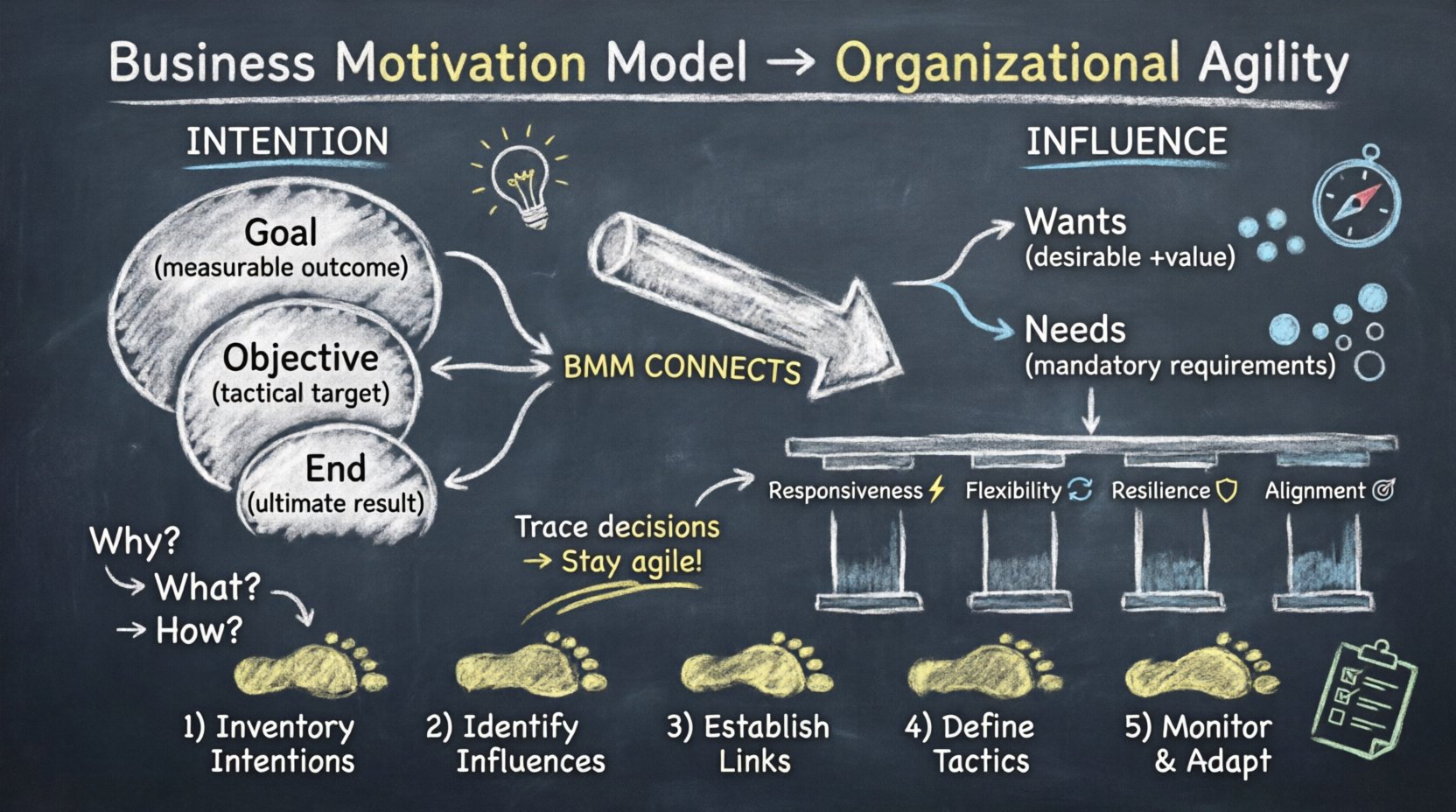
🧩 Understanding the Business Motivation Model (BMM)
The Business Motivation Model is an open standard defined by the Object Management Group (OMG). It serves as a meta-model for business architecture. Unlike traditional flowcharts that focus solely on processes, BMM focuses on the drivers behind those processes. It answers questions about what the organization wants to achieve and what factors influence those achievements.
At its core, the model separates intention from influence. This distinction allows for clearer planning and more adaptable execution. The framework is divided into two primary categories:
- Intention: What the organization aims to do. This includes goals, objectives, and outcomes.
- Influence: What affects the intention. This includes internal capabilities, external pressures, and motivations.
🎯 The Anatomy of Intention
Intention in BMM is hierarchical. It starts broad and becomes specific.
- Goal: A desired outcome that is measurable and time-bound. For example, increasing market share by 5% within two years.
- Objective: A specific target that supports a goal. It is often more tactical than a goal.
- End: The ultimate result of an activity or process, distinct from the goal which is the desired state.
By defining these layers clearly, organizations can trace a line from a high-level strategic vision down to the specific actions required to realize it.
⚡ The Anatomy of Influence
Influence represents the forces that push or pull on the intention. These are categorized into Wants and Needs.
- Wants: Desirable outcomes that are not strictly required but add value. For instance, improving employee satisfaction beyond the baseline.
- Needs: Mandatory requirements. Without meeting these, the intention fails. Compliance with new regulations is a common need.
Influence factors can be internal (resources, culture) or external (competitors, economic climate). Mapping these factors allows an organization to see exactly what drives success and what poses risks.
🔄 Defining Organizational Agility
Agility is often misunderstood as mere speed. In a business architecture context, agility is the capacity to adapt to change while maintaining stability. It is the ability to detect shifts in the environment and reorient resources accordingly.
Key characteristics of an agile organization include:
- Responsiveness: The speed at which the organization reacts to external stimuli.
- Flexibility: The ability to modify processes without breaking the underlying structure.
- Resilience: The ability to recover quickly from disruptions.
- Alignment: Ensuring that changes at the tactical level do not drift away from strategic intent.
Without a model like BMM, agility can become chaotic. Teams may move fast, but in different directions. BMM provides the coordinate system that keeps movement purposeful.
🔗 Connecting BMM to Agility
The link between Business Motivation Models and agility lies in the traceability of decisions. When a change occurs, BMM allows leaders to assess the impact on intentions and influences immediately.
1. Dynamic Goal Management
Traditional planning often treats goals as static documents. In an agile framework using BMM, goals are living entities. Because the model explicitly links goals to influences, a change in an influence factor (e.g., a supply chain disruption) can trigger an automatic review of the associated goal.
This reduces the lag time between problem identification and strategic adjustment.
2. Clarifying the “Why”
Agile teams often work in sprints. Without context, they focus on tasks. BMM ensures every task is linked to a Goal or Objective. When a team member understands how their work influences a specific Goal, they are empowered to make better decisions when faced with obstacles.
This decentralization of decision-making is a hallmark of agility.
3. Managing Conflicting Priorities
Organizations often face competing wants and needs. For example, a need for speed might conflict with a goal for quality. BMM visualizes these relationships. By mapping conflicts to influence factors, leaders can negotiate trade-offs based on data rather than intuition.
📊 Strategic Alignment Mechanisms
To leverage BMM effectively, organizations must establish mechanisms for alignment. This involves connecting the Strategic Layer with the Operational Layer.
| BMM Component | Strategic Layer | Operational Layer |
|---|---|---|
| Goal | Long-term vision and market position | Departmental targets |
| Objective | Specific milestones | Project deliverables |
| Need | Compliance and Risk | Process constraints |
| Want | Customer Experience | Service enhancements |
| Plan | Business Strategy | Tactics and Activities |
This table illustrates how the abstract concepts of BMM translate into tangible operational elements. By maintaining this mapping, agility is preserved because operational changes are always traceable back to strategic intent.
🛠️ Implementation Pathway
Implementing a BMM-driven approach does not require new software licenses. It requires a shift in thinking and documentation practices. Follow these steps to begin the journey.
Step 1: Inventory Existing Intentions
Collect all current strategic documents, mission statements, and performance metrics. Map them to the BMM categories of Goal and Objective. Identify gaps where intentions exist but are not clearly defined.
- Action: Create a master list of all current organizational goals.
- Action: Tag each goal with its primary influence factors.
Step 2: Identify Influence Factors
Conduct workshops with stakeholders to identify what drives the business. Distinguish between internal capabilities and external pressures.
- Action: List all internal strengths and weaknesses.
- Action: List all external opportunities and threats.
- Action: Categorize these as Wants or Needs.
Step 3: Establish Links
Connect the intentions to the influences. This creates the web of motivation. A goal is not an island; it is supported or hindered by specific factors.
- Action: Draw connections between Goals and influencing factors.
- Action: Ensure every Goal has at least one positive influence and one risk factor identified.
Step 4: Define Tactics
Translate intentions into actionable plans. This is where BMM meets execution. Tactics are the specific activities chosen to influence the factors and achieve the intentions.
- Action: List specific projects that support key Goals.
- Action: Assign ownership for each tactic.
- Action: Set review cycles to validate the tactic’s effectiveness.
Step 5: Monitor and Adapt
Agility requires continuous feedback. Use the BMM structure to monitor the health of intentions against the current state of influences.
- Action: Regularly update the status of influence factors.
- Action: Adjust tactics if an influence factor changes significantly.
- Action: Review Goals periodically to ensure they remain relevant.
⚠️ Challenges and Mitigation
While powerful, adopting this model comes with challenges. Organizations must be aware of common pitfalls to avoid them.
| Challenge | Impact on Agility | Mitigation Strategy |
|---|---|---|
| Over-Engineering | Slows down decision-making due to excessive modeling | Keep models lightweight. Focus on high-level links first. |
| Stakeholder Buy-in | Teams may ignore the model if they do not see value | Involve teams in the mapping process to create ownership. |
| Static Documentation | Model becomes outdated quickly in volatile markets | Integrate model reviews into regular planning cycles. |
| Lack of Traceability | Strategic goals become disconnected from daily work | Enforce mandatory links between projects and goals. |
📈 Measuring Success
How do you know if leveraging the Business Motivation Model has improved agility? Look for changes in operational metrics and cultural indicators.
- Time-to-Decision: Measure how long it takes to pivot strategy when a threat is identified. A successful implementation should show a reduction in this time.
- Goal Achievement Rate: Track the percentage of goals met within the target timeframe. Improved alignment should lead to higher success rates.
- Employee Clarity: Survey employees to see if they can articulate how their work contributes to the organization’s goals.
- Risk Response: Evaluate how quickly risks are identified and mitigated. The influence mapping should highlight risks earlier.
🌱 Cultural Alignment
Technology and models are secondary to culture. For BMM to drive agility, the organizational culture must support transparency and adaptability.
Transparency: The model should be visible to all relevant stakeholders. Hidden intentions lead to misalignment.
Collaboration: Influence factors often span departments. Cross-functional teams must work together to manage these factors.
Learning: Treat the model as a learning tool. When a goal is missed, analyze the influence factors. Did an external pressure change? Was a need underestimated?
🔮 Future Outlook
As organizations continue to navigate complex environments, the demand for structured yet flexible planning frameworks will grow. The Business Motivation Model offers a language that bridges the gap between business strategy and enterprise architecture.
Focusing on the relationships between intentions and influences allows organizations to move from reactive firefighting to proactive adaptation. By understanding what drives the business, leaders can build structures that withstand volatility.
The path to enhanced organizational agility is not about moving faster blindly. It is about moving with purpose. The Business Motivation Model provides the compass for that journey.
Start by mapping your current intentions. Identify the forces that influence them. Then, build the tactics that navigate those forces. In doing so, you create an organization that is not just resilient, but adaptable.