
Agile development relies heavily on the quality of communication between stakeholders, product owners, and the development team. At the heart of this communication lies the User Story. However, even within a well-structured framework, teams often fall into traps that degrade the value of these artifacts. These traps are known as user story anti-patterns. When left unchecked, they lead to confusion, wasted effort, and technical debt.
This guide provides a deep dive into recognizing these patterns and applying effective resolution strategies. We will explore why these issues occur, how they impact delivery, and what concrete steps teams can take to maintain high-quality backlog items without relying on specific tools.
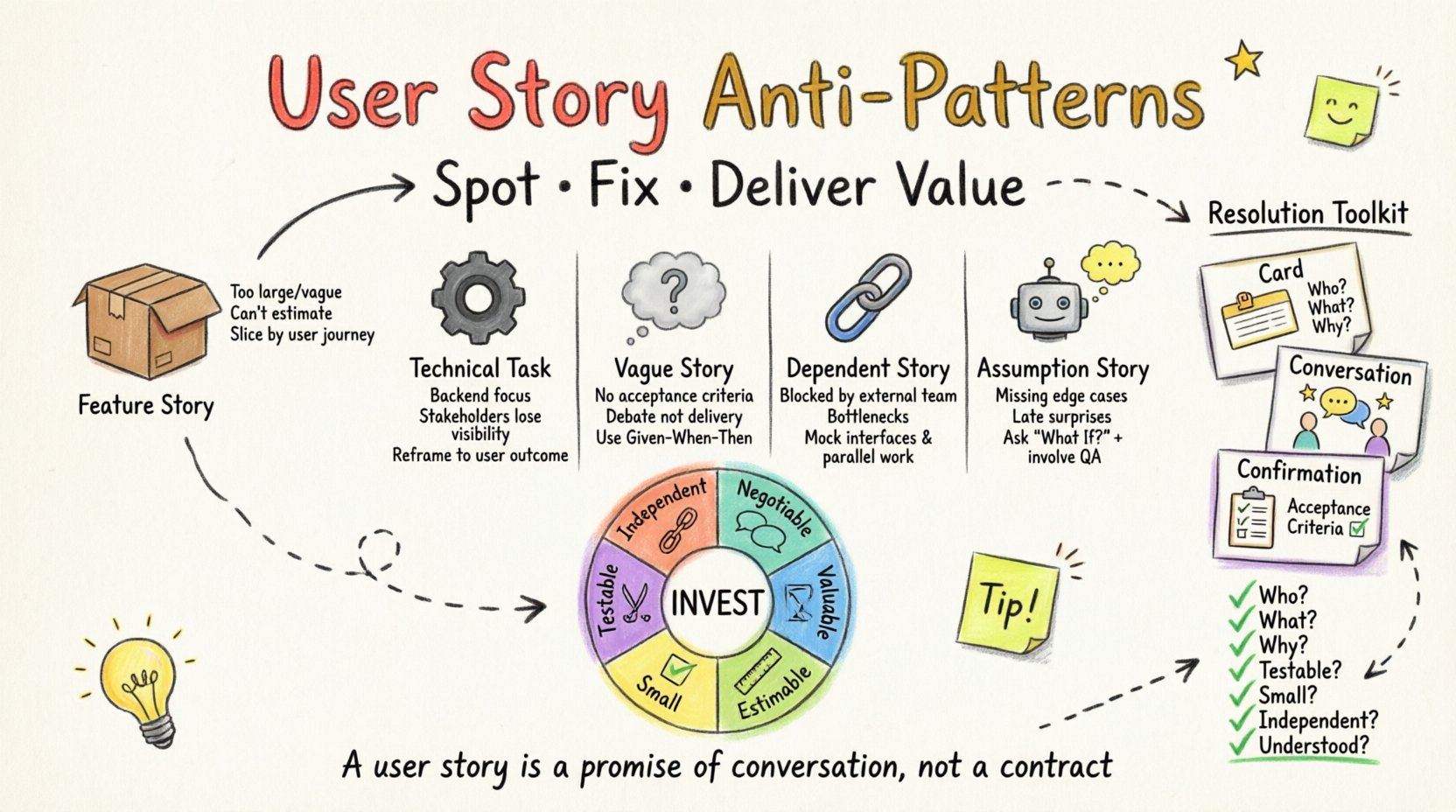
🧩 What Defines a User Story Anti-Pattern?
An anti-pattern is a common response to a recurring problem that is usually ineffective and risks being highly counterproductive. In the context of Agile requirements, a user story anti-pattern occurs when the format, content, or intent of a story deviates from the principles that make user stories effective.
Effective user stories are not just tasks disguised as stories. They are placeholders for conversation. When a story becomes a command, a technical task, or an assumption, it ceases to function as a bridge between business value and implementation.
⚠️ The Cost of Poor Stories
Before addressing the patterns, it is crucial to understand the cost associated with them:
- Increased Rework: Ambiguous stories lead to incorrect implementations that must be fixed later.
- Team Frustration: Developers spend time clarifying requirements instead of building.
- Slower Velocity: Time spent debating requirements reduces time available for coding.
- Lower Quality: Lack of clear acceptance criteria often results in incomplete testing.
📏 Context: The INVEST Model
To identify anti-patterns, one must understand the baseline. The INVEST model provides a mnemonic for good criteria:
- Independent
- Negotiable
- Valuable
- Estimable
- Small
- Testable
Anti-patterns usually violate one or more of these principles. For instance, a story that is too large violates the “Small” principle. A story that relies on another story to be delivered violates the “Independent” principle.
🚫 Top 5 Common User Story Anti-Patterns
The following table outlines the most frequent deviations found in product backlogs. Recognizing these in their early stages allows teams to pivot before significant resources are committed.
| Anti-Pattern Name | Typical Symptom | Impact on Team |
|---|---|---|
| 📦 The Feature Story | Too large, complex, or vague. | Cannot be estimated accurately; high risk of failure. |
| 🔧 The Technical Task | Focuses on backend code, not user value. | Stakeholders lose visibility on progress. |
| ❓ The Vague Story | Lacks clear acceptance criteria. | Ends in debate rather than delivery. |
| 🔗 The Dependent Story | Relies on external teams or systems. | Creates bottlenecks and blocks work. |
| 🤖 The Automated Story | Written without human context. | Misses the “why” behind the feature. |
🧐 Deep Dive: The Feature Story (Too Big)
This is perhaps the most common anti-pattern. A feature story attempts to describe an entire capability rather than a discrete increment of value. It often reads like a project plan rather than a user story.
❌ Example of the Anti-Pattern
“As a user, I want to manage my account settings so that I can update my profile, change my password, and delete my data.”
Why it fails: This story combines three distinct user needs. It is too large to fit into a single sprint. It is difficult to test all three components simultaneously. If the password change works but the profile update fails, the story is only partially complete.
✅ Resolution Strategy
Break the story down using the slicing technique. Identify the smallest unit of value that can be delivered independently.
- Split by User Journey: Create separate stories for updating the profile, changing the password, and deleting data.
- Split by Complexity: If the profile update involves complex validation, handle the basic version first, then add complexity in a second iteration.
- Split by Role: If the settings differ for Admins vs. Regular Users, create separate stories.
By reducing scope, the team can deliver value earlier. This aligns with the principle of delivering working software frequently.
🧐 Deep Dive: The Technical Task
Teams often write stories that describe technical infrastructure work. While necessary, these do not represent value to the end user directly. They are often hidden from stakeholders.
❌ Example of the Anti-Pattern
“Migrate the database from SQL Server to PostgreSQL to improve performance.”
Why it fails: The stakeholder does not care about the database type. They care about the performance improvement. This story obscures the business value. If the migration fails, the stakeholder sees no benefit.
✅ Resolution Strategy
Reframe the story to focus on the outcome rather than the implementation.
- Focus on the Benefit: “As a shopper, I want faster page load times so I can complete my purchase before I lose interest.”
- Hide Technical Details: The implementation details (database migration, caching, code optimization) are part of the how, which the team decides during refinement.
- Use Enabler Stories: If the technical work must be tracked explicitly, label it as an Enabler story. This distinguishes it from value-adding stories while acknowledging its necessity.
This approach ensures that the backlog remains focused on user value, even when technical debt must be addressed.
🧐 Deep Dive: The Vague Story
A story without clear boundaries is a recipe for disagreement. This happens when acceptance criteria are missing or written in natural language that allows for multiple interpretations.
❌ Example of the Anti-Pattern
“As a user, I want to search for products easily.”
Why it fails: “Easily” is subjective. Does it mean three clicks? Does it mean auto-complete? Does it mean filtering by color? Without concrete criteria, the developer builds one version, and the stakeholder expects another.
✅ Resolution Strategy
Apply the Definition of Done rigorously to every story. Use Acceptance Criteria in a structured format.
- Use Gherkin Syntax: Where possible, use Given-When-Then scenarios. This forces clarity.
- Quantify Metrics: Replace “fast” with “loads in under 2 seconds”.
- Define Edge Cases: What happens if the search returns zero results? What happens if the input is null?
Clarity reduces the cognitive load on the team. When the criteria are clear, the team can focus on execution rather than interpretation.
🧐 Deep Dive: The Dependent Story
Agile teams strive for autonomy. When a story is blocked by another team, a third-party API, or a missing system, it violates the principle of independence.
❌ Example of the Anti-Pattern
“As a user, I want to log in using my social media account, once the login API is ready.”
Why it fails: The team cannot start work. They are waiting on an external dependency. This creates idle time and disrupts the flow of work.
✅ Resolution Strategy
Manage dependencies proactively during the planning and refinement phases.
- Mocking and Stubs: Create mock interfaces for external systems to allow development to proceed without the real API.
- Parallel Work: Identify tasks that can be done independently. The team working on the frontend can build the UI while the other team builds the backend.
- Explicit Dependency Tracking: If a dependency is unavoidable, make it visible in the backlog. Do not hide it inside the story description.
Reducing dependencies increases the team’s ability to deliver value continuously.
🧐 Deep Dive: The Assumption Story
Stories often contain implicit assumptions about user behavior or system state. These assumptions are rarely tested until it is too late.
❌ Example of the Anti-Pattern
“As a user, I want to upload a profile picture.”
Why it fails: What file formats are supported? What is the maximum size? What happens if the image is too large? The assumption is that the system handles everything gracefully, but this must be explicitly stated.
✅ Resolution Strategy
Challenge every assumption during refinement sessions.
- Ask “What If”: What if the user cancels the upload? What if the network drops?
- Visualize the Flow: Use wireframes or flowcharts to map out the states.
- Involve QA Early: Quality assurance professionals are excellent at spotting missing edge cases.
🛠️ Strategies for Resolution
Once an anti-pattern is identified, how does a team resolve it? The following strategies provide a framework for improvement.
1. Backlog Refinement Sessions
Refinement is not a one-time event. It is a continuous process. During these sessions, the team reviews upcoming stories specifically for anti-patterns.
- Check for INVEST: Run through the checklist mentally. Is it testable? Is it valuable?
- Question the “Why”: If a story does not clearly state the user benefit, ask the Product Owner why it exists.
- Split Large Items: If a story takes more than a week to implement, split it.
2. The Three C’s Framework
Remember the three components of a User Story to ensure completeness:
- Card: The written text.
- Conversation: The discussion between team members and stakeholders.
- Confirmation: The tests that verify the story is done.
If any of these are missing, the story is incomplete. Often, anti-patterns arise because the team focuses only on the Card and skips the Conversation.
3. Continuous Feedback Loops
Deliver working increments frequently. This allows the team to validate assumptions early. If a story was written with an anti-pattern, the feedback loop will reveal the confusion quickly.
- Demo Early: Show progress to stakeholders before the sprint ends.
- Retrospectives: Discuss story quality in the retrospective. Did vague stories cause issues? Did technical tasks block progress?
📋 Quality Checklist for User Stories
Use this checklist before moving a story from To Do to In Progress. If the answer is “No” to any of these, the story needs refinement.
- ✅ Does the story clearly state who the user is?
- ✅ Does it clearly state what they want to do?
- ✅ Does it clearly state why they want to do it (the value)?
- ✅ Are the acceptance criteria specific and testable?
- ✅ Is the story small enough to be completed in a single sprint?
- ✅ Does it not depend on external teams for core functionality?
- ✅ Is the technical complexity understood by the team?
🔄 Building a Story-Centric Culture
Resolving anti-patterns is not just about fixing text. It is about shifting the team culture. When a team values clarity, they naturally produce better stories.
Encourage Collaboration
Stories are not written in isolation. They are the result of collaboration. Encourage developers and testers to participate in the writing process. Their perspective on feasibility and testing often reveals gaps that Product Owners miss.
Normalize Rejection
Create an environment where it is safe to reject a story that does not meet quality standards. A story should not be accepted simply because it is in the backlog. If it is not ready, it should remain in the backlog until it is refined.
Focus on Value, Not Output
Shift the conversation from “How many stories did we finish?” to “How much value did we deliver?” This reduces the pressure to rush stories and allows time for proper refinement.
🔍 Summary of Key Takeaways
Identifying and resolving user story anti-patterns is an ongoing practice. It requires vigilance, collaboration, and a commitment to quality. By understanding the common pitfalls—such as feature stories, technical tasks, and vague criteria—teams can prevent rework and frustration.
Adopting the INVEST model, utilizing the Three C’s framework, and maintaining a rigorous refinement process will lead to a healthier backlog. Remember that a user story is a promise of conversation, not a contract of delivery. When the conversation is clear, the delivery follows naturally.
Start by auditing your current backlog. Look for the patterns described in this guide. Apply the resolution strategies. Over time, you will see a marked improvement in velocity, quality, and team morale.