In the landscape of organizational efficiency, few concepts are as misunderstood as Business Process Model and Notation. Often dismissed as a mere drawing exercise, this standard carries significant weight in defining how work gets done. When organizations treat it simply as a visual aid, they miss its true potential as a rigorous communication protocol. This guide explores the structural depth of BPMN and why it serves as a foundational element for modern operational architecture. 🏗️
What is BPMN Really? 🏗️
Business Process Model and Notation is an open standard, maintained by the Object Management Group (OMG). It was designed to provide a notation that is intuitive for business users, yet detailed enough for technical developers. Unlike generic flowcharts, which rely on custom shapes and inconsistent logic, BPMN adheres to a strict syntax. This ensures that a process model created by one team can be understood and executed by another without ambiguity.
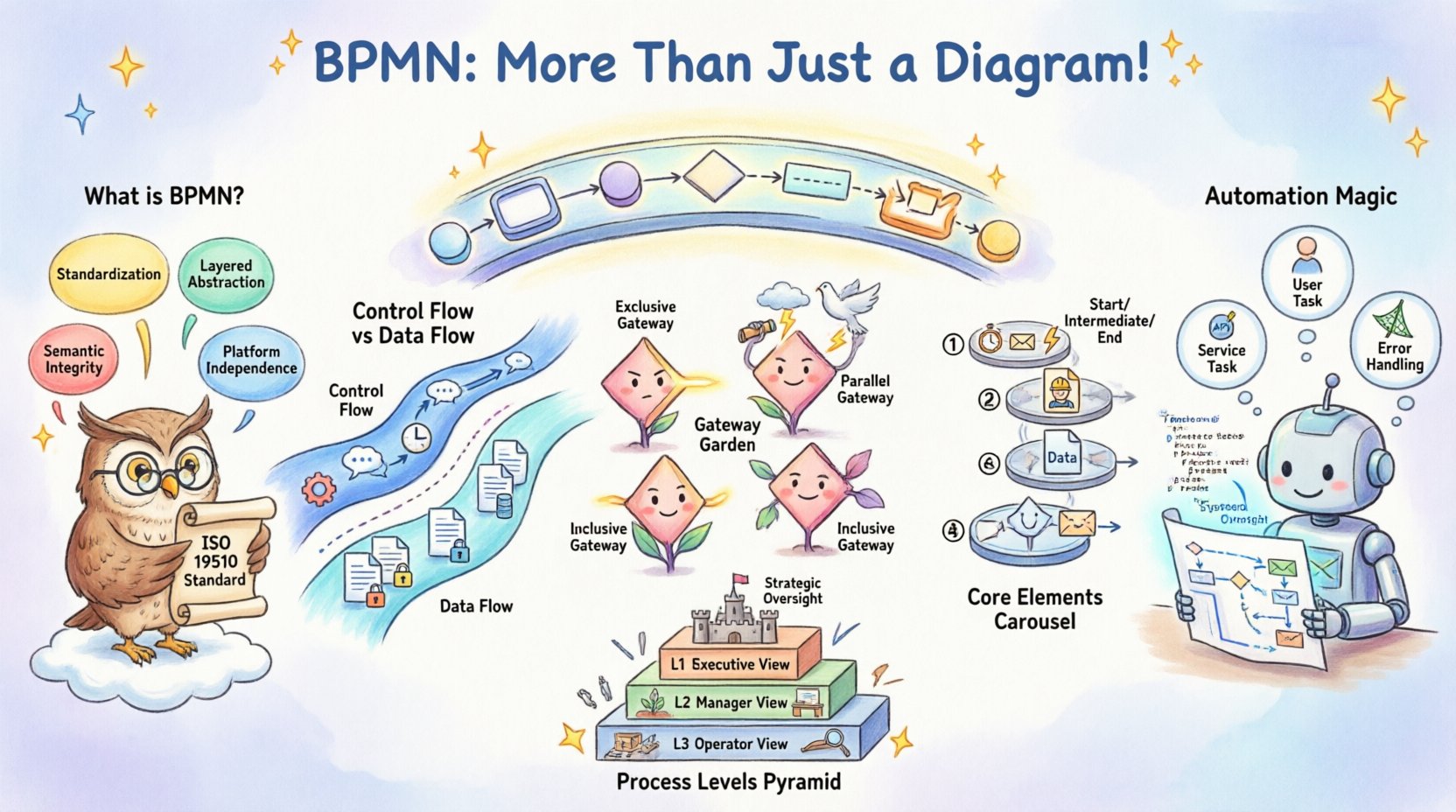
The distinction lies in the intent. A flowchart answers “What comes next?”. BPMN answers “How does the system handle this logic, data, and timing?”. It bridges the gap between abstract strategy and concrete implementation. Here are the core pillars that define its authority:
- Standardization: It is an ISO standard (ISO 19510), ensuring global consistency.
- Layered Abstraction: It allows for high-level views and granular technical details within the same document.
- Semantic Integrity: Every shape has a specific behavior defined in the specification.
- Platform Independence: It describes process logic without tying it to a specific technology stack immediately.
Control Flow vs. Data Flow ⚙️
One of the most common errors in process modeling is conflating control flow with data flow. BPMN separates these distinct concepts, allowing for clearer analysis of bottlenecks and inefficiencies.
Control Flow
This represents the sequence of activities. It dictates the order in which tasks occur. Using sequence flows, connectors, and gateways, the model determines the path a message or work item takes through the system. It handles the “when” and “where” of the operation.
Data Flow
Data objects exist independently of the control flow. They represent information entering or leaving the process. Understanding this distinction is critical for automation. If you model a task as requiring an invoice, that requirement is defined by the data object, not the arrow connecting the boxes. This separation allows for:
- Clearer auditing trails regarding information handling.
- Easier identification of data dependencies.
- Accurate mapping to database schemas in technical environments.
The Grammar of Business Logic 📝
Just as programming languages have syntax to prevent errors, BPMN has rules to prevent logical fallacies. A model is not valid if it violates these rules. This grammatical structure is where the hidden power lies. It forces the modeler to think through edge cases before implementation begins.
Consider the concept of a Gateway. In a generic diagram, a diamond might just mean a decision. In BPMN, it specifies the type of logic:
- Exclusive Gateway: Only one path is taken based on a condition.
- Parallel Gateway: Multiple paths are executed simultaneously.
- Inclusive Gateway: One or more paths may be taken, depending on conditions.
- Event-Based Gateway: The system waits for an external event to trigger a path.
By forcing the distinction between these gateways, the model eliminates ambiguity. A developer does not have to guess if tasks should run sequentially or concurrently. The notation dictates the execution order explicitly.
Core Elements and Their Meanings 📊
To understand the depth of this standard, one must look at the specific symbols and their operational implications. The table below outlines the fundamental building blocks and what they signify in a live environment.
| Symbol Type | Visual Representation | Function & Logic |
|---|---|---|
| Event | Circle (Start, Intermediate, End) | Triggers or terminates an activity. Can be time-based, message-based, or error-based. |
| Activity | Rounded Rectangle | Represents work. Can be a Task (single unit), Sub-Process (grouped), or Call Activity (reusable). |
| Gateway | Diamond | Controls the divergence and convergence of paths based on logic conditions. |
| Data Object | Sheet of paper icon | Information used or produced. Does not affect flow control directly. |
| Message Flow | Dashed Line with Arrow | Shows communication between different participants or pools (e.g., between organizations). |
Bridging Business and IT 🤝
Perhaps the most significant benefit of adopting this standard is the alignment it creates between departments. Historically, business analysts defined processes in natural language, while developers translated them into code. This translation layer often introduced errors and lost context. BPMN acts as the intermediary.
When business stakeholders review a model, they see the logic in a format they understand. When technical teams review the same model, they see the execution requirements. This shared artifact reduces the back-and-forth communication cycle. Key advantages include:
- Reduced Ambiguity: Requirements are visualized, not just written in text documents.
- Faster Onboarding: New team members can understand the process flow immediately.
- Traceability: Changes in requirements can be tracked directly against the visual model.
- Compliance Audits: Regulators can verify process adherence by reviewing the diagram.
Execution and Automation Logic 🤖
The standard supports executable modeling. This means the diagrams are not static images but can be interpreted by process engines. This capability transforms the diagram from a documentation artifact into a functional specification.
The Execution Lifecycle
When a model is deployed, the engine follows the instructions defined by the notation. It manages the state of every instance. If a process involves waiting for a payment confirmation, the engine pauses that specific instance until the event occurs. This is managed through:
- Instance Management: Tracking the state of individual process runs.
- Variable Scope: Storing data specific to a single instance.
- Error Handling: Defining what happens when a step fails (e.g., retry, escalate, or abort).
Human vs. Automated Tasks
BPMN distinguishes between work done by humans and work done by systems. A User Task implies a human needs to perform an action. A Service Task implies an automated API call or script. This distinction allows organizations to optimize resource allocation. You can identify exactly which steps require human intervention and which are candidates for full automation.
Governance and Compliance 📜
In highly regulated industries, process consistency is not optional. It is a legal requirement. BPMN provides a mechanism to document these requirements formally. Because the notation is standardized, the documentation remains valid over time, regardless of software upgrades.
Effective governance requires version control. Just as code has versions, process models do too. This allows organizations to:
- Track historical changes to a specific process.
- Revert to previous versions if a new logic fails.
- Analyze the impact of a change before it goes live.
Furthermore, the standard supports Intermediary Events. These allow the process to pause and wait for external input, such as a regulatory check or a customer approval. Modeling these pauses correctly ensures that compliance checks are not bypassed.
Future-Proofing Your Processes 🚀
Organizations face constant change. New regulations, market shifts, and technological advancements require processes to adapt. A rigid documentation method makes this adaptation difficult. BPMN offers flexibility through its hierarchy.
Process Levels
You can model at different levels of detail without losing context:
- L1 (Value Chain): High-level view of the entire organization.
- L2 (Process): Detailed view of a specific departmental function.
- L3 (Task): Step-by-step instructions for a specific activity.
This hierarchy allows different audiences to engage with the content relevant to their role. Executives see L1, managers see L2, and operators see L3. This structure prevents information overload and keeps the focus sharp.
Common Pitfalls to Avoid ⚠️
Even with a robust standard, poor implementation can lead to confusion. To maintain the integrity of the model, avoid these common mistakes:
- Over-Modeling: Do not model every single click of a user. Focus on the business logic, not the UI interaction.
- Mixing Concerns: Do not mix organizational boundaries with process logic in the same diagram unless necessary. Use Pools and Lanes to separate entities clearly.
- Ignoring Exception Paths: Always model what happens when things go wrong. The happy path is not the whole story.
- Inconsistent Naming: Use a consistent naming convention for tasks and events to ensure clarity across the enterprise.
Strategic Implementation Steps 📋
Adopting this standard requires a shift in mindset. It is not just about drawing better pictures. It is about adopting a disciplined approach to process definition. Here is a recommended path for integration:
- Define Standards: Establish rules for naming, colors, and shapes within your organization.
- Train Stakeholders: Ensure business users understand the symbols. They do not need to be experts, but they must understand the logic gates.
- Start Small: Begin with a single high-value process. Prove the value before expanding.
- Review Cycles: Schedule regular reviews to ensure the model matches reality. Processes drift over time.
- Integrate with Tools: Ensure the modeling tool you use supports the full BPMN specification, including execution capabilities.
Final Thoughts on Process Architecture 🏁
Viewing this notation solely as a diagramming tool limits its utility. It is a specification language for business operations. By adhering to the standard, organizations gain clarity, reduce errors, and create a foundation for automation. The investment in learning the semantics pays dividends in operational stability and strategic agility.
The power of the standard lies in its ability to translate human intent into machine logic without losing meaning. As organizations continue to digitize, the need for a common language for processes will only grow. Mastering the nuances of this standard ensures that your organization remains adaptable in a complex environment.
Remember, the goal is not to create a perfect drawing. The goal is to create a reliable blueprint for how work gets done. When the model is accurate, the execution follows suit. This alignment is the true competitive advantage.