
Complex projects involve numerous moving parts, and few elements create friction quite like dependencies between user stories. When teams work in silos or lack clear visibility into how tasks relate to one another, delays compound, quality suffers, and the overall delivery timeline stretches beyond initial estimates. Managing these interconnections requires deliberate planning, constant communication, and a structured approach to tracking progress. This guide explores practical methods for identifying, managing, and resolving dependencies to maintain flow and predictability.
Understanding the Nature of Dependencies 🧩
A dependency exists when one task cannot start or finish until another task has been completed. In the context of user stories, this often means a feature cannot be released to the user until a specific backend service is available, or a design cannot be implemented until the content strategy is finalized. These connections are not merely administrative hurdles; they represent the structural integrity of the delivery pipeline.
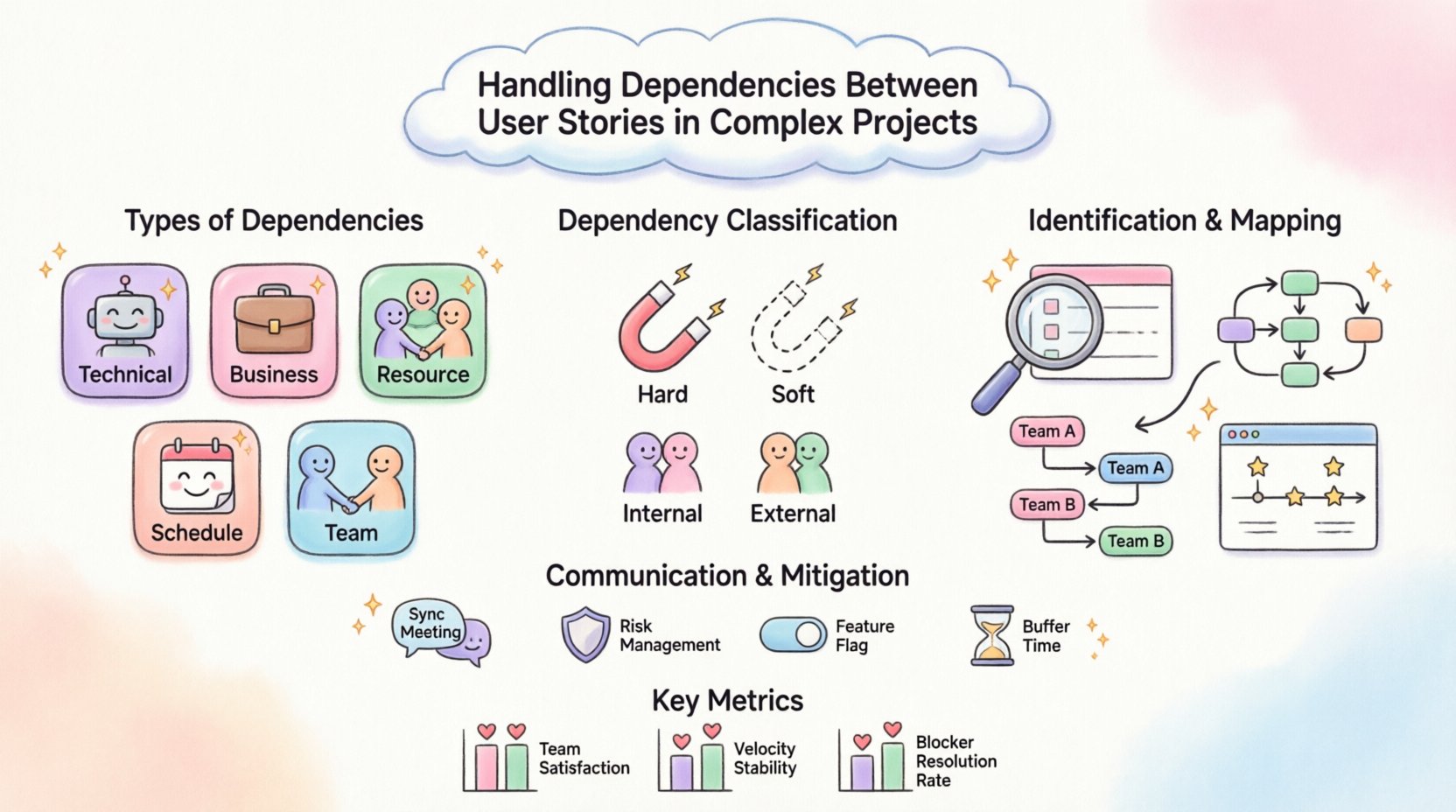
Dependencies fall into several categories. Recognizing the type helps in determining the best management strategy. Some dependencies are hard constraints, where the technical architecture dictates a specific order. Others are soft dependencies, often related to resource allocation or team availability.
Common Types of Dependencies
- Technical Dependencies: One story relies on code, APIs, or infrastructure changes made in another story.
- Business Dependencies: A feature is blocked until a specific business rule is defined or a regulatory requirement is met.
- Resource Dependencies: Two stories require the same specialist, such as a specific developer or designer, who cannot work on both simultaneously.
- Schedule Dependencies: One story is planned for a later sprint because the prerequisite story is scheduled for the current one.
- Team Dependencies: Multiple teams must collaborate to complete a single user story, requiring synchronization across different squads.
Understanding these distinctions allows teams to address the root cause rather than just the symptoms. For instance, a resource dependency might be solved by hiring more staff, whereas a technical dependency might require architectural refactoring.
Dependency Classification Table 📋
| Type | Definition | Example |
|---|---|---|
| Hard | Cannot proceed without the other task | Login feature cannot exist without the database schema. |
| Soft | Can proceed with workarounds or risk | UI polish can be delayed until marketing assets are ready. |
| Internal | Within the same team or project | Backend API and Frontend UI integration. |
| External | Requires input from outside the team | Third-party payment gateway integration. |
Identifying Dependencies Early ⏱️
Waiting until a story is in progress to discover a dependency is a recipe for disruption. Early identification happens during the refinement and planning phases. The goal is to uncover hidden relationships before the work begins.
Teams can employ specific techniques to surface these connections:
- Backlog Refinement Sessions: Dedicate time to review upcoming stories specifically for links to other work. Ask “What does this story need to function?”
- Architecture Reviews: Involve technical leads to map out system interactions. They often spot API contracts or data flow requirements that functional stories miss.
- Stakeholder Interviews: Talk to business owners about prerequisites. They know which features must launch together for a coherent user experience.
- Visual Mapping: Use physical or digital boards to map stories against each other. Seeing the connections visually often reveals bottlenecks that text descriptions hide.
- Definition of Ready (DoR): Enforce a standard where stories cannot be pulled into a sprint unless dependencies are identified and accepted.
It is important to acknowledge that not all dependencies can be found. Some will emerge only when work starts. However, increasing the visibility of known links reduces the shock factor when new ones appear.
Mapping and Visualization Techniques 🗺️
Once dependencies are identified, they must be mapped clearly. Ambiguity in mapping leads to confusion about who is responsible for what. Visualization makes the relationships tangible.
Several methods exist for mapping these connections effectively:
- Dependency Graphs: Create a visual graph where nodes represent stories and arrows represent dependencies. This helps spot chains of tasks that could cause critical path delays.
- Swimlane Diagrams: Use swimlanes to represent different teams or streams. Draw lines between swimlanes to show cross-team dependencies clearly.
- Story Maps: Organize stories along a horizontal timeline. Vertical alignment can show which stories rely on others in the same column.
- Tags and Labels: Use consistent labels in tracking systems to mark stories that are blocked or are prerequisites. This allows for quick filtering and reporting.
The key is consistency. If the team uses a specific tag for dependencies, it must be used by everyone. Inconsistency leads to data that cannot be trusted for planning.
Communication Protocols for Dependency Management 🗣️
Even with the best maps, dependencies fail when communication breaks down. Teams often assume others know about a change, but assumptions are the enemy of complex delivery. Structured communication ensures everyone stays aligned.
Effective communication strategies include:
- Daily Standups: Use this time to explicitly state if a story is blocked by a dependency. Do not just say “blocked”; specify which story is the blocker.
- Sync Meetings: Hold regular meetings between teams that share dependencies. These should be short and focused solely on integration points.
- Change Logs: Maintain a record of changes to dependent stories. If a deadline shifts, notify all downstream teams immediately.
- Shared Dashboards: Create a view that shows all active dependencies across teams. This gives leadership a real-time view of potential bottlenecks.
- Escalation Paths: Define who gets involved if a dependency is delayed. Is it the product owner? The technical lead? The project manager?
Communication should be proactive, not reactive. Waiting for a blocker to occur before speaking up wastes time. Teams should anticipate when a dependency is at risk and raise the flag early.
Mitigation Strategies and Risk Management 🛡️
Dependencies introduce risk. If one story slips, the impact ripples outward. Mitigation involves planning for these risks so that the impact is minimized.
Consider these approaches to reduce dependency risk:
- Decoupling: Where possible, redesign the system to reduce hard dependencies. Use interfaces or mock services so teams can work independently.
- Parallel Development: Structure stories so that teams can work in parallel on different parts of the same feature, merging later.
- Buffer Time: Add contingency time to the schedule for dependent tasks. This acknowledges that dependencies often cause delays.
- Mocking and Stubs: Use fake data or service stubs to allow frontend work to proceed while backend work is still in progress.
- Feature Flags: Implement features behind flags. This allows code to be merged and deployed even if the full dependency chain is not ready.
Every strategy has a trade-off. Decoupling might increase initial technical debt. Buffer time might delay delivery. The goal is to choose the strategy that balances risk with effort.
Impact on Velocity and Planning 📉
Dependencies directly affect velocity. When stories are blocked, the team’s output drops. This can lead to inaccurate planning in future sprints if the impact of dependencies is not accounted for.
To manage this impact:
- Track Blocked Stories: Measure how often stories are blocked by dependencies. This data helps in forecasting future capacity.
- Adjust Estimates: Include dependency overhead in story points. If a story requires waiting on another team, it should be estimated higher.
- Review Velocity Trends: Look at velocity over time. If it fluctuates wildly, check if dependency bottlenecks are the cause.
- Capacity Planning: When planning capacity, account for the time spent on integration and dependency management, not just development.
Ignoring the impact of dependencies on velocity leads to overcommitment. Teams should be honest about how much time is spent waiting for others.
Resolving Conflicts and Blockers 🔧
Despite best efforts, conflicts will arise. A team might need a resource that is already committed elsewhere, or a dependency might change. Resolving these conflicts requires a systematic approach.
Steps for resolution:
- Identify the Root Cause: Is the delay due to a technical issue, a resource shortage, or a decision delay?
- Assess Priority: Determine which story is most critical to the business goal. Focus resources there first.
- Explore Alternatives: Can the work be done in a different way? Can a workaround be used temporarily?
- Escalate if Necessary: If the team cannot resolve the issue, escalate to a higher level of management who can make resource decisions.
- Document the Resolution: Record how the conflict was resolved. This helps prevent similar issues in the future.
Conflict resolution should not be punitive. It is a process improvement opportunity. Analyze why the conflict happened and how to prevent it next time.
Tools vs. Process 🛠️
Many teams look for tools to solve dependency problems. While tools can help, they are not a substitute for good process. A tool cannot fix a team that does not communicate.
Key considerations:
- Visibility: Does the tool provide visibility into dependencies across teams?
- Automation: Can the tool automate notifications when a dependency changes?
- Integration: Does the tool integrate with the rest of the development ecosystem?
- Overhead: Does using the tool add too much administrative work?
The best tool is one that the team actually uses. If a tool requires too much maintenance, it will be ignored, and the data will become stale.
Measuring Success and Continuous Improvement 📈
Managing dependencies is an ongoing effort. Teams should measure their success and look for ways to improve their process over time.
Metrics to track:
- Dependency Lead Time: How long does it take to resolve a dependency?
- Blocker Frequency: How often do stories get blocked by dependencies?
- Dependency Ratio: What percentage of stories have dependencies?
- Team Satisfaction: Do team members feel blocked often? Their feedback is crucial.
Regularly review these metrics in retrospectives. Use the data to drive changes in how stories are split, how planning is done, and how communication flows. The goal is to reduce the number of dependencies over time by improving system design and team autonomy.
Conclusion on Dependency Management 🏁
Dependencies are an inherent part of complex software development. They cannot be eliminated entirely, but they can be managed effectively. By understanding the types, identifying them early, mapping them clearly, and maintaining open communication, teams can reduce friction and deliver value consistently. The focus should always be on enabling flow rather than just tracking tasks. When dependencies are handled with care, the project moves forward smoothly, and the team can focus on building what matters most to the users.