Business Process Model and Notation (BPMN) has long served as the universal language for defining workflows. From simple linear sequences to complex event-driven architectures, it has provided a standard way to visualize business logic. However, the digital landscape is shifting rapidly. Automation, artificial intelligence, and cloud-native infrastructure are reshaping how organizations design and execute processes.
The question now is not just how we document processes, but how we model them for a dynamic environment. The next generation of process modeling must address real-time adaptability, data-driven discovery, and seamless integration with intelligent agents. This guide explores the technical trajectory of BPMN, examining where the standard is heading and what implications this holds for architects and analysts.
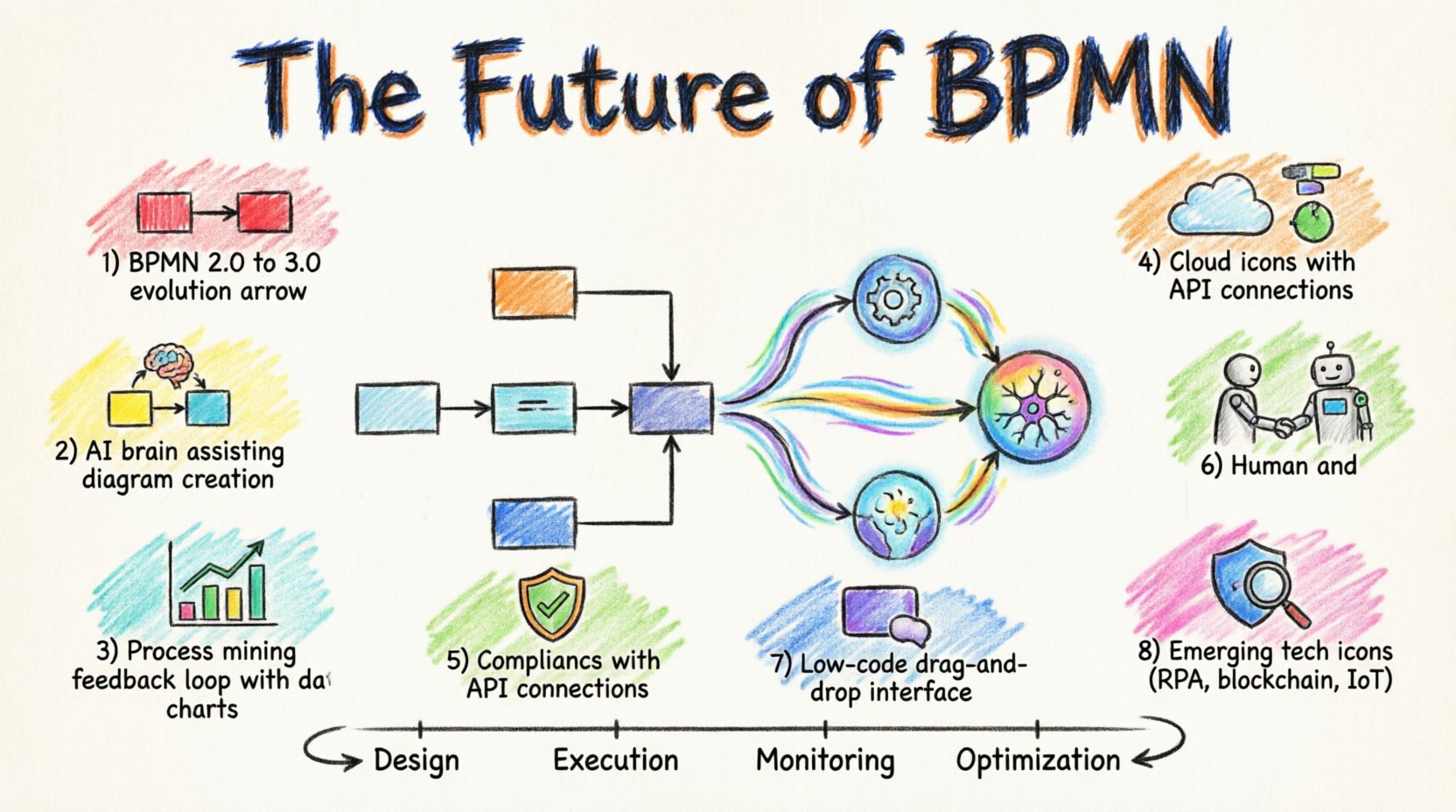
📊 Evolution from BPMN 2.0 to 3.0
Current implementations rely heavily on BPMN 2.0. While robust, this version was designed primarily for human-readable diagrams that map to executable code in monolithic or service-oriented architectures. The upcoming iterations aim to bridge the gap between static modeling and dynamic runtime environments.
Key Areas of Speculation and Development
- Adaptive Flow Control: Moving beyond static gateways to allow conditional paths determined by real-time context rather than predefined variables.
- Enhanced Event Handling: More granular control over asynchronous events, including better support for distributed messaging systems.
- Data-Centric Modeling: Explicitly defining data schemas within the model to ensure type safety across microservices.
- Versioning and Lifecycle: Built-in mechanisms for handling process versioning without breaking active instances.
These shifts suggest a move from “design-time” artifacts to “runtime-aware” definitions. The goal is to reduce the latency between a model change and its deployment in a live system.
🤖 Integration of Artificial Intelligence
Artificial Intelligence is not merely a tool for automation; it is becoming a collaborator in the modeling phase. Generative AI can assist in creating initial drafts of process flows based on natural language requirements. This does not replace the human architect but accelerates the initial scoping phase.
AI-Driven Modeling Capabilities
- Natural Language to Diagram: Converting textual descriptions of workflows into structured BPMN elements automatically.
- Predictive Pathing: Using historical data to suggest likely paths within a process flow before the model is finalized.
- Anomaly Detection: Identifying bottlenecks or logical dead-ends during the design phase using simulation.
- Automated Documentation: Generating maintenance documentation and user guides directly from the model structure.
This integration requires a standard format that AI models can parse effectively. Semantic annotations within the BPMN XML will become increasingly important for training these systems. Without standardized metadata, AI-driven optimization remains limited to surface-level patterns.
🔗 Process Mining and Continuous Improvement
Static models often drift from reality. Organizations execute processes differently than documented. Process mining bridges this gap by analyzing event logs from enterprise systems to reconstruct the actual flow of work. The future of BPMN involves tighter coupling with these mining techniques.
The Feedback Loop
| Stage | Traditional Approach | Next Generation Approach |
|---|---|---|
| Design | Manual modeling based on interviews. | AI-assisted modeling using event log data. |
| Execution | Follows the model strictly. | Model adapts to exceptions automatically. |
| Monitoring | Periodic audits against the model. | Real-time drift detection and alerts. |
| Optimization | Post-project retrospectives. | Continuous improvement via data feedback. |
This convergence means BPMN files will need to carry more metadata about execution performance. Metrics like cycle time, resource utilization, and error rates could become part of the model definition itself, allowing for self-optimizing workflows.
☁️ Cloud-Native and API-First Design
Legacy process engines often operated as monolithic servers. Modern infrastructure relies on containers, microservices, and serverless functions. BPMN needs to reflect this distributed nature.
Technical Adjustments for Cloud
- API-First Definitions: Process steps should explicitly define REST or GraphQL endpoints rather than generic service tasks.
- Stateless Execution: Models must support stateless patterns where possible to align with container scaling strategies.
- Event-Driven Architecture: Increased use of event-based gateways to handle asynchronous microservice communication.
- Orchestration vs. Choreography: A clearer distinction between centralized orchestration and decentralized choreography in the notation.
This shift ensures that the model is not just a diagram, but a specification for cloud infrastructure. It reduces the friction between the design team and the DevOps team, as the output is compatible with modern orchestration tools.
🛡️ Governance and Compliance Automation
Regulatory requirements are becoming more stringent. GDPR, HIPAA, and industry-specific standards require strict adherence to process rules. Future BPMN versions will likely embed compliance checks directly into the model structure.
Compliance Features
- Role-Based Access Control: Defining who can execute specific tasks within the model itself.
- Audit Trail Requirements: Specifying mandatory logging points for sensitive operations.
- Data Privacy Tags: Marking data fields that require encryption or masking during transit.
- Regulatory Rule Binding: Linking specific process steps to external compliance rule sets.
This moves compliance from a post-deployment audit to a design-time requirement. If a model violates a compliance rule, the system prevents deployment. This reduces risk and ensures that security is baked into the process foundation.
👥 The Human Element in Automated Processes
Despite automation trends, human intervention remains critical for exceptions and complex decision-making. The future of BPMN focuses on seamless handoffs between machines and humans.
Human-Machine Collaboration
- Contextual Task Assignment: Routing tasks to users based on skills, availability, and current workload.
- Decision Support: Providing AI recommendations to human users during task execution.
- Feedback Mechanisms: Allowing users to flag process inefficiencies directly from their task interface.
- Empowerment: Giving users the ability to adapt minor steps without IT intervention.
This approach acknowledges that rigid automation can fail when faced with unique scenarios. Flexible models allow for human judgment where it matters most, while automating the repetitive tasks surrounding it.
🛠️ Low-Code and Citizen Development
Business users increasingly want to build and modify processes without deep technical knowledge. BPMN serves as the visual interface for low-code platforms, but the underlying standards must support this abstraction.
Abstraction Layers
- Simplified Notation: Offering a subset of BPMN features for non-technical users.
- Drag-and-Drop Logic: Translating visual actions into executable logic automatically.
- Validation Rules: Real-time feedback on whether a model is logically sound before execution.
- Template Libraries: Pre-built process patterns for common business scenarios.
This democratization of process modeling requires a robust underlying engine to ensure that simplified models do not compromise stability. The standard must support both high-fidelity technical models and simplified business views.
📈 Challenges and Adoption Barriers
While the future looks promising, several challenges stand in the way of widespread adoption of next-generation modeling standards.
Key Obstacles
- Backward Compatibility: New standards must remain compatible with existing models to avoid massive migration costs.
- Tooling Maturity: Tools must evolve to support new features without creating fragmentation in the market.
- Skill Gaps: Analysts need to understand data science and cloud architecture alongside traditional process modeling.
- Standardization Delays: The process of updating the official specification can be slow compared to technological innovation.
Organizations must balance the need for innovation with the stability of their current infrastructure. A phased approach to adoption is often the most practical strategy.
🔮 Emerging Trends to Watch
Beyond the core specification, several adjacent technologies are influencing the BPMN landscape.
Trending Technologies
- RPA Integration: Robotic Process Automation tasks are becoming first-class citizens in the notation.
- Blockchain Verification: Using distributed ledgers to verify process integrity and immutability.
- IoT Event Sources: Direct integration of sensor data as triggers for process initiation.
- Metaverse Workflows: Exploring 3D visualizations of processes for immersive training and monitoring.
These technologies expand the scope of what a process model can represent. They move the standard from a purely business logic tool to a comprehensive system integration blueprint.
🎯 Preparing Your Organization
To stay ahead of these shifts, organizations should focus on specific strategic areas.
Strategic Actions
- Invest in Training: Upskill teams on data analytics and cloud architecture.
- Review Current Models: Audit existing BPMN diagrams for technical debt and outdated patterns.
- Establish Governance: Create clear guidelines for who can modify process models.
- Pilot New Standards: Test emerging features in a sandbox environment before full deployment.
- Focus on Data: Ensure event logs are high-quality to support future mining and AI integration.
Preparation is not about waiting for a new standard release. It is about building the infrastructure and skills that allow for flexibility when changes occur.
🏁 Summary of the Transition
The evolution of BPMN is not a replacement of the past but an extension of its capabilities. The core principles of clarity, standardization, and visual communication remain valid. What changes is the depth of integration with data, intelligence, and cloud infrastructure.
By embracing these changes, organizations can move from static documentation to dynamic process management. This shift enables faster response times, better compliance, and more efficient resource allocation. The future of process modeling is one where the model is alive, constantly learning, and continuously improving.
Stakeholders should monitor the official specification updates closely. Engaging with the community and understanding the technical nuances will be vital for successful implementation. The goal is to create processes that are resilient, efficient, and aligned with the broader digital strategy of the enterprise.