
Agile teams frequently face a common challenge during planning sessions: the struggle to predict how long a task will take. Estimating user stories is an essential practice for delivering value predictably, yet it often becomes a source of friction and anxiety. When teams rush to assign numbers without proper context, they fall into traps that distort reality and undermine trust.
This guide explores the mechanics of effective estimation. It focuses on moving away from rigid time-based promises and towards a nuanced understanding of effort, complexity, and risk. By adopting disciplined techniques, teams can create reliable forecasts without the stress of unrealistic deadlines. We will examine why estimation fails, identify common pitfalls, and outline practical methods to improve accuracy over time.
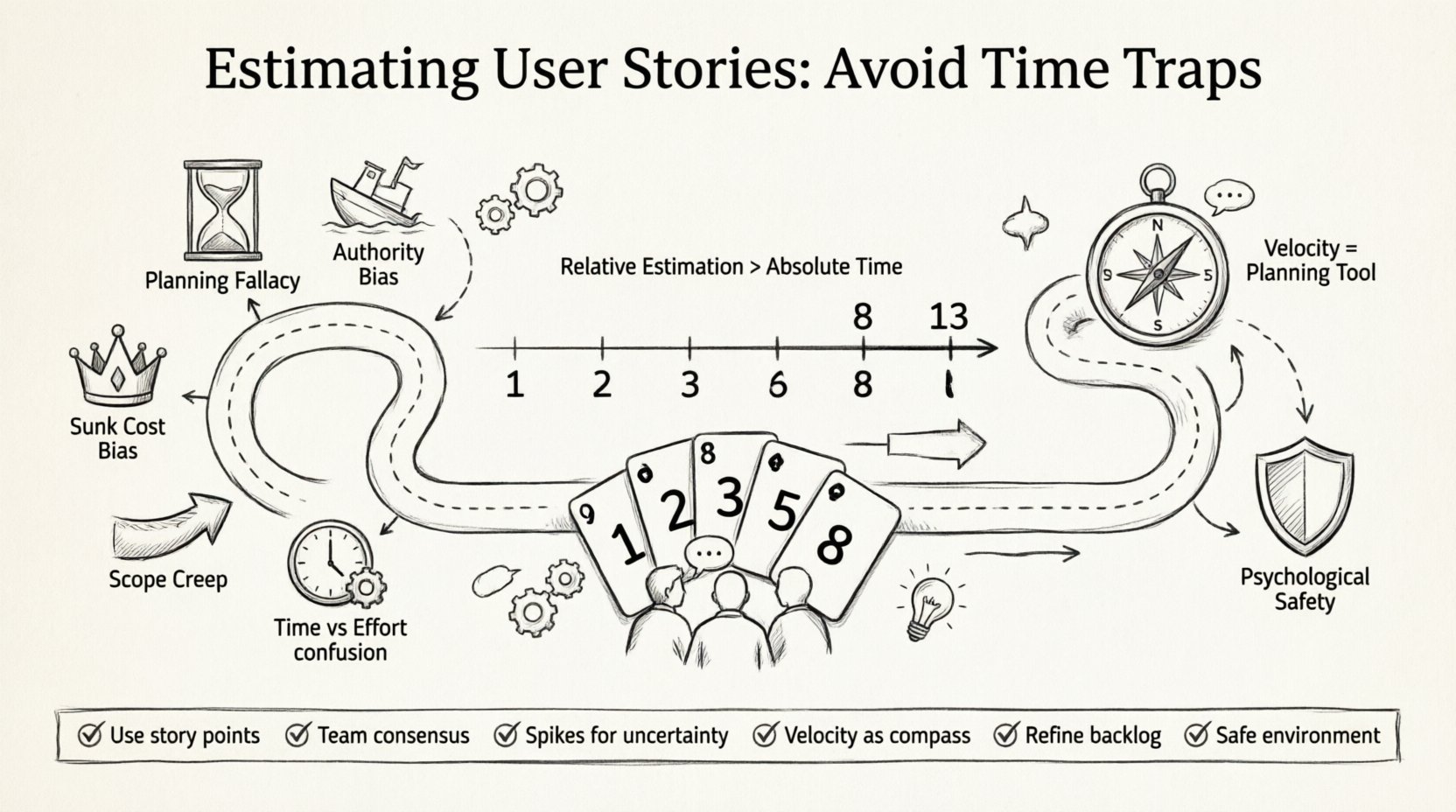
🤔 Why Estimation is Inherently Difficult
Human beings are notoriously poor at predicting the future. This cognitive bias affects every industry, but software development magnifies the issue due to the complexity of the work. When a developer estimates a task, they are not just counting hours. They are accounting for:
- Technical debt that may not be visible in the initial review
- Dependencies on other teams or systems
- Learning curves for new technologies or frameworks
- Unforeseen bugs that arise during implementation
- Context switching and interruptions during the sprint
Because these variables change constantly, a specific number like “5 hours” is rarely accurate. It is better to view estimation as a range of probability rather than a fixed promise. This shift in mindset reduces pressure and allows the team to focus on delivery quality rather than hitting an arbitrary clock.
🕳️ Common Time Traps to Avoid
Several cognitive traps can derail estimation sessions. Recognizing these patterns is the first step toward correcting them. Below is a breakdown of frequent errors and their impact on project health.
| Trap | Symptom | Solution |
|---|---|---|
| Planning Fallacy | Team consistently underestimates effort because they imagine the best-case scenario. | Review historical data from previous sprints to ground expectations in reality. |
| Sunk Cost Bias | Team continues to estimate a story as low effort because they have already spent time discussing it. | Encourage fresh eyes to review the story before finalizing the estimate. |
| Authority Bias | Senior members dominate the discussion, and others defer to their opinion without input. | Use anonymous voting techniques to gather independent opinions from all members. |
| Scope Creep | Estimates increase mid-sprint because new requirements are added without adjusting the plan. | Freeze scope for the sprint and require change requests for new items. |
| Confusing Time with Effort | Team estimates in hours instead of relative complexity points. | Switch to story points to account for complexity and risk, not just duration. |
Understanding these traps helps teams navigate discussions more effectively. When a team member points out a potential trap, the conversation shifts from “how long” to “what are we missing?” This distinction is vital for maintaining velocity.
⏱️ Relative Estimation vs Absolute Time
One of the most significant shifts in mature agile teams is moving from absolute time estimates to relative estimation. Absolute time (e.g., “3 days”) implies a certainty that rarely exists. Relative estimation (e.g., “3 story points”) compares the effort of one story to another.
The Logic Behind Relative Estimation
Humans are better at comparing things than measuring them. It is easier to say, “This task is twice as hard as that task,” than to say, “This task will take 14 hours exactly.” Relative estimation leverages this natural ability.
- Comparison: The team selects a baseline story and rates new stories against it.
- Scale: A scale like Fibonacci (1, 2, 3, 5, 8, 13) is often used. The gaps between numbers reflect the increasing uncertainty of larger tasks.
- Focus: It forces the team to discuss the complexity of the work rather than the duration.
When using story points, the team does not need to agree on how many hours a point is worth. That metric emerges naturally over time through velocity. This decoupling of complexity from time allows for more flexible planning.
🤝 Consensus-Based Techniques
Estimation is a team activity, not an individual one. When a single person provides a number, it often lacks the collective wisdom of the group. Consensus techniques ensure that all perspectives are considered, including those of the most junior developers and the most experienced architects.
Planning Poker
This is the most widely adopted technique for collaborative estimation. It involves cards with numbers representing effort levels. The process works as follows:
- The product owner presents the user story and acceptance criteria.
- The team discusses any questions or ambiguities regarding the scope.
- Each member selects a card that represents their estimate.
- Everyone reveals their cards simultaneously.
- If there is a wide variance (e.g., a 2 and an 8), the outliers explain their reasoning.
- The team discusses until they converge on a number or agree to split the story.
This method prevents anchoring bias, where the first number spoken influences the rest of the group. By keeping estimates hidden until reveal, the team ensures independent thought. It also surfaces hidden risks. If one person estimates significantly higher, they might know about a technical risk the others are unaware of.
Large Group Estimation
For very large initiatives, teams may use t-shirt sizing (XS, S, M, L, XL) instead of numbers. This is useful during release planning when granular detail is not yet available. Once the scope is clearer, the team can break these large items down into smaller stories and assign story points.
⚠️ Dealing with Uncertainty and Risk
Not all stories are created equal. Some are straightforward enhancements, while others involve significant research or integration with legacy systems. Estimating uncertainty requires a different approach than estimating known work.
Spikes
A spike is a time-boxed investigation designed to reduce uncertainty. If a team cannot estimate a story because they do not understand the technical approach, they should create a spike story instead. The goal of the spike is to produce enough knowledge to allow for a proper estimate of the actual work.
- Define the Goal: What specific information do we need to learn?
- Time Box It: Limit the spike to a few days. If the problem is too complex, a spike is not the solution.
- Output: The result should be a recommendation, a proof of concept, or a refined story with an estimate.
Buffer and Contingency
Even with careful estimation, things go wrong. Teams should build contingency into their planning. This does not mean padding every estimate by 20%. Instead, it means acknowledging that velocity will fluctuate.
Calculate velocity based on the last three sprints. Use the average, not the maximum. This provides a realistic baseline for how much work the team can commit to. If a story carries high risk, the team can increase its story points to reflect that probability of delay.
📈 Velocity and Metrics
Velocity is the measure of how much work a team completes in a sprint. It is calculated by summing the story points of all accepted user stories. While velocity is a useful metric, it is often misused.
Velocity as a Compass
Velocity should guide future planning, not serve as a performance target. Comparing velocity between teams is meaningless because every team defines “one story point” differently. A point for Team A might equal 2 hours, while a point for Team B might equal 4 hours.
Use velocity to:
- Predict when a backlog of features will be completed.
- Identify trends in team capacity over time.
- Spot when the team is over-committing or under-utilizing capacity.
Tracking Estimation Accuracy
Teams can track how close their estimates were to the actual time taken. However, this data is sensitive. If used punitively, it will discourage honest estimation. If used constructively, it helps calibrate future estimates.
Review the data during retrospectives. Ask:
- Did we miss a dependency?
- Was the acceptance criteria vague?
- Did we encounter unexpected technical debt?
Focus on the process improvement rather than the individual performance of the estimator.
🔧 Refining the Process
Estimation is not a one-time event. It is a continuous improvement loop. As the team learns more about the product and the technology, their estimates become more accurate.
Refining Backlog Items
Teams should not estimate stories that are vague or incomplete. This leads to the “garbage in, garbage out” problem. Product owners and business analysts must ensure stories are clear before they enter the estimation phase. The INVEST criteria (Independent, Negotiable, Valuable, Estimable, Small, Testable) provides a checklist for readiness.
Splitting Large Stories
If a team consistently estimates a story as an 8 or 13, it is likely too large. Large stories are hard to estimate because they contain hidden sub-tasks. Break them down into smaller, vertical slices of functionality. Smaller stories reduce risk and improve estimation confidence.
Regular Calibration
Teams should hold calibration sessions periodically. Review a few completed stories and discuss how the actual effort compares to the estimate. This keeps the team aligned on what a “point” means. Over time, the definition of a point may shift as the team grows or the technology stack changes.
🧠 The Human Element
Estimation is deeply psychological. Fear of commitment drives some to underestimate, while fear of failure drives others to overestimate. Creating a safe environment for estimation is crucial.
- Psychological Safety: Team members must feel safe admitting they do not know the answer. Honesty is valued over confidence.
- Separate Estimation from Commitment: Estimating a story does not mean the team has promised to finish it by Friday. It is a forecast, not a contract.
- Respect the Estimate: Once an estimate is agreed upon, do not change it arbitrarily to fit a deadline. Changing the estimate to meet a date invalidates the planning process.
When the team feels safe, they provide better data. Better data leads to better planning. Better planning leads to less stress. This cycle builds a culture of trust and reliability.
📝 Summary of Best Practices
To summarize, effective estimation requires discipline, transparency, and a focus on relative effort. Avoid the temptation to force precision where none exists. Instead, embrace uncertainty and manage it through communication and buffer planning.
- Use relative estimation (story points) rather than absolute time.
- Involve the whole team in the estimation process.
- Identify and mitigate risks using spikes.
- Treat velocity as a planning tool, not a KPI.
- Continuously refine the backlog to ensure stories are ready for estimation.
- Maintain a culture of psychological safety to encourage honest input.
By following these principles, teams can navigate the complexities of software development with greater confidence. Estimation becomes a tool for planning and communication rather than a source of anxiety. The goal is not to be perfect, but to be consistently accurate enough to deliver value predictably.
Remember, the best estimates are those that evolve as the team learns. Stay flexible, keep the conversation open, and focus on the value being delivered. This approach ensures long-term success without burning out the team in the process.