
The Business Motivation Model (BMM) serves as a foundational architecture for understanding the drivers behind organizational actions. It provides a structured method to map out the connections between strategic intent, business goals, tactics, and the rules that govern operations. By establishing a clear framework, enterprises can align their daily activities with long-term visions without relying on ad-hoc decision-making processes.
This guide explores the core elements required to build a resilient BMM. It focuses on the structural relationships that ensure consistency across the organization, ensuring that every action contributes to a defined purpose. The following sections detail the specific components, their interdependencies, and the principles that guide their implementation.
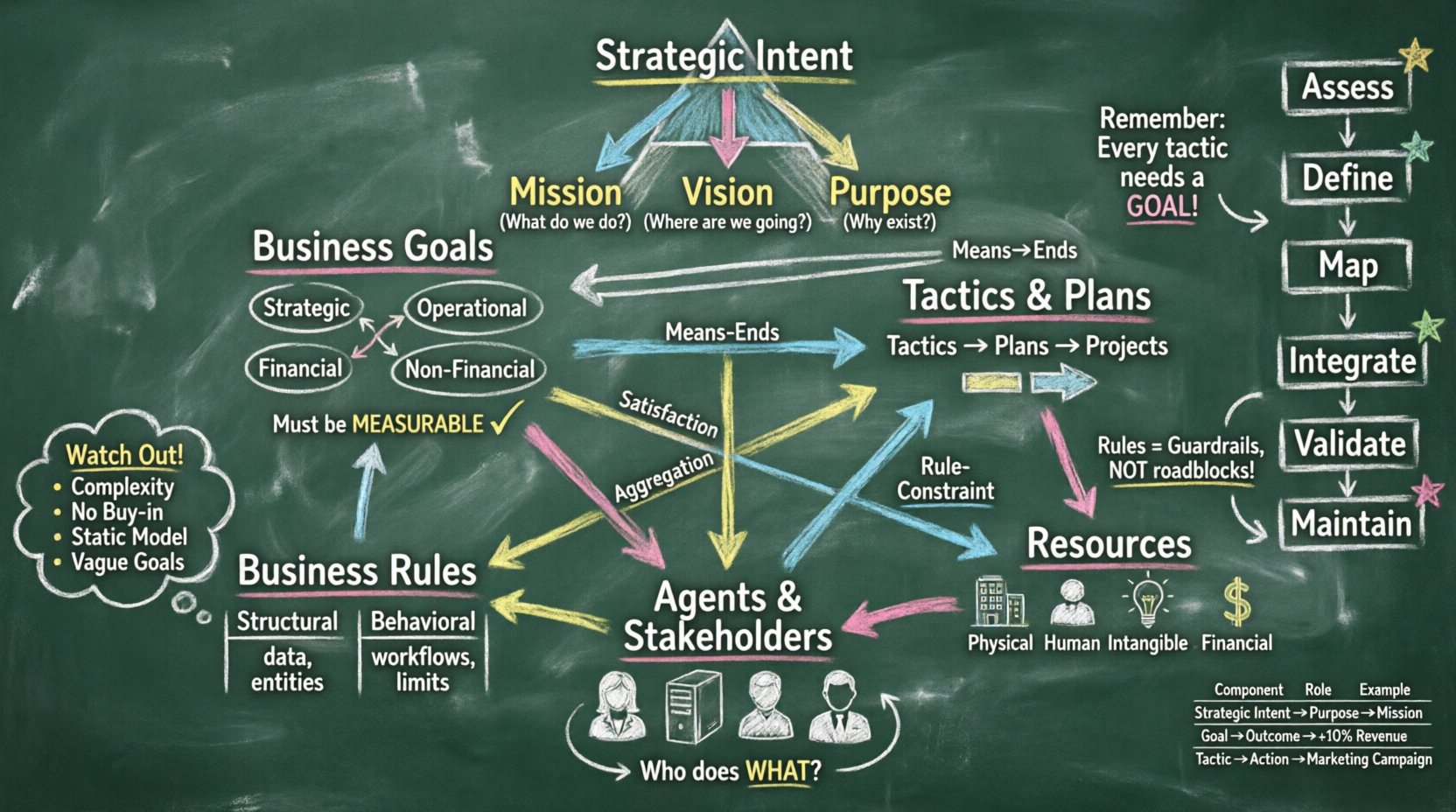
🎯 Understanding Strategic Intent
At the top of the hierarchy lies the concept of Strategic Intent. This is the overarching reason for an organization’s existence. It is not merely a slogan but a functional directive that guides resource allocation and priority setting.
- Mission: Defines the core purpose and primary objectives. It answers the question, “What do we do?”
- Vision: Describes the desired future state. It answers the question, “Where are we going?”
- Purpose: The fundamental reason for being, often linked to stakeholder value.
These elements form the bedrock. Without a clearly defined mission and vision, subsequent goals lack direction. The Strategic Intent acts as the anchor for all motivation within the enterprise.
🎯 Business Goals and Objectives
Once the intent is established, it must be translated into actionable targets. Business Goals represent the desired outcomes that the organization strives to achieve. They differ from tactics, which are the methods used to reach those outcomes.
Types of Goals
Goals can be categorized based on their scope and timeframe:
- Strategic Goals: High-level outcomes aligned with the mission, often spanning multiple years.
- Operational Goals: Shorter-term targets that support strategic goals, often measured quarterly or annually.
- Financial Goals: Specific metrics related to revenue, cost, or profitability.
- Non-Financial Goals: Metrics related to customer satisfaction, employee engagement, or market share.
Each goal must be measurable. A robust framework requires that every objective has a defined metric to assess success. This prevents ambiguity and allows for objective evaluation of progress.
🛠️ Tactics and Plans
Tactics are the specific actions taken to achieve a business goal. They are the “how” in the “what” and “how” equation. A plan is a collection of tactics organized to achieve a specific result.
- Tactics: Individual steps or initiatives.
- Plans: A structured sequence of tactics.
- Projects: A temporary endeavor undertaken to create a unique product or service.
The relationship between goals and tactics is critical. A tactic should never exist without a direct link to a goal. This ensures that resources are not wasted on activities that do not contribute to the broader strategy.
⚖️ Business Rules
Business Rules define the constraints within which the organization operates. They are the policies and regulations that dictate what actions are permissible and what are prohibited. Rules ensure compliance and consistency.
There are two primary categories of business rules:
- Structural Rules: Define the static nature of the business, such as data definitions or entity relationships.
- Behavioral Rules: Define the dynamic nature, such as approval workflows or transaction limits.
Integrating rules into the framework ensures that goals are pursued within the boundaries of legal and ethical standards. Violation of these rules can invalidate the satisfaction of a goal, regardless of the outcome.
👥 Stakeholders and Agents
Every business activity involves people or systems acting on behalf of the organization. In BMM terminology, these are referred to as Agents or Stakeholders.
- Stakeholders: Individuals or groups with an interest in the business outcome (e.g., customers, investors).
- Agents: Entities that act to achieve goals (e.g., employees, departments, automated systems).
Understanding who is responsible for what is essential for accountability. A robust framework maps agents to the goals and tactics they influence. This clarity prevents gaps in execution and ensures that every goal has an owner.
💎 Resources and Assets
To execute tactics and satisfy goals, an organization requires resources. These are the assets necessary to perform work.
- Physical Assets: Buildings, equipment, inventory.
- Human Resources: Skills, time, labor.
- Intangible Assets: Intellectual property, brand reputation, data.
- Financial Assets: Capital, credit, cash flow.
Resource allocation is a key function of the framework. It ensures that the most critical goals receive the necessary support. Without adequate resources, even the best tactics will fail.
🔗 Relationships and Dependencies
The power of the Business Motivation Model lies in the relationships between components. These relationships define how the parts work together to form a cohesive whole.
Means-Ends Relationships
This is the most common relationship. It connects a lower-level element (Means) to a higher-level element (Ends). For example, a tactic is the means to achieve a goal (the end).
Satisfaction Relationships
This relationship indicates that an element contributes to the satisfaction of another. For instance, a resource might contribute to the satisfaction of a goal. This is often used when the contribution is indirect.
Aggregation Relationships
Aggregation allows for the grouping of elements. For example, multiple goals can be aggregated into a higher-level strategic objective. This simplifies the model and provides a high-level view of progress.
Rule-Constraint Relationships
Rules constrain the execution of tactics or the achievement of goals. They ensure that the path taken does not violate organizational policies.
📊 Component Interaction Table
The following table summarizes how different components interact within the framework.
| Component | Role | Key Relationship | Example |
|---|---|---|---|
| Strategic Intent | Defines Purpose | Guides Goals | Mission Statement |
| Business Goal | Defines Outcome | Supported by Tactics | Increase Revenue by 10% |
| Tactic | Defines Action | Achieves Goal | Launch New Marketing Campaign |
| Business Rule | Defines Constraint | Constrains Tactics | Compliance with Data Privacy Laws |
| Agent | Defines Actor | Executes Tactics | Sales Team |
| Resource | Defines Input | Enables Tactics | Budget Allocation |
🚀 Implementation Strategy
Building this framework requires a methodical approach. It is not a one-time exercise but an ongoing process of refinement.
- Assessment: Evaluate the current state of the organization. Identify existing goals, rules, and stakeholders.
- Definition: Clearly define the Strategic Intent. Ensure alignment with leadership.
- Mapping: Map out the goals and link them to tactics. Identify the resources required.
- Integration: Incorporate business rules to ensure compliance. Define the agents responsible for each action.
- Validation: Review the model with stakeholders to ensure it reflects reality and is actionable.
- Maintenance: Regularly update the model as the business environment changes.
⚠️ Common Challenges
Implementing a Business Motivation Model framework comes with challenges. Awareness of these potential pitfalls helps in navigating the process.
- Complexity: The model can become overly complex if not managed well. It is important to keep the hierarchy clear and avoid unnecessary depth.
- Stakeholder Buy-in: Without agreement from key agents, the model will not be followed. Communication is vital.
- Static vs. Dynamic: Business environments change. A static model becomes obsolete quickly. Regular reviews are necessary.
- Ambiguity: Vague goals lead to confusion. Metrics must be precise.
- Isolation: The model should not exist in a vacuum. It must integrate with other planning and management systems.
🔍 Detailed Component Analysis
To ensure a deep understanding, let us examine the specific nuances of the core components.
1. The Nuance of Goals
Goals are not just wishes. They are commitments. A goal implies a commitment of resources. In the framework, a goal is satisfied only when the specific criteria are met. This distinction separates aspiration from objective.
2. The Role of Rules
Rules are often seen as obstacles, but they are safeguards. They protect the organization from risk. In the model, rules constrain the satisfaction of goals. A goal cannot be considered satisfied if the rules were broken during the process.
3. The Dynamics of Agents
Agents are the human or systemic actors. Their motivation must align with the business goals. If an agent is motivated by a different outcome, friction occurs. The framework helps align individual incentives with organizational objectives.
4. Resource Scarcity
Resources are finite. The framework helps prioritize. By linking resources to goals, leaders can see where the investment yields the highest return. This prevents resource dilution across too many initiatives.
🌐 Integration with Enterprise Architecture
The Business Motivation Model does not exist in isolation. It is a critical layer within the broader Enterprise Architecture. It bridges the gap between high-level strategy and IT or operational execution.
- Strategy Layer: BMM defines the “Why” and “What”.
- Capability Layer: Defines the “How” (Business Capabilities).
- Execution Layer: Defines the “Who” and “When” (Processes and Systems).
By integrating these layers, the organization ensures that technology and processes are serving the business intent, rather than driving it.
📈 Measuring Success
Success in this framework is measured by the alignment of activities with intent. Key performance indicators should be derived directly from the business goals. This creates a direct line of sight from daily work to strategic value.
- Alignment Metrics: Percentage of initiatives linked to strategic goals.
- Efficiency Metrics: Resource utilization against planned tactics.
- Compliance Metrics: Adherence to business rules.
- Outcome Metrics: Achievement of defined goals.
🛡️ Governance and Control
Establishing governance is essential for maintaining the integrity of the model. A governance body should be responsible for approving changes to the framework.
- Change Management: Procedures for updating goals, rules, or tactics.
- Audit Trails: Records of decisions and their rationale.
- Review Cycles: Scheduled times to review the entire model.
Governance ensures that the model remains relevant and accurate over time. It prevents drift where the model no longer reflects the business reality.
💡 Best Practices for Adoption
To maximize the value of the Business Motivation Model, consider these recommendations.
- Start Small: Begin with a pilot group or a specific department before scaling.
- Use Visuals: Diagrams and charts help stakeholders understand the relationships.
- Train Users: Ensure everyone understands the terminology and the purpose.
- Keep it Simple: Avoid over-engineering the model. Clarity is more important than complexity.
- Focus on Value: Always tie the model back to business value creation.
🔄 Continuous Improvement
The business landscape is dynamic. The framework must evolve to meet new challenges. Continuous improvement involves feedback loops where the results of tactics inform the adjustment of goals.
This iterative process ensures resilience. It allows the organization to adapt quickly to market shifts without losing sight of its core mission. The model becomes a living document rather than a static artifact.
📝 Summary of Key Takeaways
Building a robust Business Motivation Model Framework requires attention to detail and a clear understanding of organizational dynamics. The following points summarize the essential elements discussed:
- Strategic Intent provides the foundation.
- Goals define the desired outcomes.
- Tactics define the actions to reach goals.
- Rules define the boundaries of operation.
- Agents and Resources enable the execution.
- Relationships connect all components cohesively.
By adhering to these principles, organizations can achieve greater alignment and operational efficiency. The framework serves as a compass, guiding decision-making from the boardroom to the front line.