
Software development has evolved significantly over the last few decades. The shift from rigid Waterfall methodologies to flexible Agile frameworks changed how teams build products. With a focus on speed, iteration, and customer feedback, documentation often takes a backseat to code. This shift has sparked a debate: Are Entity Relationship Diagrams (ERDs) still necessary? Some argue that in a fast-paced Agile environment, drawing complex diagrams slows you down. Others insist that without a solid data model, the foundation of any application crumbles.
This article explores the truth behind this common myth. We will examine why data modeling remains crucial, how it fits into iterative cycles, and practical ways to maintain structure without sacrificing velocity. 🚀
Understanding the Core Conflict 🧱
Before diving into the solution, we need to define the two opposing forces at play. On one side, we have the Entity Relationship Diagram. On the other, we have Agile Development. Understanding the core purpose of each helps clarify why they are not mutually exclusive.
What is an ER Diagram? 📐
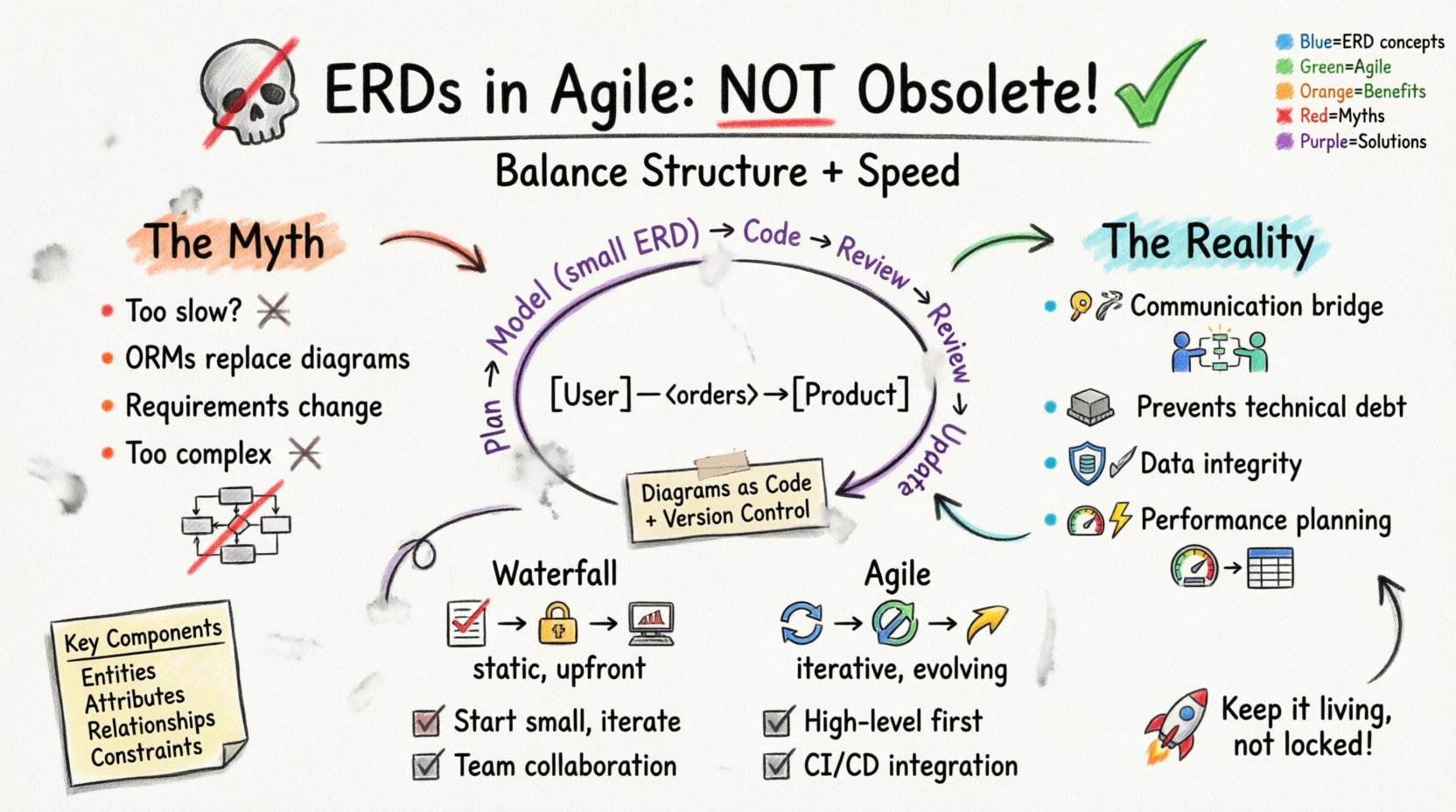
An ERD is a visual representation of data structures. It maps out entities (tables), attributes (columns), and relationships (foreign keys). It serves as a blueprint for database design. Key components include:
Entities: The objects or concepts being stored (e.g., Users, Orders, Products).
Attributes: The specific details within those entities (e.g., Email, Price, Date).
Relationships: How entities interact (One-to-One, One-to-Many, Many-to-Many).
Constraints: Rules governing data integrity (Primary Keys, Unique Values).
Traditionally, these diagrams were created at the very beginning of a project. They were part of the extensive upfront design phase. This approach worked well in Waterfall models where requirements were fixed early.
The Agile Mindset 🔄
Agile prioritizes working software over comprehensive documentation. The Agile Manifesto suggests that responding to change is more valuable than following a plan. In practice, this means:
Development happens in short sprints.
Requirements evolve based on feedback.
Teams value collaboration over rigid documentation.
Code is refactored frequently to accommodate new needs.
When you combine “working software over documentation” with “data modeling,” it looks like a contradiction. If the requirements change every two weeks, why spend time drawing diagrams that might be outdated by next sprint?
The Myth: Why People Think ERDs Are Dead 💀
The belief that ERDs are obsolete stems from valid concerns about efficiency. In modern development environments, teams often prioritize speed. Here are the common arguments against traditional ERD creation:
Speed of Delivery: Drawing detailed diagrams takes time. Developers would rather write code immediately.
Database Abstraction: ORMs (Object-Relational Mappers) allow code to define structure automatically. Some believe the code is the source of truth, not the diagram.
Schema Migration: Tools can automatically alter database schemas. There is a perception that manual modeling is redundant.
Changing Requirements: If a product pivots, a diagram created at the start is useless. Maintaining it feels like a waste of effort.
Complexity: ERDs can become overwhelming for large systems. They are hard to read and maintain for non-technical stakeholders.
While these points highlight real challenges, they represent a misunderstanding of how data modeling should function in an iterative environment. They suggest that ERDs are static artifacts rather than living tools.
The Reality: Why ERDs Are Still Vital ✅
Data is the backbone of almost every software application. Whether it is a simple blog or a complex financial platform, how data is stored affects performance, scalability, and maintainability. Here is why ERDs remain essential.
1. Communication and Shared Understanding 🗣️
Code is often too technical for everyone. Business stakeholders, product managers, and QA testers may not understand SQL syntax. An ERD provides a visual language that bridges this gap. It allows the whole team to agree on what data means before a single line of code is written.
Clarity: Visuals reduce ambiguity regarding relationships.
Alignment: Everyone agrees on the data model, reducing rework later.
Onboarding: New team members can grasp the system structure quickly.
2. Preventing Technical Debt 🏗️
When you skip data modeling and build directly on code, you often create tight coupling between tables. This leads to:
Denormalization Issues: Data duplication that makes updates difficult.
Join Complexity: Queries become slow and hard to optimize.
Refactoring Costs: Changing a data structure later requires massive migration scripts.
An ERD helps identify these structural issues early. It forces the team to think about normalization and integrity constraints before implementation.
3. Data Integrity and Security 🔒
Agile does not mean skipping quality. Data integrity is critical. ERDs define constraints like foreign keys and unique indexes. These constraints prevent bad data from entering the system. Without a clear model, it is easy to allow inconsistent states that break the application logic.
4. Performance Optimization ⚡
Database performance is heavily influenced by structure. Indexing strategies depend on how tables are related. An ERD helps developers plan for indexing needs. It allows them to anticipate query patterns and design the schema to support them efficiently.
Integrating ERDs into Agile Workflows 🏃
So, if ERDs are important, how do we use them without slowing down Agile teams? The key is to change how you create and maintain them. They should not be a big upfront design phase. They should be just-in-time and evolving.
1. Start Small, Iterate Often 🔄
Do not try to model the entire system at once. Create a high-level ERD for the current sprint. Focus on the core entities needed for the immediate feature. As the feature grows, update the diagram. This keeps the documentation relevant without requiring massive upfront effort.
2. Treat Diagrams as Code 📝
Just like source code, diagram definitions can be version-controlled. Store the schema definition in text files or use tools that generate diagrams from code. This ensures that the diagram stays in sync with the actual database schema. If the code changes, the diagram generation process updates the visual representation.
3. Collaborative Modeling 👥
Involve the whole team in the modeling process. Developers, DBAs, and Product Owners should review the diagram together during sprint planning. This ensures that technical constraints are understood and business rules are accurately captured.
4. Define Boundaries 🚧
Use ERDs to define clear boundaries between different parts of a system. In microservices architectures, data ownership is critical. An ERD helps visualize which service owns which data, preventing the “distributed monolith” problem where services share databases too tightly.
Comparison: Traditional vs. Agile ERD Usage 📊
To visualize the difference, here is a comparison of how ERDs are typically handled in traditional settings versus modern Agile environments.
Aspect | Traditional (Waterfall) | Agile / Modern |
|---|---|---|
Timing | Created at the start of the project. Static. | Created iteratively. Evolving with sprints. |
Detail Level | High detail, comprehensive coverage. | High-level initially, detailed just-in-time. |
Tooling | Manual drawing, often separate from code. | Code-driven, version-controlled, automated. |
Ownership | Often the responsibility of a DBA alone. | Shared responsibility across the team. |
Updates | Difficult to update without overhauling. | Updated frequently alongside code changes. |
Primary Goal | Documentation for handoff. | Communication and structural guidance. |
Common Pitfalls to Avoid ⚠️
Even with the right mindset, teams can stumble. Here are common mistakes that undermine the value of ERDs in Agile teams.
Over-Modeling: Trying to predict every future requirement. This leads to bloated schemas that are hard to change. Focus on current needs.
Ignoring Changes: Updating the code but forgetting to update the diagram. This creates a disconnect where the visual representation no longer matches reality.
Lack of Standards: If one team names tables differently than another, integration becomes a nightmare. Establish naming conventions early.
Skipping Relationships: Focusing only on tables and columns but ignoring foreign keys. This misses the most important part of the diagram.
Perfectionism: Waiting for the diagram to be “perfect” before coding. In Agile, done is better than perfect. Get it working, then refine.
Best Practices for Data Modeling in Agile 🛠️
To ensure your ERDs add value rather than hinder progress, follow these practical guidelines.
1. Use Naming Conventions Consistently 🏷️
Consistency reduces cognitive load. Decide on a standard for table names (e.g., singular vs. plural) and column names (e.g., snake_case vs. camelCase). Apply this across all diagrams and code.
2. Document Relationships Clearly 🔗
Ensure that the lines connecting entities clearly indicate the cardinality (1:1, 1:N, M:N). Ambiguity here leads to implementation errors. Use standard notation like Crow’s Foot or UML to make it readable for all.
3. Keep It High-Level Initially 🧭
For large systems, do not draw every single column. Start with the major entities and their relationships. Add detail only when necessary for specific features or complex logic.
4. Integrate with CI/CD Pipelines 🔗
Make schema validation part of your automated testing. If the code changes the database structure in a way that violates the ERD, the pipeline should flag it. This enforces discipline without manual checks.
5. Review During Sprint Planning 📅
When planning a new sprint, briefly review the data model. Ask: “Does this feature require new tables?” “Does this change existing relationships?” This keeps the model fresh and relevant.
The Role of Data Architecture in Scalability 📈
As applications grow, the complexity of data relationships increases. A simple ERD might suffice for a startup MVP, but as you scale, you need a robust architecture. ERDs help identify bottlenecks before they become critical.
Sharding Strategies: Understanding relationships helps decide how to split data across servers.
Read vs. Write Loads: Identifying which tables are read-heavy allows for optimization strategies like caching or read replicas.
Data Governance: For regulated industries, knowing where data lives is a compliance requirement. ERDs provide the map for this governance.
Final Thoughts on Data Modeling 🎯
The debate about ERDs in Agile is not about choosing between structure and speed. It is about finding the right balance. Data modeling is not a relic of the past; it is a foundational skill for building reliable software.
When done correctly, ERDs do not slow you down. They prevent costly rework. They clarify requirements. They ensure that the system remains maintainable as it grows. The key is to treat them as living documents that evolve with your product, not as static artifacts locked in a drawer.
Teams that embrace data modeling within their Agile workflow build products that are not only fast to develop but also stable to operate. The diagram is not the enemy of agility; it is a tool that supports it. By visualizing the data, you empower your team to make better decisions, faster. 🚀
Whether you are building a simple web app or a complex enterprise system, never underestimate the power of a well-drawn Entity Relationship Diagram. It remains the most effective way to communicate the structure of your data to your team. Keep it simple, keep it updated, and keep it visible.