
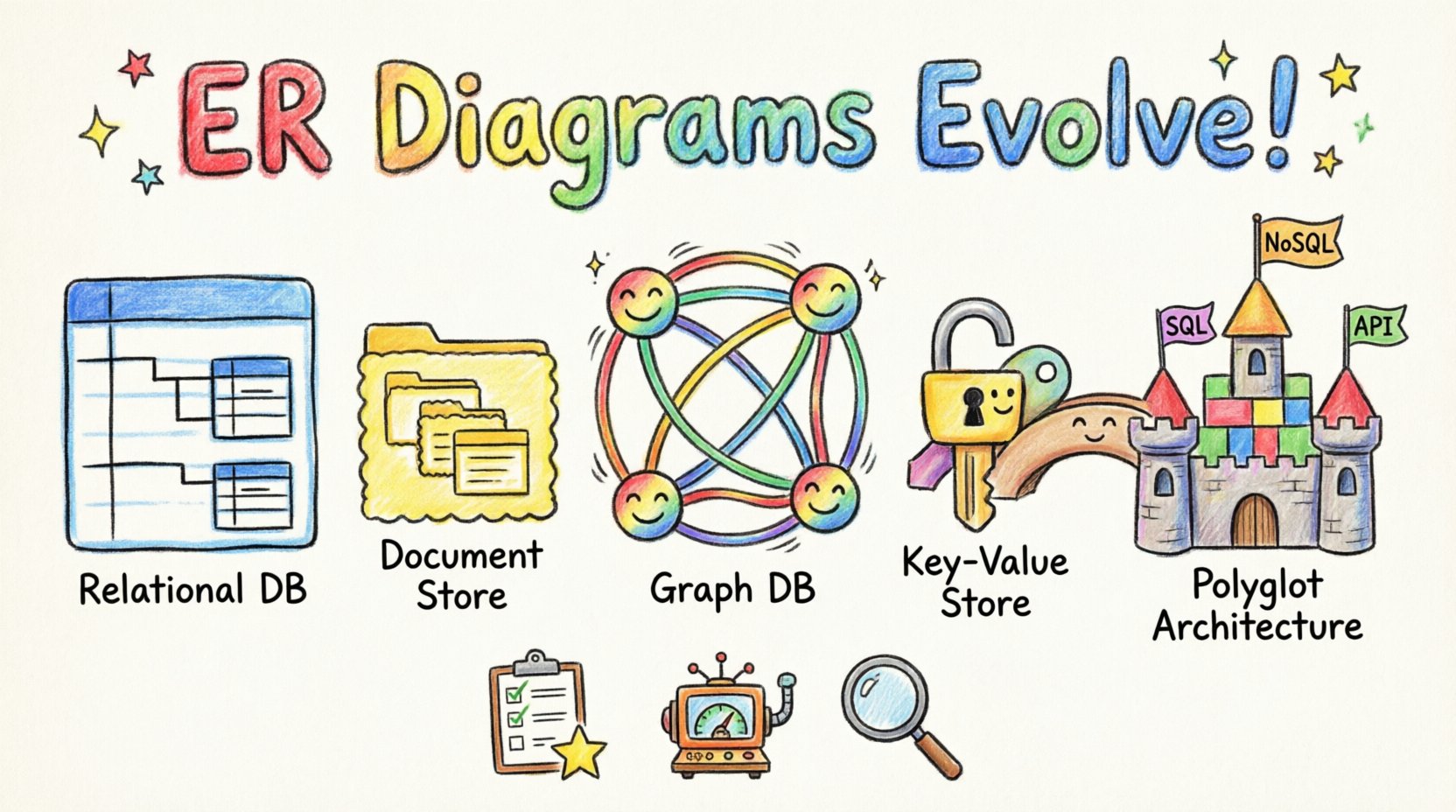
The landscape of data management has shifted dramatically over the last decade. Where relational databases once reigned supreme, a diverse ecosystem of storage engines now coexists. This transition impacts how developers visualize, design, and document their data structures. The Entity Relationship Diagram (ERD) remains a cornerstone of database design, yet its application has expanded beyond the rigid constraints of SQL. This guide explores how ER diagrams evolve within the context of NoSQL and polyglot persistence architectures, ensuring your data models remain robust and scalable.
Understanding the Traditional ERD Foundation 📐
Traditionally, the ERD served as a blueprint for relational databases. It defined entities, attributes, and relationships using strict cardinality rules. These diagrams facilitated the normalization process, ensuring data integrity through foreign keys and unique constraints. In this environment, the schema was often defined before the application code. This approach, known as schema-first design, offered stability but lacked flexibility.
- Entities: Represented as tables.
- Attributes: Represented as columns with specific data types.
- Relationships: Represented via foreign keys linking tables.
- Cardinality: Defined one-to-one, one-to-many, or many-to-many connections.
While this model provided a clear path for ACID transactions, it struggled with the demands of modern applications. High write throughput, massive scale, and complex relationships often required compromises that traditional ERDs could not easily represent. As technology advanced, the definition of a relationship expanded beyond simple table joins.
The Shift to NoSQL Data Modeling 🔄
NoSQL databases introduced a paradigm where flexibility often superseded strict consistency. This shift required a reevaluation of how we model data. The Entity Relationship Diagram did not disappear; instead, its syntax and semantics adapted to fit new storage mechanisms. Developers now consider the access patterns of their applications alongside the data structure itself.
Key differences in this evolution include:
- Schema Flexibility: Schemas can be dynamic or enforced at the application level rather than the database level.
- Data Locality: Storing related data together reduces the need for joins, changing how relationships are visualized.
- Consistency Models: The CAP theorem influences design choices, prioritizing availability or partition tolerance over immediate consistency.
When moving away from relational norms, the ERD becomes less about defining constraints and more about documenting data flow and structure. This is critical for maintaining clarity in polyglot environments where multiple database types interact.
Polyglot Persistence Architecture Explained 🏗️
Polyglot persistence refers to the practice of using different data storage technologies to handle different parts of an application. This approach allows teams to leverage the strengths of various engines without forcing a one-size-fits-all solution. For instance, a user profile might reside in a document store, while transactional logs live in a key-value store, and social connections utilize a graph database.
In this architecture, a single ERD is often insufficient. Instead, a composite data model emerges. This composite model maps how data moves between stores and how relationships are maintained across boundaries.
| Database Type | Primary Use Case | ERD Representation |
|---|---|---|
| Document Store | User profiles, catalogs | Nested JSON structures |
| Graph Database | Social networks, recommendations | Nodes and Edges |
| Key-Value Store | Caching, session management | Simple lookup maps |
| Relational DB | Financial records, inventory | Normalized Tables |
Visualizing this architecture requires a higher level of abstraction. Architects must document not only the schema within a store but also the integration points between stores. This ensures that data integrity is maintained even when the underlying technology changes.
Adapting ERDs for Document Stores 📄
Document-oriented databases store data in JSON-like structures. This format allows for embedding related information directly within a single record, reducing the need for joins. However, deep nesting can lead to performance issues during updates. The ERD for document stores focuses on embedding strategies versus referencing strategies.
Consider the following modeling patterns:
- Embedding: Storing related data inside the parent document. This is efficient for read-heavy operations where the related data rarely changes independently.
- Referencing: Storing a link or ID to a separate document. This is necessary when data is large, shared across multiple documents, or frequently updated.
When drawing diagrams for these stores, arrows often denote references rather than physical foreign keys. The diagram highlights the logical relationship rather than the physical storage mechanism. It is vital to note the maximum depth of embedding to prevent document size limits from being exceeded.
Modeling Relationships in Graph Databases 🕸️
Graph databases treat relationships as first-class citizens. Unlike relational tables where relationships are implicit through keys, graphs explicitly store connections as edges. This makes traversing complex hierarchies significantly faster. The ERD evolves here to emphasize nodes and edges rather than tables and columns.
Key considerations for graph modeling include:
- Node Properties: Attributes attached directly to the entity.
- Edge Properties: Relationships can also hold data, such as a “knows” relationship having a “since” timestamp.
- Traversal Paths: Diagrams should illustrate how queries traverse the graph, avoiding deep loops.
In a polyglot setup, a graph might be used for recommendation engines while the main user data remains in a document store. The ERD must show how the user ID in the document store links to the node in the graph. This cross-store linking is a critical component of the modern data model.
Key-Value Stores and Simple Lookups 🗝️
Key-value stores are the simplest form of data storage. They excel at speed and scalability for specific use cases like caching or session data. An ERD for this layer is often minimal. It focuses on the key generation strategy and the structure of the value payload.
Design patterns for key-value stores include:
- Namespacing: Using prefixes to organize keys logically.
- Serialization: Defining how complex objects are serialized into strings or binary formats.
- Expiration: Documenting TTL (Time To Live) policies for temporary data.
While complex relationships are rare here, the diagram must clarify how these keys are generated. A well-documented key structure prevents collisions and ensures that data retrieval remains efficient at scale.
Challenges in Polyglot Schema Management 🧩
Maintaining consistency across multiple storage types introduces unique challenges. Data duplication is common, as denormalization is often used to optimize read performance in NoSQL stores. This duplication means that updates in one store might not immediately reflect in another. Consistency patterns such as eventual consistency must be clearly documented in the data model.
Common challenges include:
- Data Synchronization: Keeping data in sync across stores without creating circular dependencies.
- Transaction Management: Handling distributed transactions across different storage engines.
- Query Complexity: Joining data from multiple sources in application code rather than the database layer.
The ERD must serve as a communication tool for these complexities. It should highlight where data is duplicated and where referential integrity is managed by the application logic rather than the database engine.
Best Practices for Modern Data Modeling ✅
To ensure long-term maintainability, teams should adopt specific practices when designing for these architectures. Documentation is paramount. Code comments are insufficient; the schema must be visible and versioned alongside the application code.
- Unified Notation: Adopt a standard notation that can represent both relational and non-relational concepts.
- Version Control: Treat schema changes as code. Use migration tools to manage evolution over time.
- Access Pattern First: Design the model based on how data is read and written, not just how it relates logically.
- Regular Audits: Periodically review the data model to ensure it still matches the current application requirements.
These practices help mitigate the risk of technical debt accumulating as the system grows. A clear model reduces the cognitive load on new team members and simplifies debugging processes.
Future Trends in Data Visualization 📈
The tools used to create ERDs are evolving. Modern design platforms increasingly support multi-model diagrams. These tools allow users to mix tables, documents, and nodes in a single view. This visual integration helps stakeholders understand the entire data ecosystem without switching contexts.
Emerging trends include:
- Interactive Models: Clicking on a node in the diagram reveals sample data or query performance metrics.
- Automated Generation: Generating diagrams directly from the running application schema.
- Cloud-Native Integration: Diagrams that automatically update when cloud resources are provisioned or deprovisioned.
These advancements promise to make the data modeling process more dynamic. The static diagram of the past is becoming a living representation of the system.
Implementation Strategies for Teams 👥
Transitioning to a polyglot architecture requires a cultural shift. Teams must understand the trade-offs of each storage engine. Training is essential to ensure that developers understand how to query and model data in non-relational environments.
Recommended steps for implementation:
- Assess Current Workloads: Identify which data types fit best with which storage engines.
- Define Standards: Create guidelines for naming conventions and relationship documentation.
- Pilot Projects: Start with a non-critical service to test the new modeling approach.
- Feedback Loops: Gather feedback from developers who interact with the data daily.
By taking a measured approach, organizations can adopt new technologies without destabilizing existing operations. The goal is incremental improvement rather than a disruptive overhaul.
Conclusion on Data Architecture Evolution 🎯
The evolution of the Entity Relationship Diagram reflects the broader changes in software architecture. As data becomes more diverse, our tools for modeling it must become more adaptable. Polyglot persistence offers the flexibility needed for modern applications, but it demands rigorous documentation and thoughtful design.
By understanding how to represent document structures, graph relationships, and key-value lookups within a unified modeling language, teams can build systems that are both scalable and maintainable. The future of data modeling lies in clarity, flexibility, and a deep understanding of the trade-offs inherent in every storage choice.