In the complex ecosystem of software development, a user story is more than a line of text in a backlog. It is a promise of value, a contract between business and engineering, and the fundamental unit of work that drives delivery. However, when teams operate in silos or communicate through fragmented channels, that promise can become ambiguous. The cost of misalignment is measured in rework, delayed releases, and frustrated stakeholders. Ensuring shared understanding is not a one-time event; it is a continuous practice embedded in the rhythm of development.
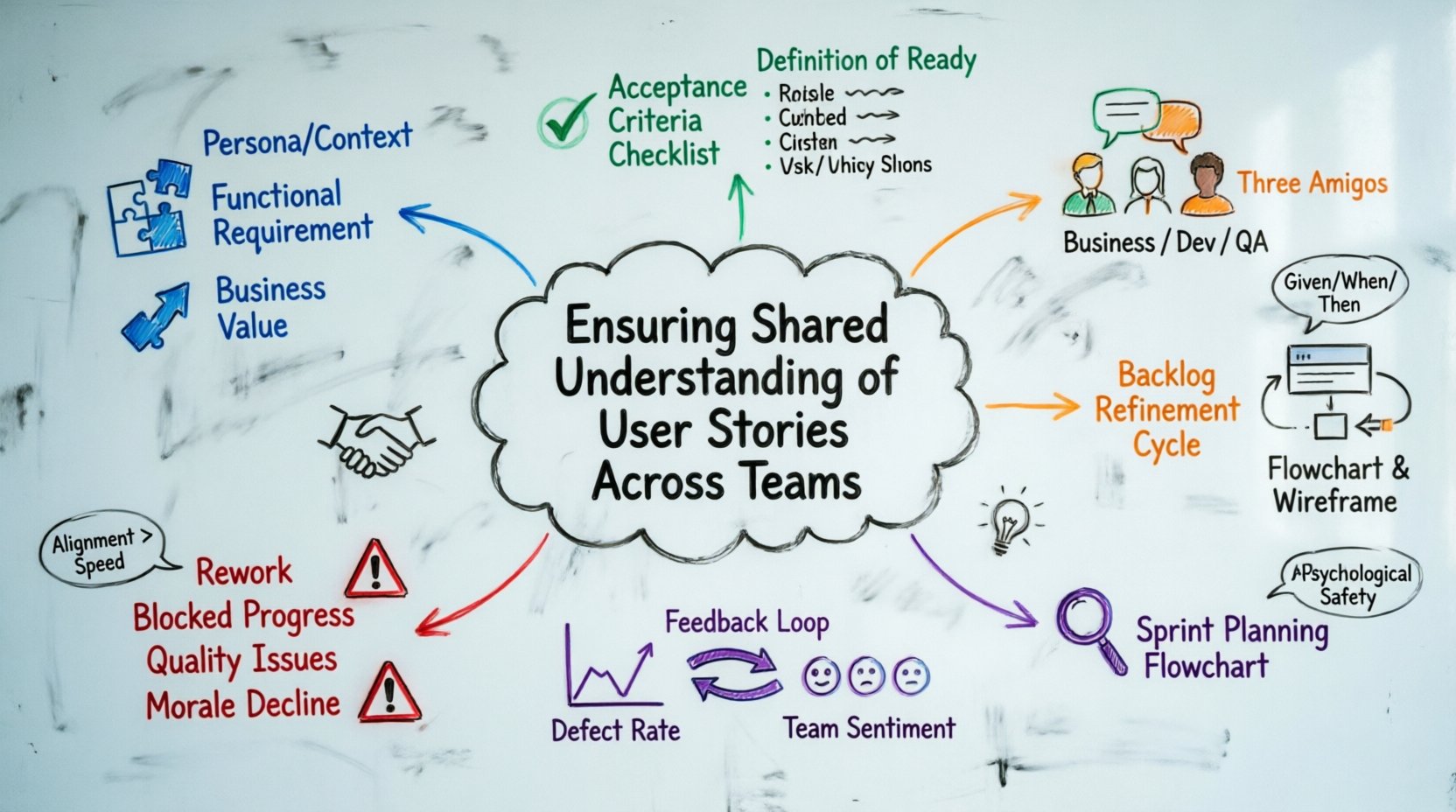
Why Alignment Matters More Than Speed 🏎️
Organizations often prioritize velocity over clarity. The assumption is that faster delivery means more value. However, without a foundational agreement on what constitutes a finished item, speed often leads to accumulating technical debt and confusion. When a developer interprets a story differently than the product owner, or when the QA team tests against a mental model different from the designer, the final product reflects those gaps rather than the intended vision.
Shared understanding acts as a friction reducer. It allows cross-functional teams to move forward without constant clarification loops. It reduces the cognitive load on individuals who otherwise spend significant time guessing requirements. When everyone is aligned, the focus shifts from “What does this mean?” to “How do we build this best?”.
The Cost of Ambiguity
Ambiguity in user stories manifests in several ways that impact the organization:
- Rework: Code is written, tested, and then discarded because it did not meet the actual need.
- Blocked Progress: Teams wait for clarification before starting work, creating bottlenecks.
- Quality Issues: Edge cases are missed because the scenario was not explicitly defined.
- Morale Decline: Engineers feel frustrated when their work is rejected due to misunderstood requirements.
- Stakeholder Disappointment: The delivered feature does not solve the business problem it was meant to address.
The Anatomy of a Clear User Story 🧩
A well-structured story provides enough context for a team to make informed decisions without needing constant intervention. While the standard format is “As a [role], I want [feature], so that [benefit],” this alone is insufficient for cross-team alignment.
1. The Persona and Context
Who is using this feature? A developer might optimize for performance, while a product owner optimizes for usability. Defining the persona ensures that the solution fits the user’s mental model.
- Specify the user role clearly.
- Describe the environment where the feature is used.
- Identify any constraints the user faces (e.g., low bandwidth, accessibility needs).
2. The Functional Requirement
This is the core action. It must be specific enough to be implemented but broad enough to allow technical creativity.
- Use active verbs.
- Avoid technical jargon that the business side may not understand.
- Focus on the behavior, not the implementation details.
3. The Business Value
Why are we building this? Understanding the “why” empowers the team to suggest better solutions if they encounter technical hurdles.
- Connect the story to a broader goal or metric.
- Explain the problem being solved.
- State the expected outcome.
Acceptance Criteria: The Contract of Completion ✅
Acceptance criteria are the specific conditions that a software product must satisfy to be considered complete. They are the boundary between “done” and “not done.” Without them, the definition of completion is subjective.
Best Practices for Writing Criteria
- Be Specific: Avoid vague terms like “fast,” “easy,” or “user-friendly.” Use measurable terms like “loads in under 2 seconds” or “requires fewer than 3 clicks.”
- Cover Edge Cases: Discuss what happens when things go wrong. What happens if the network fails? What happens if the input is empty?
- Use Gherkin Syntax: Where appropriate, use Given/When/Then structures to standardize the logic across teams.
- Keep it Testable: If you cannot write a test case for it, it is not a valid acceptance criterion.
Example Comparison
Consider the following comparison to illustrate the difference between vague and specific criteria.
| Vague Criteria | Specific Criteria |
|---|---|
| The page should load quickly. | The homepage must render within 2 seconds on a 4G connection. |
| Users can search for items. | Users can filter results by price range, category, and availability. |
| The system handles errors. | Display a friendly error message if the login fails, and do not expose stack traces. |
Collaborative Rituals for Alignment 🤝
Documentation alone cannot bridge the gap between teams. Human interaction is required to surface assumptions and clarify intent. Several structured rituals facilitate this process.
1. Backlog Refinement
Refinement is the ongoing process of reviewing, sizing, and clarifying items before they enter a sprint. It is not a one-off meeting but a recurring habit.
- Frequency: Schedule it regularly, such as mid-week.
- Participants: Include developers, testers, product owners, and designers.
- Goal: Ensure stories are ready for the upcoming planning session.
2. The Three Amigos
This technique involves a conversation between three key perspectives before work begins: Business (Product Owner), Development (Engineering), and Quality (Testing). This trio ensures that the requirements make sense, the solution is feasible, and the quality standards are clear.
- Business: Validates the value and the user need.
- Development: Assesses technical feasibility and complexity.
- Quality: Identifies potential risks and testing scenarios.
3. Sprint Planning
During planning, the team commits to work. This is the final checkpoint before implementation. The discussion here should focus on “How” and “When,” assuming “What” was agreed upon during refinement.
- Break down stories into technical tasks.
- Identify dependencies between tasks.
- Confirm capacity and availability.
Definition of Ready (DoR) 📋
The Definition of Ready is a checklist of criteria that a user story must meet before it can be accepted into a sprint. It prevents teams from starting work on incomplete or ambiguous items.
Components of a Strong DoR
| Criteria | Description |
|---|---|
| Clear Goal | The value proposition is understood by all. |
| Acceptance Criteria | Conditions for completion are defined. |
| Dependencies | External requirements are identified and managed. |
| Design Assets | Visual mocks or wireframes are available. |
| Estimation | The team has a shared sense of effort required. |
Visual Communication and Artifacts 🎨
Text is linear, but software systems are often non-linear. Visual aids help bridge the gap between abstract requirements and concrete implementation.
- Flowcharts: Illustrate the decision paths and logic flows within a feature.
- Wireframes: Show the layout and placement of elements.
- State Diagrams: Clarify how an object moves from one state to another.
- Whiteboarding: Real-time drawing during meetings captures ideas as they are generated.
Managing Cross-Team Dependencies 🧱
In larger organizations, features often span multiple teams. This introduces complexity regarding synchronization and understanding.
Strategies for Multi-Team Alignment
- Feature Teams: Structure teams around end-to-end features rather than layers (e.g., frontend vs. backend).
- Interface Contracts: Define clear API contracts between teams early to avoid integration surprises.
- Shared Documentation: Maintain a central source of truth for cross-team requirements.
- Regular Syncs: Hold integration meetings to track progress on shared components.
Feedback Loops and Continuous Improvement 🔄
Alignment is not static. It requires constant checking and adjustment. Feedback loops ensure that understanding remains accurate as the product evolves.
Types of Feedback
- Code Review: Peers check the implementation against the requirements.
- Testing: Automated and manual tests verify the behavior.
- User Feedback: Real users validate the solution in production.
- Retrospectives: Teams discuss what went well and what didn’t regarding communication.
Common Pitfalls and How to Avoid Them ⚠️
Even with the best intentions, teams can fall into traps that hinder understanding.
1. The Silo Effect
Teams working in isolation without visibility into others’ work. To combat this, enforce cross-team meetings and shared documentation spaces.
2. Over-Documentation
Spending too much time writing documents that no one reads. Focus on living documents and just-in-time information.
3. Assumption of Knowledge
Assuming everyone knows the context. Always provide background context when introducing a story.
4. Ignoring Non-Functional Requirements
Focusing only on features while neglecting performance, security, or scalability. Include these in the acceptance criteria.
Measuring Success 📊
How do you know if your alignment is working? Track metrics that reflect communication health.
- Defect Rate: Fewer bugs often indicate clearer requirements.
- Rejection Rate: Lower rates of work being returned for rework.
- Sprint Completion: Higher consistency in delivering committed work.
- Team Sentiment: Surveys indicating reduced frustration and clearer direction.
The Human Element of Technical Communication 👥
Ultimately, technology is built by people. The most robust processes fail if the human element is ignored. Empathy is crucial. Engineers need to understand the business pressure, and business stakeholders need to understand the technical constraints. Creating a culture where asking questions is encouraged, and no question is considered too basic, is vital for shared understanding.
Active listening plays a significant role. During refinement sessions, ensure that all voices are heard. Sometimes the most important insight comes from a junior developer who notices a logical gap that others missed. Encouraging psychological safety allows teams to admit uncertainty early rather than hiding it until it becomes a critical failure.
Summary of Best Practices 📝
- Define clear acceptance criteria for every story.
- Hold regular refinement sessions with all roles involved.
- Use the Three Amigos technique for critical stories.
- Maintain a Definition of Ready checklist.
- Utilize visual aids to complement text.
- Manage dependencies proactively.
- Establish feedback loops to validate understanding.
- Foster a culture of open communication and curiosity.
Building shared understanding is a discipline. It requires intention, consistency, and a commitment to clarity. When teams invest in this alignment, they create an environment where value flows smoothly from idea to delivery. The result is not just better software, but a more cohesive and effective organization.