In the fast-paced environment of Agile development, clarity is currency. A user story is not merely a ticket in a backlog; it is a promise of conversation, a vehicle for value delivery, and a blueprint for engineering effort. Without a robust structure, stories become ambiguous requests that lead to rework, misalignment, and frustrated stakeholders. This guide dissects the anatomy of a high-quality user story, providing a framework that ensures every piece of work delivered aligns with genuine user needs and business objectives.
When teams invest time in crafting the right structure, they reduce ambiguity before a single line of code is written. This approach shifts the focus from documentation to collaboration. Below, we explore the core components, evaluation models, and refinement strategies that define an effective story.
1. The Core Template: As a, I Want, So That 💬
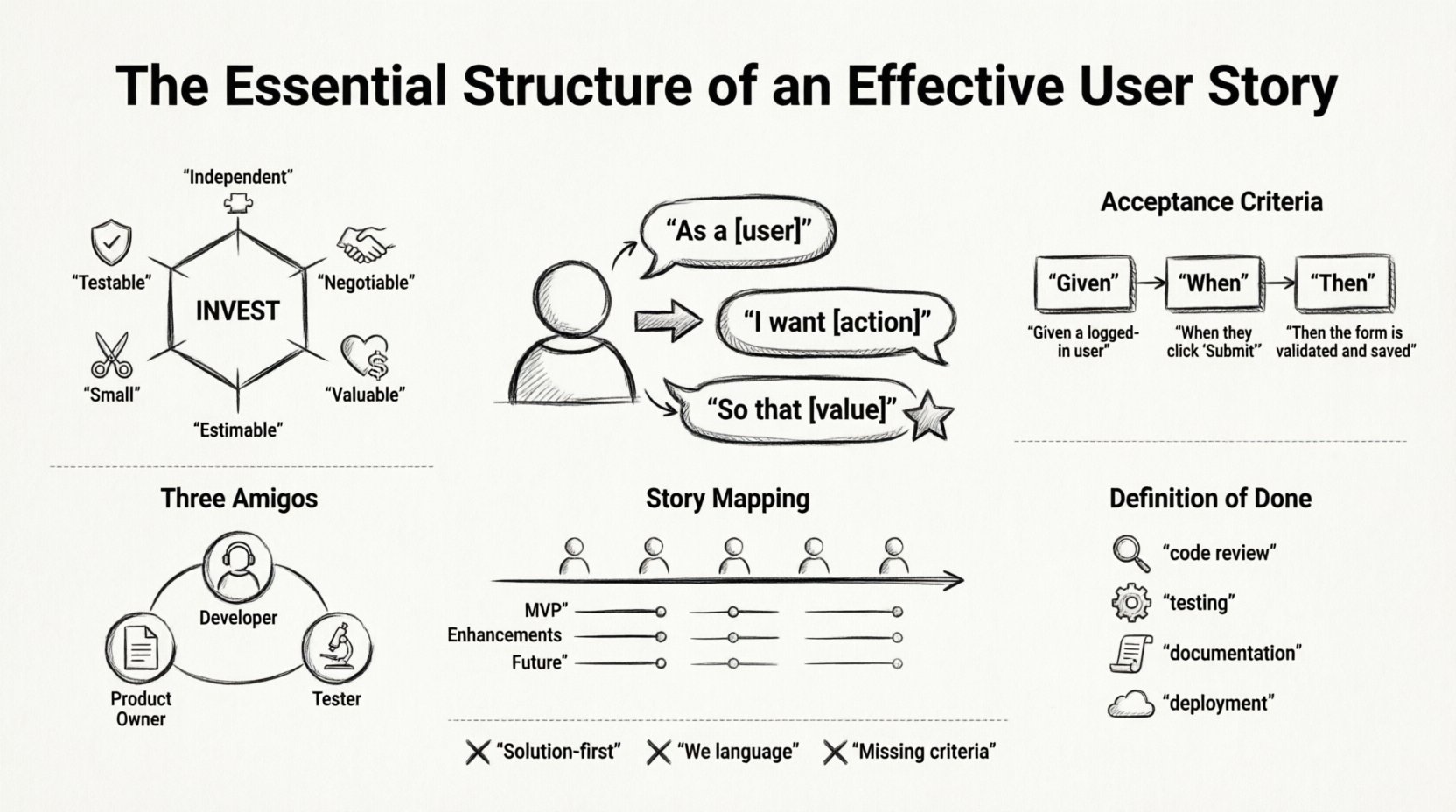
The foundation of most user stories rests on a simple, three-part sentence structure. While it may seem basic, this template forces the writer to consider the actor, the action, and the value. It prevents the common pitfall of writing feature requests instead of user needs.
The Actor: As a [Type of User]
Identifying the user is the first step. This is not just about a job title, but about the specific persona interacting with the system. Are they a new visitor? An administrative power user? A guest browsing in incognito mode?
- Specificity matters: “As a user” is too vague. “As a premium subscriber” provides context for permissions and constraints.
- Multiple personas: A single story might involve multiple roles, but it should focus on the primary beneficiary.
- Anonymous access: Sometimes the user is “As a visitor” or “As a system,” which is valid if the interaction is impersonal.
The Activity: I Want [Action/Goal]
This section describes the need or the desired capability. It should be agnostic of the solution. Avoid describing the implementation details here (e.g., “I want a dropdown menu”). Instead, focus on the function.
- Focus on intent: “I want to filter results” is better than “I want a search bar.” The implementation of the filter is the team’s responsibility, not the story’s definition.
- Active voice: Keep the language direct and active to maintain clarity.
The Benefit: So That [Value]
This is the most critical part of the template. It answers the “Why.” Without this, the development team cannot prioritize or understand the impact of the work. It connects the feature to the business outcome.
- Business value: Does this increase revenue? Does it reduce support tickets? Does it improve security?
- User value: Does it save time? Does it reduce cognitive load? Does it provide peace of mind?
- Validation: If you cannot articulate the benefit, the story might not be worth building.
2. Acceptance Criteria: The Contract of Quality ✅
A user story defines what we are building, but acceptance criteria define when the work is complete. They serve as a shared understanding between the Product Owner and the Development Team. These are not test cases, but rather conditions that must be met for the story to be accepted.
Writing Effective Criteria
Criteria should be specific, testable, and unambiguous. Avoid subjective terms like “user-friendly” or “fast.” Instead, use measurable standards.
| Ambiguous Criteria | Specific Criteria |
|---|---|
| The page should load quickly. | The homepage must load within 2 seconds on 4G networks. |
| Make the button easy to find. | The “Checkout” button must be visible above the fold on mobile devices. |
| Ensure data is secure. | Personal data must be encrypted using AES-256 before storage. |
Using Gherkin Syntax
Many teams adopt a structured format known as Gherkin to write acceptance criteria. This uses a Given-When-Then structure that reads like a specification.
- Given: The initial context or state of the system.
- When: The action or event that triggers the change.
- Then: The expected outcome or result.
Example:
- Given the user is logged in as an admin.
- When they click the “Delete User” button.
- Then a confirmation modal appears, and the user record is removed from the database.
3. The INVEST Model: A Quality Framework 📊
Not all stories are created equal. To maintain a healthy backlog, stories should adhere to the INVEST model. This acronym serves as a checklist to ensure stories are well-formed and manageable.
Independent
Stories should be as independent as possible. Dependencies between stories create bottlenecks. If Story B cannot start until Story A is finished, they should ideally be linked, but the work should be decoupled where possible to allow for flexible scheduling.
Negotiable
The details of the story are not set in stone. The story represents a commitment to a conversation, not a rigid contract. The team should have the freedom to discuss implementation details and find the best solution together.
Valuable
Every story must deliver value to the end-user or the business. If a feature does not provide utility, it should not exist. This criterion forces the team to question the necessity of every item in the backlog.
Estimable
The team must be able to estimate the effort required. If a story is too vague, it cannot be estimated. This often requires splitting the story into smaller, clearer components until the scope is understood.
Small
Stories should be small enough to be completed within a single sprint. Large stories are often called “Epics” and need to be broken down. Large stories carry high risk and are difficult to test.
Testable
There must be a way to verify that the story is complete. If you cannot write a test case for it, you cannot verify it. This ties directly back to acceptance criteria.
| Criterion | Key Question | Indicator of Failure |
|---|---|---|
| Independent | Can this be built without blocking others? | High dependency on external teams. |
| Negotiable | Can we discuss the solution? | Requirements are fixed before discussion. |
| Valuable | Does this help the user? | Feature is requested by stakeholders but no user impact. |
| Estimable | Can we guess the effort? | Story is too complex to size. |
| Small | Can it fit in a sprint? | Story spans multiple sprints. |
| Testable | Can we verify it works? | Criteria are subjective. |
4. Story Mapping: Visualizing the Flow 🗺️
While a single story defines a discrete piece of work, a collection of stories defines a product. Story mapping helps visualize the user journey across multiple stories. It ensures that the team is not just building a pile of features, but a coherent experience.
Building the Backbone
Start with the user activities. These are the high-level tasks a user performs. Underneath these activities, place the specific user stories that make up each step. This creates a horizontal flow that represents the typical user journey.
Prioritizing the Rows
Once the map is created, rows can be established to represent iterations or releases. The top row is the Minimum Viable Product (MVP). It contains the essential stories required to deliver a functional product. Lower rows represent enhancements or nice-to-haves.
- Essential: Must be included to solve the core problem.
- Secondary: Improves the experience but is not critical.
- Future: Ideas for later iterations.
5. The Refinement Process: Keeping Stories Fresh 🔄
Stories are living documents. They evolve as understanding grows. Refinement, or grooming, is the ongoing process of updating stories to ensure they are ready for development.
When to Refine
Refinement should not be a big event at the start of a sprint. It should happen continuously. Ideally, the team spends a portion of each sprint reviewing upcoming work.
Key Activities During Refinement
- Splitting: Breaking large stories into smaller ones that pass the INVEST test.
- Clarifying: Adding missing details to acceptance criteria.
- Estimating: Assigning story points or time estimates.
- Prioritizing: Ordering the backlog based on business value.
- Removing: Deleting stories that are no longer relevant.
6. Common Pitfalls and How to Avoid Them ⚠️
Even experienced teams fall into traps when writing stories. Recognizing these patterns early can save significant time and effort.
The Solution Prematurely Defined
Bad: “As a user, I want a checkbox to unsubscribe.”
Good: “As a user, I want to stop receiving emails so that I can manage my inbox.”
Why: The checkbox is a solution. The benefit is the need. The team might find a better way to unsubscribe (e.g., a link in the footer, a profile setting).
The “We” in the Story
Bad: “As a user, we want to see the dashboard.”
Good: “As a user, I want to see the dashboard.”
Why: Stories are about individual needs. Using “we” dilutes the responsibility and makes it harder to identify the specific persona.
Missing Acceptance Criteria
Stories without criteria are open to interpretation. This leads to the “I thought you meant” scenario. Always require criteria before a story moves to development.
Too Many Dependencies
If a story relies on three other teams, it is likely too large or poorly structured. Try to decouple the work or create a specific epic to manage the dependency.
7. Measuring Story Health 📈
How do you know if your user stories are effective? Look at the metrics that indicate flow and quality.
- Carry-over Rate: Are stories frequently moved to the next sprint? High carry-over suggests stories were too large or unclear.
- Rejection Rate: How often do stories fail acceptance? High rejection implies poor acceptance criteria.
- Refinement Time: How long does it take to discuss a story? If it takes hours to clarify a simple story, the initial definition was weak.
- Velocity Consistency: Does the team deliver a predictable amount of value? Effective stories lead to predictable planning.
8. Collaboration: The Human Element 🤝
Text alone is never enough. A user story is a placeholder for a conversation. The best stories are written in collaboration with the people who will build them and the people who will use them.
The Three Amigos
Before a story is pulled into a sprint, the Product Owner, the Developer, and the Tester should review it together. This “Three Amigos” session ensures:
- The business value is clear.
- The technical feasibility is understood.
- The testing strategy is viable.
Pairing on Stories
Developers and testers can pair up during the refinement phase to write acceptance criteria. This shared ownership reduces the chance of missed edge cases during development.
9. From Story to Done 🏁
Every story must have a clear “Definition of Done” (DoD). This applies to the story and the team. A story is not complete when the code is merged; it is complete when it is deployed, tested, and documented.
- Code Review: All changes must be reviewed.
- Testing: Unit tests, integration tests, and user acceptance tests must pass.
- Documentation: User manuals or API docs must be updated.
- Deployment: The feature must be live in the production environment.
By adhering to a rigorous structure, teams can transform their backlog from a chaotic list of tasks into a strategic roadmap. The structure provides the discipline needed to maintain agility. It ensures that every item delivered is valuable, clear, and ready for the user.
Key Takeaways 🎯
- Structure Matters: Use the “As a, I want, So that” template to enforce value.
- Criteria are Key: Acceptance criteria define quality and prevent ambiguity.
- INVEST is a Guide: Use the INVEST model to assess story quality.
- Collaborate: Stories are a vehicle for conversation, not a contract.
- Refine Continuously: Backlog health requires ongoing attention and splitting.
Effective user stories are the backbone of successful product delivery. They bridge the gap between business strategy and technical execution. By investing in the structure of your stories, you invest in the efficiency of your team and the satisfaction of your users.