The Business Motivation Model (BMM) is frequently misunderstood as a static exercise in diagramming. Many organizations treat it as a documentation task, creating boxes and arrows that gather dust on a shared drive. However, the true value lies in the behavioral alignment it facilitates. This guide explores how to transition from a static representation of goals to a living, breathing culture of motivation within an enterprise.
When we speak of motivation in a business context, we are not merely discussing employee morale. We are discussing the structural alignment of intent, action, and outcome. A robust framework allows leaders to articulate why work is done, not just what is produced. This document serves as a practical manual for implementing this framework effectively.
🧩 Understanding the Business Motivation Model
At its core, the Business Motivation Model provides a standardized vocabulary for describing the factors that influence business performance. It breaks down complex organizational dynamics into manageable components. While the standard diagram often focuses on the Goal and Obstacle relationship, the cultural application requires a deeper dive into the human elements that drive these components.
- Goal: A desired state or outcome that drives action.
- Obstacle: Anything that prevents the achievement of the goal.
- Strategy: The plan of action designed to overcome obstacles and achieve goals.
- Policy: A rule that constrains or guides behavior to ensure alignment with the strategy.
- Rule: A specific requirement that must be met.
- Stakeholder: An individual or group with an interest in the outcome.
- Resource: Anything needed to execute the strategy.
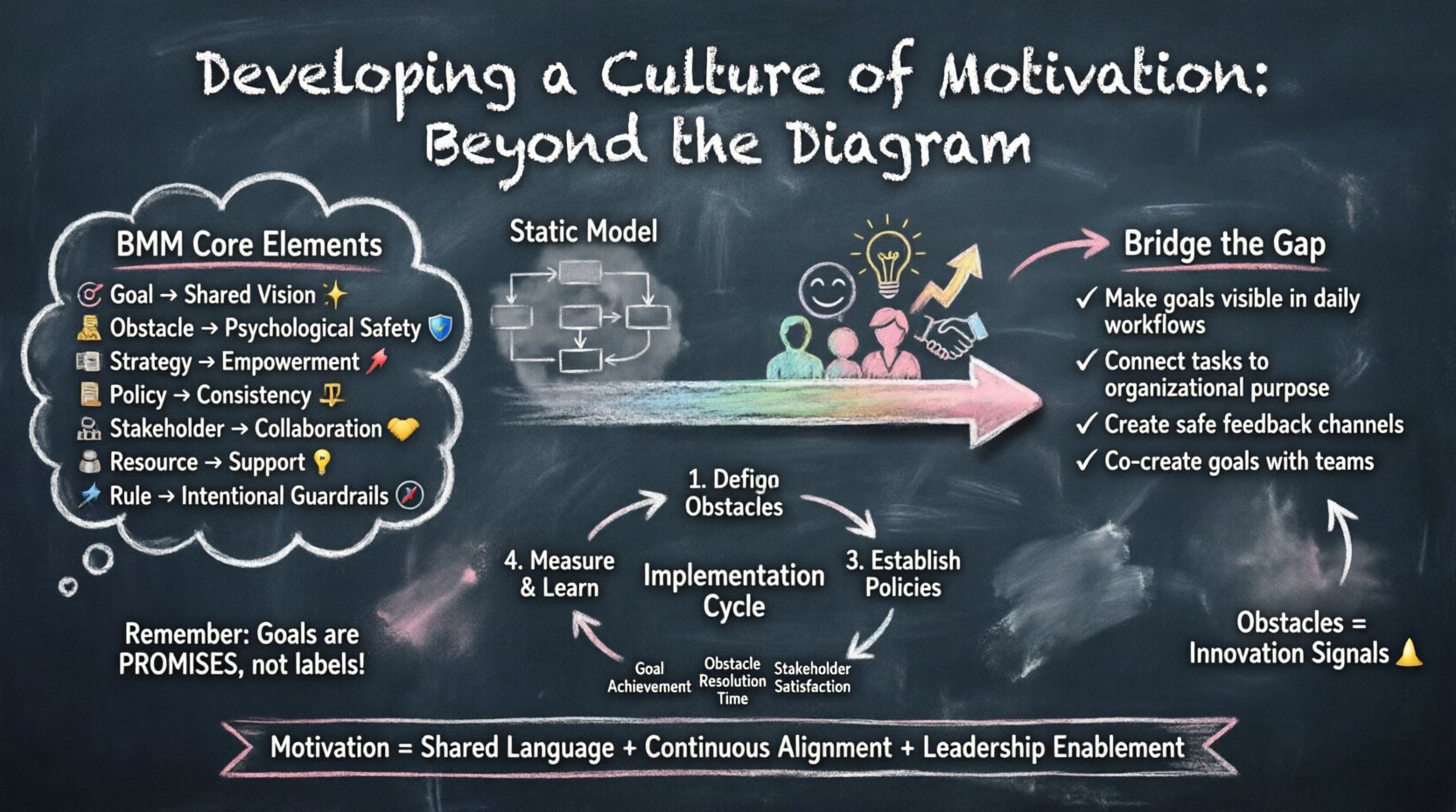
Most implementations stop at defining these terms. To build a culture, these terms must become verbs. A goal is not just a label; it is a promise. An obstacle is not just a blockage; it is a signal for innovation.
🚀 The Gap Between Model and Culture
There is often a chasm between the theoretical model and the daily reality of the workforce. Employees do not see the diagram. They see deadlines, emails, and performance reviews. Bridging this gap requires translating abstract concepts into tangible experiences.
Consider the following common disconnects:
- Visibility: The model exists in a presentation deck, not in the workflow tools.
- Relevance: Employees do not see how their daily tasks connect to the organizational goal.
- Feedback Loops: There is no mechanism to report obstacles or celebrate strategy wins.
- Ownership: Goals are assigned from the top down rather than co-created.
To close this gap, the model must be embedded into the operational rhythm. It should influence how meetings are run, how projects are scoped, and how success is measured.
📊 Mapping Model Elements to Cultural Behaviors
Effective implementation requires mapping the structural elements of the BMM to specific cultural behaviors. This table outlines the translation from abstract modeling to practical culture.
| Model Element | Cultural Behavior | Implementation Tactic |
|---|---|---|
| Goal | Shared Vision | Regularly revisit the “Why” in team stand-ups. |
| Obstacle | Psychological Safety | Create safe channels to report blockers without blame. |
| Strategy | Empowerment | Allow teams to choose the methods to achieve the goal. |
| Policy | Consistency | Ensure rules are applied fairly and transparently. |
| Stakeholder | Collaboration | Involve cross-functional groups in goal definition. |
| Resource | Support | Allocate time and budget explicitly for strategic initiatives. |
🛠️ Implementing the Strategy
Once the model is understood, the focus shifts to execution. Strategy is the bridge between the current state and the desired state. In a cultural context, this means defining how the organization intends to move forward.
1. Define the Obstacles Clearly
Many organizations fail to identify what is actually stopping them. They list symptoms rather than root causes. A culture of motivation requires honest assessment.
- Is the obstacle external (market conditions) or internal (process friction)?
- Are we resource-constrained or capability-constrained?
- Does the obstacle change as the strategy evolves?
2. Align Resources to Strategic Priorities
Resources are finite. A motivated culture knows where to invest effort. When resources are distributed evenly, focus is lost. When they are concentrated on strategic goals, momentum builds.
- Time: Protect time for deep work on strategic tasks.
- Budget: Ensure funding follows the strategy, not just historical trends.
- Talent: Place the right people in roles that require their specific skills.
3. Establish Clear Policies
Policies are not just restrictions; they are guardrails that keep the organization safe while it moves fast. They define the boundaries within which strategy is executed.
- Ensure policies are understandable to all stakeholders.
- Review policies regularly to ensure they still support the current goals.
- Communicate the rationale behind policies to reduce resistance.
🔄 Handling Rules and Compliance
Rules often get a bad reputation in creative or agile environments. However, in the Business Motivation Model, rules are the non-negotiable constraints. A culture that respects rules without understanding them becomes bureaucratic. A culture that understands the intent of the rule becomes compliant and innovative.
To manage rules effectively:
- Contextualize: Explain why a rule exists. Is it for safety? Compliance? Quality?
- Minimize: Reduce the number of rules to only those that add value.
- Automate: Where possible, embed rules into the workflow to reduce cognitive load.
📈 Measuring Impact and Success
Without measurement, there is no feedback. A culture of motivation needs to know if the strategy is working. This does not mean just tracking financial KPIs. It means tracking the health of the motivation model itself.
Key metrics to consider include:
- Goal Achievement Rate: How often are defined goals met?
- Obstacle Resolution Time: How quickly are blockers removed?
- Strategy Adherence: Are resources being used as planned?
- Stakeholder Satisfaction: Do those involved feel their interests are considered?
These metrics should be reviewed regularly. They provide data to adjust the strategy or the goals themselves. If a goal is consistently missed, it may need to be revised rather than the team being pressured further.
🤝 Stakeholder Engagement
Stakeholders are the people who care about the outcome. This includes employees, customers, partners, and regulators. A culture of motivation recognizes that different stakeholders have different interests.
Engagement strategies should vary based on the stakeholder group:
- Employees: Focus on career growth, recognition, and clear expectations.
- Customers: Focus on value delivery, reliability, and support.
- Leadership: Focus on ROI, risk management, and strategic alignment.
- Regulators: Focus on compliance, transparency, and reporting.
Regular communication is essential. Silence creates uncertainty. Uncertainty kills motivation. Keep stakeholders informed about progress, challenges, and changes.
⚠️ Common Pitfalls to Avoid
Even with a solid plan, organizations can stumble. Being aware of common traps helps in steering clear of them.
- Over-Modeling: Creating a model that is too complex to be used practically. Keep it simple enough to be actionable.
- Static Thinking: Treating the model as a one-time setup. It must evolve with the business.
- Lack of Buy-in: Imposing the model without consulting the people who will use it. Involve them in the design.
- Ignoring Obstacles: Focusing only on goals and ignoring the barriers that prevent them from being reached.
- Tool Overload: Relying too heavily on software tools instead of fostering the right behaviors.
🌱 Sustaining the Momentum
Motivation is not a one-time event. It is a continuous cycle of planning, acting, reviewing, and adjusting. To sustain it, the organization must build habits that reinforce the model.
- Ritualize Review: Make goal reviews a standard part of the calendar.
- Celebrate Wins: Acknowledge progress, even if the final goal is not yet met.
- Learn from Failure: Treat missed goals as learning opportunities, not reasons for punishment.
- Update the Model: Ensure the documentation reflects the current reality of the business.
When the model becomes part of the conversation, it ceases to be a diagram and becomes a shared language. This shared language allows teams to align quickly and efficiently, reducing friction and increasing output.
🔍 The Role of Leadership
Leadership plays a critical role in this process. Leaders must model the behavior they expect. If leaders ignore the model, employees will too.
Leadership responsibilities include:
- Defining clear and compelling goals.
- Identifying and removing obstacles for their teams.
- Ensuring resources are available when needed.
- Protecting the team from unnecessary noise and distraction.
- Communicating the vision consistently.
Leadership is not about control; it is about enabling. The Business Motivation Model provides the structure for this enabling. It clarifies what is needed and removes ambiguity.
🛡️ Building Resilience
A motivated culture is a resilient culture. When obstacles arise, a resilient team adapts rather than breaks. The BMM helps build this resilience by making the dependencies and constraints visible.
Resilience comes from:
- Clarity: Knowing exactly what needs to be done.
- Flexibility: The ability to change tactics without losing the goal.
- Support: Knowing that help is available when stuck.
- Trust: Confidence that the organization will support the effort.
By focusing on these elements, organizations can weather change and uncertainty. The model provides the anchor that keeps the ship steady.
📝 Final Thoughts on Sustainable Motivation
The Business Motivation Model is more than a set of boxes and lines. It is a framework for organizational alignment. When applied correctly, it transforms how people work together. It moves the focus from individual tasks to collective outcomes.
Building this culture takes time and effort. It requires patience and consistency. However, the payoff is an organization that is agile, focused, and driven by a shared purpose. The diagram is just the starting point. The real work begins when the model comes to life in the daily actions of the team.
Start small. Pick a single goal and a single obstacle. Map them out. Discuss them. Act on them. Measure the result. Then expand. This iterative approach ensures that the culture grows naturally alongside the business.
The goal is not perfection. The goal is progress. By keeping the model visible and relevant, organizations can maintain a high level of motivation and performance over the long term. This is the true power of the Business Motivation Model.