In the fast-paced environment of software development, scope creep is the silent killer of projects. It erodes timelines, inflates budgets, and frustrates teams. The most effective defense against this phenomenon is not a change in management style or a stricter budget, but the rigorous definition of acceptance criteria within user stories. When crafted correctly, acceptance criteria act as a contract between stakeholders and developers, ensuring everyone agrees on what “done” looks like before a single line of code is written.
This guide explores how to construct robust acceptance criteria that protect your project from uncontrolled expansion. We will examine the mechanics of scope creep, the structural elements of strong criteria, and the collaborative processes required to maintain them.
Understanding Scope Creep in Agile Projects 📈
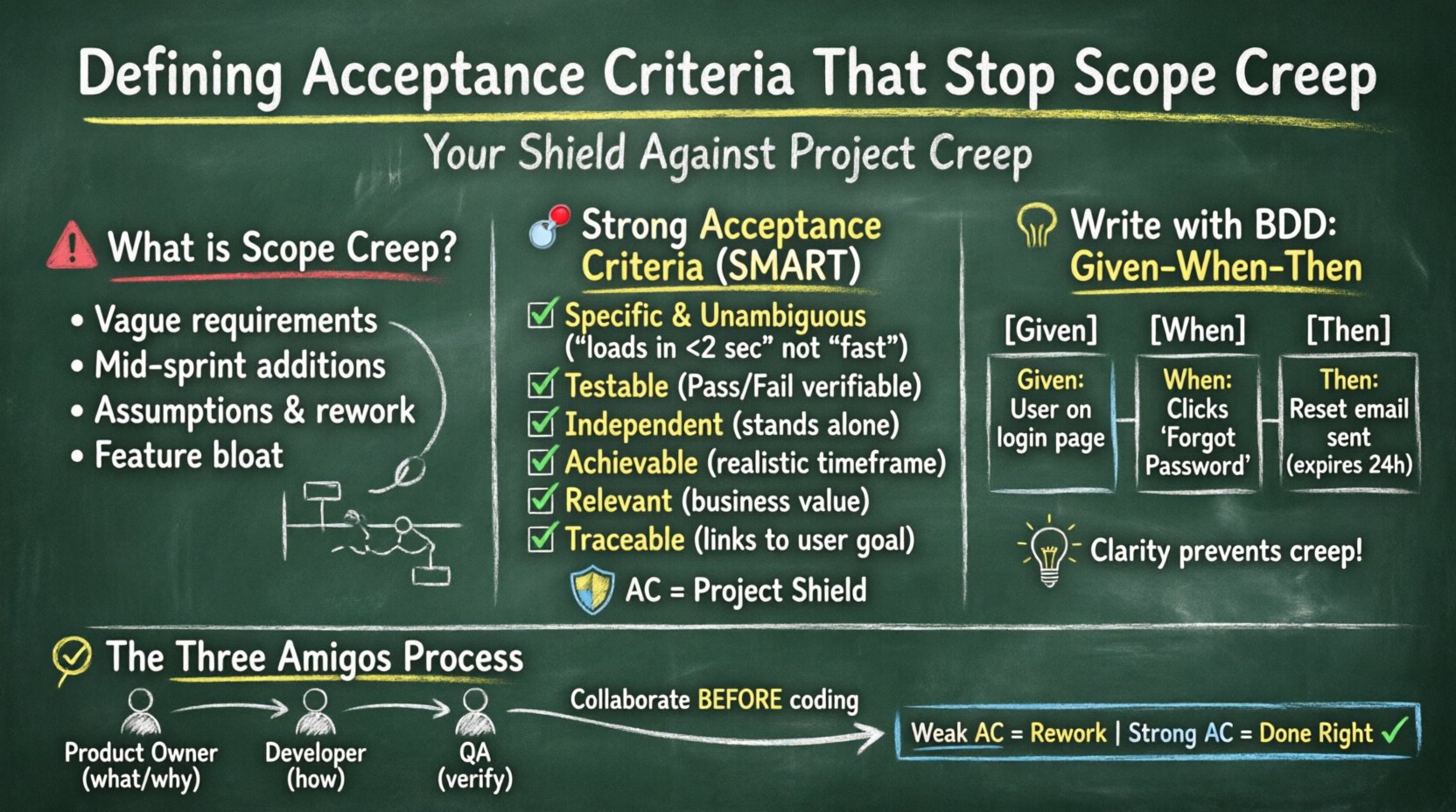
Scope creep refers to uncontrolled changes or continuous growth in a project’s scope. In the context of user stories, it manifests when new requirements are added mid-sprint without adjusting the timeline or resources. This often happens because requirements were vague at the start.
When a user story lacks clear boundaries, team members make assumptions. These assumptions lead to feature bloat. A developer might build a feature slightly differently than the stakeholder imagined, leading to rework. Or, a stakeholder might realize during testing that a missing feature is critical, pushing the story over the edge.
Common causes include:
- Vague Requirements: Statements like “Make it user-friendly” are subjective and open to interpretation.
- Lack of Collaboration: When developers and stakeholders do not discuss details before work begins.
- Gold-Plating: Developers adding extra features because they think it adds value, even if not requested.
- Changing Priorities: Stakeholders shifting focus without formally updating the backlog.
Preventing this requires a shift from vague desires to specific, measurable outcomes. Acceptance criteria provide the necessary specificity.
The Critical Role of Acceptance Criteria 🎯
Acceptance criteria are the conditions that a software product must satisfy to be accepted by a user, customer, or other stakeholders. They are not technical specifications; they are business requirements written in a way that is verifiable.
Think of them as the quality gates for a user story. If the criteria are met, the story is complete. If they are not, the story is not ready for release. This binary state removes ambiguity.
Strong acceptance criteria serve three primary functions:
- Clarification: They force stakeholders to think through edge cases and specific behaviors.
- Verification: They provide a checklist for testers to validate the work.
- Boundary Setting: They explicitly state what is not included in the current iteration, effectively saying “no” to new features without a formal change request.
By defining the boundaries early, you create a shield against scope creep. If a new idea arises, the team can check it against the criteria. If it does not fit, it is added to the backlog as a separate story, not tacked onto the current one.
Characteristics of Strong Acceptance Criteria ✅
Not all criteria are created equal. Vague criteria fail to stop scope creep just as much as having no criteria at all. To be effective, criteria must adhere to specific principles.
1. Specific and Unambiguous
Avoid words like “fast,” “easy,” or “intuitive.” These are subjective. Instead, use measurable terms. “The page loads in under 2 seconds” is specific. “The page loads quickly” is not.
2. Testable
Every criterion must be verifiable. A tester should be able to mark a box as “Pass” or “Fail.” If you cannot test it, you cannot verify it.
3. Independent
Criteria should stand alone. They should not rely on external documentation or other stories to be understood.
4. Achievable
Ensure the criteria are realistic within the timebox. If a story requires a technology not yet available, the criteria will fail, leading to scope issues later.
5. Relevant
Focus on business value. If a criterion does not add value to the user or the business, it is noise.
6. Traceable
Each criterion should link back to a specific business need or user goal.
Writing AC Using Behavior-Driven Development 🧠
One of the most effective frameworks for writing acceptance criteria is Behavior-Driven Development (BDD). This approach uses a shared language, often based on the Gherkin syntax, to describe behavior.
The structure typically follows the Given-When-Then format:
- Given: The initial context or state of the system.
- When: The action or event that occurs.
- Then: The expected outcome or result.
This structure forces the writer to think about the sequence of events and the resulting state. It reduces ambiguity because it describes behavior from the user’s perspective.
Example Scenario
Consider a story for a “Forgot Password” feature.
Weak Criteria:
- User can reset password.
- System sends email.
Strong Criteria (Gherkin):
- Given the user is on the login page
- When they click the “Forgot Password” link
- Then they are redirected to the password reset form
- And an email is sent to their registered address
- And the email contains a link that expires in 24 hours
The strong version leaves no room for interpretation regarding the expiration time or the redirection process.
Comparison: Weak vs. Strong Criteria 📊
Visualizing the difference helps teams understand the impact of poor definition.
| Feature | Weak Acceptance Criteria | Strong Acceptance Criteria |
|---|---|---|
| Search Function | Search bar should work well. | Search results appear within 1 second. Results sort by relevance by default. If no results are found, show a “No results found” message. |
| Checkout | Users can pay for items. | Users can select credit card or PayPal. Payment confirmation appears immediately. Discount codes are applied before total calculation. |
| Upload | File upload works. | Supports JPG, PNG, and PDF formats. Max file size is 5MB. Shows a progress bar during upload. Displays error message if file exceeds limit. |
| Security | Login is secure. | Account locks after 5 failed attempts. Passwords must be at least 8 characters with one number. Session expires after 30 minutes of inactivity. |
Notice how the strong criteria eliminate the “well” or “secure” ambiguity. This precision is what stops scope creep.
The Collaboration Process for AC 🤝
Writing acceptance criteria is not a solitary task. It requires collaboration between the Product Owner, the Development Team, and Quality Assurance. This collaborative event is often called the “Three Amigos” session.
1. The Product Owner
The Product Owner defines the what and the why. They bring the business requirements and the vision. They ensure the criteria align with user needs and business goals.
2. The Developers
Developers define the how. They bring technical constraints to the table. They can identify if a requirement is technically feasible or if it introduces undue complexity. They help refine criteria to be testable and achievable.
3. The Quality Assurance (QA)
QA defines the how to verify. They ensure the criteria can be tested. They identify edge cases that the business logic might miss. They act as the advocate for the user experience.
When these three roles meet before sprint planning or during refinement, they create a shared understanding. This shared understanding reduces the likelihood of miscommunication later in the cycle.
Common Pitfalls to Avoid ⚠️
Even with good intentions, teams often fall into traps when defining acceptance criteria. Awareness of these pitfalls is the first step to avoiding them.
1. Confusing AC with Technical Specs
Acceptance criteria should describe behavior, not implementation details. Avoid phrases like “Use a hash function for encryption” or “Store data in SQL.” Instead, say “Data must be encrypted before storage.” This allows the team to change the implementation without changing the acceptance criteria.
2. Too Many Criteria
A user story should not have fifty acceptance criteria. If it does, the story is likely too large. Break it down into smaller stories. This makes the criteria more focused and easier to manage.
3. Ignoring Negative Cases
Many teams only write criteria for the happy path. What happens when the user enters invalid data? What happens when the network fails? You must define how the system behaves when things go wrong.
4. Static Criteria
Criteria are not set in stone. As you learn more during development, you may need to refine them. Treat them as living documents within the context of the sprint.
5. Lack of Prioritization
All criteria are not equal. Some are critical for the MVP, while others are nice-to-have. Distinguish between Must-Haves and Should-Haves to manage scope if time runs short.
Measuring AC Effectiveness 📊
How do you know if your acceptance criteria are working? You need metrics to track their impact on scope creep and delivery.
1. Story Completion Rate
Track how many stories are marked as “Done” without rework. A high completion rate suggests criteria are clear.
2. Defect Rate
If bugs are found after release, it often means the acceptance criteria missed an edge case. Monitor the number of bugs found in production.
3. Rework Percentage
Measure how much time is spent fixing issues related to misunderstood requirements. If this number is high, your criteria need work.
4. Stakeholder Satisfaction
Ask stakeholders if the delivered product matches their expectations. If they frequently say “I thought it would do X,” your criteria were likely vague.
Maintaining Criteria Over Time 🔄
Once you have defined acceptance criteria, the work is not over. You must maintain them as the product evolves.
1. Regular Reviews
Review your backlog regularly. Old criteria may no longer be relevant if the business model changes. Update them to reflect the current state.
2. Retrospectives
Use sprint retrospectives to discuss criteria quality. Ask the team: “Did the criteria help us avoid rework?” or “Did we miss any edge cases?”
3. Knowledge Base
Store your acceptance criteria in a central location. This ensures that new team members can understand the requirements without needing to ask questions.
4. Automation
Whenever possible, automate the verification of acceptance criteria. If a criterion is testable, write an automated test for it. This ensures the criteria remain valid as code changes.
Conclusion on Scope Control
Scope creep is inevitable in any project that involves human interaction and complex requirements. However, it does not have to be destructive. By defining acceptance criteria that are specific, testable, and agreed upon by all parties, you create a framework that protects your project’s integrity.
The key lies in collaboration. When the business, development, and testing teams speak the same language, ambiguity disappears. Ambiguity is the fuel for scope creep. Without it, your project remains focused on the intended value.
Invest time in refining your user stories. Ensure every story has clear boundaries. This investment pays dividends in reduced rework, higher quality software, and teams that can predict delivery dates with confidence.
Start today. Review your current backlog. Identify stories with vague criteria. Bring the team together. Rewrite those criteria. Stop scope creep before it starts.