
In the complex landscape of enterprise architecture, few frameworks provide as much clarity as the Business Motivation Model (BMM). This standard, developed by the Object Management Group (OMG), helps organizations articulate their reasons for acting, the goals they seek to achieve, and the strategies they employ to get there. However, implementing a BMM is not merely a documentation exercise; it is a strategic discipline. When executed poorly, it creates confusion, misalignment, and wasted resources. Understanding the common pitfalls allows architects and business leaders to build robust models that drive actual performance rather than gathering dust in a repository.
This guide explores the critical errors found in Business Motivation Modeling and provides actionable strategies to prevent them. By focusing on clarity, alignment, and adaptability, you can ensure your model serves as a living tool for decision-making.
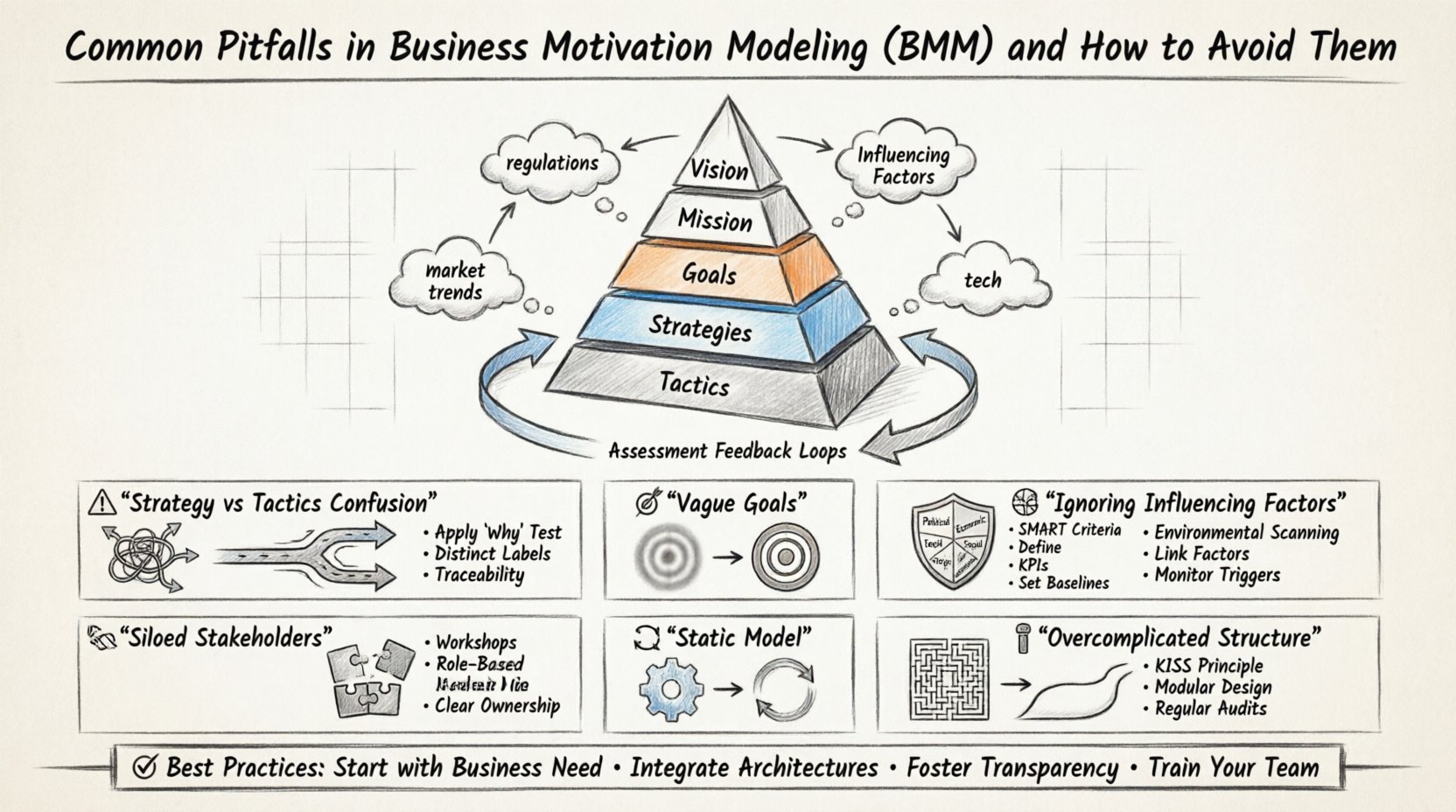
🧩 Understanding the Business Motivation Model Foundation
Before diving into errors, it is essential to define what constitutes a robust BMM. The model is hierarchical and links high-level aspirations to specific actions. It typically includes the following core components:
- Vision: The desired future state of the organization.
- Mission: The purpose and scope of the organization.
- Goals: Specific outcomes the organization aims to achieve.
- Strategies: The approach to achieve the goals.
- Tactics: Specific actions taken to implement the strategies.
- Influencing Factors: Internal and external elements that affect the model (e.g., regulations, market trends).
- Assessments: The evaluation of goals and strategies.
When these elements are connected logically, they create a traceability chain from the boardroom to the execution floor. The pitfalls discussed below often occur when this chain is broken or obscured.
⚠️ Pitfall 1: Confusing Strategy with Tactics
One of the most frequent errors in BMM implementation is the blurring of lines between strategy and tactics. Leaders often treat a tactical initiative as a strategic plan, or conversely, mistake a high-level aspiration for a concrete strategy. This confusion leads to execution gaps where teams work hard on the wrong things.
Why This Happens
Strategies are the “how” at a high level, describing the approach to achieve a goal. Tactics are the “what” at a granular level, describing specific activities. When these are conflated, the organization loses the ability to pivot. If a tactic fails, it should not invalidate the entire strategy, but if the strategy is actually a tactic in disguise, a single failure can derail the whole vision.
How to Avoid This Error
- Apply the “Why” Test: For every strategy, ask why this approach is chosen. If the answer is a specific action, it is likely a tactic.
- Use Distinct Labels: Ensure your modeling tool or documentation clearly distinguishes between Strategy and Tactics fields.
- Focus on Scope: Strategies should be broad enough to survive changes in market conditions. Tactics should be specific enough to be assigned to individuals.
- Traceability: Ensure every tactic is linked to a strategy, and every strategy is linked to a goal. If a tactic links directly to a Vision, it is likely too broad.
🎯 Pitfall 2: Vague or Unmeasurable Goals
A goal without a metric is merely a wish. Many BMM implementations fail because the Goals component is populated with aspirational statements like “Improve Customer Satisfaction” or “Increase Efficiency.” Without specific criteria, these goals cannot be assessed, managed, or achieved.
The Cost of Ambiguity
Ambiguous goals lead to subjective assessments. One department may believe the goal is met while another believes it is not. This creates conflict and makes it impossible to calculate Return on Investment (ROI) for business initiatives. Furthermore, without measurable goals, there is no clear incentive for stakeholders to align their efforts.
How to Avoid This Error
- Adopt SMART Criteria: Ensure every goal is Specific, Measurable, Achievable, Relevant, and Time-bound.
- Define Success Metrics: Explicitly link a Key Performance Indicator (KPI) to every goal. For example, instead of “Increase Revenue,” use “Increase Revenue by 10% by Q4 2024.”
- Set Baselines: Document the current state before setting the target. This provides context for progress tracking.
- Review Regularly: Goals should not be static. Review them quarterly to ensure they remain relevant to the current market environment.
🌍 Pitfall 3: Ignoring Influencing Factors
The Business Motivation Model includes a component specifically designed for Influencing Factors. These are the internal and external forces that impact the organization’s ability to achieve its goals. A common pitfall is to treat the model as an isolated system, ignoring the environment in which the business operates.
The Risk of Isolation
If you model your goals without considering regulatory changes, competitor actions, or technological shifts, your model becomes obsolete quickly. An organization might plan a strategy that is viable today but illegal tomorrow due to new compliance rules. Ignoring these factors leads to strategic brittleness.
How to Avoid This Error
- Conduct Environmental Scanning: Regularly update the Influencing Factors section with PESTLE analysis data (Political, Economic, Social, Technological, Legal, Environmental).
- Categorize Factors: Distinguish between Internal Factors (e.g., employee skills, budget) and External Factors (e.g., market demand, legislation).
- Link Factors to Goals: Explicitly map which factors positively or negatively influence specific goals. This highlights risk areas.
- Monitor Triggers: Set up alerts for specific influencing factors. If a factor changes (e.g., a new tax law), trigger a review of the related strategies.
🤝 Pitfall 4: Siloed Stakeholder Alignment
Business Motivation Modeling is often treated as a task for the Architecture team or Strategy department. When stakeholders from IT, Operations, Marketing, and Sales are not involved, the model lacks the necessary context and buy-in. This results in a “top-down” model that does not reflect the reality of “bottom-up” execution.
The Consequence of Silos
Without broad alignment, departments pursue conflicting tactics. Marketing might run a campaign that Sales cannot support, or IT might build a system that Operations cannot maintain. The BMM should act as a central source of truth that connects these disparate views.
How to Avoid This Error
- Stakeholder Workshops: Conduct collaborative sessions where different departments define their contributions to the goals.
- Role-Based Views: Create different views of the model for different stakeholders. Executives see Goals and Strategies; Managers see Tactics.
- Communication Channels: Establish a feedback loop where operational teams can report on the viability of tactics to the model owners.
- Ownership Assignment: Assign clear owners to each Goal, Strategy, and Tactic. There should be no ambiguity about who is accountable.
🔄 Pitfall 5: Treating the Model as Static
Organizations are dynamic entities. Markets shift, technologies evolve, and customer needs change. A common mistake is to build the BMM once and consider it “complete.” A static model becomes a historical document rather than a planning tool.
The Danger of Rigidity
If the model does not evolve, it loses its utility. Decisions based on outdated goals or strategies can lead to significant financial loss. Furthermore, a static model discourages innovation because new ideas do not fit into the existing structure.
How to Avoid This Error
- Version Control: Treat the BMM like software. Maintain versions and track changes over time.
- Review Cadence: Schedule formal reviews of the model (e.g., annually or bi-annually).
- Trigger-Based Updates: Define events that mandate a model update, such as a merger, a new product launch, or a significant market disruption.
- Feedback Loops: Encourage a culture where employees suggest updates to the model based on their daily work experiences.
🛠 Pitfall 6: Overcomplicating the Structure
In the pursuit of comprehensiveness, architects often create models that are too complex to use. Excessive hierarchy, redundant links, and overly detailed tactics can make the BMM unreadable. If a stakeholder cannot understand the model in five minutes, it will not be used.
The Paradox of Detail
Too much detail obscures the big picture. Executives need to see the forest, not every tree. When the model becomes a maze of connections, it fails to communicate the essential path forward. Complexity also increases the maintenance burden, leading to model decay.
How to Avoid This Error
- Keep it Simple: Aim for the simplest model that captures the necessary complexity. Use the “KISS” principle.
- Modular Design: Break the model into logical modules (e.g., by business unit or product line) rather than one massive diagram.
- Drill-Down Capability: Ensure that high-level views are summary views, with links to detailed tactical plans only when necessary.
- Regular Audits: Periodically review the model to remove obsolete or redundant elements.
📊 Summary of Pitfalls and Solutions
The following table summarizes the critical pitfalls and the corresponding corrective actions to ensure a healthy Business Motivation Model.
| Pitfall | Impact | Corrective Action |
|---|---|---|
| Confusing Strategy and Tactics | Execution gaps and misalignment | Apply the “Why” test; enforce distinct labeling |
| Vague or Unmeasurable Goals | Inability to track progress | Use SMART criteria; define specific KPIs |
| Ignoring Influencing Factors | Strategic brittleness | Conduct PESTLE analysis; link factors to goals |
| Siloed Stakeholder Alignment | Departmental conflict | Conduct workshops; assign clear ownership |
| Treating Model as Static | Obsolescence | Implement version control; schedule regular reviews |
| Overcomplicating Structure | Low adoption rate | Use modular design; remove redundant elements |
🏗 Best Practices for Implementation
To ensure long-term success, consider these foundational practices when building your Business Motivation Model.
1. Start with the Business Need
Do not start with the tool or the template. Start with the business problem you are trying to solve. Why are you modeling motivation? Is it for compliance? For strategic planning? For IT alignment? The answer dictates the depth and breadth of your model.
2. Integrate with Other Architectures
The BMM does not exist in a vacuum. It should integrate with Business Capability Maps, Value Streams, and Application Portfolios. Linking your Goals to your Capabilities ensures that you are building the right capabilities to achieve your goals.
3. Foster a Culture of Transparency
The model should be visible to the relevant stakeholders. Hiding the model creates distrust. When employees can see how their daily work contributes to the Vision, engagement increases.
4. Train Your Team
Ensure that everyone involved understands the BMM terminology. If a manager interprets “Strategy” differently than the architect, the model breaks. Standardize definitions across the organization.
📈 The Business Architecture Hierarchy
Understanding the hierarchy of the BMM is crucial for avoiding structural errors. The following breakdown illustrates the flow from high-level intent to low-level action.
| Level | Component | Description | Example |
|---|---|---|---|
| 1 | Vision | The ultimate desired future state | To be the global leader in sustainable energy |
| 2 | Mission | The purpose and scope | To provide clean energy solutions to all households |
| 3 | Goals | Specific measurable outcomes | Reduce carbon emissions by 50% by 2030 |
| 4 | Strategies | The approach to achieve goals | Invest in renewable technology R&D |
| 5 | Tactics | Specific actions to implement strategy | Hire 10 new scientists; Open R&D lab in Berlin |
🔍 Deep Dive: Assessments and Motivation
Many models neglect the Assessments component. In BMM, Assessments are the evaluations of Goals and Strategies. They provide the motivation for action. Without assessment, there is no feedback loop.
Consider the relationship between Needs and Wants. A Need is a necessity (e.g., compliance), while a Want is a desire (e.g., market share). A robust BMM clearly distinguishes between these. Confusing them can lead to resource misallocation where urgent but unimportant tasks consume the budget meant for critical strategic goals.
Assessment Types:
- Positive Assessment: The goal is met or the strategy is effective.
- Negative Assessment: The goal is missed or the strategy is failing.
- Neutral Assessment: No significant change observed.
By systematically documenting assessments, you create a history of decision-making. This historical data is invaluable for future planning. It allows you to see which strategies historically worked and which did not.
🛑 Conclusion
Building a Business Motivation Model is a significant investment in organizational clarity. It requires discipline to avoid the common traps of ambiguity, isolation, and rigidity. By focusing on measurable goals, distinct strategy definitions, and continuous alignment, you create a framework that supports sustainable growth.
The model is a tool, not a destination. Its value lies in its use, not its creation. Regular maintenance and stakeholder engagement ensure that the BMM remains relevant. When executed correctly, it bridges the gap between high-level vision and daily execution, ensuring that every action taken within the organization contributes to the ultimate purpose.
Start by auditing your current modeling efforts against the pitfalls outlined in this guide. Identify the gaps, implement the corrective actions, and watch your strategic alignment improve. The path to effective business architecture is paved with clear motivations and disciplined execution.