
Moving from a monolithic architecture to microservices changes how you think about data. It is not just a code restructuring exercise; it is a fundamental shift in how information flows, persists, and relates across your system. For junior engineers, the transition often brings a specific set of challenges when modeling data relationships. The instinct to replicate the familiar patterns of a monolith within a distributed environment is strong, yet dangerous.
Entity Relationship Diagrams (ERDs) serve as the blueprint for your data layer. In a microservices context, a poorly designed ERD can lead to tight coupling, data inconsistency, and operational nightmares that are difficult to resolve later. This guide explores the critical pitfalls found in early-stage data modeling and provides a structured approach to avoid them. We will look at shared schemas, relationship handling, and domain boundaries without relying on specific tooling, focusing instead on architectural principles.
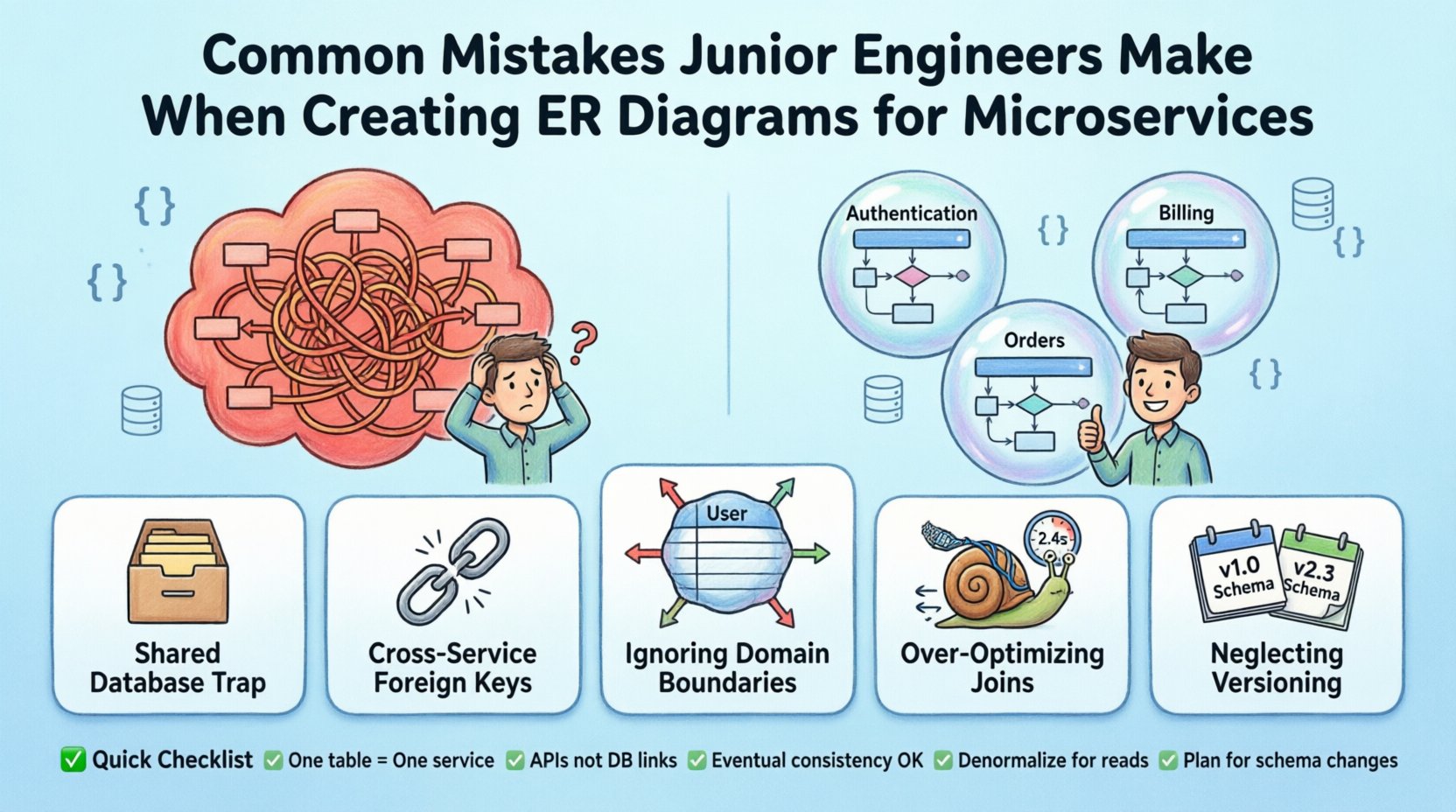
💡 The Monolith Legacy Trap
Most engineers begin their careers working with monolithic applications. In this environment, a single database often serves multiple modules. The Entity Relationship Diagram reflects this reality with a vast network of tables and foreign keys connecting everything. When a junior engineer approaches microservices, the natural tendency is to draw an ERD that looks like a scaled-up version of their previous work.
This approach fails because microservices are designed around business capabilities, not technical implementation details. A monolithic ERD optimizes for write consistency and transactional integrity across the entire system. A microservices ERD must optimize for service isolation and independent deployment. When you draw a single diagram representing the entire system as one database, you are implicitly designing for a monolith, even if you intend to deploy distributed services.
- Monolith Mindset: Assumes a single source of truth for all data.
- Microservices Mindset: Accepts multiple sources of truth managed by specific services.
- ERD Scope: Should be scoped per service, not for the entire organization.
The first mistake is drawing a global ERD. Instead, each service should have its own schema design. The diagram represents the internal state of a specific service, not the aggregate state of the application. This distinction is crucial for maintaining the independence that makes microservices viable.
🗄️ Mistake 1: The Shared Database Anti-Pattern
One of the most common errors is the assumption that services should share a database schema. In the diagram, this looks like two different services reading from and writing to the same set of tables. While this might seem efficient for data access, it creates a hidden dependency.
If Service A and Service B both access the same database tables, they are tightly coupled. If Service A needs to change a column name to accommodate a new feature, Service B will break. This forces both services to deploy simultaneously to maintain compatibility. This defeats the primary purpose of microservices, which is independent deployment and scaling.
Why This Fails
- Deployment Coupling: Changes to the schema require coordination across teams.
- Failure Propagation: A schema migration issue in one service impacts others.
- Security Risks: Broad access to tables increases the surface area for data leaks.
In the ER diagram, this often manifests as tables being labeled with the names of multiple services or having foreign keys pointing to tables owned by other services. The correct approach is to ensure that each service owns its data exclusively. Data sharing should happen through API calls or asynchronous events, not direct database access.
Visualizing the Correct Approach
When reviewing the diagram, look for table ownership. Every table should belong to one service. If a relationship is needed between two services, it is modeled as a reference or an event trigger, not a foreign key constraint.
🔗 Mistake 2: Treating Foreign Keys as Global Truth
Foreign keys are a powerful tool for maintaining data integrity within a single database. In a distributed system, enforcing foreign key constraints across service boundaries is technically complex and often counter-productive. Junior engineers frequently attempt to model relationships using foreign keys that span across different service databases.
Attempting to enforce a foreign key relationship between two separate databases requires distributed transactions. This introduces latency and complexity. If the database for Service A is unavailable, the integrity check for Service B fails. This can cause cascading failures across your architecture.
The Consistency Trade-off
In microservices, you often have to choose between strong consistency and availability. Foreign keys enforce strong consistency. In a distributed environment, maintaining strong consistency across services is expensive. It slows down write operations and increases the risk of system downtime.
- Strong Consistency: Guarantees that data is immediately the same across all nodes. Hard to achieve in distributed systems.
- Eventual Consistency: Accepts that data may differ briefly before converging. Preferred for microservices.
Instead of foreign keys, use logical references. Store the ID of a related entity, but do not enforce the relationship at the database level. Validation should occur at the application level or through event verification. This allows services to evolve independently without waiting for the other service to validate data integrity.
🌍 Mistake 3: Ignoring Domain Boundaries in Schema Design
Data modeling should follow the business domain, not the technical infrastructure. This concept is central to Domain Driven Design (DDD). A common error is grouping data by technical convenience rather than business capability. For example, creating a table for “Users” that is shared by the Billing service and the Authentication service.
When the ER diagram reflects technical convenience over business boundaries, it leads to a high degree of coupling. The Billing service might need a user’s payment history, while the Authentication service only needs credentials. Merging these into a single “User” entity creates a bloated schema that is difficult to maintain.
Identifying Bounded Contexts
To avoid this, define the context in which the data is used. Each service should represent a specific bounded context. The ER diagram should reflect the terminology and structure of that specific context.
- Authentication Context: Focuses on identities, credentials, and sessions.
- Ordering Context: Focuses on products, prices, and delivery status.
- Notification Context: Focuses on channels, messages, and delivery logs.
If you see a table in the diagram that is referenced by five different services, question its placement. It likely belongs to a shared library or should be split into multiple service-specific entities. Data should be duplicated if it serves different contexts, rather than shared if it serves different technical requirements.
🔄 Mistake 4: Over-Optimizing for Joins
In traditional database design, normalization is key to reducing redundancy. Engineers strive for third normal form to ensure data is stored efficiently. In microservices, this mindset can lead to over-normalization. If a service requires data that lives in another service, the temptation is to design a schema that allows for efficient joins across the network.
Joins across services are expensive. They require network calls, serialization, and aggregation. If the ERD is designed to facilitate these joins, the system becomes fragile. Network latency becomes a bottleneck, and the system loses the ability to scale independently.
The Denormalization Strategy
It is often better to denormalize data within a service. If Service A needs data from Service B, Service A should maintain a copy of the necessary fields. This is known as a read model. The ER diagram for Service A should reflect this denormalized structure.
- Write Model: Optimized for updates and strict integrity (often normalized).
- Read Model: Optimized for queries and performance (often denormalized).
When creating the diagram, ask: “Does this relationship require a join to answer a business question?” If yes, consider duplicating the data within the service that needs it. This reduces latency and removes the dependency on the other service’s database availability.
📈 Mistake 5: Neglecting Data Evolution and Versioning
Schemas change over time. Services evolve. A common oversight in the initial ER diagram is the lack of a plan for schema migration. Junior engineers often design a perfect schema for the current requirements without considering how it will change in six months.
In a monolith, you can drop a column and update the application in one deploy. In microservices, dropping a column used by an external API or a different service requires a careful deprecation strategy. The ERD should not just show the current state; it should hint at versioning strategies.
Handling Schema Changes
Consider how your data structure handles new fields. Instead of adding a column directly, consider using a flexible data type or a separate metadata table. This allows you to introduce new attributes without breaking existing consumers.
- Backward Compatibility: New fields should be optional for existing clients.
- Deprecation: Old fields should be marked for removal in the diagram’s notes.
- Versioning: API versions often dictate data structure versions.
Documenting the lifecycle of a field within the diagram helps future engineers understand when a change was introduced and when it might be removed. This prevents “schema drift” where different services interpret the same data differently.
📊 Comparison: Monolith vs. Microservices Data Patterns
| Feature | Monolithic Approach | Microservices Approach |
|---|---|---|
| Data Ownership | Centralized in one database | Decentralized per service |
| Relationships | Foreign Keys | API Calls or Events |
| Consistency | Strong (ACID) | Eventual (CAP Theorem) |
| Schema Changes | Single deploy | Independent deployment |
| Join Operations | Database Joins | Application Aggregation |
| Failure Domain | Single point of failure | Isolated service failure |
✅ Verification Checklist for Junior Engineers
Before finalizing your Entity Relationship Diagram, run through this checklist to ensure you have avoided common architectural pitfalls.
- Ownership: Does every table belong to exactly one service?
- Dependencies: Are there any foreign keys pointing to tables outside the service?
- Scope: Does the diagram represent a bounded context rather than the whole system?
- Read Models: Are read-optimized structures separated from write models?
- Events: Are changes to data modeled as events for other services to consume?
- Idempotency: Can data updates be retried safely without duplication?
- Privacy: Are sensitive fields separated or encrypted in the design?
🛠️ Practical Implementation Steps
When you begin drawing the diagram, follow these steps to maintain architectural integrity.
- Define the Context: Start by listing the business capabilities the service supports.
- Identify Entities: List the nouns associated with those capabilities (e.g., Order, Customer, Invoice).
- Determine Relationships: Map how these entities interact. Avoid cross-service links.
- Choose Data Types: Select types that support the required operations (JSON for flexible data, Strings for identifiers).
- Review for Coupling: Check if any entity requires data from another service to function correctly.
- Document Constraints: Note where consistency checks happen (e.g., at the API layer vs. database layer).
🔒 Security and Compliance Considerations
Data modeling also involves security. A common mistake is assuming that database security is sufficient. In a distributed system, data moves between services. The ERD should reflect where sensitive data resides.
If a service stores personally identifiable information (PII), the diagram should highlight this. Access controls must be designed around the service boundaries. If you design a schema where PII is spread across multiple tables in different services, enforcing compliance becomes difficult. Keep sensitive data contained within the service responsible for managing that data type.
🧠 Final Thoughts on Data Architecture
Designing ER diagrams for microservices requires a shift in perspective. It is not about connecting as many dots as possible; it is about isolating the dots so they can be moved independently. The diagram is a communication tool for your team. It should clearly show where data lives, who owns it, and how it flows.
Avoid the temptation to make the diagram look perfect in a centralized way. Embrace the messiness of distributed data. Accept that duplication is sometimes necessary for performance and isolation. By focusing on domain boundaries and service ownership, you create a foundation that supports long-term growth and stability.
Remember that the goal is not just to store data, but to enable the business capabilities of your organization. When the diagram reflects the business logic rather than the database mechanics, it becomes a valuable asset for the entire engineering team. Keep the focus on isolation, clarity, and the ability to evolve without breaking the system.
Review your diagrams regularly. As the system grows, patterns may shift. What worked for the first service might not work for the tenth. Continuous refinement of your data models ensures that your architecture remains robust and aligned with your technical goals. Stay vigilant against the monolith patterns, and you will build systems that are resilient and scalable.