Successful sprint planning relies heavily on the quality of the work selected for execution. When teams enter a planning session with vague or incomplete items, velocity suffers, and technical debt often accumulates. A robust checklist for ready user stories ensures that the backlog is refined, understood, and actionable. This guide outlines the essential criteria for determining readiness, helping teams maintain momentum and deliver value consistently.
Understanding Definition of Ready 🎯
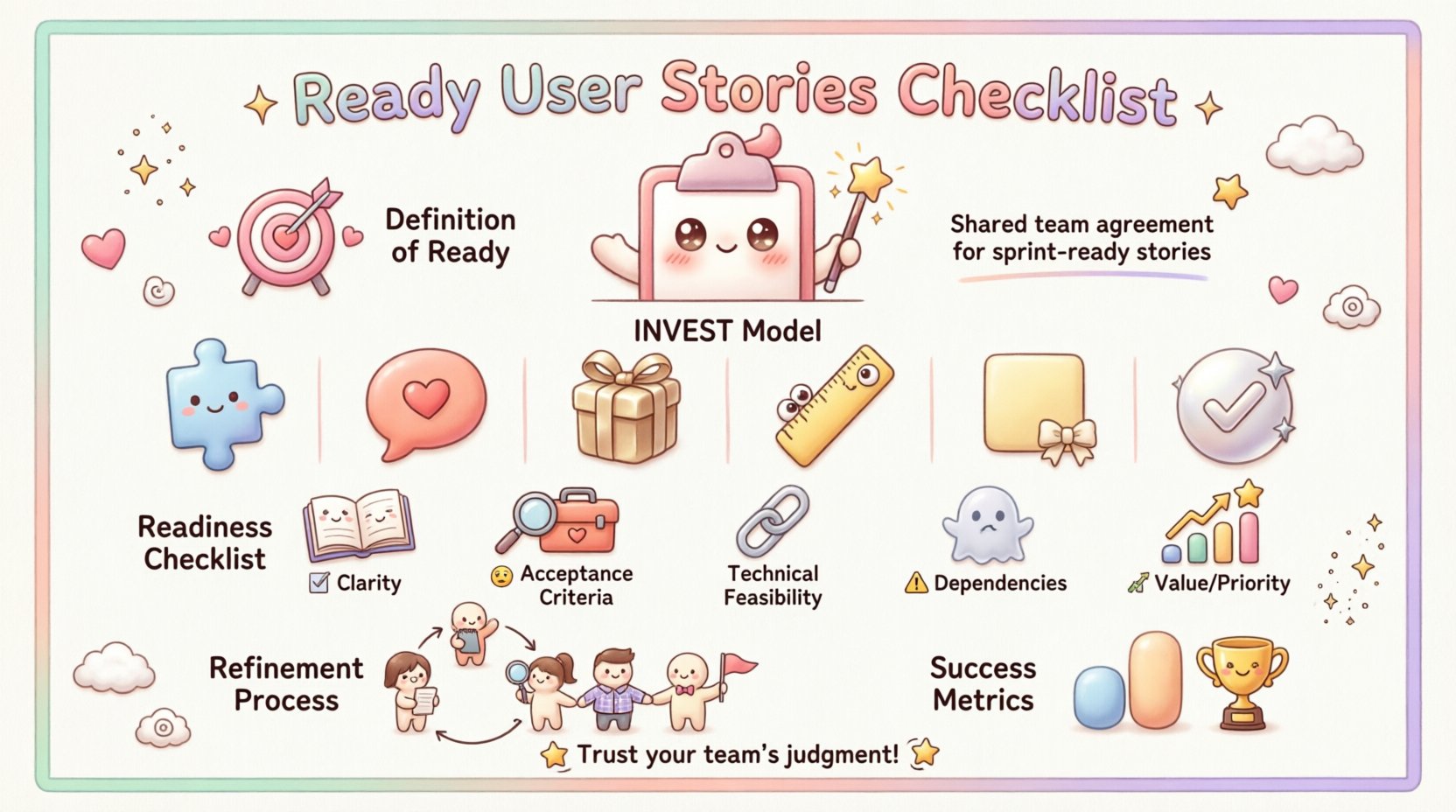
The concept of Definition of Ready (DoR) serves as a shared agreement within the team. It establishes the minimum requirements a user story must meet before it can be pulled into a sprint. Without this standard, teams risk starting work that is not fully understood, leading to interruptions, rework, and delays. The DoR is not a gatekeeper to stop progress, but a quality assurance step to facilitate flow.
When a story meets the Definition of Ready, the team has sufficient information to estimate effort and commit to completion. This readiness covers functional clarity, technical feasibility, and value alignment. Teams should review and adapt this definition over time based on feedback and changing project needs.
Why Readiness Matters for Sprint Velocity 🚀
Preparing user stories in advance has a direct correlation with sprint efficiency. If a team spends the first half of the planning meeting clarifying requirements, the capacity for actual development shrinks. A prepared backlog allows the team to focus on estimation and commitment rather than discovery. This shift in focus reduces cognitive load and allows developers to start coding sooner.
Furthermore, readiness mitigates risk. Ambiguous stories often lead to misunderstandings between stakeholders and the development team. By addressing these ambiguities before the sprint begins, teams reduce the likelihood of defects and scope creep during execution.
The INVEST Model Revisited 🧩
While the INVEST model is a foundational concept for user stories, applying it rigorously is crucial for readiness. Each letter in the acronym represents a characteristic that contributes to a well-formed story. Reviewing these attributes helps validate whether a story is truly ready.
- Independent: Stories should be as self-contained as possible. Dependencies on other stories or external systems should be identified and resolved or clearly documented.
- Negotiable: The details of the story should be open to discussion. The story is not a contract but a placeholder for a conversation. If every detail is fixed, there is no room for technical optimization.
- Valuable: Every story must deliver value to the end user or the business. If a story does not advance the product vision, it should be questioned.
- Estimable: The team must have enough information to provide a size estimate. If the story is too vague, it cannot be estimated accurately.
- Small: Stories should be small enough to be completed within a single sprint. Large stories should be broken down into smaller, manageable pieces.
- Testable: There must be clear criteria to determine if the story is complete. This usually involves acceptance criteria that can be verified.
Detailed Checklist for User Story Readiness 📝
The following sections detail the specific elements that must be present for a user story to be considered ready. Each category addresses a different aspect of the development lifecycle, ensuring comprehensive preparation.
1. Clarity and Description 📖
A user story begins with a clear statement of intent. The description must be concise yet descriptive enough to convey the core requirement. It should follow the standard format: As a [role], I want [feature], so that [benefit].
- Role Definition: Who is the user? Is it a specific persona or a general user type?
- Feature Description: What is the action or functionality being requested?
- Benefit Statement: Why does this matter? This connects the work to business value.
Additionally, the description should avoid technical jargon that might confuse stakeholders. It should be written in language accessible to the entire team, including product owners and designers. If the story requires complex business logic, a link to a specification document or a reference to a related diagram is helpful.
2. Acceptance Criteria 🧐
Acceptance criteria define the boundaries of the story. They are the conditions that must be met for the story to be considered complete. These criteria act as a test plan for the development team and a verification guide for the product owner.
Effective acceptance criteria should be specific, measurable, and unambiguous. Vague terms like “fast” or “easy” should be avoided in favor of quantifiable metrics. For example, instead of “the page loads quickly”, use “the page loads within two seconds on a 4G connection”.
- Happy Path: The standard scenario where everything works as expected.
- Edge Cases: Scenarios where the input is unusual or an error occurs.
- Constraints: Any specific limitations regarding performance, security, or compatibility.
3. Technical Feasibility 🔧
Before a story is ready, the development team must confirm that the work is technically achievable. This involves a preliminary assessment of the architecture, existing codebase, and infrastructure.
- Design Review: Has a designer created the necessary mockups or wireframes? Visual assets ensure the UI matches expectations.
- API Documentation: If the story involves external systems, the API specifications must be available.
- Technical Debt: Are there known issues in the current system that might impact this story? These should be flagged early.
- Resource Availability: Are the necessary skills available within the team? If specialized knowledge is required, training or consultation should be planned.
4. Dependencies and Risks ⚠️
Stories rarely exist in isolation. Identifying dependencies early prevents bottlenecks during the sprint. A dependency is any factor that affects the ability to complete the story.
Dependencies can be internal or external. Internal dependencies involve other stories within the same team. External dependencies involve other teams, vendors, or third-party services.
| Dependency Type | Example | Management Strategy |
|---|---|---|
| Internal | Story B requires Story A to be complete | Sequence in backlog or split into smaller tasks |
| External Team | Waiting for API from Payment Team | Identify contact, set up mock data, track progress |
| Infrastructure | Need new server configuration | Submit request early, provision test environment |
| Security/Compliance | Must pass security audit | Include security review in timeline |
5. Value and Priority 📈
Every story should contribute to the overall product roadmap. Before a story is ready, the product owner must confirm its priority. This ensures that the team is working on the most important items first.
- Business Value: How does this feature help the business? Is it revenue-generating or cost-saving?
- User Impact: How many users will benefit? How critical is the problem being solved?
- Strategic Alignment: Does this story align with the current quarter’s goals?
If a story lacks clear value, it should be moved to the backlog for further discussion. Time spent developing low-value features is time not spent on high-impact work.
The Refinement Process 🔍
Readiness is not a one-time event; it is a continuous process. Backlog refinement sessions are dedicated to grooming stories before they reach the sprint planning stage. These sessions should happen regularly, ideally weekly, to keep the backlog healthy.
During refinement, the team collaborates to break down large initiatives into smaller stories. This process involves estimating effort, clarifying requirements, and identifying missing information. It is a collaborative effort where developers, testers, and product owners work together.
Refinement allows the team to surface issues early. If a story is too complex, it is broken down. If the requirements are unclear, the product owner clarifies them. This proactive approach reduces the risk of surprises during the sprint.
Who Participates in Readiness Checks? 👥
Readiness is a team responsibility, but specific roles play key parts in the process.
- Product Owner: Responsible for defining the what and why. They ensure value is clear and requirements are complete.
- Developers: Responsible for assessing the how. They evaluate technical feasibility and identify architectural risks.
- Testers: Responsible for defining the how to verify. They help craft acceptance criteria and identify edge cases.
- Scrum Master: Facilitates the process. They ensure the team has the time and space to refine stories and remove impediments.
Common Pitfalls in Story Preparation 🚫
Even with a checklist, teams often encounter obstacles. Recognizing common pitfalls helps in avoiding them.
1. Over-Engineering the Description
Writing a story that is too detailed can stifle creativity. Developers might feel constrained by a rigid specification. The goal is to provide enough context to understand the problem, not to dictate the solution. Leave room for technical discussion.
2. Ignoring Non-Functional Requirements
Functional requirements describe what the system does. Non-functional requirements describe how the system performs. These include performance, security, scalability, and reliability. Ignoring these leads to systems that work but fail under load or violate security policies.
3. Rushing the Estimation
Estimation should happen during refinement, not during planning. If a team is asked to estimate a story they have not discussed, the estimate is likely inaccurate. Use historical data and team consensus to improve accuracy.
4. Siloed Communication
When the product owner writes stories without consulting the team, gaps appear. Collaboration is essential. The product owner should share drafts with the team to get feedback on feasibility and clarity before finalizing.
Handling Ready Stories During Sprint 🏁
Once a sprint begins, the focus shifts to execution. However, stories that are marked as ready should not be treated as immutable. Changes may still occur due to new insights or technical discoveries. The key difference is that the baseline is stable enough to start work.
If a story is not ready during the sprint, it should not be pulled. Instead, the team should pause and work with the product owner to complete the preparation. Pulling incomplete work often leads to unfinished stories at the end of the sprint, which impacts the team’s velocity and morale.
Teams should also monitor the flow of ready stories. If the backlog is full of ready stories but the team is not completing them, there may be an issue with capacity or complexity. If the backlog is empty of ready stories, the team is at risk of idle time. Balancing the flow is a key aspect of sustainable development.
Measuring Success and Continuous Improvement 📊
To ensure the checklist remains effective, teams should track metrics related to story readiness. These metrics provide insight into the health of the backlog and the planning process.
- Commitment vs. Completion: How many ready stories were planned versus completed? High variance suggests readiness issues.
- Rework Rate: How often do stories require rework due to unclear requirements? A high rate indicates poor definition of ready.
- Refinement Time: How much time is spent refining stories compared to building them? This ratio should remain sustainable.
- Team Satisfaction: Survey the team on how prepared they feel for planning. Subjective feedback is valuable.
Regular retrospectives provide a forum to discuss these metrics. If the team notices a pattern of delays or defects, the Definition of Ready should be adjusted. The checklist is a living document that evolves with the team’s maturity and the project’s complexity.
Conclusion on Preparation 🛡️
Investing time in preparing user stories is an investment in sprint success. A well-defined backlog reduces uncertainty and allows the team to focus on delivery. By adhering to a structured checklist, teams ensure that every story is clear, feasible, and valuable. This discipline leads to higher quality software, predictable delivery, and a more satisfied team.
Remember that readiness is not about perfection. It is about having enough information to make an informed decision. As teams grow and learn, their standards will naturally evolve. The goal is to maintain a steady rhythm of preparation and delivery, ensuring that the product moves forward efficiently.
Final Thoughts on Execution 💡
The checklist serves as a tool, not a rulebook. Teams should use it to guide their preparation without losing the flexibility needed for innovation. When in doubt, ask the team. If the developers feel unsure about a story, it is likely not ready. Trusting the team’s judgment is often the best indicator of readiness.
By integrating these practices into daily workflows, teams can transform sprint planning from a chaotic debate into a focused strategy session. The result is a predictable, high-performing delivery cycle that consistently meets stakeholder expectations.