Making a career pivot is never simple. It requires courage, planning, and a willingness to learn. Transitioning into User Experience (UX) design is particularly popular right now, yet many enter the field without a clear picture of what the work actually entails. This guide is designed for those coming from engineering, marketing, psychology, or even retail backgrounds. We will focus on the substance of the work, not the tools.
UX design is fundamentally about problem-solving. It is the process of enhancing customer satisfaction by improving the usability, accessibility, and pleasure provided in the interaction between the user and the product. This does not mean making things look pretty. It means making things work better.
🧠 Understanding the Core of UX Design
Before diving into the steps, you must understand the landscape. UX is often confused with User Interface (UI) design. While they overlap, they are distinct disciplines.
- UX Design: Focuses on the overall feel of the experience. It involves research, information architecture, wireframing, and testing.
- UI Design: Focuses on the visual touchpoints. It involves colors, typography, buttons, and layout.
As a beginner, your primary focus should be UX. UI is often learned alongside, but the strategic thinking behind UX is what drives value in the industry.
🔍 Phase 1: Assessing Your Transferable Skills
You likely already possess skills that are valuable in UX. You do not need to start from zero. The trick is identifying where your current experience aligns with design needs.
Key Transferable Skills
- Communication: Designers must explain their reasoning to stakeholders. If you have managed projects or presented to clients, you have this skill.
- Empathy: Understanding user pain points is crucial. If you have worked in customer support or sales, you know what users want.
- Logic & Analysis: Engineering or data backgrounds provide a strong foundation for analyzing user behavior and creating logical flows.
- Writing: Content strategy is a huge part of UX. Clear copy guides the user. If you are a writer, you are already a UX designer.
📚 Phase 2: Building Your Knowledge Base
There is no single degree that guarantees success in this field. However, there is a body of knowledge you must master. This is not about memorizing shortcuts; it is about understanding principles.
1. Design Thinking
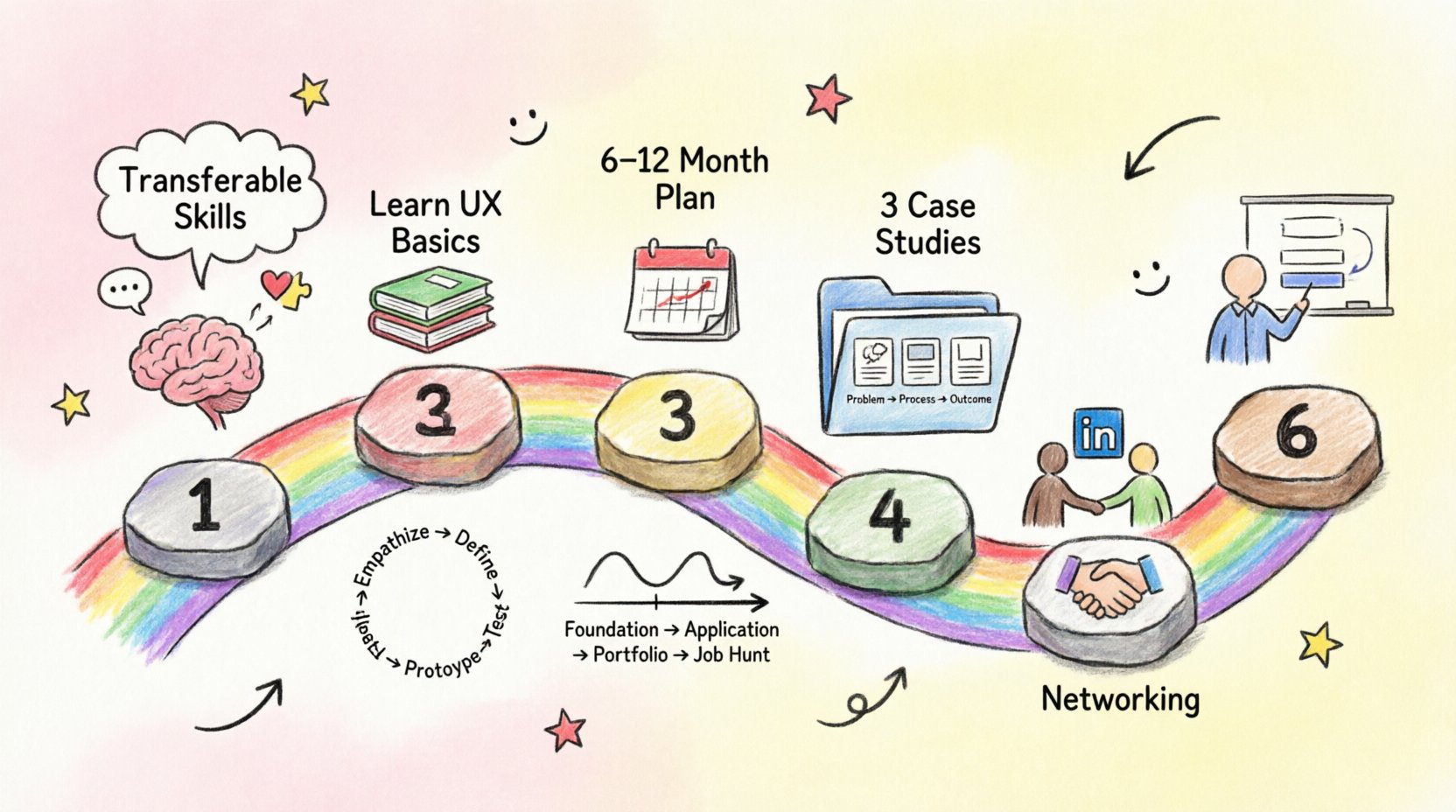
This is the methodology most companies use. It follows a non-linear process:
- Empathize: Understand the user.
- Define: State the problem.
- Ideate: Generate solutions.
- Prototype: Build representations.
- Test: Validate with users.
2. Research Methods
You cannot design for a crowd. You must design for specific people. You will learn two main types of research:
- Qualitative: Interviews, observations, and focus groups. This tells you why users do things.
- Quantitative: Surveys, analytics, and A/B testing. This tells you how many users do things.
3. Information Architecture (IA)
IA is the structure of your product. It is how you organize content so users can find it. This involves sitemaps, navigation structures, and taxonomy.
4. Prototyping & Wireframing
Before building the final product, you create sketches and low-fidelity models. This allows you to test ideas cheaply. You will learn to create flow diagrams that map user journeys.
5. Usability Testing
This is the validation step. You watch real people try to complete tasks. You observe where they hesitate, click the wrong button, or give up. You do not tell them what to do; you watch what they do.
🗺️ Phase 3: The Practical Roadmap
Here is a step-by-step timeline to guide your transition over a typical 6 to 12-month period.
| Phase | Duration | Focus Area | Deliverable |
|---|---|---|---|
| Foundation | Month 1-2 | Concepts & Theory | Notes & Diagrams |
| Application | Month 3-5 | Tools & Practice | Redesign Projects |
| Portfolio | Month 6-8 | Case Studies | 3 Full Case Studies |
| Job Hunt | Month 9+ | Networking & Interviewing | Offer |
Step 1: Consume Educational Resources
There are many books and courses available. Look for resources that focus on the process rather than just the software. Read about accessibility standards (WCAG) and cognitive psychology. Understanding how the human brain processes information is more important than knowing a specific tool.
Step 2: Practice on Existing Products
Find an app or website you use daily that frustrates you. This is your first project. Do not redesign it for the sake of aesthetics. Identify the friction points. Why is the checkout process confusing? Why is the menu hard to find? Document your findings.
Step 3: Learn the Visual Language
While UX is strategy, you still need to communicate visually. Learn the basics of grid systems, hierarchy, and contrast. You do not need to be a graphic designer, but your wireframes must be legible.
📂 Phase 4: Building a Portfolio That Gets Noticed
Your portfolio is your most important asset. It replaces your resume. Recruiters want to see your thinking process, not just the final images.
What to Include
- Problem Statement: What were you trying to solve?
- Process: Show your research notes, sketches, and failed attempts. Show how you arrived at the solution.
- Outcome: Did the design improve the metric? If this is a hypothetical project, state the expected outcome based on your research.
- Role: Be clear about what you did. Did you do the research alone? Did you work with a team?
Structure of a Case Study
Each project should follow a narrative arc. Start with the context. Move to the discovery phase. Then show the solution. Finally, reflect on what you learned.
Avoid the mistake of only showing the final high-fidelity screen. That is a screenshot, not a case study. A case study is a story about problem-solving.
💼 Phase 5: Entering the Job Market
The job market for UX is competitive. You need to differentiate yourself through networking and positioning.
Networking Strategies
- LinkedIn: Optimize your profile. Connect with other designers. Engage with their content.
- Communities: Join online forums and local meetups. Learning from peers accelerates growth.
- Informational Interviews: Ask people in the role what their day looks like. Do not ask for a job. Ask for advice.
Resume Optimization
Your resume should highlight impact. Instead of saying “Designed screens,” say “Reduced user drop-off by 15% through improved navigation flow.” Use action verbs. Focus on the business value of your design work.
🎤 Phase 6: The Interview Process
UX interviews are different from standard technical interviews. They focus on collaboration and critical thinking.
Common Interview Tasks
- Portfolio Review: You will walk them through your work. Expect questions like “Why did you choose this solution?” or “What would you do differently?”
- Whiteboarding: You may be given a problem, like “Design a login flow for a bank.” You must think aloud as you sketch.
- Collaboration: You might work with another designer to solve a problem. They will watch how you communicate and handle feedback.
🛑 Common Pitfalls to Avoid
Even with a solid plan, beginners often stumble. Here are common traps to watch out for.
- Focusing on Tools: Learning software is easy. Learning strategy takes time. Do not spend months on software tutorials.
- Ignoring Accessibility: Design for everyone, not just the able-bodied. Learn the basics of screen readers and color contrast.
- Designing for Yourself: Just because you like a feature doesn’t mean the user needs it. Validate your ideas with data.
- Lack of Consistency: Inconsistent spacing or fonts make a product feel broken. Learn to use design systems.
🌱 The Business Value of UX
Understanding the business side is crucial for career longevity. You must be able to speak the language of stakeholders. This means talking about ROI, conversion rates, and retention.
When you propose a change, back it up with evidence. “I recommend this layout because user testing showed a 20% increase in task completion.” This builds trust and authority.
🔮 Looking Ahead: Continuous Learning
The digital landscape changes rapidly. New patterns emerge, and old ones fade. Your learning journey does not end with your first job.
- Stay Updated: Follow industry blogs and newsletters.
- Stay Human: Technology changes, but human behavior remains relatively constant. Focus on psychology.
- Mentorship: Find a mentor who can guide you through the early stages of your career.
🏁 Final Thoughts
Crossing over into UX design is a marathon, not a sprint. It requires patience and a commitment to evidence-based decision-making. You do not need to be an artist to succeed. You need to be curious, empathetic, and rigorous.
Start small. Redesign one page. Conduct one interview. Write one case study. Progress is built through consistent action. The industry needs diverse perspectives, and your background is an asset, not a hurdle.
Good luck on your journey.