Digital transformation is often described as a journey of technological adoption, yet history shows that technology alone rarely guarantees success. The true catalyst for change lies in the clarity of purpose. This is where the Business Motivation Model (BMM) becomes a critical asset. By providing a structured framework to articulate why an organization is changing, BMM ensures that digital initiatives remain anchored to strategic intent. This guide explores how formalizing motivation drives alignment, reduces risk, and sustains value in modern enterprise transformation.
🧩 Understanding the Business Motivation Model
The Business Motivation Model is not merely a diagramming technique; it is a standardized methodology for representing the elements that drive an enterprise. Developed by the Object Management Group (OMG), BMM offers a vocabulary to describe the “why” and “how” of business operations. It moves beyond simple process flows to capture the underlying drivers of decision-making.
- Focus on Intent: Traditional architecture often maps what the system does. BMM maps why the system exists.
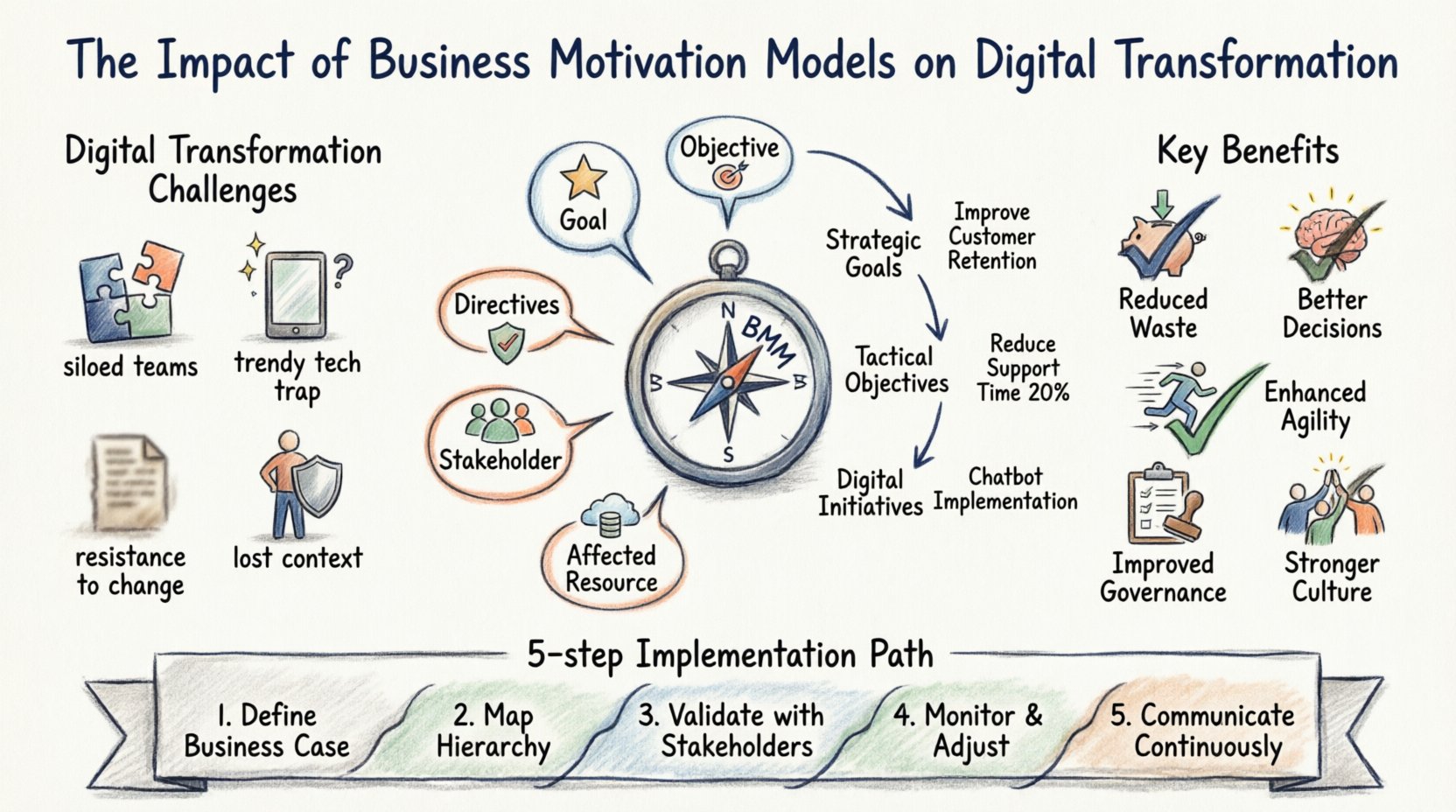
- Standardized Vocabulary: It provides common terms like Goal, Objective, Directives, and Stakeholders that bridge the gap between business and IT.
- Traceability: It allows organizations to trace a specific software deployment back to a high-level strategic intent.
Without this model, digital transformation initiatives often drift. Teams build features based on assumptions rather than verified business needs. BMM acts as the compass, ensuring every line of code serves a defined purpose.
🌐 The Digital Transformation Challenge
Organizations today face a paradox. They have access to more technology than ever before, yet transformation outcomes remain inconsistent. The challenges are rarely technical; they are organizational and motivational.
Common Pitfalls in Transformation
- Siloed Initiatives: Different departments pursue digital tools without a shared vision, leading to fragmentation.
- Technology-Led Strategy: Decisions are made based on what is trendy rather than what solves a core business problem.
- Loss of Context: As teams scale, the original reason for a project is forgotten. Work continues due to inertia rather than value.
- Resistance to Change: Employees often reject new systems if they do not understand the benefit to their daily work.
These issues stem from a lack of explicit motivation. When the “why” is not documented and understood, the “how” becomes a guessing game. Digital transformation requires a shift from executing tasks to achieving outcomes.
🔗 How BMM Anchors Transformation
The integration of BMM into digital transformation initiatives creates a layer of governance that is both lightweight and powerful. It does not require heavy bureaucracy; it requires clarity.
1. Clarifying Strategic Alignment
Transformation efforts must connect to the overarching strategy. BMM provides a mechanism to link Strategic Goals to Tactical Objectives. For example, a high-level goal might be “Improve Customer Retention.” A tactical objective derived from this could be “Reduce Support Ticket Resolution Time by 20%.” A digital initiative, such as implementing a new chatbot, is then evaluated against the objective. If the chatbot does not reduce resolution time, it is not aligned.
2. Managing Stakeholder Expectations
Digital transformation impacts people. BMM explicitly identifies Stakeholders and their interests. By modeling who is affected by a change and what they desire, organizations can anticipate resistance and design change management strategies accordingly.
- Identify Influencers: Who has the power to stop the project?
- Identify Beneficiaries: Who gains value from the transformation?
- Identify Regulators: What external rules must the transformation respect?
3. Prioritizing Investments
Resources are finite. BMM helps prioritize initiatives based on their impact on motivation elements. If a project supports multiple high-priority goals, it receives higher priority. If a project supports a low-priority goal, it may be deferred. This ensures capital is allocated to initiatives that drive the business forward.
📊 BMM Components in the Transformation Context
To understand the impact, we must look at the specific elements of the Business Motivation Model and how they function during a transformation.
| BMM Element | Definition | Role in Digital Transformation |
|---|---|---|
| Goal | A desired state or condition to be achieved. | Defines the high-level vision (e.g., Market Expansion). |
| Objective | Specific, measurable steps toward a Goal. | Quantifies success (e.g., Increase online sales by 15%). |
| Directives | Rules or policies that constrain actions. | Ensures compliance and ethical standards in tech usage. |
| Affected Resource | Things that are changed or used. | Identifies data, systems, and people impacted. |
| Stakeholder | Individuals or groups with an interest. | Ensures user adoption and satisfaction. |
| Capability | Ability to perform an action. | Highlights skill gaps in the current workforce. |
This structured approach prevents the common error of building technology before defining the capability required to use it.
🛠 Implementation Framework
Integrating BMM into a digital transformation project does not require a massive overhaul. It can be introduced incrementally. The following steps outline a practical approach.
- Define the Business Case: Before writing requirements, articulate the motivation. Why are we doing this? What happens if we don’t?
- Map the Hierarchy: Create a visual hierarchy from Strategy down to Projects. Ensure every project connects to a Goal.
- Validate with Stakeholders: Review the motivation model with key leaders. Ensure they agree on the Goals and Objectives.
- Monitor and Adjust: As the transformation progresses, revisit the model. If market conditions change, the Goals may shift, and the initiatives must adapt.
- Communicate Continuously: Use the BMM diagram as a communication tool. It helps explain complex decisions to the broader organization.
⚖️ Benefits of BMM-Driven Transformation
Organizations that adopt this model report distinct advantages over those that rely on ad-hoc planning.
- Reduced Waste: Projects that no longer align with current goals can be stopped early, saving budget and effort.
- Better Decision Making: Leaders have a clear view of how technical decisions impact business outcomes.
- Enhanced Agility: When goals are clear, teams can pivot quickly. They know what to change without losing sight of the destination.
- Improved Governance: Audits become easier because the rationale for every system is documented.
- Stronger Culture: Employees understand how their work contributes to the bigger picture, increasing engagement.
⚠️ Risks and Mitigation Strategies
While powerful, the Business Motivation Model is not a silver bullet. There are risks associated with its implementation that must be managed.
Risk 1: Over-Modeling
Creating too many models can lead to paralysis. If the documentation takes longer than the work, the initiative stalls.
- Mitigation: Keep models high-level. Focus on the critical drivers. Use lightweight notation.
Risk 2: Static Thinking
Businesses change rapidly. A model created today may be obsolete tomorrow if not maintained.
- Mitigation: Treat the model as a living artifact. Schedule regular reviews during transformation milestones.
Risk 3: Lack of Adoption
If teams do not use the model, it becomes a shelf-ware exercise.
- Mitigation: Integrate the model into existing workflows. Do not create a separate process for modeling.
📈 Measuring Success
How do we know if BMM is having a positive impact? Success metrics should reflect the alignment between business intent and technical execution.
- Goal Achievement Rate: Percentage of defined goals met within the transformation timeline.
- Initiative Turnover: Reduction in the number of projects cancelled due to misalignment.
- Stakeholder Satisfaction: Surveys measuring how well transformation outcomes meet user expectations.
- ROI Clarity: Ability to quantify the financial return of specific digital investments based on their motivational contribution.
🔮 Future Outlook
As enterprises become more data-driven, the need for clear motivation will only grow. Artificial Intelligence and automation will handle more routine tasks, but they will still require human direction. The Business Motivation Model provides that direction.
Future iterations of business architecture will likely integrate BMM more deeply with operational data. Real-time feedback loops will allow organizations to adjust their motivations as market conditions shift instantly. This creates a dynamic ecosystem where strategy and execution are constantly in sync.
🏁 Summary
Digital transformation is a human endeavor supported by technology. The Business Motivation Model offers the structure needed to manage the human side of change. By explicitly defining goals, objectives, and stakeholders, organizations can ensure their digital investments deliver real value. It moves the conversation from “What tool should we buy?” to “What problem are we solving?”.
Implementing BMM is not about adding bureaucracy. It is about adding clarity. In a world of constant change, clarity is the most valuable asset an organization can possess. By anchoring initiatives in well-defined motivation, enterprises can navigate the complexities of digital transformation with confidence and precision.