Enterprise architecture serves as the strategic blueprint for organizational technology and operations. However, a common challenge arises when technical designs fail to align with the underlying reasons for their existence. This is where the Business Motivation Model (BMM) becomes critical. For senior architects, understanding motivation is not merely a theoretical exercise; it is a practical necessity for sustainable design. This guide addresses the most pressing inquiries regarding how motivation drives architectural decisions.
We will explore the core components, the integration with broader frameworks, and the practical application of these concepts in complex environments. By focusing on the “why” behind the “what,” architects can ensure their solutions deliver tangible value rather than just technical functionality.
What Exactly is the Business Motivation Model? 🧩
The Business Motivation Model provides a standardized view of the factors that drive an organization. It is distinct from a simple list of requirements because it captures the intent behind the requirements. It breaks down business activity into a hierarchy of motivations, goals, objectives, and principles.
For a senior architect, this model offers a lens to view the enterprise beyond code and infrastructure. It answers questions such as:
- Why is this capability being built?
- What business outcome are we trying to achieve?
- How does this technical change impact our strategic direction?
Without this context, architects risk optimizing for performance or stability at the expense of business agility. The model ensures that every architectural artifact traces back to a specific business need.
Key Components of the Model
To understand the model, one must distinguish between the different types of drivers:
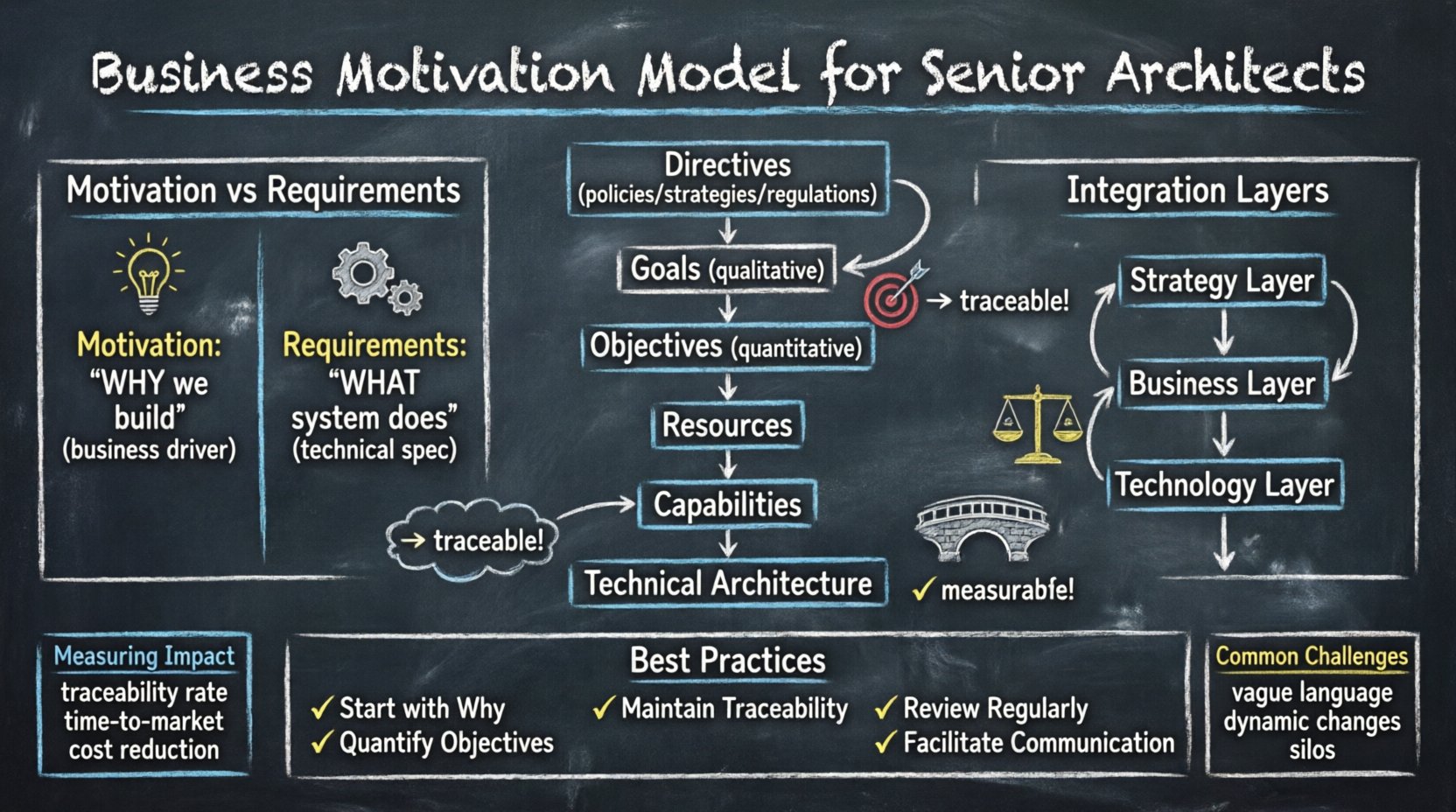
- Directives: These are the inputs that drive the organization. They include policies, strategies, and external regulations.
- Goals and Objectives: Goals are high-level, qualitative outcomes (e.g., “Improve Customer Satisfaction”). Objectives are quantitative measures of those goals (e.g., “Reduce wait time by 20%”).
- Resources: The assets required to achieve the goals, such as capital, personnel, or technology.
- Capabilities: The abilities the organization possesses to utilize resources effectively.
Architects map technical capabilities to these business capabilities. This mapping creates a traceability chain that validates the existence of every system component.
How Does Motivation Differ from Requirements? 🤔
Requirements define what a system must do. Motivation explains why the system exists. Confusing the two leads to scope creep and misaligned deliverables.
- Requirements: “The system shall process 10,000 transactions per minute.”
- Context: This is a technical specification.
- Motivation: “We need to reduce transaction costs to remain competitive in the retail sector.”
- Context: This is the business driver.
When an architect understands the motivation, they might realize that 10,000 transactions is sufficient, but latency is the real issue. Or, they might realize that a different technology stack could achieve the business goal (cost reduction) without needing such high throughput. The motivation provides flexibility in how requirements are met.
Senior architects must facilitate conversations that shift stakeholders from stating features to stating outcomes. This shift empowers the architecture team to propose innovative solutions that satisfy the underlying need without being constrained by premature technical choices.
How to Integrate BMM with Existing Frameworks? 🔄
Organizations rarely operate in a vacuum. They often utilize established enterprise architecture frameworks. The Business Motivation Model integrates seamlessly with these methodologies, acting as the foundational layer.
Integration Points
When working with established frameworks, the BMM elements map to specific layers:
- Strategy Layer: BMM Goals and Objectives directly feed into strategic planning diagrams.
- Business Layer: Business Capabilities and Resources align with business process modeling.
- Technology Layer: Technical Capabilities map to the architecture’s infrastructure and application portfolio.
This integration ensures that the technical architecture is not an island. It becomes a direct reflection of the business strategy. For example, if the business strategy is “Market Expansion,” the BMM will highlight this as a directive. The architect then ensures the infrastructure supports multi-region deployment and low-latency access globally.
Mapping Elements to Architecture
| Business Motivation Element | Architectural Concern | Outcome |
|---|---|---|
| Directive (Policy) | Compliance & Security Standards | Architectural guardrails |
| Goal (Qualitative) | System Vision & Roadmap | Long-term direction |
| Objective (Quantitative) | Performance Metrics & KPIs | Measurable success criteria |
| Capability | Service Portfolio & API Design | Reusability & Agility |
| Resource | Infrastructure & Budget Allocation | Cost Efficiency |
Using this table, architects can audit their designs. If a specific capability exists in the architecture but has no corresponding BMM element, it may be a candidate for retirement or refactoring.
What Are the Common Challenges in Implementation? ⚠️
While the model is robust, applying it in real-world scenarios presents hurdles. Senior architects often encounter resistance or confusion during the adoption process.
1. Ambiguity in Business Language
Business stakeholders often use vague terms. “Better service” is not a measurable goal. Architects must work to refine these terms into specific objectives. This requires strong communication skills and the ability to ask probing questions.
- Challenge: Stakeholders cannot define clear objectives.
- Solution: Facilitate workshops to break down qualitative goals into quantitative metrics.
2. Dynamic Environments
Business motivations change faster than architectural lifecycles. A directive issued today might be obsolete in six months. Static models fail in this context.
- Challenge: Architecture becomes rigid when business shifts.
- Solution: Treat the model as living documentation. Implement review cycles to update motivations and reassess architectural alignment.
3. Siloed Departments
Different departments may have conflicting motivations. Sales wants speed; Finance wants cost control. The architecture must balance these competing interests.
- Challenge: Architectural trade-offs create dissatisfaction.
- Solution: Use the BMM to visualize conflicts. Show stakeholders how a specific decision impacts their specific objectives. Make trade-offs explicit.
How Do You Measure the Impact of Motivation? 📊
Architects need to demonstrate value. Measuring the impact of business motivation alignment requires looking at both technical and business metrics.
Alignment Metrics
- Traceability Rate: Percentage of technical components linked to a business goal.
- Change Request Origin: Percentage of changes driven by business motivation shifts vs. technical debt.
- Feature Utilization: Usage rates of features that support high-priority business objectives.
When the architecture is well-aligned, change requests typically originate from the business side (new opportunities) rather than the technical side (fixing broken systems). This indicates the system is resilient and adaptable.
Business Value Indicators
Beyond technical metrics, look at the business outcomes:
- Reduction in time-to-market for new products.
- Improvement in customer satisfaction scores correlated with specific system upgrades.
- Decrease in operational costs due to streamlined processes.
These indicators prove that the architecture is not just a cost center but a value driver.
How Should Architects Handle Conflicting Motivations? ⚖️
Conflicts are inevitable. One department wants maximum security; another wants maximum ease of use. A senior architect must act as a mediator, using the model to prioritize.
Prioritization Framework
Not all objectives hold equal weight. Architects should assign priority levels based on strategic importance:
- Strategic Critical: Goals that define the survival of the organization.
- Tactical Important: Goals that improve operational efficiency.
- Nice to Have: Goals that enhance user experience but are not essential.
When conflicts arise, the solution lies in satisfying the higher-priority directive. However, transparency is key. Stakeholders must understand why a decision was made. The model provides the evidence base for these decisions.
Scenario: Speed vs. Security
Consider a scenario where the business wants to launch a feature quickly (Speed) but compliance requires extensive auditing (Security).
- Analysis: If the directive is “Market Leadership,” Speed might take precedence initially, with a phased security rollout.
- Analysis: If the directive is “Trust & Reliability,” Security takes precedence.
The architecture design changes based on which directive is the primary driver. This prevents the “one size fits all” approach that often fails.
What Role Do Stakeholders Play in BMM? 🤝
Stakeholders are the source of the motivations. Their engagement determines the accuracy of the model.
Engagement Strategies
- Executive Sponsors: Define the high-level directives and goals.
- Process Owners: Define the capabilities and resources required.
- End Users: Provide feedback on objectives regarding usability and effectiveness.
Architects should not work in isolation. Regular reviews with these groups ensure the model remains accurate. If the business strategy shifts, the stakeholders should update the directives, which cascades down to the architectural changes.
Can BMM Support Digital Transformation? 🚀
Digital transformation is often about more than just technology; it is about business model innovation. BMM is ideal for this context.
- Shift from Product to Service: Motivations change from “Sell Units” to “Deliver Service Outcomes”. The architecture shifts from monolithic systems to service-oriented architectures.
- Data-Driven Decisions: Objectives become more data-centric. The architecture must support advanced analytics and real-time processing.
- Ecosystem Integration: Directives may include partnerships. The architecture must expose APIs and support external integrations.
By aligning the transformation roadmap with the BMM, organizations ensure that technology investments directly support the new business model. This reduces the risk of building systems that do not support the future state.
Why is Documentation Essential? 📝
Documentation of the Business Motivation Model is often overlooked. It serves as the single source of truth for why decisions were made.
Benefits of Documentation
- Onboarding: New architects can understand the strategic context quickly.
- Auditing: Regulators and auditors can see the link between compliance goals and system controls.
- Continuity: If key personnel leave, the rationale for the architecture remains.
Documentation should not be static. It should be part of the architectural governance process. Changes to business directives should trigger updates to the architectural documentation.
Summary of Best Practices ✅
To effectively utilize the Business Motivation Model, senior architects should adopt the following habits:
- Start with the Why: Never design a system without understanding the business directive.
- Quantify Objectives: Ensure goals have measurable targets.
- Maintain Traceability: Keep a clear link between technical components and business goals.
- Review Regularly: Treat the model as a living document that evolves with the business.
- Facilitate Communication: Use the model as a common language between business and IT.
By adhering to these practices, architects ensure their work is not just technically sound, but strategically vital. The Business Motivation Model bridges the gap between boardroom strategy and server room implementation. It transforms architecture from a support function into a strategic partner.