In the complex landscape of modern enterprise, alignment is not merely a buzzword; it is the fundamental engine of survival and growth. Organizations that fail to connect their daily operations with their long-term vision often find themselves drifting in a sea of inefficiency. The Business Motivation Model provides a structured framework to bridge this gap. It offers a clear language for describing what an organization wants to achieve and how it plans to get there. This guide explores the core principles behind effective business motivation, drawing on insights from seasoned leaders who have navigated these waters successfully.
Understanding the mechanics of motivation within a business context requires moving beyond simple incentives. It involves a deep dive into the structural elements that drive decision-making, resource allocation, and strategic execution. We will examine the relationships between goals, strategies, and capabilities, ensuring that every action taken contributes meaningfully to the broader mission.
🎯 Defining the Core Elements
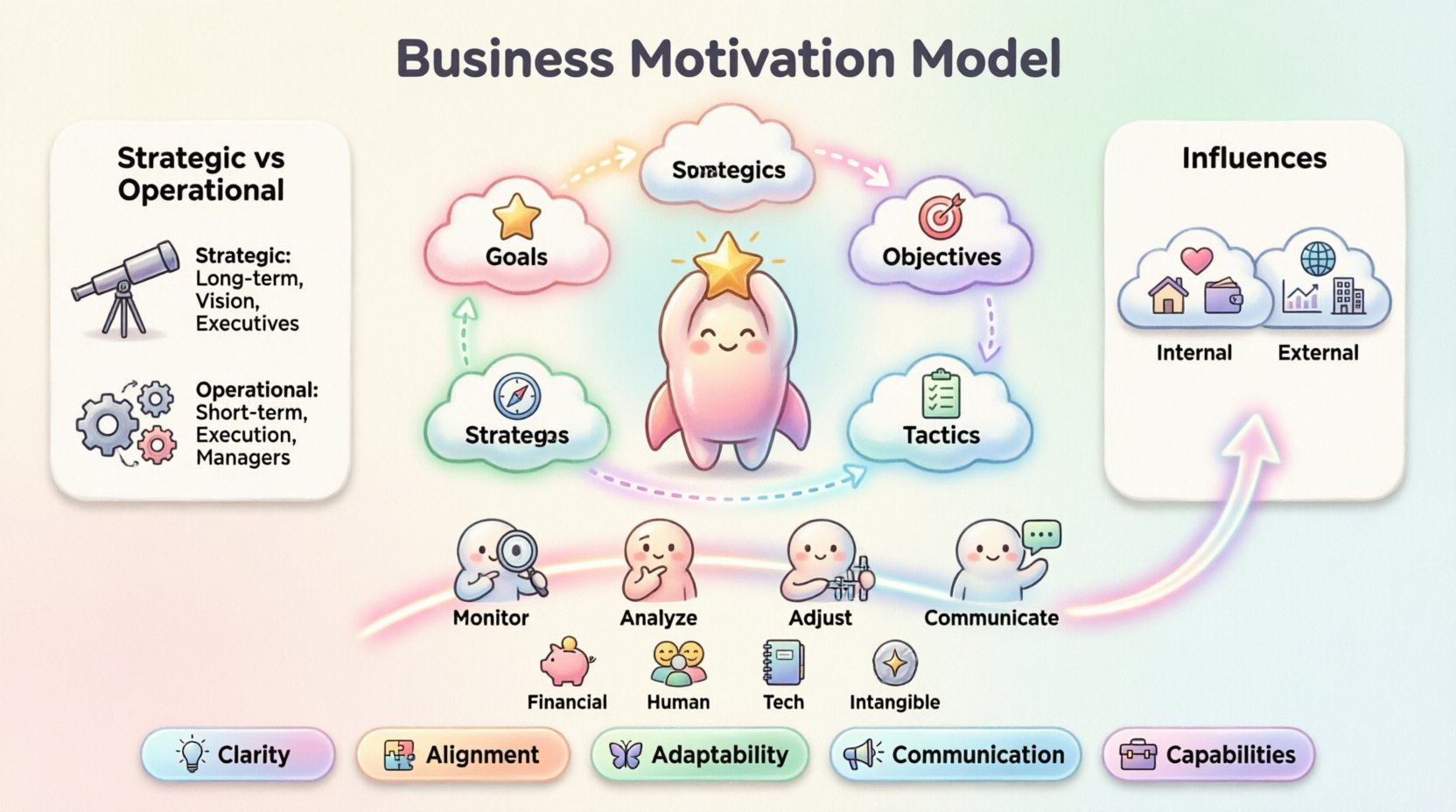
Before implementing any changes, it is crucial to establish a shared understanding of the terminology used in business motivation. Clarity prevents confusion and ensures that stakeholders are working from the same playbook. The model distinguishes between several key concepts that, when woven together, create a cohesive strategy.
- Goals: These are the high-level aspirations of the organization. They represent the desired end state. A goal is often qualitative and directional, such as “becoming a market leader” or “improving customer satisfaction”.
- Objectives: Unlike goals, objectives are specific and measurable. They provide the concrete metrics against which success is judged. If a goal is to improve satisfaction, an objective might be to achieve a Net Promoter Score of 50 within twelve months.
- Strategies: These are the high-level approaches used to achieve objectives. Strategies describe the “how” at a broad level. For example, a strategy might be to “expand into emerging markets” or “adopt a digital-first customer experience”.
- Tactics: Tactics are the specific actions taken to execute a strategy. They are the granular steps. If the strategy is to expand into emerging markets, a tactic could be “hire local sales representatives in region X”.
Separating these elements is vital. Confusing a strategy with a tactic leads to poor planning. Confusing a goal with an objective leads to vague measurement. Industry leaders emphasize that maintaining this distinction allows for agile adjustments. If a tactic fails, the strategy may still hold. If a strategy fails, the objective may need to be revised.
📊 Strategic vs. Operational Planning
One of the most common friction points in organizations is the disconnect between the boardroom and the front line. Strategic planning often lives in abstract terms, while operational work is grounded in immediate tasks. The motivation model seeks to align these two worlds.
| Aspect | Strategic Level | Operational Level |
|---|---|---|
| Time Horizon | Long-term (3-5+ years) | Short-term (Days to months) |
| Focus | Direction and Vision | Execution and Efficiency |
| Decision Maker | Executive Leadership | Team Leads and Managers |
| Output | Policies and Roadmaps | Tasks and Deliverables |
Effective motivation requires translating strategic intent into operational reality. When a frontline employee understands how their daily task contributes to a long-term goal, engagement increases. This linkage is often missing in traditional hierarchies. Leaders must ensure that the chain of command flows clearly from the top-level goal down to the individual task.
🌍 Understanding Influences and Constraints
No business operates in a vacuum. External and internal factors exert pressure on every decision. The model categorizes these pressures as influences. Recognizing these influences allows an organization to anticipate challenges rather than merely react to them.
- Internal Influences: These include company culture, available budget, existing technology infrastructure, and the skill set of the current workforce.
- External Influences: These encompass market trends, regulatory changes, competitor actions, and economic conditions.
- Constraints: These are limitations that cannot be easily changed. Examples include legal compliance requirements, fixed capital assets, or non-negotiable brand values.
- Opportunities: Favorable conditions that can be leveraged. A new regulation might open a market; a competitor’s exit might create space.
Ignoring influences is a recipe for failure. A strategy that looks perfect on paper may fail if it ignores a changing regulatory environment. Conversely, a strategy that fully accounts for constraints but ignores opportunities may stagnate. Industry veterans suggest conducting regular influence audits. This involves mapping out the forces acting on the organization and assessing their potential impact on current goals.
⚙️ Capabilities and Resources
Once goals are set and strategies defined, the organization must assess its capacity to execute. This is where the concepts of capabilities and resources come into play. A common error is to assume that a strategy exists in a vacuum, ignoring what is actually needed to make it happen.
Capabilities refer to the ability to perform specific activities. This is often a combination of people, processes, and technology working together. For instance, “rapid product deployment” is a capability. It is not just having software; it is having the trained staff and the approved workflows to use that software effectively.
Resources are the assets required to build and maintain capabilities. These include financial capital, human talent, intellectual property, and physical assets. Resources are finite, which necessitates prioritization.
| Resource Type | Examples | Management Focus |
|---|---|---|
| Financial | Cash flow, Investment capital, Credit lines | Budgeting, ROI analysis |
| Human | Employees, Contractors, Leadership | Recruitment, Training, Retention |
| Technological | Hardware, Software licenses, Data | Maintenance, Upgrades, Security |
| Intangible | Brand reputation, Patents, Customer trust | Brand management, Legal protection |
When gaps appear between required capabilities and existing resources, the organization must decide how to close them. Options include building new capabilities internally, acquiring them through partnerships, or adjusting the scope of the goal. Leaders often advise against overextending resources. It is better to scale back ambitions to match capacity than to promise more than can be delivered.
🔄 The Feedback Loop
Business motivation is not a one-time event. It is a continuous cycle. As the environment changes, the goals, strategies, and capabilities must evolve. This requires a robust feedback mechanism.
Key components of this loop include:
- Monitoring: Regularly checking progress against objectives. This involves collecting data and comparing it to the baseline.
- Analysis: Understanding why variances occurred. Was the objective too ambitious? Did an external influence disrupt the plan?
- Adjustment: Making necessary changes to the plan. This might mean tweaking a tactic, revising a strategy, or redefining a goal.
- Communication: Ensuring that changes are understood across the organization. Transparency maintains trust.
Without this loop, an organization becomes rigid. It continues to pursue outdated objectives despite evidence that the path is blocked. Industry leaders stress the importance of cadence. Whether it is weekly reviews or quarterly strategy sessions, there must be a rhythm to the evaluation process.
🤝 Aligning Stakeholders
One of the most difficult aspects of business motivation is aligning diverse stakeholders. Different departments often have conflicting priorities. Sales wants to close deals quickly, while Compliance wants to ensure every transaction is thoroughly vetted. The motivation model helps mediate these conflicts by making the trade-offs visible.
When stakeholders can see how their departmental goals contribute to the overall organizational goals, collaboration improves. This requires a shared vocabulary. If Marketing and Engineering use different terms for “success,” alignment will never be complete. Establishing a common framework allows for clearer dialogue.
Furthermore, stakeholder alignment is not just about internal teams. It extends to customers, partners, and regulators. Their expectations form a significant part of the external influences. Ignoring customer needs in favor of internal efficiency often leads to market share loss. Conversely, listening to feedback can highlight new opportunities for innovation.
🛠️ Implementation Without Specific Tools
Many organizations believe they need complex software to manage their motivation. While technology can assist, the core principles rely on human understanding and disciplined processes. You do not need a specific platform to define goals or track progress. The essential requirement is documentation and discipline.
Effective implementation starts with a central repository for motivation artifacts. This could be a shared drive, a wiki, or a dedicated document management system. The key is accessibility. If the strategy is locked away in a private folder, it cannot guide daily work.
Here are steps to implement a basic framework:
- Document the Vision: Write down the high-level goals in clear, concise language.
- Define Metrics: Specify exactly how success will be measured for each objective.
- Map the Plan: Create a visual or written map linking goals to strategies, tactics, and resources.
- Assign Ownership: Ensure every tactic has a single owner responsible for its execution.
- Review Regularly: Schedule recurring meetings to review progress and update the plan.
This approach keeps the focus on the content of the strategy rather than the tool used to manage it. It ensures that the system remains adaptable and does not become a bureaucratic hurdle.
🚧 Common Pitfalls to Avoid
Even with a solid framework, organizations often stumble. Understanding common pitfalls can help leaders navigate around them. Here are the most frequent errors observed in practice.
- Goal Creep: Continuously adding new goals without removing old ones. This dilutes focus. It is better to have three clear goals than ten vague ones.
- Lack of Context: Communicating objectives without explaining the “why.” Employees need to understand the reason behind a target to stay motivated.
- Static Planning: Creating a plan and never updating it. The business environment is dynamic; the plan must be too.
- Over-Reliance on Incentives: Assuming that financial bonuses alone will drive performance. Intrinsic motivation and clear purpose are often stronger drivers.
- Ignoring Constraints: Planning as if resources are infinite. This leads to burnout and unmet promises.
Avoiding these traps requires humility and a willingness to adapt. It means admitting when a strategy is not working and pivoting quickly. It also means acknowledging that some goals may need to be abandoned to preserve the health of the organization.
🌟 Future Outlook
The landscape of business motivation continues to evolve. As organizations become more decentralized and remote, the need for clear alignment grows stronger. Digital tools are making data more accessible, which allows for more real-time feedback loops. However, the fundamental human element remains unchanged. People need to understand their role in the bigger picture.
Leaders who prioritize clear motivation structures tend to build more resilient organizations. They are better equipped to handle disruptions because their core objectives are clear. Even if the tactics change, the destination remains the same. This clarity provides stability in uncertain times.
Looking ahead, the integration of motivation models with broader operational frameworks will likely deepen. The separation between strategy and execution will continue to blur as organizations seek greater agility. The ability to articulate what is being done and why will become a core competency for all leaders, not just executives.
🔑 Key Takeaways
To summarize the essential points for driving business motivation effectively:
- Clarity is King: Ensure goals and objectives are specific and unambiguous.
- Alignment Matters: Connect daily tasks to long-term vision consistently.
- Adaptability is Essential: Be willing to adjust strategies based on feedback and changing conditions.
- Communication is Critical: Share the plan and the progress with all relevant stakeholders.
- Focus on Capabilities: Ensure you have the resources and skills to execute the plan.
By adhering to these principles, organizations can create a culture of purpose and direction. This does not happen overnight. It requires consistent effort and a commitment to the process. However, the result is a more cohesive, efficient, and motivated workforce ready to tackle the challenges ahead.
The path forward is not about finding a single perfect solution. It is about building a system that allows for continuous improvement and learning. When an organization gets this right, it creates a self-sustaining engine of growth that can withstand market shifts and internal challenges alike.
Start by reviewing your current objectives. Are they clear? Do they align with your vision? If the answer is no, begin the work of alignment. The effort you invest today will pay dividends in performance and stability tomorrow.