The modern enterprise landscape operates at a velocity that demands precision in strategic alignment. Organizations often struggle with the disconnect between high-level aspirations and day-to-day execution. This gap frequently results in wasted resources, misaligned initiatives, and stagnant growth. To bridge this divide, the Business Motivation Model (BMM) provides a structured framework. It enables architects and leaders to visualize the causal relationships between what an organization wants to achieve and the means required to get there. This guide explores the mechanics of the BMM standard, its core components, and how it drives sustainable enterprise performance.
Understanding the Business Motivation Model Framework 🧩
The Business Motivation Model is an Object Management Group (OMG) standard designed to model the “why” and the “how” of an enterprise. Unlike traditional architecture frameworks that focus heavily on structure or process, BMM centers on motivation. It captures the drivers behind business decisions. The model distinguishes clearly between the desired outcomes and the mechanisms that produce them.
At its core, the BMM separates Directives from Means. Directives represent the organization’s intentions, such as goals and objectives. Means represent the resources and actions taken to fulfill those intentions, such as capabilities and resources. This separation allows for a clearer analysis of whether the current infrastructure supports the stated strategy.
Why Adopt a Motivation Model? 🤔
Implementing a BMM structure offers several tangible benefits for enterprise planning:
- Clarity of Intent: It forces stakeholders to articulate exactly what they want to achieve, reducing ambiguity.
- Traceability: You can trace a specific capability back to the goal it supports. If a goal is retired, you know which capabilities can be decommissioned.
- Agility: When market conditions change, the model helps identify which parts of the strategy need adjustment without dismantling the entire architecture.
- Alignment: It ensures that tactical plans align with strategic directives, preventing siloed efforts.
Core Elements of the Business Motivation Model 🔑
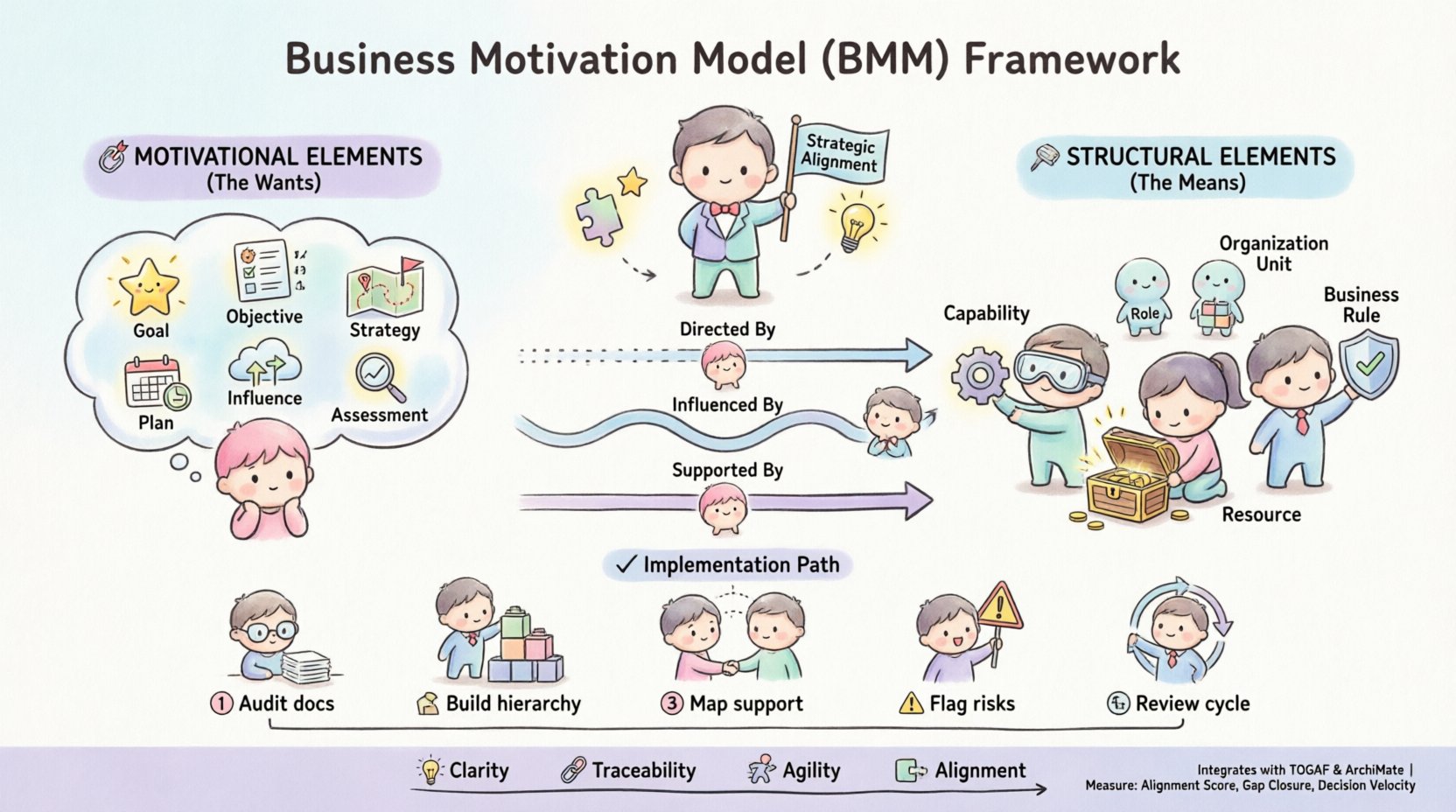
To utilize the BMM effectively, one must understand its atomic elements. The model organizes these elements into two distinct categories: the Motivational Elements and the Structural Elements.
1. Motivational Elements (The Wants) 🎯
These elements define the desired state of the enterprise. They answer the question: What is the organization trying to do?
- Goal: A general statement of intent. It is qualitative and not necessarily measurable. Example: Improve customer satisfaction.
- Objective: A specific, measurable target derived from a goal. It is quantitative and time-bound. Example: Increase Net Promoter Score by 10 points by Q4.
- Strategy: A plan of action designed to achieve a goal or objective. It describes the approach. Example: Implement a new CRM system.
- Plan: A detailed schedule for executing a strategy. It includes timelines and milestones.
- Influence: An external factor that affects the motivation but is outside the direct control of the enterprise. Example: New government regulations or competitor pricing.
- Assessment: An evaluation of the current state against the desired state. It measures progress.
2. Structural Elements (The Means) 🛠️
These elements define the capabilities and resources available to the enterprise. They answer the question: What do we have to do it?
- Capability: An ability to perform a function or activity. It is a skill or competence. Example: Data Analysis Capability.
- Resource: A tangible or intangible asset used to support a capability. Example: A database server or a skilled analyst.
- Business Rule: A condition that must be met to ensure compliance or quality. Example: All customer data must be encrypted.
- Role: A set of responsibilities assigned to an individual or group. Example: Chief Data Officer.
- Organization Unit: A grouping of roles within the enterprise structure. Example: IT Department.
Relationships and Connections 🔗
The power of the Business Motivation Model lies in the relationships between elements. These connections create a web of accountability and logic. The model defines specific directions for how elements relate to one another.
Understanding the Directed By relationship is critical. This indicates that a goal is supported by an objective, or an objective is supported by a strategy. This hierarchy ensures that every tactical plan contributes to a strategic vision.
The Influenced By relationship highlights dependencies. A goal might be influenced by external market trends or internal resource constraints. Mapping these influences helps risk managers anticipate potential blockers before they derail a project.
Another vital connection is Supported By. This links a capability or resource to a strategy. It answers the question: Do we have the capacity to execute this plan? If a strategy has no supporting capability, it remains theoretical. If a capability has no supporting strategy, it may represent technical debt or unused asset.
Visualizing the Model: A Comparative Table 📋
Comparing the different motivational elements helps clarify their distinct roles. The following table outlines the differences between common BMM terms.
| Element | Type | Definition | Example |
|---|---|---|---|
| Goal | Motivation | High-level intent | Expand market share |
| Objective | Motivation | Measurable target | Achieve 15% growth in APAC |
| Strategy | Motivation | Approach to achieve goal | Acquire local competitor |
| Capability | Structure | Ability to perform | Legal Compliance |
| Resource | Structure | Asset used | Legal Team Budget |
| Business Rule | Structure | Constraint or condition | GDPR Compliance |
Implementing BMM in Enterprise Architecture 🏗️
Integrating the Business Motivation Model into existing architecture practices requires a methodical approach. It is not merely a documentation exercise; it is a change management process. The following steps outline a practical implementation path.
Step 1: Assessment and Inventory 📝
Before modeling begins, conduct a thorough audit of current strategic documents. Gather mission statements, annual reports, and project charters. Identify existing goals and objectives. Simultaneously, inventory current capabilities and resources. This creates a baseline for comparison.
Step 2: Define the Motivational Hierarchy 🏗️
Organize the collected data into the BMM hierarchy. Start with the highest-level goals. Break these down into specific objectives. Ensure each objective is measurable. Assign a strategy to each objective. This step often reveals gaps where objectives exist without a clear strategy, or strategies without clear objectives.
Step 3: Map Structural Support 🤝
Link the motivational elements to the structural elements. Determine which capabilities are needed to execute the strategies. Identify if current resources are sufficient. If a capability is missing, flag it as a requirement. If a capability is underutilized, assess if it can be repurposed.
Step 4: Identify Influencers and Risks ⚠️
Document external and internal influences. Consider regulatory changes, economic shifts, or technological advancements. Map these influences to the goals they impact. This creates a risk register integrated directly into the motivation model. It allows for proactive rather than reactive management.
Step 5: Continuous Review and Update 🔄
A BMM is a living artifact. It must evolve as the business evolves. Establish a review cycle, perhaps quarterly or bi-annually. Update objectives based on performance. Adjust strategies based on market feedback. Ensure that the model reflects the current reality of the enterprise.
Common Challenges and Mitigation Strategies 🛡️
While the Business Motivation Model offers significant value, adoption is not without hurdles. Understanding these challenges allows for better planning and execution.
- Complexity Overload: The model can become overly complex if every minor detail is captured. Mitigation: Focus on high-value drivers. Do not model every minor task. Keep the hierarchy manageable.
- Stakeholder Resistance: Leaders may view modeling as bureaucratic overhead. Mitigation: Demonstrate quick wins. Show how the model clarifies decision-making. Connect the model to specific budget or resource requests.
- Data Silos: Information about goals often resides in different departments. Mitigation: Establish a central governance body for the model. Ensure data integration across HR, Finance, and IT.
- Static Documentation: Models often become outdated shortly after creation. Mitigation: Automate updates where possible. Integrate the model into project management workflows.
Integrating BMM with Other Frameworks 🧱
The Business Motivation Model does not exist in isolation. It complements other enterprise architecture frameworks. For instance, when used alongside TOGAF or ArchiMate, BMM provides the strategic context that these frameworks sometimes lack.
In a TOGAF context, the BMM aligns with the Architecture Vision and Business Architecture. It ensures that the technology solutions built later in the cycle actually solve the business problems defined at the start. In ArchiMate, BMM elements map to the Motivation layer. This layer sits above the Business, Application, and Technology layers, providing the rationale for architectural decisions.
This integration ensures a holistic view. Strategy informs architecture, and architecture supports strategy. Without the BMM, architecture risks becoming purely technical without business justification. Without the architecture framework, strategy risks remaining abstract and unexecutable.
Measuring Success with BMM 📏
How do you know the model is working? Success metrics should be defined within the model itself. Use the Objective element to set targets for the modeling process.
- Alignment Score: Percentage of projects linked to a strategic goal.
- Gap Closure Rate: Number of identified capability gaps resolved over time.
- Decision Velocity: Time taken to make strategic decisions based on model data.
- Resource Utilization: Efficiency of resources allocated to high-priority strategies.
Tracking these metrics ensures the BMM remains a tool for value creation rather than a compliance exercise. Regular reporting on these metrics keeps leadership engaged and accountable.
Final Considerations for Strategic Execution 💡
The Business Motivation Model represents a shift from static planning to dynamic alignment. It acknowledges that business environments are volatile. By explicitly modeling the links between intent and action, organizations gain the flexibility to adapt without losing direction.
Adopting this framework requires discipline. It demands that leaders articulate their intentions clearly and that architects map their capabilities accurately. However, the payoff is a resilient organization. One where resources are deployed efficiently, where risks are anticipated, and where every action contributes to the overarching mission.
For enterprises seeking to move beyond ad-hoc decision-making, the BMM offers a proven path. It provides the structure needed to navigate complexity. By focusing on motivation, it ensures that technology and operations serve the business, not the other way around. The journey toward this alignment is ongoing, but the destination is a more robust and responsive enterprise.
Summary of Key Takeaways ✅
- The BMM standard separates motivations (Wants) from structural means (How).
- Key motivational elements include Goals, Objectives, Strategies, and Plans.
- Key structural elements include Capabilities, Resources, and Business Rules.
- Relationships like Directed By and Supported By create traceability.
- Implementation requires assessment, mapping, and continuous review.
- BMM integrates well with TOGAF and ArchiMate for holistic architecture.
- Success is measured by alignment, gap closure, and decision velocity.