In modern software development, the distance between business needs and technical implementation is often measured in time, budget, and frustration. When stakeholders describe what they want and developers describe what they build, misalignment creates friction. This friction manifests as rework, delayed releases, and features that do not meet user expectations. The User Story serves as the fundamental unit of value delivery and communication, yet its power is often underutilized. When crafted correctly, a story acts as a bridge, connecting the business vision with the technical reality.
This guide explores how to leverage user stories effectively to foster alignment. We will move beyond the basic definition and examine the nuances of collaboration, criteria definition, and the ongoing dialogue required to keep teams synchronized. By treating stories as conversation starters rather than static requirements, organizations can reduce ambiguity and increase delivery confidence.
Why the Disconnect Occurs 📉
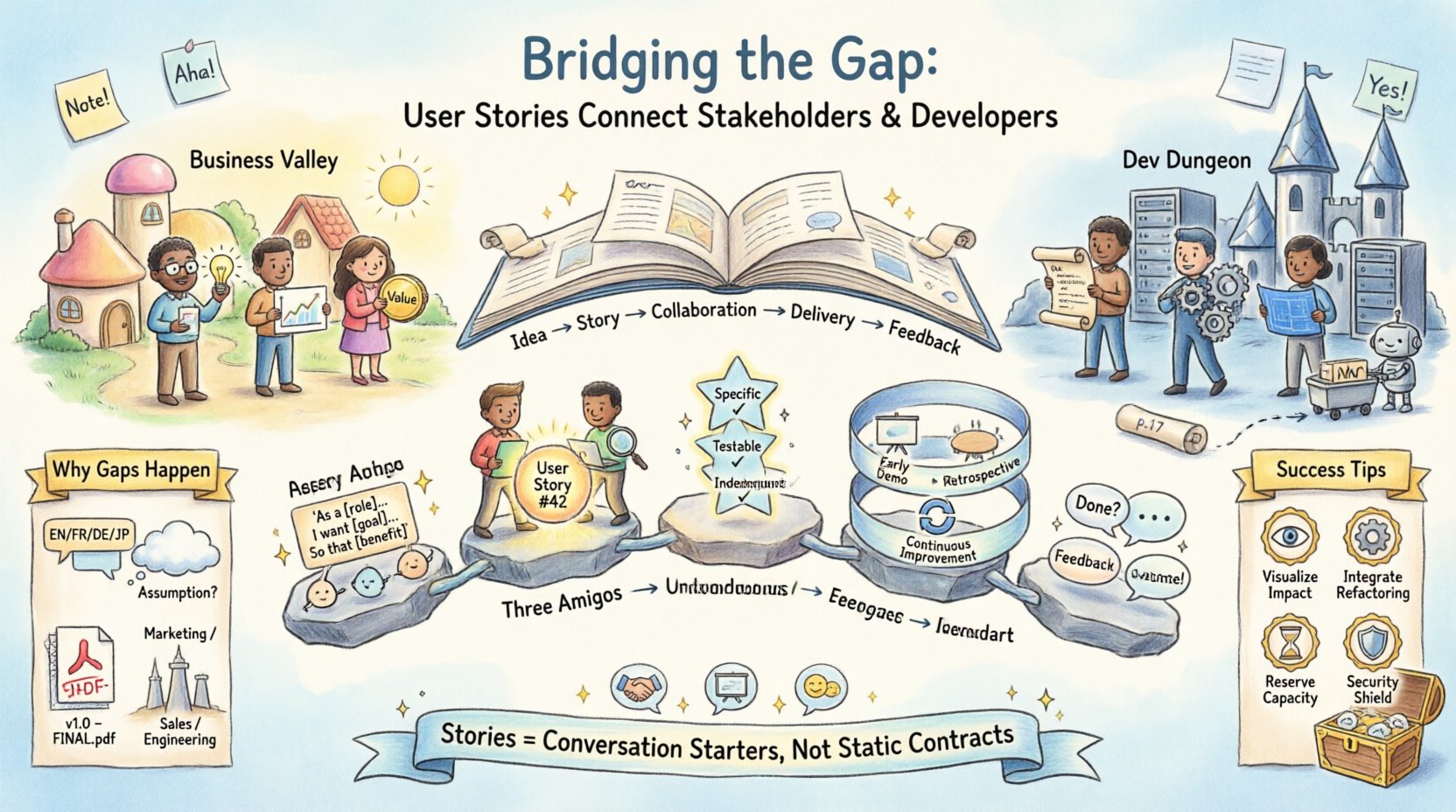
Understanding the root causes of misalignment is the first step toward resolution. Stakeholders and developers often operate in different linguistic universes. Stakeholders focus on value, outcomes, and business metrics. Developers focus on implementation, architecture, and constraints. Without a shared vocabulary, these perspectives clash.
- Business Context vs. Technical Detail: Stakeholders often lack visibility into the complexity of code changes. Conversely, developers may not fully grasp the business urgency behind a request.
- Implicit Assumptions: Both parties assume the other knows what is obvious to them. This leads to gaps in requirements that are discovered too late.
- Static Documentation: When stories are treated as fixed contracts rather than evolving discussions, the team loses the ability to adapt to new information.
- Communication Silos: Relying solely on written tickets without conversation creates a vacuum where context is lost.
To bridge this gap, the communication channel must shift from document-heavy handoffs to collaborative workshops. The goal is to ensure that the story reflects a shared understanding before development begins.
The Anatomy of an Effective User Story 📝
A well-written story is more than a task description. It is a promise of value delivered by a specific user need. The standard format provides a skeleton, but the meat lies in the details.
The Standard Template
The classic structure remains a reliable foundation for clarity:
- Role: Who is asking for this? (e.g., “As a customer…”)
- Goal: What do they want to do? (e.g., “…I want to filter search results…”)
- Benefit: Why does it matter? (e.g., “…so that I can find products faster.”)
While this template ensures the “What” and “Why” are present, the “How” is where the collaboration deepens. Developers need to understand constraints, and stakeholders need to understand feasibility.
Components of a High-Performing Story
| Component | Purpose |
|---|---|
| Background Context | Explains the business environment or problem statement. |
| Visual Aids | Wireframes or mockups clarify the expected interface. |
| Acceptance Criteria | Defines the specific conditions that must be met for completion. |
| Technical Notes | Highlights dependencies, performance needs, or security requirements. |
When these components are combined, the story becomes a comprehensive artifact that guides the work without dictating the solution.
Collaborative Refinement Sessions 🧠
Refinement is the process of turning a vague idea into a concrete plan. It is not a one-time event but a continuous activity. Involving the right people in these sessions is critical for bridging the stakeholder-developer divide.
The Three Amigos Approach
This collaboration model involves three key perspectives:
- Business Analyst / Product Owner: Represents the user and business value.
- Developer: Represents the implementation feasibility and technical constraints.
- QA Engineer: Represents the testing perspective and edge cases.
When these three discuss a story together, potential blockers are identified early. The developer can flag technical debt risks. The QA engineer can spot missing test cases. The business owner ensures the feature still aligns with the original goal.
Workshop Techniques
Structured workshops prevent conversations from derailing. Use the following techniques to maintain focus:
- Role-Playing: Act out the user journey to identify friction points.
- Question Storming: Generate a list of questions about the story before attempting to answer them.
- Splitting Stories: If a story is too large, break it down into smaller, deliverable increments that still provide value.
Defining Clear Acceptance Criteria ✅
Acceptance criteria are the contract between the business and the engineering team. They define when a story is truly done. Vague criteria lead to disagreements during the review phase. Clear criteria prevent scope creep and ensure quality.
Characteristics of Good Criteria
- Specific: Avoid words like “fast” or “easy.” Use measurable terms like “loads in under 2 seconds.”
- Testable: Every criterion should be verifiable through a test or a manual check.
- Unambiguous: The wording should not allow for multiple interpretations.
- Independent: Criteria should focus on the functionality, not the implementation method.
Bad vs. Good Examples
| Criteria Type | Example |
|---|---|
| Vague | The system should handle high traffic. |
| Specific | The system must handle 1,000 concurrent users without exceeding a 3-second response time. |
| Implementation | Use Redis caching for the session store. |
| Functional | Users must remain logged in for 30 minutes of inactivity. |
By focusing on functional requirements, developers retain the freedom to choose the best technical solution while meeting the business need.
Managing Technical Constraints ⚖️
One of the most common sources of tension is the discussion around technical debt and constraints. Stakeholders often view technical work as invisible or unimportant compared to new features. Developers view it as essential for stability. Bridging this gap requires transparency.
- Visualize the Impact: Explain how technical debt affects future speed and stability. Use metrics to show the cost of delays.
- Integrate Refactoring: Include technical tasks within user stories where possible. This links the code change directly to user value.
- Reserve Capacity: Dedicate a portion of every sprint to non-functional improvements. This prevents the backlog of technical tasks from growing unmanageable.
- Security & Compliance: Treat these as mandatory acceptance criteria. They are not optional features but prerequisites for release.
When developers explain the “why” behind technical constraints in plain language, stakeholders are more likely to support necessary trade-offs.
The Feedback Loop 🔁
Writing a story is only the beginning. The gap closes further when feedback flows continuously from development to stakeholders and back again.
Early Demos
Do not wait until the end of a cycle to show progress. Demonstrating small increments allows stakeholders to validate assumptions early. If a feature is built incorrectly, it is caught in days, not months.
- Internal Reviews: Show the feature to the team before the stakeholder review to catch obvious issues.
- Stakeholder Walkthroughs: Invite stakeholders to see the working software in a controlled environment.
- Real-World Testing: If possible, release to a small group of users before a full rollout.
Retrospectives on Stories
After a story is completed, discuss the delivery process. What went well? Where did communication break down? This reflection helps refine the storytelling process for future work.
- Did the acceptance criteria match the final output?
- Were there any hidden dependencies that slowed progress?
- Was the stakeholder available to answer questions when needed?
Common Pitfalls in Story Creation 🚫
Even with good intentions, teams often fall into traps that widen the gap between business and tech. Recognizing these patterns is key to avoiding them.
- Assuming Knowledge: Do not assume stakeholders understand technical limitations. Do not assume developers understand business strategy. Educate each other.
- Ignoring Edge Cases: Focusing only on the “Happy Path” leads to fragile software. Ensure criteria cover error handling and unexpected inputs.
- Over-Engineering: Building for future needs that do not exist yet wastes resources. Stick to the current story’s scope.
- Hoarding Context: If only one person knows the details of a story, the team is at risk. Document decisions and share knowledge openly.
- Skipping the “Why”: If developers do not know the benefit of the feature, they cannot make good design decisions. Always articulate the value.
Scaling Collaboration 📈
As teams grow, maintaining this level of collaboration becomes more challenging. However, the principles remain the same. You may need more structured meetings or dedicated roles to facilitate communication.
- Product Triads: Expand the Three Amigos model to include representatives from support or operations.
- Standardized Templates: Use consistent formats for stories across the organization to reduce cognitive load.
- Shared Glossary: Maintain a list of terms that are understood by both business and technical teams to avoid confusion.
- Automated Feedback: Use the tracking system to notify stakeholders when a story reaches a review-ready state.
Consistency in process builds trust. When stakeholders know that the team follows a reliable method for handling stories, they feel more secure in the delivery timeline.
Conclusion
Bridging the gap between stakeholders and developers is not about changing people; it is about changing the medium of communication. User stories, when used correctly, provide a neutral ground where business value and technical feasibility can meet. By focusing on clarity, collaboration, and continuous feedback, teams can reduce waste and increase the quality of their output.
The journey requires patience and discipline. It involves regular conversations, honest assessments of constraints, and a shared commitment to the product. When the story is truly understood by all parties, the development process becomes a shared endeavor rather than a handoff. This alignment is the foundation of sustainable delivery.
Start by refining your current stories. Check if the acceptance criteria are testable. Ensure the “why” is clear. Invite the QA engineer to the conversation early. These small steps accumulate into a significant shift in culture. Over time, the gap narrows, and the team moves faster with greater confidence.