
Organizations frequently face a significant disconnect between the strategic vision set by leadership and the daily tasks performed by operational teams. This gap often results in misaligned efforts, wasted resources, and a failure to achieve intended outcomes. To address this structural weakness, the Business Motivation Model (BMM) offers a standardized framework for mapping the relationships between strategic intent and operational execution. This guide explores the mechanics of BMM and how it serves as a critical tool for maintaining alignment across the enterprise.
When an organization defines a goal, it must ensure that every process, capability, and resource contributes meaningfully to that goal. Without a structured approach, these connections become implicit and fragile. BMM provides the explicit architecture needed to visualize and manage these dependencies. It moves beyond simple project management to encompass the full spectrum of business drivers.
🧩 Understanding the Business Motivation Model (BMM)
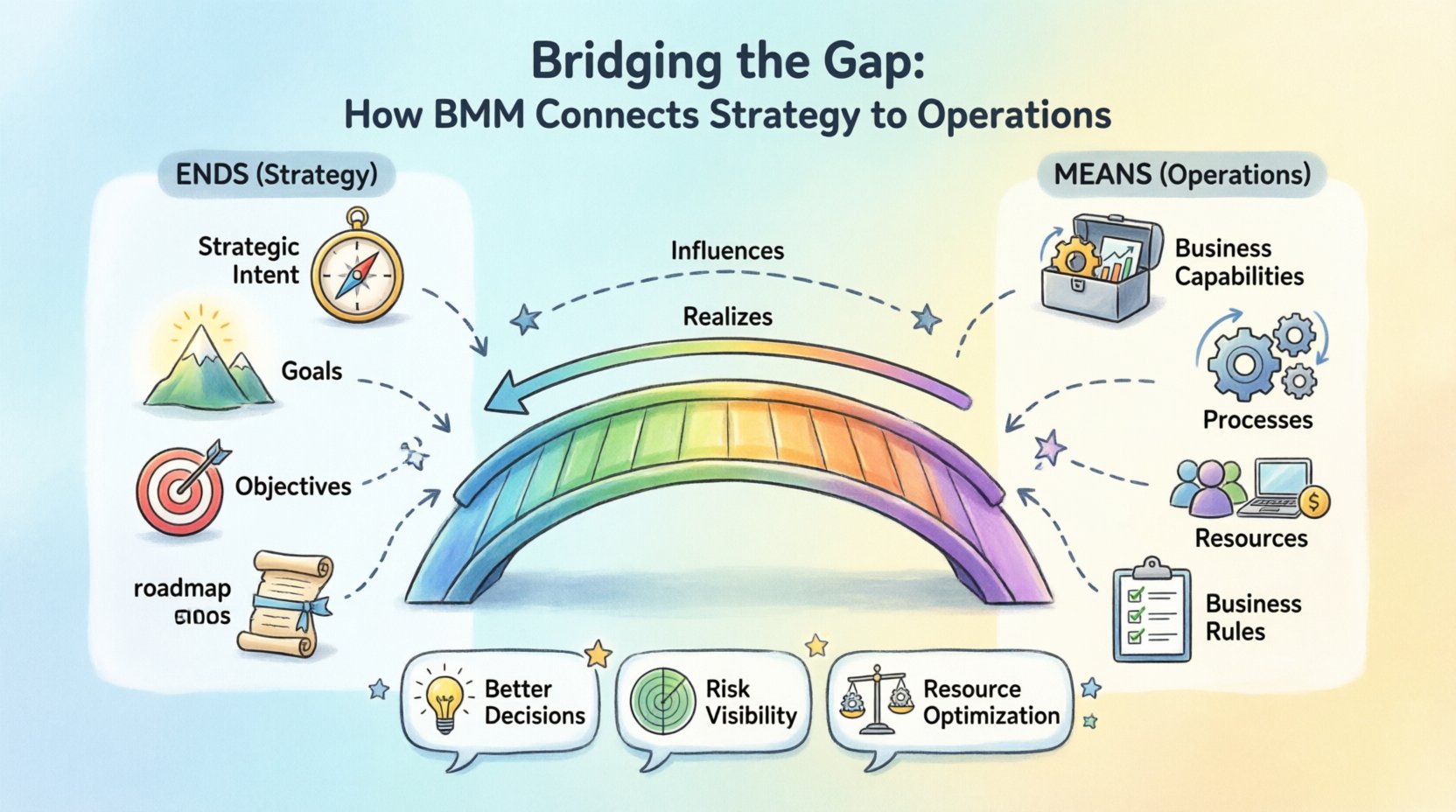
The Business Motivation Model is a comprehensive framework designed to support business architecture. It is not a software product but a conceptual standard that helps organizations document the “why” and “how” of their business decisions. The model distinguishes between the motivations that drive the business and the means used to achieve those motivations.
At its core, BMM breaks down the business into two primary categories:
- Ends: These represent what the organization wants to achieve. They include goals, objectives, and plans.
- Means: These represent how the organization achieves its ends. They include business capabilities, business processes, resources, and rules.
By separating these elements, BMM allows stakeholders to see how high-level aspirations translate into tangible actions. This separation is vital for agility. When market conditions change, an organization might need to alter its means without changing its ends, or vice versa. BMM makes these trade-offs visible.
🎯 The Core Architecture: Ends and Means
Effective business alignment requires a deep understanding of the elements within the model. Below is a detailed breakdown of the components that make up the BMM structure.
1. The Ends (Motivations)
Ends are the targets of the business. They provide the direction and purpose. The hierarchy of ends typically flows from broad aspirations down to specific targets.
- Strategic Intent: The overarching purpose or mission of the organization. This defines the long-term direction.
- Goals: Broad, high-level outcomes that support the strategic intent. Goals are often qualitative and long-term.
- Objectives: Specific, measurable targets that support a goal. Objectives are quantitative and time-bound.
- Plans: The specific actions or projects designed to achieve objectives. Plans are the bridge to execution.
2. The Means (Capabilities and Resources)
Means are the assets and activities utilized to reach the ends. This layer focuses on the operational reality of the business.
- Business Capabilities: The abilities an organization possesses to achieve its ends. This includes skills, competencies, and functional areas.
- Business Processes: The sequence of activities that transform inputs into outputs. These are the workflows that execute the capabilities.
- Resources: The assets required to perform work. This includes people, technology, facilities, and financial capital.
- Business Rules: The constraints and policies that govern behavior. Rules define what is allowed and what is prohibited within the processes.
🌉 The Strategic Gap Explained
Why does the disconnect between strategy and operations occur so often? Several factors contribute to this failure in alignment. Understanding these root causes is the first step toward using BMM to close the gap.
- Lack of Visibility: Senior leadership often operates in a high-level environment, while operational staff work in the details. There is rarely a clear line of sight connecting a daily task to a corporate goal.
- Static Documentation: Strategic documents are often created once a year and then filed away. They do not evolve with the pace of daily operations.
- Language Barriers: Executives speak in terms of value and ROI, while IT and operations speak in terms of systems and uptime. BMM provides a common vocabulary to bridge this linguistic divide.
- Decoupled Planning: Operational planning (budgeting, staffing) is frequently treated as separate from strategic planning. This leads to resource allocation that does not support the stated goals.
Without a model like BMM, these issues compound over time. Resources are spent on low-value activities, and strategic goals remain theoretical. The BMM framework forces the organization to document the linkages, ensuring that every resource has a defined purpose.
📊 Mapping Strategy to Operations
The primary function of BMM is to create explicit relationships between the Ends and the Means. This mapping ensures that operations are not just busy, but productive.
Consider the relationship between a strategic goal and a daily process. In a traditional setup, a goal might sit in a slide deck, and a process might exist in a workflow tool. There is no digital or conceptual link. In BMM, these elements are connected through relationships such as Influences and Realizations.
Influence describes how one element affects another. For example, a business rule might influence a process. A strategic goal might influence a plan.
Realization describes how a means achieves an end. A capability realizes a goal. A process realizes an objective. This distinction is critical for understanding accountability.
To visualize the difference between strategic and operational elements, refer to the table below.
| Element Type | Strategic Level | Operational Level |
|---|---|---|
| Focus | Direction, Value, Long-term | Execution, Task, Short-term |
| Example Goal | Increase Customer Satisfaction | Reduce Ticket Resolution Time by 20% |
| Example Capability | Customer Relationship Management | Ticketing System Support |
| Example Resource | Annual Budget Allocation | Software License for Support Team |
| Example Rule | Code of Conduct | Login Timeout After 15 Minutes |
This table illustrates how the same concept (e.g., a goal or resource) manifests differently depending on the level of abstraction. BMM allows these variations to coexist within a single model.
🚀 Key Components Deep Dive
To fully leverage BMM, one must understand the specific relationships that bind the model together. These relationships define the logic of the organization.
Realization Relationships
This is the most critical link in the chain. It answers the question: “How do we get there?” A realization relationship connects a means to an end.
- A Process realizes a Goal.
- A Capability realizes a Objective.
- A Plan realizes a Strategy.
If a goal exists without a realizing means, it is merely a wish. If a means exists without a realizing end, it is a waste of resources. BMM audits these connections to ensure balance.
Influence Relationships
Not all relationships are direct. Some elements affect the environment in which others operate. Influence relationships capture these dependencies.
- A Business Rule influences a Process.
- A Market Trend influences a Goal.
- A Resource Constraint influences a Plan.
Understanding influence helps in risk management. If a resource constraint changes, the model shows which plans are influenced and which goals might be at risk.
Aggregation Relationships
Complex goals are often broken down into smaller parts. Aggregation relationships allow for the decomposition of goals and objectives.
- A Strategic Goal is composed of multiple Tactical Objectives.
- A Capability is composed of multiple Skills.
This hierarchy provides clarity. It allows an organization to drill down from a high-level mission to specific skill requirements without losing the context of the original intent.
🛡️ Operational Benefits of BMM
Implementing a Business Motivation Model brings tangible value to the organization. These benefits extend beyond mere documentation to active management of the business.
- Improved Decision Making: When considering a new investment, leaders can trace the path to strategic goals. If the investment does not support a realized end, it can be deprioritized.
- Risk Identification: The model highlights dependencies. If a critical capability is missing, the goals it supports are flagged as high risk.
- Resource Optimization: By mapping resources to ends, organizations can identify redundant efforts. Resources assigned to processes with no strategic realization can be reallocated.
- Enhanced Communication: The model provides a visual language that stakeholders from different departments can use. It reduces ambiguity regarding how different parts of the business contribute to the whole.
- Change Management: When change occurs, the impact analysis is easier. BMM shows which goals are affected by a change in process or capability.
⚠️ Challenges in Implementation
While the theoretical benefits are strong, practical implementation presents hurdles. Organizations must be aware of these challenges to avoid common pitfalls.
- Complexity Management: A BMM model can grow large quickly. Without governance, it can become a massive web of relationships that is difficult to maintain.
- Maintaining Relevance: The model must be living documentation. If it is not updated as the business changes, it becomes obsolete and distrusting.
- Stakeholder Buy-in: Creating the model requires input from various levels of the organization. Without participation from operational staff, the model lacks accuracy.
- Defining Granularity: Deciding how detailed the model should be is a constant challenge. Too high, and it is vague. Too low, and it becomes unmanageable.
📈 Best Practices for Alignment
To succeed with BMM, organizations should adopt specific practices that ensure the model remains useful and accurate over time.
- Start with the Ends: Do not build the model from the bottom up. Start with the strategic intent and work downward. This ensures the structure supports the vision.
- Regular Reviews: Schedule periodic reviews of the model. Align these reviews with the strategic planning cycle to ensure updates are timely.
- Assign Owners: Every element in the model should have an owner. A goal owner, a process owner, and a resource owner. This creates accountability.
- Keep it Visual: Use diagrams and visual representations of the model. Text-heavy models are rarely read. Visual maps help stakeholders understand the connections.
- Integrate with Governance: Embed the BMM into the governance framework. Use the model to evaluate new initiatives and projects during approval stages.
- Iterative Refinement: Accept that the first version of the model will not be perfect. Refine it based on feedback and changing business needs.
🔄 Future Considerations
As businesses become more dynamic, the need for frameworks like BMM will increase. The modern enterprise operates in an environment of constant change. Speed and adaptability are key competitive advantages.
Future developments in business architecture will likely focus on integrating BMM with other management frameworks. This includes linking BMM with performance management systems and project portfolios. The goal is to create a cohesive ecosystem where strategy, execution, and performance are measured against a single source of truth.
Furthermore, the adoption of digital tools that support business architecture will make BMM more accessible. While we do not focus on specific products, the capability to link data points directly to model elements will reduce the administrative burden of maintaining the model.
🔗 Summary of Core Principles
Success with the Business Motivation Model relies on adhering to a few core principles. These principles guide the construction and maintenance of the framework.
- Separation of Concerns: Keep the “why” (Ends) distinct from the “how” (Means) to allow for flexibility.
- Traceability: Ensure every operational activity can be traced back to a strategic goal.
- Clarity: Use clear definitions for goals, objectives, and capabilities to avoid confusion.
- Connectivity: Focus on the relationships between elements, not just the elements themselves.
By following these principles, organizations can build a robust bridge between their high-level ambitions and their daily realities. The Business Motivation Model is not just a diagram; it is a management discipline that brings order to complexity.
🏁 Moving Forward
The journey toward better alignment is continuous. It requires commitment from leadership and engagement from all levels of the workforce. When an organization effectively utilizes the Business Motivation Model, it gains the ability to navigate change with confidence. The connection between strategy and operations becomes a strength rather than a liability.
Adopting this framework allows leaders to see the full picture. It ensures that resources are deployed where they create the most value. It transforms the business from a collection of disparate activities into a unified engine designed to achieve specific outcomes. This is the true power of a well-structured business architecture.
As you consider your own organizational structure, evaluate the links between your goals and your processes. Identify where the gaps exist. Then, apply the principles of BMM to build a stronger, more resilient business model. The path from vision to value is paved with clear, documented connections.