
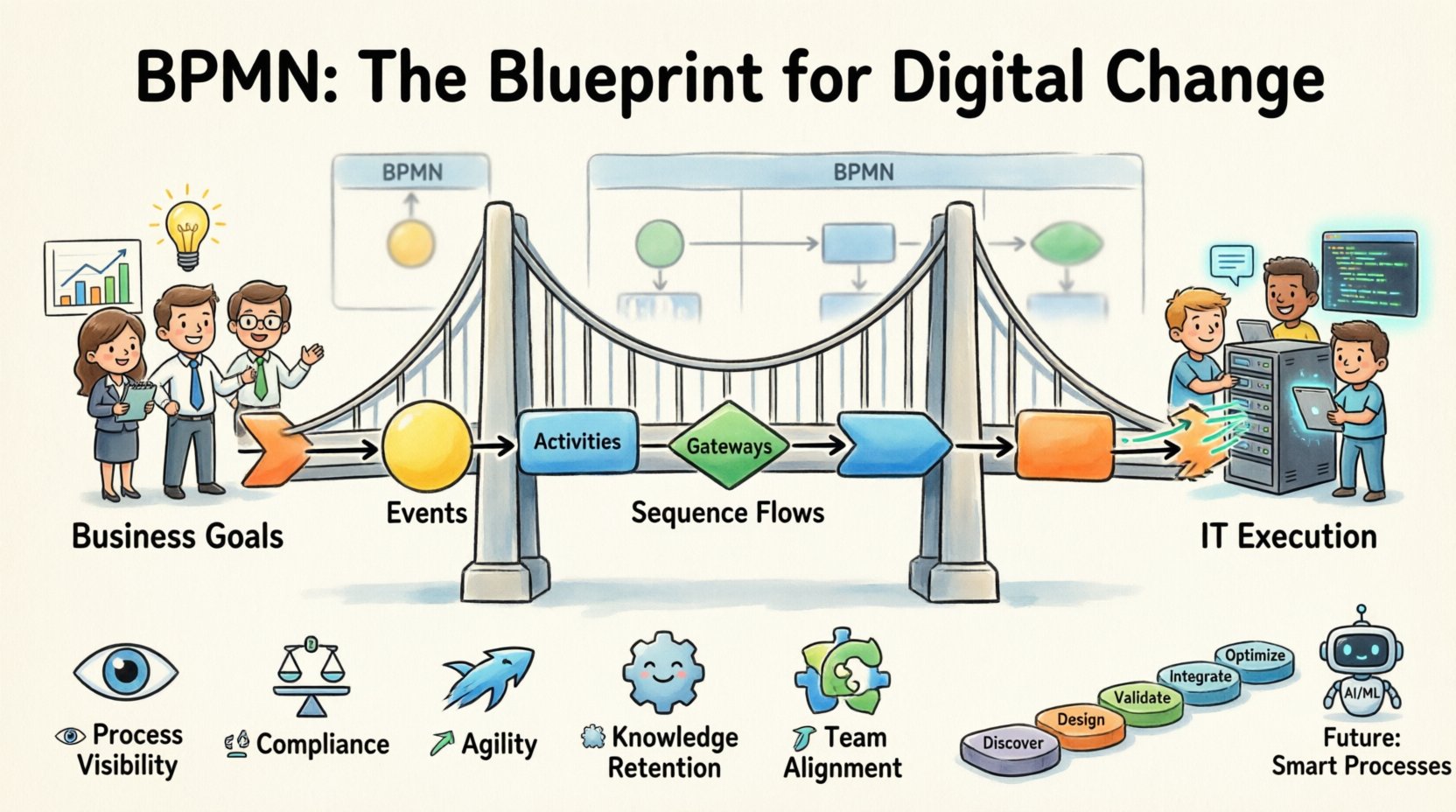
Digital transformation is often misunderstood as a purely technological upgrade. Organizations frequently assume that purchasing new software or migrating to the cloud constitutes a complete transformation. However, without a clear understanding of how work actually flows, technology simply accelerates inefficiencies. This is where Business Process Model and Notation, or BPMN, becomes critical. It acts as the bridge between strategic intent and operational execution.
When implemented correctly, BPMN provides a standardized visual language that aligns stakeholders, developers, and business leaders. It moves the conversation from abstract goals to concrete, executable logic. This guide explores how BPMN functions as a catalyst for meaningful business change, ensuring that digital initiatives deliver tangible value rather than just technical updates.
🧩 Understanding BPMN Fundamentals
BPMN is an open standard maintained by the Object Management Group. It is designed to be readable by both technical and non-technical stakeholders. Unlike flowcharts, which are often informal and vary in style, BPMN defines specific symbols and rules that ensure consistency across an enterprise.
Think of BPMN as the blueprint for a building. You would not ask a construction crew to build a skyscraper without detailed architectural drawings. Similarly, attempting to automate or optimize a business function without a modeled process often leads to errors and rework. The notation breaks down processes into logical components:
- Events: These represent something that happens, such as a trigger or a result. They are depicted as circles. Examples include a message arriving, a timer expiring, or a transaction completing.
- Activities: These are the actual work being performed. They can be tasks performed by a human or services executed by a system. They are shown as rounded rectangles.
- Gateways: These control the flow of the process. They determine where the path goes next, often involving decisions or splits in logic. Diamond shapes typically represent these gateways.
- Sequence Flows: These are the lines connecting the elements, indicating the order in which activities occur.
- Pools and Lanes: Pools represent distinct participants in a process, such as different organizations or departments. Lanes within a pool organize activities by role, system, or department.
By using these standardized elements, teams avoid ambiguity. A symbol that means a “decision” in one diagram means the same in another, regardless of who drew it. This standardization is the foundation of scalability in digital transformation.
🌉 The Bridge Between Business and IT
One of the most significant barriers to digital transformation is the communication gap between business units and information technology. Business leaders speak in terms of value, efficiency, and customer experience. IT teams speak in terms of APIs, latency, and architecture. BPMN acts as the translator between these two dialects.
When a business requirement is captured in a BPMN diagram, it translates directly into technical specifications. This reduces the need for lengthy requirement documents that are often misinterpreted. The visual nature of the model allows stakeholders to validate the logic before a single line of code is written.
Consider the scenario of a loan approval process. In the past, this might have been described in a text document. With BPMN, the process is visualized:
- Start Event: Customer submits application.
- Gateway: Is the credit score above 700?
- Exclusive Path A: If yes, route to automated underwriting system.
- Exclusive Path B: If no, route to manual review team.
- End Event: Notification sent to customer.
This level of clarity ensures that the technical team builds exactly what the business needs. It eliminates the “guesswork” phase of development, saving time and resources. It also allows for continuous improvement. If the business changes its credit policy, the model can be updated, and the technical team knows exactly where to adjust the logic.
🚀 Driving Strategic Benefits
Integrating BPMN into a digital transformation strategy offers several distinct advantages. These benefits extend beyond simple documentation; they influence how an organization operates and adapts to change.
- Process Visibility: Leaders gain a clear view of operations. Bottlenecks become obvious when visualized. If a specific gateway consistently delays a flow, it indicates a resource constraint or a logic error.
- Consistency and Compliance: Regulated industries require adherence to strict standards. BPMN models can be mapped to compliance requirements, ensuring that processes are auditable and standardized across the enterprise.
- Agility: Market conditions change rapidly. A well-modeled process can be reconfigured quickly. Instead of rewriting code from scratch, the logic is adjusted in the model and redeployed.
- Knowledge Retention: When employees leave, institutional knowledge often leaves with them. BPMN models serve as a living record of how work is performed, preserving critical operational knowledge.
- Cross-Functional Alignment: Complex processes often span multiple departments. BPMN clarifies handoffs between teams, reducing friction and the “throw it over the wall” mentality.
⚙️ Core Components Explained in Detail
To understand how BPMN drives change, one must understand the depth of its components. It is not merely about drawing boxes; it is about defining logic.
1. Events and Their Impact
Events are the anchors of a process. They define when a process starts and how it ends. In a digital context, events often trigger automated systems. For example, a message event might trigger an email notification via a middleware platform. A timer event might trigger a daily report generation. Understanding these triggers is essential for integrating new tools into existing workflows.
2. Gateways and Decision Logic
Gateways represent the brain of the process. They handle complexity. There are different types of gateways:
- Exclusive Gateway (XOR): Only one path is taken. Used for simple yes/no decisions.
- Inclusive Gateway (OR): Multiple paths can be taken simultaneously. Used when multiple conditions might apply.
- Parallel Gateway (AND): All paths are executed at once. Used for tasks that can happen concurrently, like sending an email and updating a database.
Accurate modeling of these gateways prevents logic errors in automation. If a parallel gateway is modeled incorrectly, tasks might run sequentially, slowing down the process.
3. Subprocesses
Complex processes can be broken down into subprocesses. This allows for a high-level overview while maintaining the ability to drill down into details. This abstraction is vital for large enterprises where a single process might involve hundreds of steps. It keeps the main diagram clean and readable.
📋 Common Pitfalls and Solutions
While BPMN is powerful, it is often implemented incorrectly. Organizations may create diagrams that are too complex or fail to keep them updated. The table below outlines common issues and how to address them.
| Pitfall | Impact | Solution |
|---|---|---|
| Over-Modeling | Diagrams become too complex to read, leading to confusion. | Use subprocesses to abstract detail. Focus on the “happy path” first, then add error handling. |
| Stale Models | Processes change, but diagrams do not, leading to outdated documentation. | Integrate model updates into the change management process. Treat the model as a living document. |
| Missing Error Handling | Automated systems crash when exceptions occur because the process does not account for them. | Explicitly model exception events and compensation activities for failed tasks. |
| Lack of Stakeholder Input | Models are created by IT without business validation, resulting in inaccurate logic. | Conduct workshops with process owners to validate the flow before technical implementation. |
| Tool Dependency | Models become locked into specific software, hindering portability. | Use standard BPMN XML interchange formats to ensure compatibility across different platforms. |
🛠️ Strategic Implementation Steps
Introducing BPMN into a digital transformation initiative requires a structured approach. It is not a quick fix but a cultural shift towards process discipline. The following steps outline a robust implementation strategy.
1. Process Discovery and Inventory
Before modeling, you must know what exists. Conduct an inventory of critical business processes. Identify which ones are high-value and high-volume. These are the candidates for transformation. Engage with process owners to understand the current state, often referred to as the “As-Is” model.
2. Define the Target State
Digital transformation is about change. Define the “To-Be” state. This involves identifying opportunities for automation, elimination of redundant steps, and improvements in customer experience. The BPMN model should reflect this optimized flow.
3. Validation and Sign-Off
Present the models to stakeholders. Walk through the logic using the visual diagram. Ensure that the technical team understands the requirements and the business team understands the constraints. Get formal sign-off to prevent scope creep during development.
4. Technical Integration
Map the BPMN elements to the technical architecture. Tasks assigned to humans become work items in a task list. Tasks assigned to systems become API calls or database updates. This mapping is the critical step where the model becomes executable.
5. Monitoring and Optimization
Once the process is live, monitor its performance. Use the model to track Key Performance Indicators (KPIs). If a process takes longer than expected, refer back to the model to identify where the delay occurs. Continuous improvement is a cycle, not a destination.
🔗 Connecting Modeling to Execution
The ultimate goal of BPMN in transformation is often execution. This means moving from static diagrams to dynamic workflows. This is achieved through Business Process Management engines.
These engines interpret the BPMN logic and run it. They manage the state of the process, store data, and handle exceptions. When a process is modeled correctly in BPMN, the engine can execute it without manual intervention. This is the core of workflow automation.
For example, consider an invoice processing workflow. A document is uploaded (Start Event). The system extracts data (Service Task). It checks for approval limits (Gateway). If the amount is low, it pays automatically. If high, it routes to a manager (User Task). The manager approves or rejects. The system records the result (End Event).
Because the logic is defined in the BPMN model, any change in the approval limit does not require code changes. It only requires updating the gateway condition in the model. This flexibility is a key driver of digital agility.
📊 Measuring Process Performance
Transformation requires metrics. You cannot improve what you do not measure. BPMN models provide the context for these metrics.
Key metrics to track include:
- Cycle Time: The total time from the start event to the end event.
- Throughput: The number of instances completed in a specific time frame.
- Exception Rate: The percentage of processes that hit an error path or require manual intervention.
- Cost per Instance: The resources consumed to complete one process instance.
By correlating these metrics with the process model, organizations can pinpoint inefficiencies. If cycle time increases, the model shows where the delay is occurring. If exception rates rise, the model highlights where the logic might be too fragile.
🔮 Future Considerations
The landscape of process management is evolving. Artificial Intelligence and Machine Learning are beginning to integrate with process modeling. This does not replace BPMN but enhances it.
- Predictive Analytics: Models can predict where a process instance is likely to fail based on historical data.
- Dynamic Routing: Instead of static gateways, AI can decide the best path based on real-time context.
- Process Mining: Tools can analyze system logs to discover the actual process flow and compare it against the BPMN model.
These technologies rely on a solid foundation of well-modeled processes. Without a clear BPMN structure, the data generated by these advanced tools lacks context. Therefore, establishing BPMN discipline now prepares the organization for future innovations.
🏁 Final Thoughts on Process Excellence
Digital transformation is a journey of continuous adaptation. Technology provides the tools, but process provides the direction. BPMN serves as the compass for this journey. It ensures that changes are logical, consistent, and aligned with business goals.
Organizations that invest in process modeling gain a competitive advantage. They move faster because they understand their operations. They reduce risk because they visualize their logic. They innovate because they can test changes safely in a model before applying them to reality.
Success in transformation requires discipline. It requires the commitment to document, model, and refine. By adopting BPMN, you are not just drawing diagrams; you are building a framework for sustainable growth. The path forward is clear when the process is visible. Let the models guide the technology, and the technology will empower the business.