In the complex landscape of modern enterprise architecture, organizations often struggle with alignment. Strategic plans sit on shelves while daily operations move in a different direction. This disconnect usually stems from a lack of clarity regarding why certain actions are taken. The Business Motivation Model (BMM) provides a structured framework to address this challenge. It serves as a map for organizational intent, connecting high-level aspirations with concrete actions.
This guide explores the foundational elements of the Business Motivation Model. We will examine how goals, strategies, and metrics interact to create a cohesive business plan. Whether you are a business analyst, a stakeholder, or an architect, understanding these mechanics is vital for effective enterprise management.
🧩 What is the Business Motivation Model?
The Business Motivation Model is a standard framework used to represent the motivation for a business initiative. It does not dictate how a business should operate; rather, it provides the vocabulary and structure to describe how a business operates. It answers fundamental questions:
- What does the organization want to achieve? 🎯
- What drives the organization to act? 📉
- How will success be measured? 📊
- What steps are required to get there? 🚶
Unlike other modeling techniques that focus on processes or data structures, BMM focuses on intent. It bridges the gap between the business vision and the technical execution. By defining the motivation behind a requirement, teams can prioritize work that actually delivers value.
🏗️ Core Components of the Model
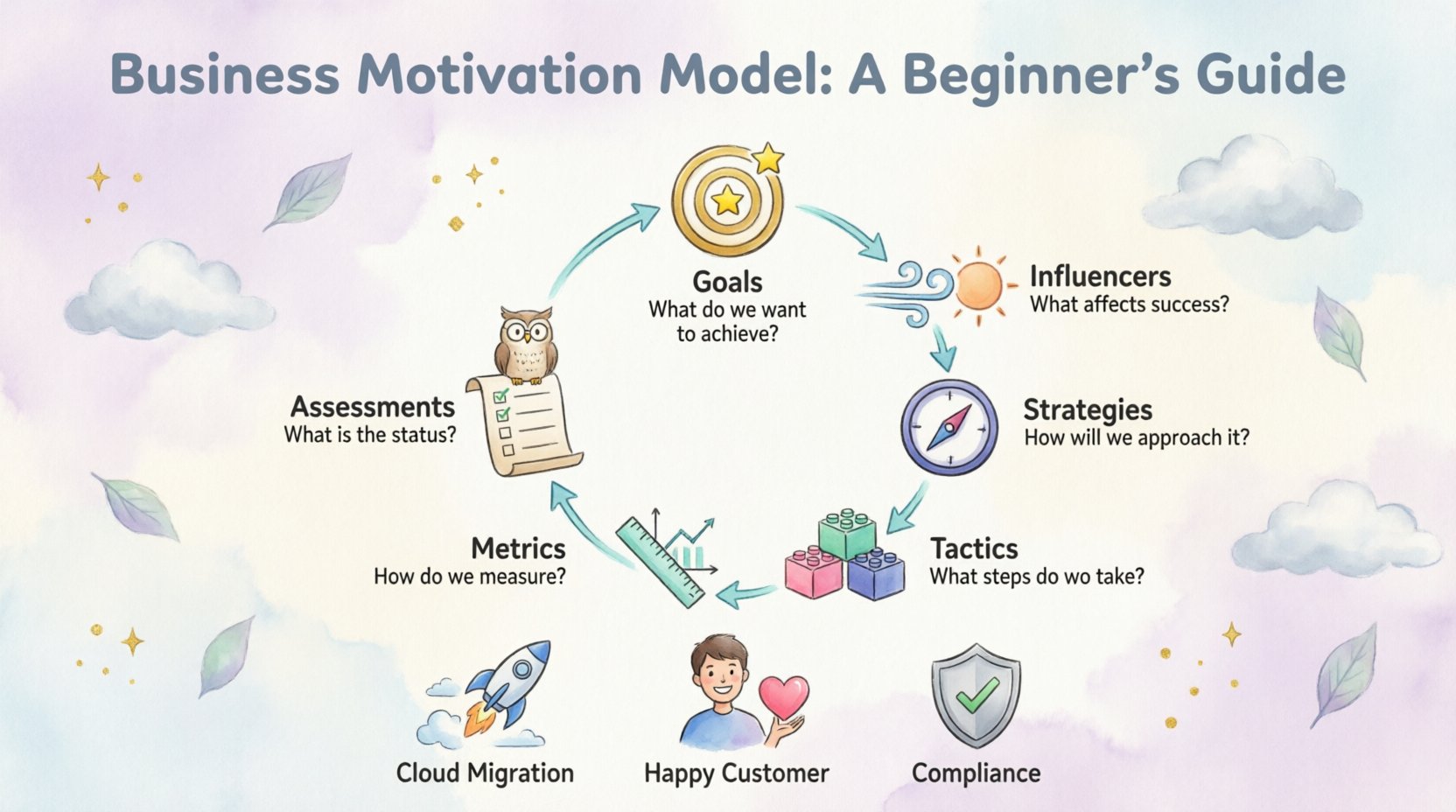
At the heart of the BMM framework are six fundamental elements. These elements form the building blocks of any motivation model. Understanding the distinction between them is crucial for accurate modeling.
1. Goals
Goals represent the desired outcomes. They are the destinations the organization aims to reach. A goal is not an action; it is a state of being or a result. For example, “Increase market share” is a goal. “Launch a new product” is an action.
- Characteristics: Goals are measurable, achievable, and time-bound.
- Purpose: They provide direction and focus.
- Example: “Achieve 99.9% system uptime by Q4.”
2. Influencers
Influencers are factors that drive, motivate, or hinder the achievement of goals. They can be positive or negative. Some influencers are internal, such as company culture or budget constraints. Others are external, such as market trends or regulatory changes.
- Positive Influencers: Resources, skilled personnel, favorable regulations.
- Negative Influencers: Competitor actions, rising costs, legacy technology debt.
- Role: They explain why a goal exists or why it is difficult to reach.
3. Strategies
Strategies are the plans or approaches taken to achieve goals. They are the high-level methods used to navigate the landscape defined by the goals and influencers. A strategy is often a choice between different paths.
- Function: Connects goals to tactics.
- Nature: High-level and often long-term.
- Example: “Adopt a cloud-first infrastructure.”
4. Tactics
Tactics are the specific steps or actions taken to execute the strategies. While strategies are the “how” at a high level, tactics are the “what” at a detailed level. They are the work items that teams actually perform.
- Function: Execute the strategy.
- Nature: Operational and short-term.
- Example: “Migrate database servers to the cloud.”
5. Metrics
Metrics are the quantitative measures used to evaluate the performance of goals, strategies, and tactics. They provide the data needed to determine if progress is being made.
- Function: Measure success.
- Types: KPIs (Key Performance Indicators), OKRs (Objectives and Key Results).
- Example: “Average response time under 200ms.”
6. Assessments
Assessments are the judgments or evaluations made based on the metrics. They determine the current state of the model. An assessment tells you if a goal is met, partially met, or missed.
- Function: Validate performance.
- Outcome: Green, Amber, or Red status.
- Example: “System uptime is currently at 99.5%.”
| Element | Question Answered | Focus |
|---|---|---|
| Goals | What do we want to achieve? | Desired Outcome |
| Influencers | What affects our ability to succeed? | Drivers & Barriers |
| Strategies | How will we approach the problem? | High-Level Plan |
| Tactics | What specific steps do we take? | Execution |
| Metrics | How do we measure progress? | Quantitative Data |
| Assessments | What is the current status? | Evaluation |
🔗 Relationships Between Elements
The power of the Business Motivation Model lies in the relationships between these elements. They do not exist in isolation. A goal without a strategy is a wish. A strategy without a tactic is a plan that never happens. Understanding these dependencies ensures coherence.
Goal and Influencer Relationships
Influencers are directly related to Goals. They explain the context. A positive influencer supports a goal, while a negative influencer hinders it. For instance, a goal to “Reduce operational costs” might be influenced positively by “New automation tools” and negatively by “Staff turnover.” Identifying these relationships helps in risk management.
Strategy and Goal Relationships
Strategies are designed specifically to achieve Goals. A single goal can be supported by multiple strategies. For example, the goal “Improve Customer Satisfaction” could be supported by the strategy “Enhance Support Team Training” and the strategy “Implement Self-Service Portal.” This flexibility allows for diverse approaches to a single objective.
Strategy and Tactic Relationships
Tactics are the concrete actions that realize the Strategy. If a strategy is the blueprint, tactics are the bricks. A strategy like “Expand into European Markets” requires tactics such as “Hire local sales representatives” and “Translate marketing materials.” This hierarchy ensures that daily work aligns with the broader plan.
Metrics and Assessments
Metrics feed into Assessments. You cannot assess a goal without measuring it. Metrics provide the raw data, while Assessments provide the interpretation. For example, the metric “Number of bugs reported” is raw data. The assessment “Quality is declining” is the interpretation used to trigger a response.
📋 Implementation Steps
Building a Business Motivation Model is a process that requires discipline and collaboration. It is not a one-time activity but a living practice. The following steps outline the standard approach to developing a model.
- Identify Stakeholders: Engage with leadership and key decision-makers. Their input is essential for defining accurate goals and influencers.
- Define Goals: Start with the end in mind. What are the critical outcomes for the organization? Ensure they are SMART (Specific, Measurable, Achievable, Relevant, Time-bound).
- Analyze Influencers: Brainstorm factors that impact these goals. Categorize them as internal or external, positive or negative.
- Develop Strategies: Determine the high-level approaches to meet the goals. Consider multiple options if necessary.
Define Tactics:- Break down strategies into actionable tasks. Assign ownership and timelines.
- Establish Metrics: Decide how success will be quantified. Avoid vanity metrics; focus on data that drives decision-making.
- Create Assessments: Define the thresholds for success. What constitutes a “pass” or a “fail”?
🚀 Benefits of Using BMM
Adopting this framework offers tangible advantages for enterprise architecture and business management. It is not just about documentation; it is about clarity and alignment.
1. Improved Alignment
When everyone understands the motivation behind a project, alignment improves. Technical teams see how their code contributes to business goals. Business teams understand the constraints and technical dependencies. This shared understanding reduces friction.
2. Better Decision Making
With clear goals and metrics, decisions become data-driven. Instead of relying on intuition, leaders can look at the Assessments to see if a strategy is working. If a metric falls below the threshold, the model indicates a need for adjustment.
3. Enhanced Communication
The model provides a common language. When a stakeholder asks, “Why are we doing this?”, the answer is not a vague vision but a specific link to a Goal and an Influencer. This transparency builds trust.
4. Risk Identification
By explicitly mapping Influencers, organizations can identify risks early. If a critical Influencer is removed or changes negatively, the impact on the Goal is immediately visible. This allows for proactive mitigation.
5. Agile Adaptability
In a changing market, goals may shift. Because the model separates Goals from Tactics, it is easier to adapt. If the Goal remains the same but the market changes, you can update the Tactics without rewriting the entire strategy.
🛑 Common Challenges and Pitfalls
While the framework is powerful, it is often misused. Awareness of common pitfalls helps in successful implementation.
- Over-Complexity: Creating a model with too many elements makes it unusable. Start small. Focus on the critical goals first.
- Static Documentation: Treating the model as a document to be written once and filed away. It must be updated regularly as the business evolves.
- Confusing Tactics with Goals: Mistaking an action for an outcome. “Launch the website” is a tactic. “Increase online sales” is the goal.
- Ignoring Influencers: Focusing only on what you can control. External factors often have the biggest impact on success.
- Bad Metrics: Choosing metrics that are easy to measure but don’t reflect true value. Vanity metrics can lead to false confidence.
🌐 Integration with Enterprise Architecture
The Business Motivation Model does not exist in a vacuum. It integrates seamlessly with broader Enterprise Architecture (EA) practices. EA frameworks often use BMM as the starting point for defining scope.
Linking to Business Architecture
Business Architecture defines the structure of the organization. BMM provides the context for that structure. It explains why the organization is structured the way it is. If a department is reorganized, the Goals and Strategies should be reviewed to ensure the new structure supports them.
Linking to Solution Architecture
Solution Architecture focuses on the technical implementation. BMM ensures that the solution is built to meet a business need. Requirements traceability flows from the Goal down to the Solution Architecture. Every feature in the software should be traceable back to a specific Goal or Strategy.
Linking to Change Management
Change Management deals with the people side of transformation. BMM helps in change management by clarifying the motivation. When employees understand the Goal and the Influencers, they are more likely to support the change. It transforms a mandate into a shared mission.
💡 Real-World Application Scenarios
To make these concepts concrete, consider how they apply in different scenarios.
Scenario 1: Digital Transformation
An organization wants to move from legacy systems to a modern cloud environment.
- Goal: Reduce IT maintenance costs by 30%.
- Influencer: Rising cost of legacy hardware maintenance (Negative).
- Strategy: Migrate critical workloads to the cloud.
- Tactic: Refactor monolithic applications into microservices.
- Metric: Monthly infrastructure spend.
Scenario 2: Customer Experience Improvement
A retail company wants to improve customer loyalty.
- Goal: Increase customer retention rate to 85%.
- Influencer: Competitor pricing strategies (Negative).
- Strategy: Enhance loyalty program benefits.
- Tactic: Implement a points-based rewards system.
- Assessment: Monthly retention report.
Scenario 3: Regulatory Compliance
A financial institution needs to comply with new data privacy laws.
- Goal: Achieve full compliance with data privacy regulations.
- Influencer: New government legislation (Positive driver).
- Strategy: Implement data governance framework.
- Tactic: Conduct data inventory and classification audit.
- Assessment: Audit pass/fail status.
🛠️ Building a Sustainable Model
Success with the Business Motivation Model requires a commitment to sustainability. It is not enough to build the model; you must maintain it.
Regular Reviews
Schedule periodic reviews. Quarterly is often a good cadence. Review the Goals to see if they are still relevant. Check the Influencers to see if the external environment has changed. Update the Metrics if the business focus shifts.
Communication Channels
Create channels for feedback. If a team member notices an Influencer that was missed, they should be able to report it. The model should be a living document that evolves with the team.
Training and Adoption
Not everyone understands the model initially. Provide training for analysts and stakeholders. Use real examples from the organization to make it relatable. When people see the value, adoption becomes natural.
🔍 Evaluating Model Health
How do you know if your Business Motivation Model is working well? Look for these signs of health.
- Traceability: Can you trace a daily task back to a strategic goal?
- Clarity: Do stakeholders understand the priorities?
- Relevance: Is the model updated regularly to reflect reality?
- Actionability: Do the metrics lead to decisions?
- Alignment: Are different departments working towards the same Goals?
If the model sits unused, it has failed. If it drives decisions and clarifies priorities, it has succeeded. The value lies in the usage, not the creation.
📈 Final Thoughts on Motivation Modeling
The Business Motivation Model is a tool for clarity. It cuts through the noise of daily operations to reveal the core intent of the organization. By defining Goals, Influencers, Strategies, Tactics, Metrics, and Assessments, leaders can navigate complexity with confidence.
It requires effort to maintain, but the payoff is a more responsive and aligned enterprise. When every action is connected to a motivation, resources are not wasted on activities that do not matter. This discipline is the foundation of sustainable growth.
Start small. Pick a single goal and build a model around it. Expand from there. The journey toward better business alignment is a continuous process, and the Business Motivation Model is the compass to guide the way.